CCSD code A2720: Proximal gastric vagotomy billing guide
What is CCSD code A2720? CCSD code A2720 is the procedure billing code assigned ...

Last Updated: Oct 8, 2026
98975 is the CPT code for remote therapeutic monitoring (eg, therapy adherence, therapy response); initial set-up and patient education on use of equipment. It covers supplying an RTM device and teaching the patient to use it, billed once per episode of care.
CPT 98975 has no time threshold and no start or stop time requirement. The 20-minute wording belongs to the treatment management codes 98980 and 98981. Physicians, nurse practitioners, physician assistants, physical therapists, occupational therapists, and speech-language pathologists can bill it under Medicare.
Let Pabau's smart automation suggest the right codes, reduce claim denials, and keep your practice compliant—effortlessly.
Automate repetitive tasks and focus on what matters most—your patients.
Reduce coding errors and ensure compliance with the latest regulations.
Clean claims, fewer denials, and faster reimbursements.
Powerful insights and reporting to help your practice thrive.
HIPAA compliant SOC 2 certified GDPR-compliant Trusted by 4,000+ clinics worldwide

CPT Code 98975 covers RTM device setup and patient education, billed once per episode of care with no minimum time.
Under 2026 CPT guidance, 98975 is reported once the patient has at least 2 days of monitoring data in a 30-day period.
Physicians, nurse practitioners, physician assistants, physical and occupational therapists, and speech-language pathologists can bill RTM. Clinical staff can furnish it under general supervision.
RTM is not a Medicare telehealth service, so 98975 takes no 95 or GT modifier.
Two avoidable denials come from billing 98975 twice in one episode or before the data threshold is met.
CPT Code 98975 is the initial setup and patient education code for remote therapeutic monitoring (RTM), billed once per episode of care. The AMA’s CPT code set reads: Remote therapeutic monitoring (eg, therapy adherence, therapy response); initial set-up and patient education on use of equipment.
The code has no time threshold, so you do not need to record start and stop times. It pays for supplying the device, setting it up, and teaching the patient to use it. The 20-minute wording often quoted for RTM belongs to the treatment management codes 98980 and 98981.
Under the 2026 CPT guidance, you report 98975 once the patient has transmitted at least 2 days of data in a 30-day period. Before 2026 the minimum was 16 days. After setup, monthly device supply is billed with 98976, 98977, or 98978, and clinician time with 98979, 98980, and 98981.
Medicare lets physicians, nurse practitioners, physician assistants, physical therapists, occupational therapists, and speech-language pathologists bill CPT Code 98975. Since 2023, physicians and non-physician practitioners (NPPs) can bill RTM that clinical staff furnish incident-to under general supervision.
Scope-of-practice rules vary by state. Some states restrict which conditions a PT or OT can treat without a physician referral. Check your state practice act and your payer policies before billing 98975.
CPT Code 98975 and 98977 serve different stages of the RTM workflow. 98975 is the one-time setup code, and 98977 is the recurring musculoskeletal device supply code.
RTM (the 98975 code family) and RPM (the 99453/99454 code family) are frequently confused because both involve devices and remote data collection. The difference lies in what the device measures and who can bill it.
Billing RPM codes for what is functionally an RTM service is a coding error. If your device tracks pain scores or exercise adherence rather than blood pressure or weight, the 98975 family applies, not the 99454 family.
The 2026 Medicare national unadjusted payment rate for CPT Code 98975 is published in the CMS Physician Fee Schedule lookup tool. Rates vary between facility and non-facility settings. The non-facility rate, typical for office-based PT or OT practices, is higher because it includes practice expense. Apply your locality’s geographic practice cost index (GPCI) to get your local payment.
Commercial payer rates are not governed by the Medicare Physician Fee Schedule. Many commercial insurers have not adopted RTM codes or apply different coverage criteria. Verify coverage before you enroll patients in an RTM program billed to a commercial plan.
Pull the CMS fee schedule lookup for CPT 98975 before each annual RTM program review. Rates change with the MPFS on January 1 each year, and the non-facility vs facility rate difference can be significant for practice-setting decisions. Always cite the ‘national unadjusted’ rate and apply your locality GPCI multiplier for the actual payment amount.
Billing CPT Code 98975 correctly comes down to six steps, completed in order before the claim goes out.
The medical record must contain each of the following to support a 98975 claim. A missing element is grounds for denial or post-payment recoupment during an audit. Good medical billing compliance treats this list as a pre-billing checklist.
Most 98975 denials trace back to a short list of preventable errors. Systematic denial management workflows catch these before the claim leaves the practice.
Every 98975 claim needs a supporting ICD-10-CM diagnosis code that justifies RTM. The table below covers common pairings by clinical category. M54.5 (low back pain) was retired on October 1, 2021, so use M54.50, M54.51, or M54.59 instead.
Verify active status for every code against the CMS ICD-10 code files before submitting. Your MAC’s local coverage policies may further restrict which diagnoses support RTM claims in your region. For full descriptors and Excludes notes on any pairing, search our ICD-10-CM codes library.
RTM adds a new billing layer to PT, OT, and SLP practices. A one-time setup code, a monthly device supply code, and a monthly treatment management code can each generate claims independently. A disorganized revenue cycle management process misses billing windows, duplicates codes, or links the setup claim to the wrong episode of care. The map below shows which code fires when, and on what threshold.
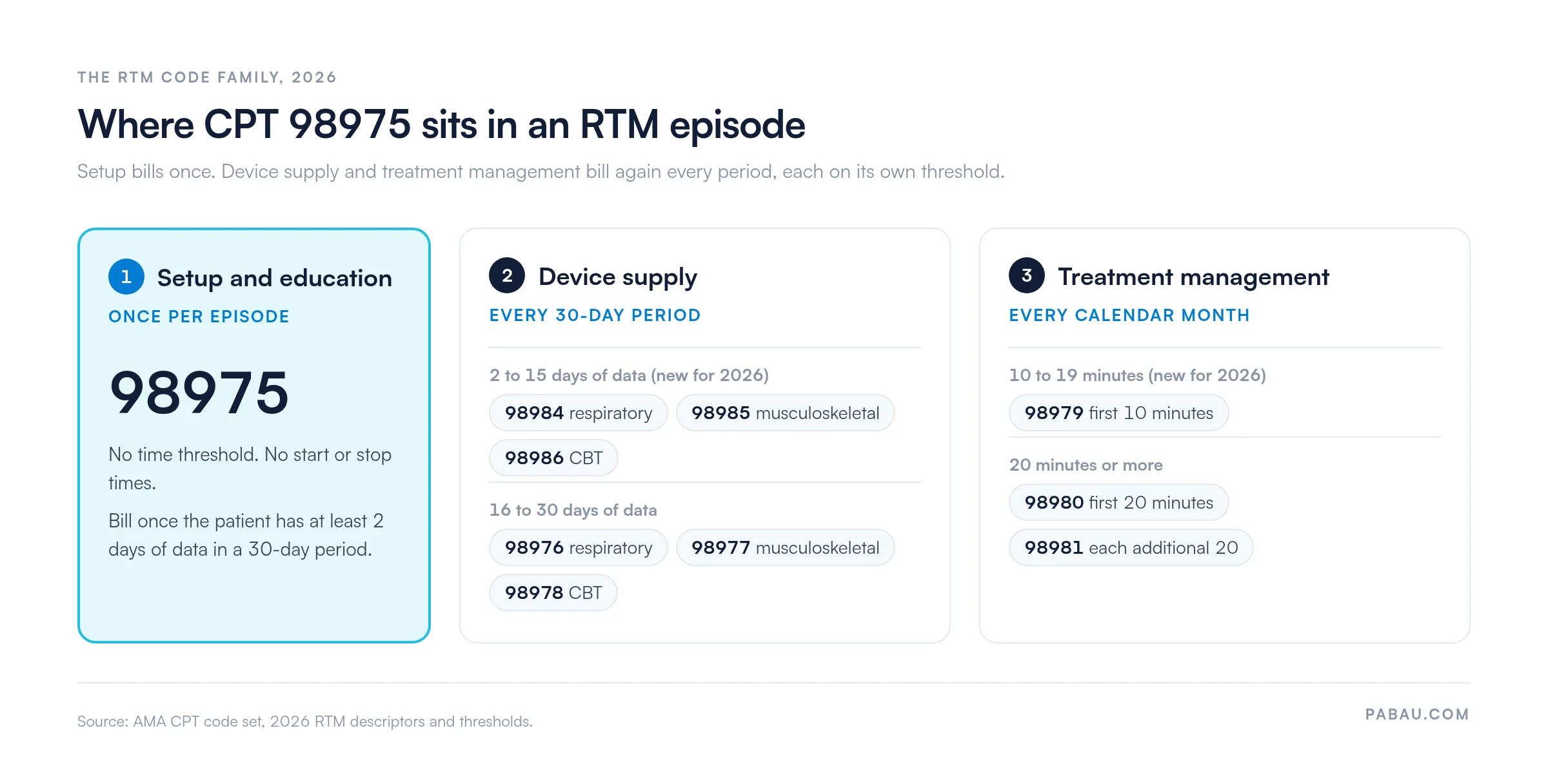
Four RTM habits keep denials down across the code family:
Set up a dedicated RTM billing queue in your practice management system, separate from standard visit billing. RTM codes have different time thresholds, episode rules, and data requirements than procedure codes. Keeping them in a separate workflow reduces the risk of staff applying standard visit billing logic to RTM claims.
Most PT and OT practices track RTM episodes in one place, notes in another, and claims in a third. That split is how 98975 ends up billed twice or sent before the second data day.
Pabau, the practice management platform we build, keeps the setup note, consent form, and claim on the same patient record. Its claims management software pulls that record into a pre-filled claim. It then submits and tracks the claim through Claim.MD and posts the ERA when payment comes back.
Your billing team sees which patients already have a 98975 on file and which claims are still open. That way, you bill each episode once and chase denials before they age.

Pabau keeps RTM setup notes, consent, and claims on one patient record, then submits and tracks claims through Claim.MD. See how it works for your practice.

Treat CPT 98975 as an event code, not a timed one. The claim stands or falls on four records: consent, the device supplied, the education delivered, and the data days that followed. A stopwatch adds nothing to that file.
The practical change for 2026 is the lower data threshold, which lets you bill setup sooner for short monitoring episodes. Build your episode tracking around it, and keep one rule fixed: one 98975 per episode of care.
Book a demo to see how Pabau keeps RTM documentation and billing on one record for PT, OT, and SLP practices.

Sending RTM claims electronically? Our Claim.MD clearinghouse review covers payer reach, pricing, and how electronic claims are submitted and tracked.
Want to reduce claim denials across your practice? Denial codes in medical billing covers the CARC reason codes that appear on RTM remittances and how to action each one.
Checking RTM coverage before setup? Insurance eligibility verification walks through confirming a patient’s benefits before the first billable service.
Reconciling RTM payments each month? Electronic remittance advice explains how to read an ERA and match it to the claims you sent.
No. CPT 98975 has no time threshold and needs no start or stop times. It covers RTM device setup and patient education, billed once per episode of care. The 20-minute wording belongs to the treatment management codes 98980 and 98981.
Physicians, nurse practitioners, physician assistants, physical therapists, occupational therapists, and speech-language pathologists can bill 98975 under Medicare. Since 2023, physicians and NPPs can bill RTM furnished by clinical staff incident-to under general supervision. Since 2025, PTs and OTs in private practice can generally supervise PTAs and OTAs for RTM.
The 2026 national unadjusted rate is published in the CMS Physician Fee Schedule lookup tool and varies between facility and non-facility settings. Use your locality’s geographic practice cost index (GPCI) to calculate your location-adjusted payment. Rates change each January 1 with the annual MPFS update.
Yes, if setup (98975) falls in the first monitoring period (98977). The patient must also transmit 16 or more days of data in that 30-day period. With 2 to 15 days of data, the musculoskeletal supply code is 98985 instead. Check your MAC’s guidance for any same-day billing restrictions.
The device must meet the FDA definition of a medical device and capture non-physiologic therapeutic data, such as adherence, pain level, or functional status. Consumer wellness apps and general fitness wearables typically do not qualify. Confirm the device’s regulatory status with the vendor before enrolling patients.