CPT Code 52630: Residual prostate resection billing guide
CPT Code 52630: Official descriptor and quick-reference billing data The America...

Last Updated: Nov 13, 2026
97755 is the CPT code for an assistive technology assessment with a written report, billed per 15 minutes of direct one-on-one contact by the provider. The assessment aims to restore, augment or compensate for existing function, optimize functional tasks, or maximize environmental accessibility.
Occupational and physical therapists bill it most often. Each unit needs documented clock start and stop times, and the written report the descriptor requires must be in the record.
Let Pabau's smart automation suggest the right codes, reduce claim denials, and keep your practice compliant—effortlessly.
Automate repetitive tasks and focus on what matters most—your patients.
Reduce coding errors and ensure compliance with the latest regulations.
Clean claims, fewer denials, and faster reimbursements.
Powerful insights and reporting to help your practice thrive.
HIPAA compliant SOC 2 certified GDPR-compliant Trusted by 4,000+ clinics worldwide

CPT code 97755 covers assistive technology assessment with a written report, billed in 15-minute timed units under the 8-minute rule.
Occupational and physical therapists may bill 97755, while SLP eligibility depends on payer policy and state scope-of-practice law.
Medicare Part B covers 97755 when it is medically necessary, ordered by a physician or NPP, and backed by a compliant plan of care.
Missing start and stop times and an absent written report are the two most common reasons 97755 claims are denied.
Pabau submits 97755 claims through Claim.MD and tracks each prior authorization on the case, warning staff when one is missing.
CPT code 97755 is the AMA code for an assistive technology assessment with a written report, billed per 15 minutes of direct one-on-one contact. Palmetto GBA’s Medicare billing article for the code restates the descriptor, which reads in full:
“Assistive technology assessment (eg, to restore, augment or compensate for existing function, optimize functional tasks and/or maximize environmental accessibility), direct one-on-one contact by provider, with written report, each 15 minutes.”
AMA CPT descriptor for 97755
Two phrases in it drive billing. “Direct one-on-one contact by provider” means only face-to-face time counts toward units. “With written report” makes the report part of the billable service, so a session without one is open to recoupment on audit.
The code sits in the Physical Medicine and Rehabilitation subsection (97010-97799) of the CPT Medicine section. It captures the skilled clinical work of judging whether a device, system, or environmental modification helps a patient. The goal is functional tasks the patient cannot yet do safely or independently.
CPT code 97755 covers the skilled evaluation, trial, and fitting recommendation for assistive technology meant to restore, augment, or compensate for a patient’s functional limitations. That includes assessments of:
Included services: Device trials with the patient, comparative evaluation of two or more AT options, and functional task observation to determine device fit. Documentation of the findings is included too, along with the written report that must accompany every billable unit.
Excluded services: Orthotic training is billed under 97760 and prosthetic training under 97761, both for the initial encounter. Later orthotic or prosthetic encounters move to 97763. Supplying durable medical equipment (DME) is billed with HCPCS codes, not CPT.
A non-skilled recommendation, such as suggesting a commercially available product without clinical evaluation, does not meet the skilled-service threshold and cannot be billed as 97755. The code covers the professional assessment only, never the assistive technology itself.
Medicare contractors also police the line with 97535. Palmetto GBA’s billing article tells providers to report 97535, self-care and home management training, when that code describes the service more precisely.
Occupational therapists and physical therapists are the primary eligible providers for CPT code 97755. AAPC coding guidance and CMS policy both confirm OT and PT eligibility.
Some commercial payers also accept SLP claims, but recognition is not universal, so verify with the payer before billing. Speech-language pathologists evaluating a speech-generating device usually report 92607 instead.
State scope-of-practice law applies too. A claim can be denied when the provider’s credential does not cover the service under state law, whatever the CPT descriptor allows.
Supervision requirements vary by setting. In outpatient rehabilitation, general supervision is typically enough, meaning the supervising practitioner is available but not on site. Some Medicare Administrative Contractor (MAC) Local Coverage Determinations require direct supervision in certain facility settings.
Check the LCD for the place of service you bill. Recording each provider’s credentials and supervision level in your practice software catches eligibility mismatches before submission.
CPT code 97755 follows standard timed-code billing rules under CMS policy. Each unit represents 15 minutes of direct one-on-one contact.
Under the 8-minute rule, you must provide at least 8 minutes of a 15-minute unit to bill that unit. Record the time as clock start and stop times in the clinical note, never as a duration estimate or a checkbox.
Worked example: A session runs 38 minutes of direct AT assessment contact. That is 2 full 15-minute units (30 minutes) with 8 minutes remaining. Because the remaining time meets the 8-minute threshold, you can bill 3 units total. If the session were 37 minutes, the remaining 7 minutes would not qualify and you could bill only 2 units.
There is no AMA-mandated per-session unit maximum for 97755, but payers may impose their own limits through medical necessity edits or prior authorization. Document the clinical rationale for extended sessions in the plan of care. Always append the appropriate discipline modifier (GP, GO, or GN) to signal the treating provider type to the payer system.
Always record clock start and stop times in the clinical note, not just duration. Payers auditing timed codes look for exact timestamps. A note that says ’45 minutes of AT assessment’ without start and stop times fails the documentation standard. The claim can then come back with a CO-16 denial for missing information.
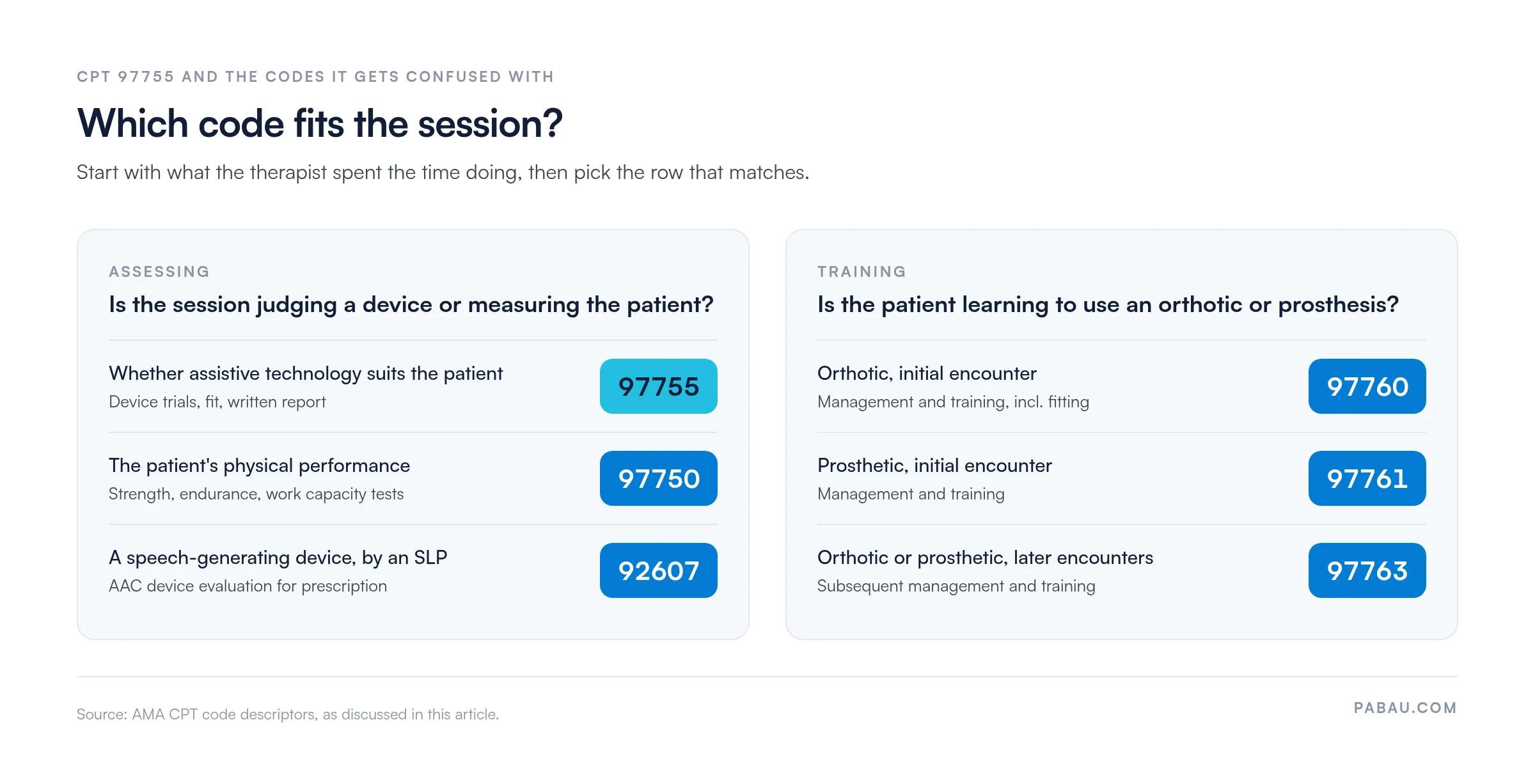
CPT code 97750 covers physical performance testing or measurement, with written report, each 15 minutes. It uses standardized tests to quantify a patient’s physical capacity, such as strength, endurance, range of motion, or work capacity.
CPT code 97755 asks a different question: whether a specific assistive technology can compensate for a functional deficit. Its focus is device fit rather than capacity measurement.
These two codes are sometimes billed on the same date of service when a session legitimately includes both physical performance measurement and an AT evaluation. That is appropriate only when the services are genuinely distinct and separately documented.
Billing 97750 and 97755 for the same clinical activity under different code labels is unbundling. It will trigger a National Correct Coding Initiative (NCCI) edit review.
CPT code 97760 covers orthotic management and training at the initial orthotic encounter, including assessment and fitting when not otherwise reported. The difference from 97755 is purpose. Code 97755 evaluates and recommends an assistive technology solution, while 97760 trains the patient to use an orthotic that has already been selected or fitted.
An OT evaluating a patient’s candidacy for a wrist-hand orthosis as an AT solution bills 97755. When that OT first teaches the patient to don, doff, and use the orthosis, the session bills 97760. Later training sessions bill 97763.
Both 97755 and 97760 may appear on the same encounter when distinct portions of the visit address each service. NCCI edits between the two codes may apply, so check the current CMS NCCI table before billing both on one date. Edit pairs are updated quarterly, and a pair permitted last year may need a modifier exception this year.
The chart below sorts these codes, and the speech-device evaluation SLPs use, by the question each session answers.
Medicare Part B covers CPT code 97755 when the service is medically necessary and ordered by a physician or non-physician practitioner (NPP). It must also be provided under a plan of care that meets CMS requirements.
The Medicare Benefit Policy Manual also requires a skilled service. The patient’s condition must need a licensed therapist’s clinical judgment, and an untrained person could not safely perform the assessment.
Medicare Advantage plans follow their own prior authorization and coverage rules, which may differ substantially from Original Medicare. Treat each MA plan as a distinct payer and verify coverage before the first session.
Original Medicare does not require prior authorization for CPT code 97755 as a standard rule. Medicare Advantage plans, Medicaid managed care organizations, and commercial insurers frequently do. The requirement varies by payer, plan tier, geographic market, and sometimes by the specific AT device being evaluated.
Turnaround times for PA decisions typically run 3-14 business days for standard reviews and 24-72 hours for urgent cases, depending on the payer. When you know the payer requires PA, start the request before scheduling the AT assessment.
A claim sent without a required authorization usually comes back with reason code CO-197, or CO-15 when the authorization number is missing or invalid. The fix is to obtain the authorization, where the payer allows it retroactively, and resubmit rather than appeal.
Documentation is where 97755 claims most often fail on audit. The AMA descriptor sets the floor, because the written report is part of what you bill. A session note without one is an incomplete service, and billing it as 97755 invites recoupment. Meeting billing compliance requirements for timed codes means every element below appears in the clinical record.
In Pabau, the practice management platform we build, OT and PT note templates can carry a structured field for each of these elements. Clean claim submission for timed codes depends on a complete clinical note before the claim goes out, not a correction after a denial arrives.
Most CPT code 97755 denials are preventable. The five patterns below are the remittance advice denial codes that 97755 claims most often draw. Denial management workflows catch them before submission rather than after.
The written report requirement in the 97755 descriptor is the single highest-audit-risk element. Build a report template into your documentation workflow so it opens with each AT assessment encounter. A separate step is the one that gets skipped under time pressure.
CPT code 97755 reimbursement is calculated from the CMS Relative Value Unit (RVU) framework. Each 15-minute unit carries Work RVUs, Practice Expense RVUs, and Malpractice RVUs. The national Medicare payment is the total RVU multiplied by the annual CMS conversion factor.
The Geographic Practice Cost Index (GPCI) then adjusts it for the practice location. Non-facility rates for office settings are higher than facility rates for hospital outpatient departments and SNFs, because the facility absorbs part of the overhead.
CMS publishes the final fee schedule for each calendar year in the fall of the prior year. The 2026 amounts then vary with each locality’s geographic adjustment. Use the CMS Physician Fee Schedule search tool or the FastRVU 2026 lookup to retrieve the non-facility and facility amounts for your GPCI locality.
Commercial payer rates for 97755 vary by contract and are usually set as a percentage of the Medicare fee schedule. Confirm them in your payer contracts rather than using CMS figures as a proxy.
The documentation failures behind most 97755 denials are missing start and stop times, absent written reports, and wrong modifiers. They are workflow problems as much as documentation problems. They shrink once the note template asks for each element at the point of care. The provider no longer has to remember them at the end of a busy session.
In Pabau, an OT or PT note template can prompt for start and stop times and the written report before the encounter is billed. Prior authorizations sit on the patient’s case with their codes, dates, and sessions, and Pabau warns staff when one is missing. Pabau’s streamlined claims management software then sends the claim through Claim.MD, our US clearinghouse partner.
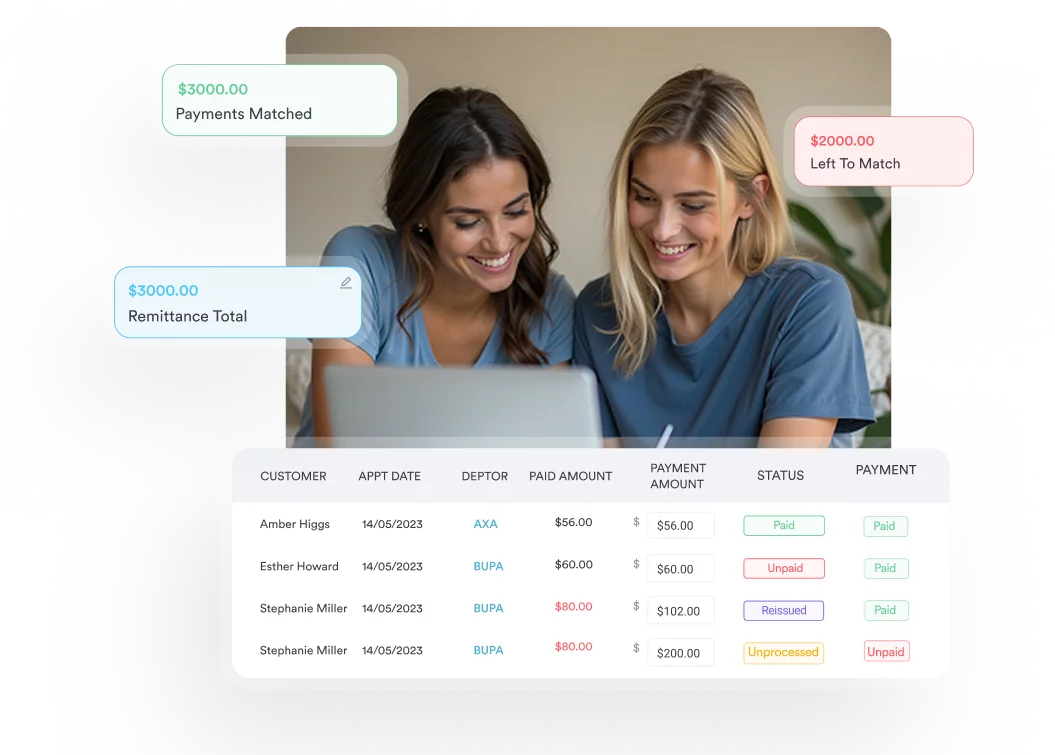
Claim.MD runs eligibility checks before the visit and returns ERA remittances that post against the patient afterward. For practices with several providers or locations, one shared template also cuts audit exposure. When one OT documents written reports and another does not, the practice carries unequal risk across its 97755 volume.

Pabau’s therapy note templates prompt for start/stop times and the written report, prior authorizations are tracked on the case, and claims go out through Claim.MD. See how OT and PT practices protect their 97755 reimbursement.

CPT code 97755 pays when the documentation supports it. The written report and the start and stop times both come from the AMA descriptor. A payer therefore treats a missing one as a missing service. Capture both at every visit and most CO-16 and CO-4 denials never happen.
The trade-off is a few minutes of structured documentation per session against weeks spent on appeals. Pabau builds those 97755 fields into the therapy note, so the report and timestamps are captured at the point of care. Book a demo to see how it protects your 97755 reimbursement.

Want to understand what a clearinghouse does for CPT claims? Claim.MD clearinghouse guide explains how electronic claim validation works before submission.
Looking to improve first-pass clean claim rates across your therapy practice? Clean claim submission covers the elements every claim must carry to avoid preventable rejections.
CPT code 97755 covers a direct, one-on-one evaluation of whether assistive technology suits a patient. Examples include AAC systems, powered mobility, and adapted computer access technology. A written report is part of every billable session. The code does not cover the AT device itself, orthotic training (97760), or non-skilled product recommendations.
CPT 97755 evaluates whether an assistive technology device fits a patient’s functional needs. CPT 97750 measures the patient’s physical performance capacity using standardized tests, such as strength, endurance, or range of motion. The key distinction is what is being assessed: the device for 97755, the patient for 97750.
There is no AMA-mandated per-session unit maximum for 97755. Units are calculated from documented direct contact time using the 8-minute rule, so at least 8 minutes must be provided to bill a 15-minute unit. Payers may impose their own unit limits through medical necessity edits or prior authorization requirements.
Yes. Medicare Part B covers CPT code 97755 when the service is medically necessary and ordered by a physician or NPP. It must also follow a compliant plan of care. Coverage requires that the AT assessment constitutes a skilled service. Local Coverage Determinations from your Medicare Administrative Contractor may impose additional criteria specific to your geographic area.
Both occupational therapists and physical therapists are eligible to bill CPT code 97755. OTs use the GO modifier, and PTs use GP. Speech-language pathologist eligibility depends on payer policy and state scope-of-practice law, so verify with the payer before billing. OT assistants and PT assistants may bill with proper supervision and the CO or CQ modifier appended.
The most common reasons are missing start and stop times or an incomplete written report (CO-16), and a wrong or missing discipline modifier (CO-4). Others are a diagnosis code that does not match the functional limitation (CO-11) and missing prior authorization (CO-197 or CO-15).