CPT Code 50432: Nephrostomy tube placement billing guide
CPT Code 50432: Official description and procedure overview CPT Code 50432 is th...

Last Updated: Nov 13, 2026
96573 is the CPT code for photodynamic therapy by external application of light to destroy premalignant skin lesions, such as actinic keratosis. A physician or other qualified health care professional applies the photosensitizing drug and activates the light, and the code is reported once per day.
Staff-delivered PDT is reported with 96567, and PDT preceded by debridement of hyperkeratotic lesions with 96574. Only one of the three codes goes on the claim per patient per day, and the drug is billed separately with J7308 or J7345.
Let Pabau's smart automation suggest the right codes, reduce claim denials, and keep your practice compliant—effortlessly.
Automate repetitive tasks and focus on what matters most—your patients.
Reduce coding errors and ensure compliance with the latest regulations.
Clean claims, fewer denials, and faster reimbursements.
Powerful insights and reporting to help your practice thrive.
HIPAA compliant SOC 2 certified GDPR-compliant Trusted by 4,000+ clinics worldwide

CPT Code 96573 reports photodynamic therapy by external application of light when a physician or QHP applies the drug and activates the light, per day.
96567 reports the same service delivered by staff without direct physician or QHP involvement, and 96574 adds debridement of hyperkeratotic lesions first.
Only one of 96567, 96573 or 96574 can be reported per patient per day, and modifier 59 does not unbundle them.
Bill the drug on its own line: J7308 for Levulan Kerastick per 354 mg unit, or J7345 for Ameluz gel per 10 mg.
Pair the claim with L57.0 for actinic keratosis, and document who applied the drug and who activated the light.
CPT Code 96573 is the Category I CPT code for photodynamic therapy (PDT) by external application of light. In other words, a physician or other qualified health care professional (QHP) provides it. The American Medical Association (AMA) maintains the descriptor as part of its CPT code set, and it reads:
Photodynamic therapy by external application of light to destroy premalignant lesions of the skin and adjacent mucosa with application and illumination/activation of photosensitizing drug(s) provided by a physician or other qualified health care professional, per day.
Three details in that wording drive the coding. First, the physician or QHP must be directly involved in applying the drug and activating the light. The code is per day, so one unit covers every lesion treated in the session. The descriptor also targets premalignant lesions, so the usual diagnosis is L57.0 for actinic keratosis, from the ICD-10-CM code set.
96573 covers one complete PDT session on one date. In particular, it includes both the application of the photosensitizing drug and the light activation, as long as a physician or QHP is directly involved in both.
Included in CPT Code 96573:
Not included, so bill it separately or use a different code:
A PDT visit has three clinical phases. They map to one procedure line and one drug line, and who performs the phases decides the CPT code.
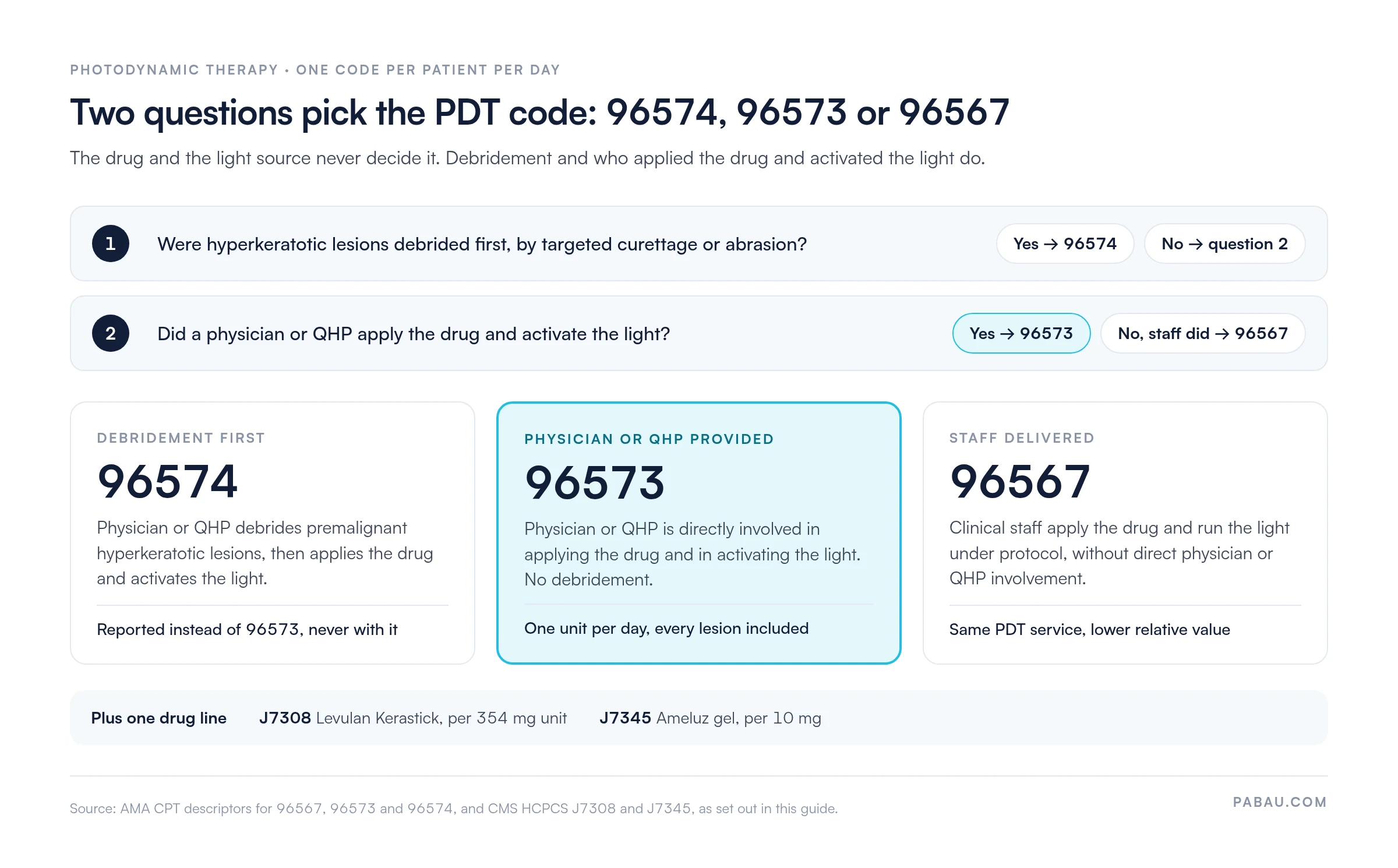
The CPT code covers the application and the illumination together. First, if a physician or QHP was directly involved in both, report 96573. Second, if staff handled them without that involvement, report 96567. Finally, if the physician debrided hyperkeratotic lesions first, report 96574 on its own. The diagram below runs the same test as two questions.
The photosensitizing drug is not bundled into 96573. Instead, it is a separately billable supply, reported on the same claim with a HCPCS Level II J-code. The J-code reports what was applied, and the CPT code reports what the clinician did. The J7308 guide covers billing the Levulan Kerastick on its own.
Q2037 and Q2038 are influenza vaccine codes, not PDT drug codes. As a result, a claim that pairs 96573 with either one will not match the service. Many Medicare Administrative Contractors (MACs) also ask for the National Drug Code (NDC) next to the J-code. Therefore, confirm your contractor’s NDC rules before you submit.
The two codes describe the same PDT service. However, what separates them is who provides it. 96573 requires direct physician or QHP involvement in applying the drug and activating the light, while 96567 covers PDT delivered without that involvement.
The practical test is in the procedure note. First, find who applied the photosensitizer and who started the illumination. If the physician or QHP did both, 96573 fits. Otherwise, if a nurse or medical assistant did both under protocol, 96567 fits. The drug and the light device do not decide the code.
96574 is a standalone code, not an add-on. Instead, it describes PDT provided by a physician or QHP, preceded by debridement of premalignant hyperkeratotic lesions by targeted curettage or abrasion. Consequently, on a day when that debridement happens, it replaces 96573.
The CPT code 96574 guide covers debridement documentation in more detail.
Medicare’s national coverage for actinic keratosis treatment sits in National Coverage Determination (NCD) 250.4. It covers PDT among the accepted treatments for actinic keratosis, without limits based on lesion count or location. Each session still has to be medically necessary, and the MAC judges how many visits are reasonable.
The billing compliance requirements for PDT extend beyond diagnosis codes. For example, they include credentialing, place-of-service accuracy and timely filing. Holding to all of them in a dermatology practice takes a systematic claim review process.
The Medicare Physician Fee Schedule (MPFS) sets separate rates for non-facility (office) and facility settings. As a result, office-based PDT pays the higher non-facility rate, because the practice absorbs overhead such as the light device and treatment room. Then, use the CMS Physician Fee Schedule lookup tool to pull current rates for your payment locality.
Confirm that the J-code for the photosensitizer has its own line on the same claim. In addition, the drug is paid separately and is not part of the 96573 MPFS rate.
Before scheduling a PDT session, run an eligibility check for the specific payer to confirm 96573 is covered and to spot any prior authorization rules. A denial after the session is a revenue loss you can only recover through a formal appeal.
An auditor reviewing a 96573 claim looks for seven elements in the chart note. Missing any one of them can therefore trigger a denial, recoupment or audit flag. Submitting clean claims for PDT depends on building these elements into the template your providers use for every PDT visit.
Modifier errors on 96573 claims usually come from an E/M service on the same date, or from trying to report two PDT codes together. Also, the AAPC Codify CPT lookup is a useful reference for bundling edits.
96573 denials follow predictable patterns, and a pre-submission check catches most of them. Moreover, denial management workflows in dermatology work best with root-cause tracking rather than claim-by-claim fire-fighting.
Run a monthly report of 96573 denials grouped by the reason code on the remittance. If CO-11 (diagnosis inconsistent with procedure) leads, audit your documentation templates. If PDT code-pair edits keep appearing, set charge capture to allow one PDT code per patient per day.
Place of service 11 (Office) is the standard setting for 96573. In fact, most PDT for actinic keratosis happens in outpatient dermatology offices, and the Medicare non-facility rate assumes that overhead. Otherwise, a different POS code is a common source of payment reductions and rework.
Checking the place of service before submission prevents most of these errors. So does an insurance eligibility verification process that confirms the benefit for that setting.
PDT billing breaks down in the handoffs. First, the note records who applied the drug, the stock record shows which product and how much, and the claim has to match both. Pabau, the practice management platform we build, keeps the visit, the note and the claim on one patient record.
Pabau’s claims management software holds the claim your coders build from the note. Through Pabau’s integration with Claim.MD, it submits claims electronically, checks eligibility before the session and tracks remittances. Denial reason codes from the remittance then sit next to the claim they belong to.
Your coders still choose between 96567, 96573 and 96574. Pabau’s digital forms can prompt the clinician to record who applied the drug and who ran the light, so that choice rests on the note.

Pabau keeps the PDT note, the drug applied and the claim on one patient record. Claim.MD submits the claim electronically, checks eligibility and tracks the remittance.

CPT Code 96573 turns on one question: who applied the drug and activated the light. First, a physician or QHP doing both makes it 96573. Staff doing both makes it 96567, and debridement first makes it 96574.
In addition, only one of those codes goes on the claim for a given day. The drug goes on its own line as J7308 or J7345, and L57.0 carries the medical necessity. When those three lines match the note, a PDT claim gives a payer little to deny.
Book a demo to see how Pabau keeps the PDT note, the drug and the claim on one patient record.

Billing debridement before PDT? CPT code 96574 covers the documentation that separates it from 96573.
Confused about CO-4 and CO-11 denial codes? Denial codes in medical billing explains the most common CARC codes and the appeal actions that resolve each one.
Billing the Levulan Kerastick? HCPCS code J7308 explains the drug line that goes on the same claim as 96573.
Want to reduce claim rework across your practice? What is revenue cycle management covers the full workflow from eligibility check through payment posting.
CPT Code 96573 covers photodynamic therapy by external application of light to destroy premalignant skin lesions, such as actinic keratosis. A physician or QHP applies the drug and activates the light, and the code is reported once per day. The drug is billed separately, and debridement moves the session to 96574.
The difference is who provides the service. 96573 requires direct physician or QHP involvement in applying the drug and activating the light. 96567 covers the same PDT when staff deliver it without that involvement. The light source and the drug do not decide between them.
No. 96574 is a standalone code, not an add-on. It describes physician or QHP-provided PDT preceded by debridement of hyperkeratotic lesions. NCCI allows only one of 96567, 96573 or 96574 per patient per day, so report 96574 instead of 96573 when debridement is performed.
Modifier 25 goes on the E/M code, not on 96573, when a significant, separately identifiable E/M service happens the same day. Modifier 59 does not let you report two PDT codes on one date. Report one unit of 96573 per day, regardless of lesion count.