HCPCS Code Q4185: Cellesta flowable amnion billing guide
HCPCS Code Q4185: definition and official descriptor HCPCS Code Q4185 is the Lev...

Last Updated: Nov 20, 2026
S0940 is the CCSD code for photodynamic therapy (PDT), with artificial light source, to non malignant lesions of skin. It covers a session where a light-sensitizing cream is applied to a lesion that isn't cancerous, such as actinic keratosis, then activated with a lamp.
PDT on a malignant skin lesion bills under S0606 or S0607 instead. CCSD flags S0940 as incompatible with both of those codes and with S1500 skin biopsy.
Let Pabau's smart automation suggest the right codes, reduce claim denials, and keep your practice compliant—effortlessly.
Automate repetitive tasks and focus on what matters most—your patients.
Reduce coding errors and ensure compliance with the latest regulations.
Clean claims, fewer denials, and faster reimbursements.
Powerful insights and reporting to help your practice thrive.
HIPAA compliant SOC 2 certified GDPR-compliant Trusted by 4,000+ clinics worldwide

CCSD code S0940 covers photodynamic therapy (PDT) with an artificial light source to non-malignant skin lesions, in chapter 15 under Lesions of skin.
PDT on a malignant skin lesion bills under S0606 (up to three lesions) or S0607 (four or more), never S0940.
CCSD flags S0940 as incompatible with S0606, S0607 and S1500 skin biopsy, so plan which procedures share a claim.
The descriptor names an artificial light source, so ask the insurer how they want daylight PDT coded.
Rejected PDT claims often trace back to a missing diagnosis, no pre-authorization or a cosmetic indication the policy excludes.
CCSD code S0940 is the UK private insurance code for photodynamic therapy (PDT) on skin lesions that aren’t malignant. It’s listed in chapter 15 of the Clinical Coding and Schedule Development schedule, under Lesions of skin. The full descriptor reads “Photodynamic therapy (PDT), with artificial light source, to non malignant lesions of skin.”
In practice, that means a session where a light-sensitizing cream goes onto the lesion and a lamp in the practice activates it. Actinic keratosis is the classic example.
Two words in the descriptor do most of the work: “non malignant” and “artificial light source.” Get either one wrong and the claim belongs under a different code, or none at all.
The code names the procedure, while each insurer sets its own fee and session limits under the member’s policy. Neighboring skin procedures, from laser destruction to biopsy, have their own entries in our CCSD codes library. Cutting out four or more skin lesions from the head and neck, for instance, bills as code S0642. Before anyone books the lamp, though, settle whether the lesion is malignant.
CCSD splits skin PDT into two families. S0940 covers non-malignant lesions as one code. The malignant-lesion codes split by how many lesions you treat.
CCSD lists S0940 as incompatible with both malignant-lesion codes. So if one patient has actinic keratoses and a basal cell carcinoma, don’t put S0940 and S0606 on the same claim. Talk to the insurer first about how they want that course billed.
Bowen’s disease is squamous cell carcinoma in situ, so it normally sits with the malignant codes S0606/S0607. Confirm the insurer’s expectation before you code it. NICE guidance on PDT for non-melanoma skin tumours groups it with actinic keratosis and basal cell carcinoma as lesions PDT can treat.
Put together, the coding decision comes down to three questions in a fixed order: malignancy, light source, then lesion count.
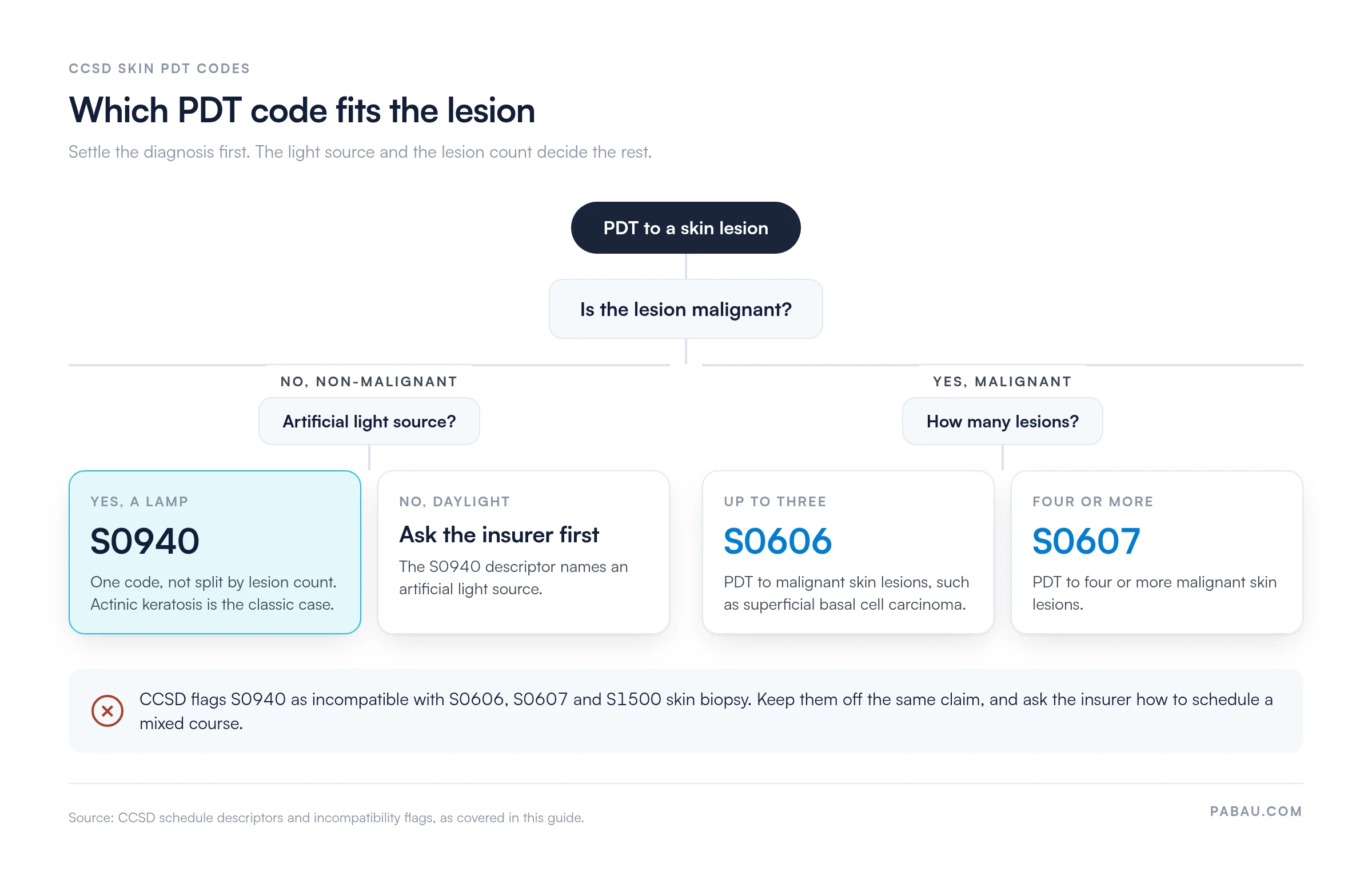
With the code settled, the claim itself follows a predictable path. Here’s the usual route for a private dermatology practice.
A course often runs to more than one session. Treat each session date as its own line, and check the authorization covers the number you plan.
Take an illustrative patient, Mr. Hale, with several rough, scaly patches on his scalp. He also has one pearly lesion on his cheek. The dermatologist diagnoses actinic keratoses on the scalp and takes a punch biopsy of the cheek.
That first visit bills the biopsy under S1500, not S0940. CCSD flags the pair as incompatible, so the PDT goes on a later date. Had the cheek lesion been shaved off at skin level instead, the biopsy would bill under S1420. Histology comes back as superficial basal cell carcinoma.
Now the course splits. The scalp sessions bill as S0940, because actinic keratosis isn’t malignant. The cheek lesion bills as S0606, a single malignant lesion. Since the two codes are incompatible, the practice asks the insurer how they want them scheduled before booking.
Insurers can ask for notes after payment, so write the record as if someone will audit it. For each PDT session, capture these details.
Run through this list before each PDT invoice leaves the practice. Each line maps to a rule covered earlier in this guide.
Even with the checklist in place, a few errors keep coming back.
Do all insurers need pre-authorization for PDT? Requirements vary by insurer and by policy. Asking before the first session costs little, and it protects the claim.
Does the policy have to include outpatient cover? PDT usually happens as an outpatient session, so a policy without outpatient benefit may not pay. Check the member’s level of cover when you ask for authorization.
What if histology changes the diagnosis mid-course? Stop and update the insurer. The new diagnosis may move the remaining sessions to S0606 or S0607, with a fresh authorization.
Trouble with an S0940 claim often starts before anyone raises the invoice. A consent form sits on paper, lesion photos live on a phone, and the authorization reference is in an email. Then someone has to pull it all together to raise one invoice.
Pabau, a practice management platform, keeps those pieces on the patient record. Patients sign digital consent forms before they arrive. Your clinicians write treatment notes and attach photos in the same place.
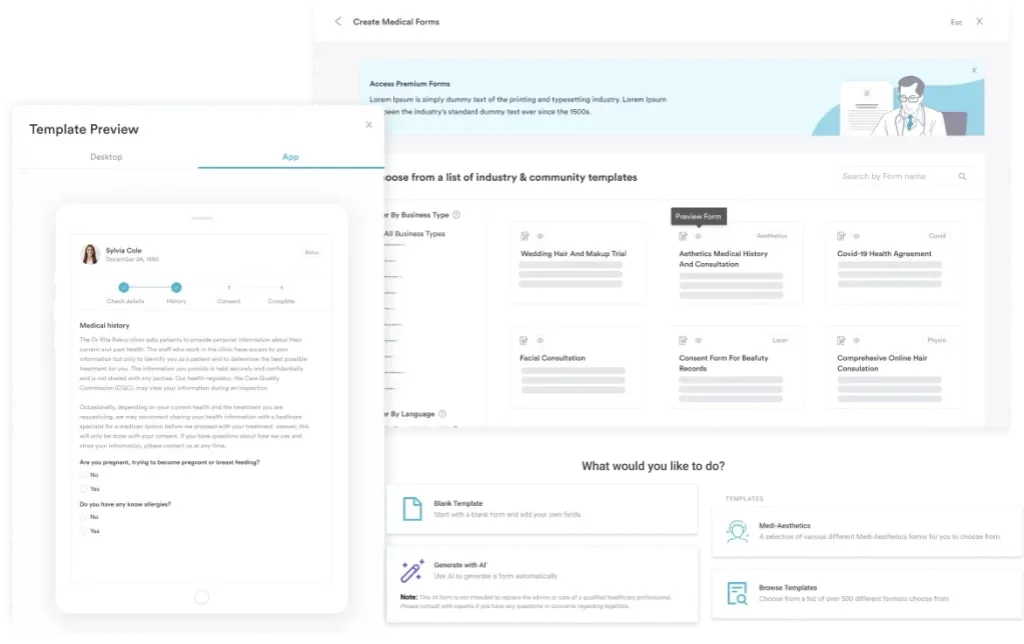
When the session is done, Pabau’s claims management software sends the insurer invoice through its Healthcode integration. It warns you when an authorization code is missing on the case before the claim goes.
Choosing the right CCSD code stays with your clinicians and billing team. Pabau then helps you follow up unpaid claims, so a finished session doesn’t stay unpaid.

Pabau stores consent, treatment notes and photos on the patient record, then sends insurer invoices through Healthcode and helps you follow up unpaid claims.

S0940 rewards the practice that settles the diagnosis before the lamp goes on. A non-malignant lesion, an artificial light source and a claim free of S0606, S0607 and S1500 are the three conditions to confirm every time.
If you change one habit, make it the pre-authorization call. Confirm the code, the session count and the cover at that point, and the invoice becomes routine.
Book a demo to see how Pabau keeps PDT consent, notes and insurer claims on one patient record.

Treating the malignant lesions in the same course? CCSD code S0606 covers PDT to up to three malignant skin lesions.
Treating four or more malignant lesions? CCSD code S0607 covers PDT when the malignant lesion count reaches four.
Taking a biopsy before PDT? CCSD code S1500 covers biopsy of skin or subcutaneous tissue.
Billing phototherapy rather than PDT? CCSD code S0980 walks through phototherapy billing for dermatology.
Destroying a lesion by laser instead? CCSD code S0922 covers laser destruction of a skin lesion up to 25 cm².
Often, when it treats a diagnosed skin condition and the policy includes outpatient cover. Treatment done mainly for appearance, such as PDT for photoaging, is usually excluded. Check the member’s policy and get pre-authorization first.
Not automatically. The S0940 descriptor names an artificial light source, and daylight PDT uses natural light instead. Ask the insurer how they want daylight sessions coded before you treat.
Actinic keratosis, ICD-10 code L57.0, is the most common diagnosis behind a non-malignant PDT claim. Use the code that matches the diagnosis recorded in the notes.
Plan for a long slot. Common creams need around three hours to absorb before the lamp goes on, but follow the product’s license. Illumination itself takes minutes, so book the appointment length to match.
Usually. Insurers generally pay an outpatient consultation as a separate consultation fee, while S0940 covers the treatment session. Check the insurer’s rules for a same-day consultation and treatment.