CCSD Code F3400: Tonsillectomy guide for ENT practices
What is CCSD Code F3400? CCSD Code F3400 is the Clinical Coding and Schedule Dat...

Last Updated: Oct 22, 2026

CPT code 96116 covers a neurobehavioral status examination performed by a physician or qualified healthcare professional, billed per hour of total time.
That hour counts face-to-face time with the patient plus the time spent interpreting results and preparing the report.
Only physicians and QHPs may bill 96116 independently. Technicians cannot bill it, even when they help administer parts of the exam.
96116 requires no standardized test battery. Billing it when formal testing was performed is the upcoding error behind most denials.
Practice management software like Pabau pre-fills the CMS-1500 from the clinical record and submits claims electronically through Claim.MD.
CPT code 96116 covers the first hour of a neurobehavioral status exam. That exam is a clinical assessment of a patient’s thinking, reasoning, and judgment. The billable hour covers more than chair time. It counts the minutes spent with the patient plus the minutes spent interpreting results and writing the report.
That one detail decides a lot of claims. Log face-to-face time alone and you under-report the hour. Run a formal test battery, bill 96116 anyway, and you have upcoded.
Both mistakes come back as denials. Below you will find the documentation, the units, the 2026 rates, and the code choices that keep a 96116 claim clean.
CPT code 96116 describes a neurobehavioral status examination (NSE) performed by a physician or other qualified healthcare professional (QHP).
The exam looks at neurobehavioral function through a patient history review, a cognitive assessment, and medical decision making.
The code is reported per hour of service time. That hour is total time, so it covers the face-to-face portion plus the time spent interpreting results and preparing the report.
Per the American Medical Association’s CPT code set, 96116 was revised in the 2019 overhaul that restructured the psychological and neuropsychological testing family.
One distinction drives most 96116 denials. The code does not require standardized tests or a formal test battery. A neurobehavioral status examination is a clinical evaluation, not a testing session.
The comparison section below shows exactly where that line falls.
CPT code 96116 may only be billed by a physician or other qualified healthcare professional. The AMA definition of a QHP is broad, and individual payer local coverage determinations (LCDs) often narrow it. Check with the applicable MAC or private payer before you bill.
Eligible provider types typically include:
Psychological and neuropsychological technicians cannot bill CPT 96116 on their own. They may administer parts of an exam, but the claim goes out under the supervising QHP.
That supervision rule separates 96116 from technician add-on codes such as 96138, which exist for delegated test administration.
The exam is a structured clinical evaluation of a patient’s thinking, reasoning, and judgment. A QHP uses it to assess cognitive and behavioral function as part of ongoing clinical management. It is not the vehicle for a formal battery of standardized psychological tests.
According to AMA coding resources, the examination components typically include:
The NSE does not include administering standardized neuropsychological test batteries. Those belong to 96132 and 96133. Billing 96116 when formal testing was performed is the top upcoding error in this family, and Medicare audit protocols flag it.
Because 96116 is a time-based code, thin time documentation is the leading cause of denial. The record has to support both the total time spent and the clinical complexity of the evaluation. One shared template across providers keeps the required elements from going missing.
Required documentation elements:
Time is the most scrutinized element in Medicare audits for 96116. State the actual minutes, never a range or an estimate. Auditors look for start and stop times on the face-to-face portion.
They also want a separate note of the minutes spent interpreting results and writing the report. Many practices record what they did not perform as well, so a 96116 versus 96132 question answers itself.
Medicare reimbursement for CPT code 96116 is set annually through the CMS Physician Fee Schedule. Rates move with geography, through the Geographic Practice Cost Index (GPCI), and with place of service.
The figures below are 2026 national average estimates. Verify current rates in the CMS fee schedule lookup tool before you bill.
Private payer rates vary and are not bound by the Medicare fee schedule. Many commercial plans reimburse behavioral health codes at 110% to 140% of Medicare, though the contract always decides. Some plans also want prior authorization before they will pay a 96116 claim at all.
Bill CPT 96116 in one-hour increments based on total time, not on appointment length. If the exam, the interpretation, and the report add up to 100 minutes, bill 96116 once and 96121 once. Record the face-to-face start and stop times, then record the interpretation and report minutes separately. Never round up to the next hour.
The 2019 CPT restructuring drew a clearer line between the clinical status exam and formal testing. Confusion across that line is still the most common reason a 96116 claim gets denied.
The table below sorts the four codes by who performs the service and whether a standardized instrument was used.
The practical rule is simple. If anyone administered or scored a standardized psychological or neuropsychological instrument, reach for 96132 or 96130 instead of 96116. CPT 96116 fits judgment-based assessment that uses brief office screening tools as part of the exam itself.
Those screeners are not standalone batteries. The chart below routes an encounter to its code in one pass.
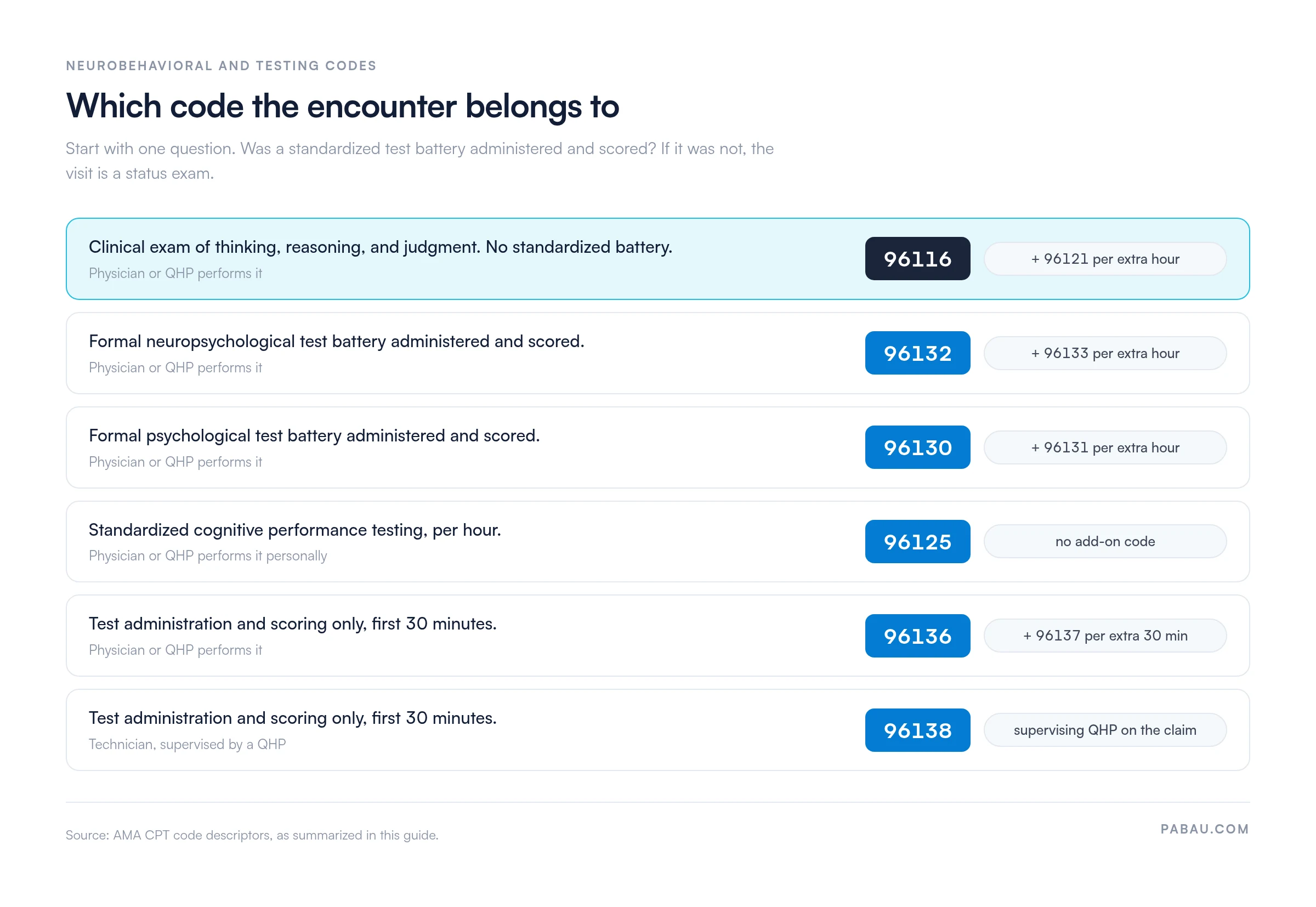
The 2019 restructuring created a full family of testing codes, and each one has a narrow job. Knowing the neighbors prevents both under-billing and bundling problems.
When a QHP only administers and scores the tests, 96136 covers the first 30 minutes of that work.
CPT 96116 sits on the CMS Medicare telehealth services list, so Medicare allows it for real-time audio-visual encounters.
Coverage still tracks current policy, so check with CMS and your Medicare Administrative Contractor (MAC) before you submit a telehealth 96116 claim.
Key telehealth billing rules for CPT 96116:
Telehealth policy for behavioral health codes keeps moving. The Continuing Appropriations Act, 2026, signed on February 3, 2026, extended Medicare telehealth flexibilities through December 31, 2027. Confirm current policy on the CMS telehealth fact sheet before you build a workflow around it.
Denials on 96116 cluster around a short, predictable list. Catching them at the point of care beats working them after the payer says no. It also pays to recognize the common denial codes behind these rejections, because the remark code tells you which fix the claim needs.
The claim itself moves in a straight line. The QHP signs the note, then the coder attaches 96116 and any 96121 units.
The diagnosis pairing goes on the charge line, and the claim leaves for the clearinghouse. One weak link on that path surfaces as a denial three weeks later.
Four checks catch most 96116 denials:
Time-based codes leave a trail that manual workflows lose. A QHP running several neurobehavioral exams a week has to get four details right on every claim:
Notes in one system and billing in another turn each of those into a handoff, and handoffs are where time-based billing errors start. Practice management software like Pabau closes that loop. Pabau’s faster claims management pre-fills the CMS-1500 straight from the record.
The CPT code attached to the service lands on the charge line, and the ICD-10 slots seed from the client’s recorded problem list. Built-in ICD-10-CM and CPT lookup libraries sit behind a search icon, so a coder can check a descriptor without leaving the claim.
Required-field validation then runs before the claim goes out. If an authorization number or a membership number is missing, the Send button stays locked. Claims submit electronically through Claim.MD, which reaches thousands of US payers.
Eligibility checks, remittance posting, and claim-status tracking run on the same pipeline. A 96116 denial surfaces in Pabau instead of in a paper remittance weeks later.
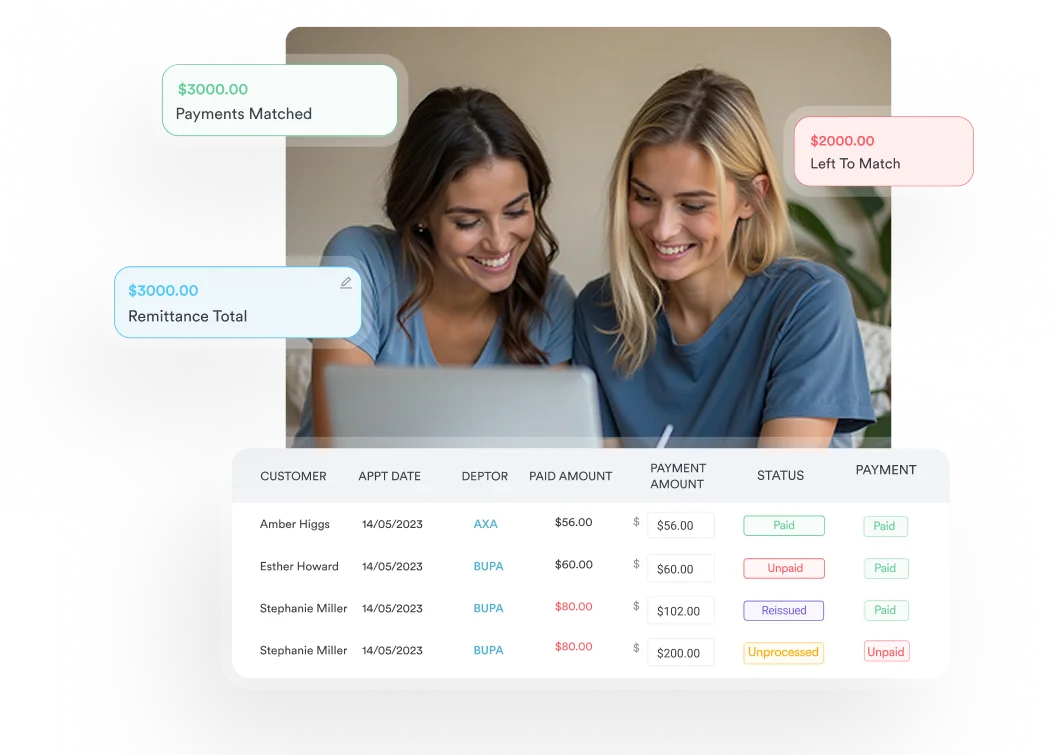

Pabau pre-fills the CMS-1500 from the clinical record and submits electronically through Claim.MD. See how that keeps CPT 96116 documentation, units, and diagnosis pairing consistent on every claim.

CPT 96116 stops being difficult once the hour is defined correctly. Count the face-to-face minutes, add the interpretation and report minutes, and write both into the note. Then confirm that no standardized battery was administered, because that single fact decides between 96116 and 96132.
Time-based codes reward habit more than effort. A practice that captures minutes the same way every time rarely argues with a payer about them, and the appeals queue shrinks on its own.
To see how Pabau keeps those minutes, codes, and diagnosis pairings together on one claim, book a demo with our team.

Billing behavioral screening alongside the exam? ADHD screening CPT codes covers the codes and documentation rules for screening services that often run in the same visit.
Delegating test administration to a technician? CPT code 96138 explains the supervision and claim rules for technician-administered testing.
Working a stack of behavioral health denials? Denial management in healthcare sets out a workflow for triaging, appealing, and preventing repeat rejections.
Want more claims paid on the first pass? What makes a clean claim breaks down what a payer needs before it will accept a claim without rework.
Billing coaching or allied health services too? Coaching CPT codes covers the billing rules for services that often run alongside neuropsychological evaluations.
No. A brief mental status check belongs to an evaluation and management visit, so it is not separately billable. CPT 96116 is a standalone, time-based assessment with its own findings and a written report.
No. The hour is total time, so part of it happens after the patient leaves. Face-to-face assessment counts, and so does the time spent interpreting results and preparing the report. Document the two portions separately.
96116 covers the first hour of the exam, and 96121 covers each additional hour. As an add-on code, 96121 never bills on its own. Both are measured on total time, not on appointment length.
Payers look for a diagnosis that explains the cognitive concern. Codes describing memory or attention symptoms, dementia, and mental disorders due to a physiological condition are the usual pairings. Check your MAC’s local coverage determination for the covered list.
Medicare does not require prior authorization for 96116. Many commercial and Medicare Advantage plans do, especially for behavioral health services. Confirm the requirement before the appointment, because payers rarely approve an authorization after the fact.