

CPT Code 98981: RTM Treatment Management Billing Guide
CPT code 98981: Definition and official descriptor CPT code 98981 is an add-on c...

Last Updated: Nov 9, 2026
96113 is the CPT add-on code for developmental test administration, each additional 30 minutes. A physician or other qualified health care professional administers standardized developmental instruments, interprets the results, and writes the report. The testing can assess fine and gross motor, language, cognitive, social, memory and executive functions.
Report 96113 with its primary code, 96112, which covers the first hour. Under the CPT midpoint rule, the first 96113 unit is reportable once total time reaches 76 minutes. Interpretation and report time count toward that total.
Let Pabau's smart automation suggest the right codes, reduce claim denials, and keep your practice compliant—effortlessly.
Automate repetitive tasks and focus on what matters most—your patients.
Reduce coding errors and ensure compliance with the latest regulations.
Clean claims, fewer denials, and faster reimbursements.
Powerful insights and reporting to help your practice thrive.
HIPAA compliant SOC 2 certified GDPR-compliant Trusted by 4,000+ clinics worldwide

CPT code 96113 is the add-on code for each additional 30 minutes of developmental test administration after the first hour, which 96112 reports.
96113 is never reported alone, so 96112 must appear on the same claim for the same date and provider.
Under the CPT midpoint rule, 96112 is reportable from 31 minutes of total time and the first 96113 unit from 76 minutes.
Interpretation and report preparation are part of the service, so that time counts toward the total along with test administration.
Pabau, our practice management software, runs eligibility checks and submits and tracks 96112 and 96113 claims through Claim.MD.
CPT code 96113 is the add-on code for each additional 30 minutes of developmental test administration. A physician or other qualified health care professional (QHP) performs it. It follows CPT 96112, which reports the first hour. The American Medical Association marks 96113 with a plus (+) symbol as an add-on code, so it is never reported without 96112.
The official descriptor covers testing of fine and gross motor, language, cognitive, social, memory and executive functions with standardized developmental instruments. In addition, the service includes interpretation of the results and the written report. Notably, report preparation counts toward the billable time, even when the patient is not present.
CPT 96112 is the primary code for developmental test administration, and it covers the first hour. In contrast, CPT 96113 covers each additional 30 minutes after that. The add-on also needs 96112 on the same claim, for the same date and the same provider. As a result, payers deny 96113 when it arrives without 96112.
The add-on covers the time a physician or QHP spends administering and scoring standardized developmental instruments, interpreting the results, and preparing the report. For example, evaluations under this code commonly look at autism spectrum disorder (ASD), ADHD, global developmental delay, specific learning disorders, and developmental coordination disorder.
Included in the time count:
Not included (use a different code):
Physicians, licensed psychologists, and other QHPs can report 96113. The physicians who bill it are usually pediatricians, developmental-behavioral pediatricians, and child psychiatrists. The physician or QHP must also personally administer the testing. Consequently, most payers do not accept 96113 for testing that a technician or supervised staff member performs.
State Medicaid programs and commercial payers sometimes narrow this list. For example, some Medicaid plans limit 96113 to licensed psychologists or developmental-behavioral pediatricians. Nurse practitioners and physician assistants also qualify under some payer contracts but not all. Therefore, confirm the eligible provider types with each payer before billing.
A denial for an ineligible provider type is a non-covered service denial. Thus, it cannot be appealed on clinical grounds.
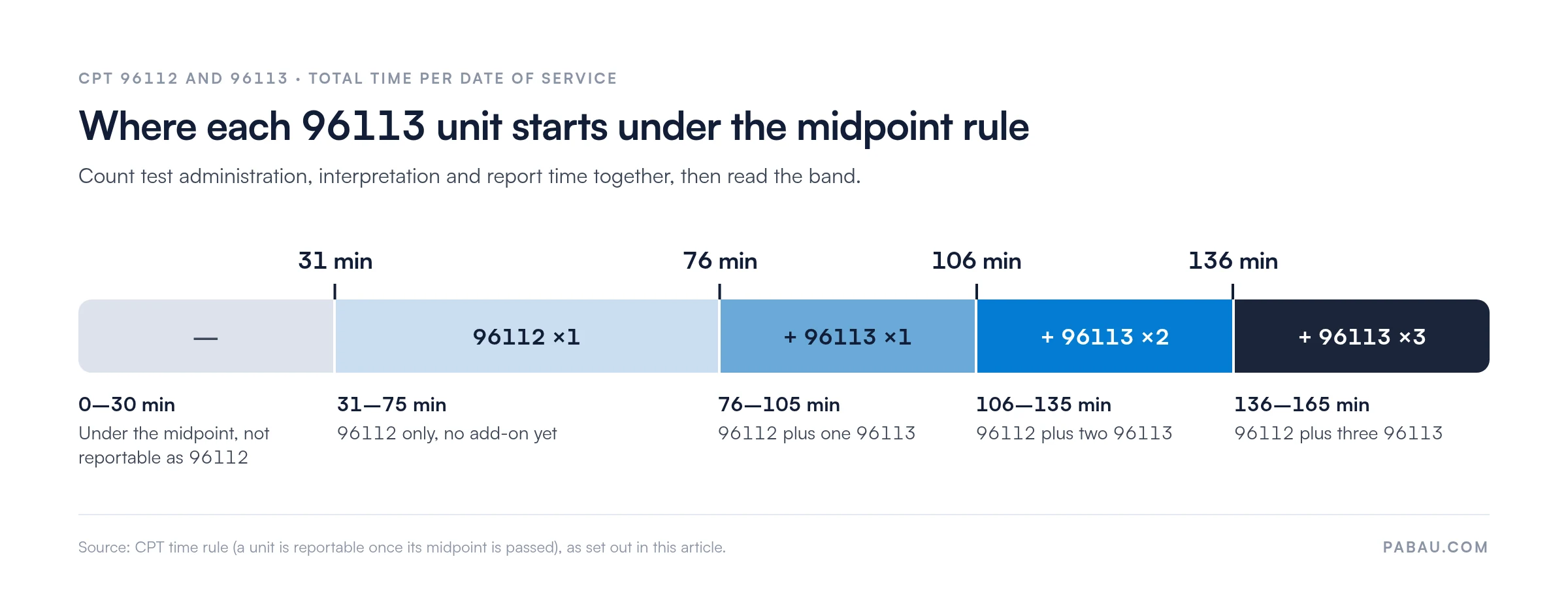
CPT time rules apply a midpoint test to 96112 and 96113. 96112 is reportable once total time passes the midpoint of the first hour, at 31 minutes. Then the first 96113 unit is reportable at 76 minutes, which is 16 or more minutes beyond 60. Likewise, each later unit needs another 30-minute block, again counted from its midpoint.
The bands below show where each unit starts.
Payers expect documented total time in minutes. A note that reads “approximately 2 hours” does not support a unit count. Instead, record the total minutes for test administration, interpretation, and report preparation.
Several codes sit close to 96113 in structure and clinical use. NCCI procedure-to-procedure (PTP) edits may apply to some pairs, so check the current edits before billing them together. The table shows the key distinction for each.
For ADHD screening codes, confirm whether the service is a brief behavioral screen (96127) or a full developmental evaluation (96112 plus 96113). The two also differ sharply in payment and documentation burden.
The diagnosis on a 96113 claim must support the need for extended developmental testing. A vague or unspecified code invites a medical necessity denial, so choose the most specific code the record supports. The codes below are common on these claims, but the list is not exhaustive. Where your MAC has a local coverage determination (LCD) for this testing, it governs which diagnoses are covered.
Use the CrossCoder CPT-to-ICD-10 crosswalk tool to check diagnosis-to-procedure pairings before you submit. In addition, the full list of ICD-10-CM codes shows every code in the F80-F89 developmental block. Finally, for a confirmed autism diagnosis, F84.0 has its own code guide.
When coding a referral for autism evaluation, pair F84.0 only after a confirmed diagnosis. If the evaluation is exploratory and the diagnosis is not yet established, use R62.50 or the most specific developmental concern code available. Submitting F84.0 on a screening-only encounter is an audit flag.
Incomplete documentation is one of the most preventable causes of 96113 denials. In particular, payers expect documented total time, not approximate duration language. Therefore, each element below belongs in the record for every encounter that bills 96113.
Medicare Part B covers CPT code 96113 when it is medically necessary, though developmental testing is mostly a pediatric service. As a result, Medicare claims usually involve adults, such as a late ASD diagnosis or an intellectual disability reassessment. For children, Medicaid and commercial plans are the main payers.
The CMS Physician Fee Schedule publishes the RVUs for 96113 each year. Payment changes with each annual update and varies by locality. Therefore, check the current rate with your MAC or the CMS fee schedule lookup for the payment year.
State Medicaid programs set their own rates and rules. For example, many require prior authorization (PA) for 96113, especially for autism and ADHD evaluations that run several add-on units. Commercial plans vary widely. A PA request for 96113 typically asks for:
Submit PA requests before scheduling extended evaluations, because a denial for missing prior authorization is rarely reversed on appeal when the payer’s policy required it before the service.
Denials on 96113 cluster around a predictable set of errors. The table maps each denial type to its corrective action.
In fact, many of these denials repeat across code types. The guide to denial management in healthcare covers how to track and work them as a pattern.
96113 appears only with 96112, on the same date and from the same provider. This is a firm requirement because of the add-on structure.
E&M on the same date: An evaluation and management (E&M) service, such as 99213-99215, can be billed on the same date as 96112 and 96113. However, the E&M must be separately identifiable from the testing and carry modifier 25. The record needs a distinct E&M note with its own assessment and plan, separate from the test interpretation. A single combined narrative, for instance, does not support modifier 25.
Codes to check against NCCI PTP edits before billing on the same date:
CMS updates NCCI edits quarterly, so treat any pairing rule as current only for that quarter. Check the Medicare NCCI PTP edit tables at the time of billing. A clean claim for 96113 passes those edits before it reaches the payer.
Planning an E&M with modifier 25 on the same date as 96112 and 96113? Confirm the note has a separate E&M section with its own assessment and plan. A single note covering both the testing and an E&M visit does not support modifier 25 and invites audit findings.
Developmental testing runs long, and payers check eligibility, prior authorization, and unit counts closely. Many practices still confirm coverage by phone and key each claim into a separate clearinghouse portal.
Pabau connects to Claim.MD, a US medical claims clearinghouse. Your team runs eligibility checks before evaluation day and submits 96112 and 96113 claims from the same system. Its claims management software then tracks each claim, so a rejection shows up without a separate portal login.
Meanwhile, coding, unit counts, and documentation stay with your clinicians and billers. Pabau then carries the claim they build to the payer and reports back what the payer decided.
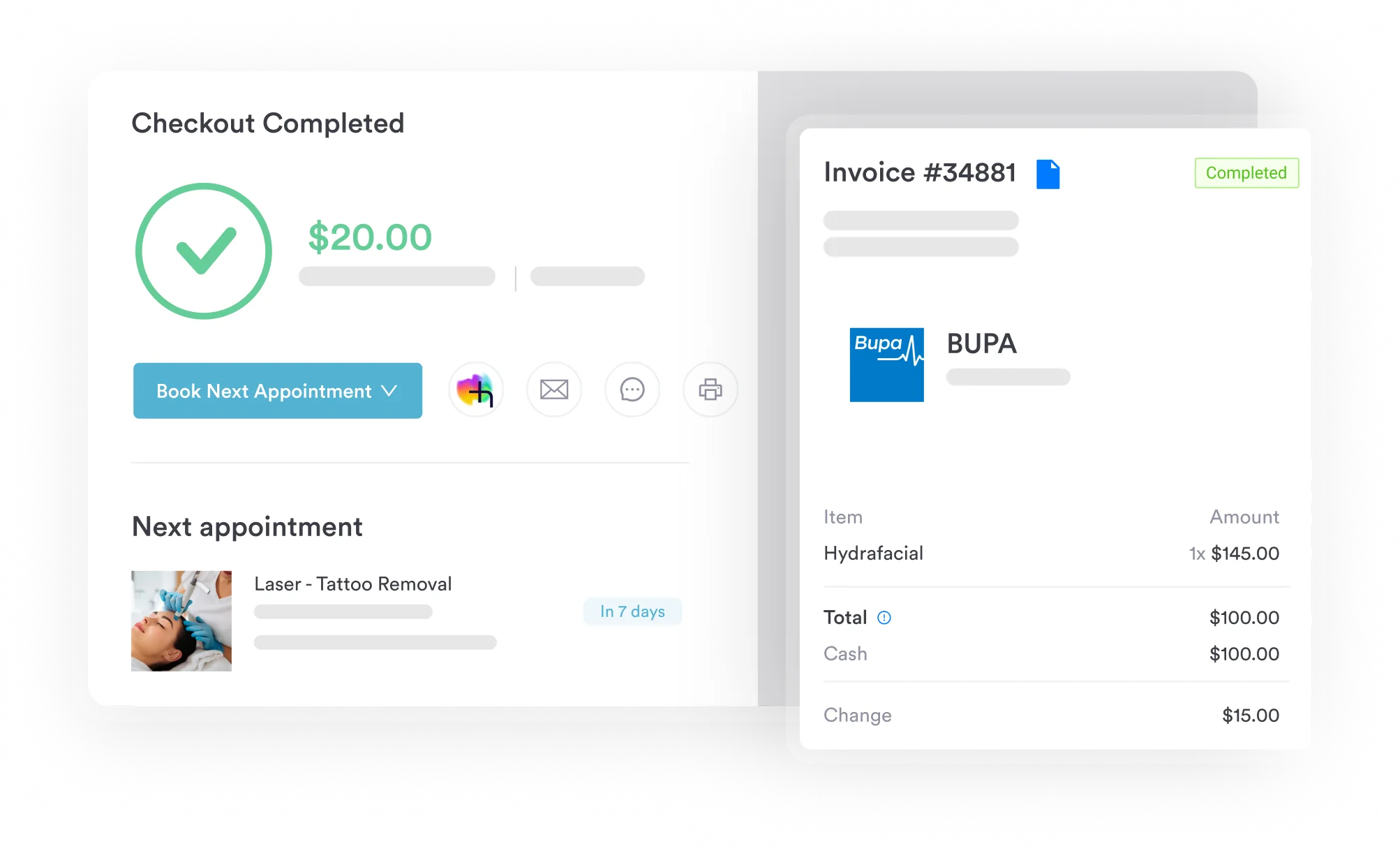

Pabau connects to Claim.MD so your team can check eligibility before evaluation day, then submit and track 96112 and 96113 claims in one place.

The 96113 rules are short once the time math is right. Count every minute of administration, interpretation, and report writing, apply the midpoint rule, and report 96113 only beside 96112.
In fact, practices that get paid for these evaluations settle the paperwork before the patient arrives. Get prior authorization, confirm the payer accepts the provider type, and check NCCI edits for any same-day screening. The claim then carries the time and the diagnosis that justify each unit.
Book a demo to see how Pabau handles eligibility checks and claim tracking for developmental testing.

Screening before a full evaluation? CPT code 96110 covers developmental screening with a standardized instrument and when it fits ahead of 96112.
Adding a brief behavioral screen? CPT code 96127 explains how per-instrument emotional and behavioral assessments are billed.
Need a broader overview of medical billing workflows? What is medical billing explains the end-to-end claims lifecycle, from charge capture through ERA posting.
Submitting claims through a clearinghouse for the first time? Claim.MD clearinghouse guide covers how US clearinghouse submission works and what to expect from 837P and ERA workflows.
Building a denial prevention strategy? Denial codes in medical billing maps the most common CARC codes to their root causes and corrective actions.
CPT code 96113 covers each additional 30 minutes of developmental test administration after the first hour, which CPT 96112 reports. The service includes standardized instrument administration and scoring, interpretation of the results, and the written report. Report preparation counts toward the total time, even when the patient is not present.
CPT 96112 is the primary code for the first hour of developmental test administration. CPT 96113 is the add-on code for each additional 30 minutes. 96113 needs 96112 on the same claim, for the same date and provider. Payers deny 96113 when it is billed without 96112.
Count total time and apply the CPT midpoint rule. 96112 is reportable from 31 minutes. One 96113 unit is reportable at 76 to 105 minutes, two at 106 to 135, and three at 136 to 165. A partial block counts once it passes its midpoint, so document total minutes for every session.
Possibly, but only if the current NCCI procedure-to-procedure (PTP) edits allow the pair. Check those edits for the quarter of service before billing both codes on one date. CMS updates them quarterly, so do not treat the answer as fixed.
Documentation must include the clinical reason for testing and the name and version of each standardized instrument. It also needs total time in minutes, including interpretation and report preparation. Add the interpreted results with raw and standard scores, the clinician’s impression and ICD-10 diagnosis, and a treatment or referral plan.




