CCSD Code D1010: Radical mastoidectomy including meatoplasty
CCSD Code D1010: Definition and clinical scope CCSD Code D1010 is the UK private...

Last Updated: Nov 25, 2026
CPT code 96111 was the AMA code for extended developmental testing with interpretation and report. The AMA deleted it effective January 1, 2019, and replaced it with 96112 (first hour) and 96113 (each additional 30 minutes). Legacy fee schedules and older records still reference 96111, which is why it is still searched.
Let Pabau's smart automation suggest the right codes, reduce claim denials, and keep your practice compliant—effortlessly.
Automate repetitive tasks and focus on what matters most—your patients.
Reduce coding errors and ensure compliance with the latest regulations.
Clean claims, fewer denials, and faster reimbursements.
Powerful insights and reporting to help your practice thrive.
HIPAA compliant SOC 2 certified GDPR-compliant Trusted by 4,000+ clinics worldwide

CPT code 96111 was deleted by the AMA effective January 1, 2019, and replaced by 96112 (first hour) and 96113 (each additional 30 minutes).
Before deletion, 96111 covered extended developmental testing with interpretation and report, reported once per testing session.
Claims now use 96112 from 31 minutes of testing time, plus one 96113 unit per additional 30 minutes, starting at 77 minutes.
Superbills and charge templates that still list 96111 need updating, since claims carrying the deleted code are rejected.
Pabau, a practice management platform with built-in insurance billing, sends 96112 and 96113 claims through Claim.MD and tracks prior authorizations on the case.
CPT code 96111 was the AMA code for extended developmental testing with interpretation and report, and the AMA deleted it effective January 1, 2019. A University of Washington coding summary lists 96111 as deleted and shows 96112 and 96113 replacing it from that date.
The official descriptor read: “Developmental testing; extended (includes assessment of motor, language, social, adaptive, and/or cognitive functioning by standardized developmental instruments) with interpretation and report.” It applied to in-depth neurodevelopmental assessments that went beyond brief developmental screening. The service required direct patient contact, standardized instruments, scoring, interpretation, and a written report.
The AMA deleted 96111 on January 1, 2019, as part of a broader restructuring of developmental and behavioral testing codes. The replacement code set separates the professional work more precisely:
96111 was reported per testing session. 96112 and 96113 now split the work by time: 96112 for the first hour, 96113 for each additional 30 minutes. If 96111 turns up on a legacy remittance or an older LCD, map the session to 96112 and 96113 by its documented time.
Practices still seeing 96111 on payer fee schedules should contact their MAC or commercial payer directly. Some state Medicaid programs updated their fee schedules after the 2019 effective date. A few payers with legacy systems may still process 96111 claims. Verify with each payer individually before submitting.
Under both the deleted 96111 and the current 96112/96113, billable services cover five parts. These are standardized test administration, scoring, clinical interpretation, integration with history and observations, and a written report. The evaluation must use validated instruments such as the Bayley Scales of Infant Development, Vineland Adaptive Behavior Scales, or ADOS-2 for autism-specific evaluations.
What is explicitly excluded from 96112/96113 billing:
Documentation must distinguish administration time from interpretation time. The medical record must show total face-to-face time with the patient and caregiver, the instruments used, and raw scores. It must also carry the clinical interpretation linking findings to diagnosis and recommendations.
Under the 96112/96113 structure that replaced the single 96111 unit, time thresholds follow these rules:
The CPT midpoint rule turns total testing time into units. Less than 31 minutes of testing supports no developmental testing code, and 31 to 76 minutes supports 96112 alone. One 96113 unit starts at 77 minutes, a second at 107 and a third at 137, as the chart below shows.
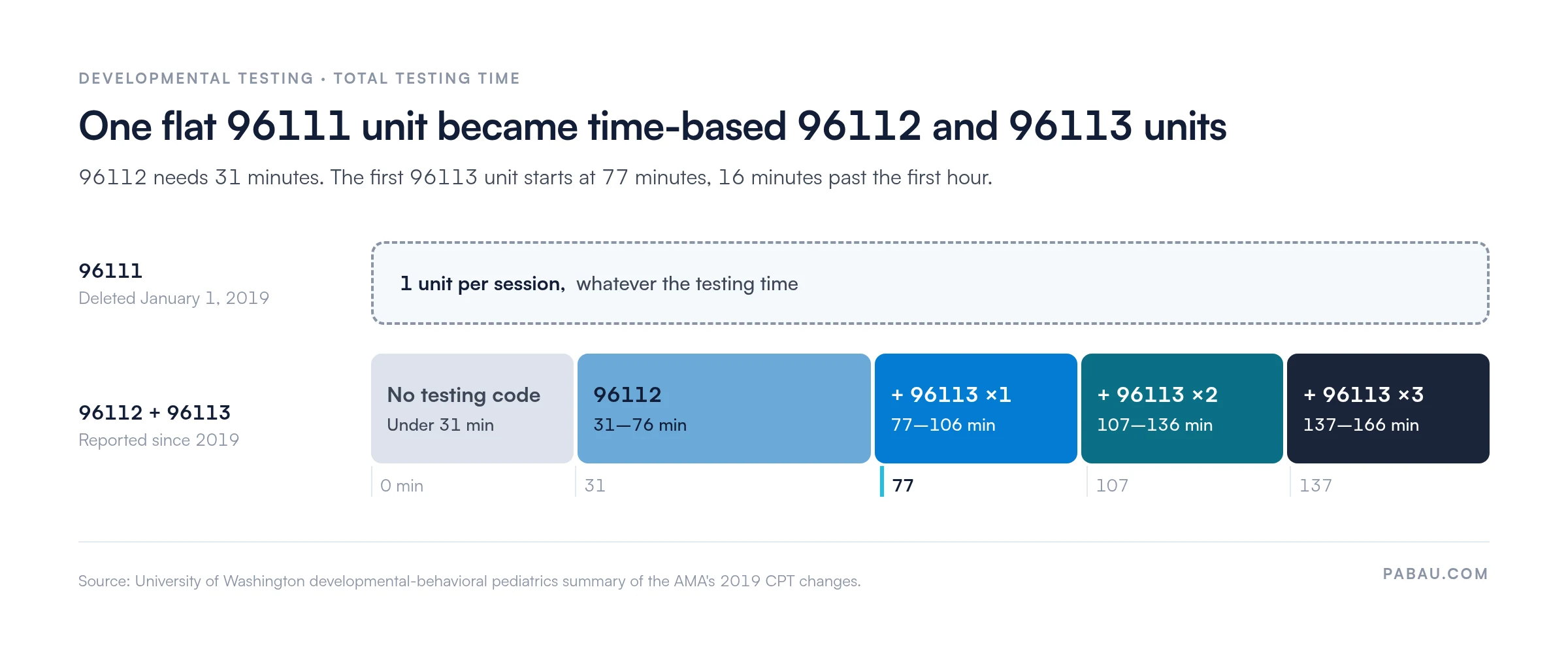
The documentation must support every unit billed. For a 2-hour session, the record must reflect at least 31 minutes for 96112. The first 96113 unit needs at least 16 minutes beyond the first hour, and each later unit needs 16 minutes past the previous 30-minute block. Time-based codes are among the most audited in developmental pediatrics and behavioral health. Each note must record:
A clean claim submission for 96112/96113 needs explicit time documentation in the medical record on the date of service. Time reconstructed after the fact won’t hold up. Post-hoc addenda that add time documentation after a denial are frequently rejected on appeal.
Document face-to-face time in real time during the evaluation, not at the end of the day. For multi-unit 96112/96113 sessions, use a time log in the chart noting start and stop times for each test administered. That log is what supports each 96113 unit if a payer audits the claim.
Under both the deleted 96111 and the current 96112/96113, billing requires a physician or other qualified health professional (QHP). That provider personally performs or directly supervises the test administration and writes the interpretation and report. Qualified provider types accepted by CMS and most commercial payers include:
Incident-to billing restrictions apply under Medicare. A non-physician practitioner (NP, PA) cannot bill 96112/96113 incident-to a physician unless two conditions hold. The physician must be physically present in the suite, and the service must be an integral part of the physician’s work. Most commercial payers follow similar restrictions, so verify each payer’s policy.
Speech-language pathologists and occupational therapists may report 96112/96113 only where payer and state scope-of-practice rules allow. Verify per payer. Where those rules don’t allow it, different code sets apply, depending on the nature of the assessment.
The codes in this family differ by depth of evaluation and by who performs it. The ADHD screening CPT code family overlaps with developmental testing codes in clinical practice, so coders covering behavioral health need to understand all four.
The clinical scenario drives code selection. A pediatrician administering an M-CHAT screening at a well-child visit uses 96110. The same pediatrician completing a two-hour Bayley/Vineland evaluation for a developmental delay workup uses 96112 plus 96113 for time beyond the first hour. Brief rating scales like the Vanderbilt ADHD rating scale fall under 96127.
Medical necessity for developmental testing requires a supported ICD-10 diagnosis. The diagnosis code must reflect the clinical indication documented in the record. Common ICD-10 codes accepted by CMS and most commercial payers for 96112/96113 (and historically for 96111) include:
Payers increasingly require specificity beyond F88 or F89 for 96112/96113 claims. Document the specific developmental domain(s) being evaluated in the encounter note, and use the most specific ICD-10 code available.
Medicare reimbursement for 96112 and 96113 varies by locality. The CMS Physician Fee Schedule lookup allows you to search by code and geographic area to get the current year’s national and locality-adjusted amounts. Use the FastRVU lookup tool to verify Work RVU, Practice Expense RVU, and Malpractice RVU values and calculate geographic-adjusted payment for your ZIP code.
Medicaid coverage varies significantly by state. Some state Medicaid programs carve out developmental testing to behavioral health managed care organizations (MCOs). Those MCOs may set different fee schedules and prior authorization rules than fee-for-service Medicaid. Always verify coverage with the specific state Medicaid program or MCO before submitting claims.
In Pabau, Medicaid claims go out through the Claim.MD clearinghouse, whose payer list sets which programs you can bill. An eligibility check before the visit confirms the patient’s Medicaid coverage is active.
Commercial payer coverage for developmental testing is generally good for medically indicated evaluations, but many plans require prior authorization. Coverage policies may specify which standardized instruments are accepted, maximum units per year, and which provider types qualify.
Prior authorization is required by most commercial payers and many Medicaid MCOs for 96112/96113 evaluations. Insurance eligibility verification before scheduling the evaluation should include an authorization check, not just coverage confirmation. A claim submitted without a required authorization will usually deny, however strong the documentation.
When submitting a prior authorization request for developmental testing, include:
Retrospective authorization requests are rarely approved for developmental testing. If the evaluation was performed without obtaining required prior auth, the claim will almost certainly deny and the appeal window is typically 60-90 days. Build the authorization workflow into scheduling, not billing.
Developmental testing claims have more failure points than a standard E/M claim: Time thresholds, add-on units, provider credentials and prior authorization. A strong denial management workflow starts with preventing the top denials before submission. When one gets through, the medical billing denial codes on the remittance tell you which fix applies.
Catching these errors before submission costs far less than appealing them. Appeals typically take 30 to 90 days, and many practices write the claim off rather than pursue it.
Update your superbills and EHR charge templates immediately if they still carry CPT 96111. Any claim submitted with the deleted code will reject at the clearinghouse or payer adjudication level. Run an audit of all charge entry templates across every location that bills developmental testing.
In most practices, a developmental testing claim passes through several hands. The clinician logs the testing time, someone checks the authorization, and the billing team turns the note into 96112 and 96113 units. Each handoff is a chance to lose the minutes or the auth code the payer will ask for.
Pabau’s claims management software keeps those steps on one patient record. The prior authorization code, its dates and the approved sessions sit on the case, and Pabau warns you when one is missing. An eligibility check runs before the visit, so coverage problems surface before testing starts.
Claims then go out through Claim.MD as CMS-1500/837P claims, and ERA remittances come back to the same record. When a 96113 unit is short-paid, you can see it next to the note that supports it and chase it with the documentation in hand.

Pabau keeps prior authorizations, eligibility checks and Claim.MD claims on one patient record. See how it handles developmental testing claims from booking to remittance.

CPT code 96111 is gone, and the fix is mechanical. Replace it in every superbill, charge template and fee schedule. Then bill 96112 once 31 minutes of testing are documented, and add a 96113 unit for each further 30 minutes.
The harder change is in the record. Under 96111, a session was one unit, so few practices kept a timed log. 96112 and 96113 are paid only for the time the note proves, which makes a start-and-stop log the most valuable line in the chart.
Book a demo to see how Pabau keeps the authorization, the timed note and the 96112/96113 claim on one record, so fewer claims deny.

Need a billing overview for ADHD-related developmental codes? ADHD screening CPT code covers the adjacent developmental screening codes used alongside 96112 in behavioral health practices.
Screening before a full evaluation? CPT code 96110 explains the brief developmental screening that often comes before 96112 testing.
Using rating scales alongside testing? CPT code 96127 shows how brief emotional and behavioral assessments are billed per instrument.
Unclear on how clearinghouse submission works for developmental testing claims? Claim.MD clearinghouse guide explains how electronic claim submission routes developmental testing and other behavioral health codes to payers.
Want to reduce claim denials across your behavioral health billing? Medical billing compliance guide covers documentation standards, audit triggers, and coding accuracy practices for behavioral and developmental health claims.
CPT code 96111 is a deleted AMA code that covered extended developmental testing with interpretation and report, reported per session. The AMA deleted 96111 effective January 1, 2019 and replaced it with 96112 (first hour) and 96113 (each additional 30 minutes). Practices currently billing for developmental test administration and interpretation should use 96112 and 96113.
CPT 96111 covered extended developmental testing with interpretation and report, reported per session, and was deleted effective January 1, 2019. CPT 96112 is the replacement code, covering the first hour of developmental test administration with interpretation and report. The main structural difference is that 96112 pairs with the add-on code 96113 for additional 30-minute increments, while 96111 was one unit per session. The documentation requirements are similar, but 96112 and 96113 are time-based, so the note must record testing minutes.
Medicare stopped accepting CPT 96111 after its deletion in 2019. For the replacement codes, Medicare covers 96112 and 96113 when medical necessity is documented and the service is provided by a qualified health professional. Reimbursement rates vary by locality. Use the CMS Physician Fee Schedule lookup to find current payment amounts for your geographic area. Some Medicare Advantage plans have separate coverage policies.
96112 is billed once per session (the first hour) and needs at least 31 minutes of testing time. 96113 is billed once per additional 30-minute increment beyond the first hour, requiring at least 16 minutes of face-to-face time per unit. A 2.5-hour evaluation would bill 96112 x1 and 96113 x3 (90 additional minutes = three 30-minute units). Most commercial payers cap the total units per evaluation episode, so check each payer’s coverage policy for annual limits.
The most commonly accepted ICD-10 codes are F84.0 (autistic disorder), F80.1 (expressive language disorder) and F81.0 (specific reading disorder). Others include F82 (developmental disorder of motor function), F88 (other disorders of psychological development) and F89 (unspecified disorder of psychological development). Use the most specific code supported by clinical findings. Vague codes such as F89 without documented clinical indication are a leading medical necessity denial trigger.
No. NCCI edits typically bundle 96110 (developmental screening) with 96112 (developmental test administration) on the same date of service. Billing both codes without an appropriate modifier will trigger an edit and denial. If screening happened at an earlier visit and the full evaluation later, each is billed on its own date without conflict.