CPT Code 31653: EBUS With 3+ Mediastinal Stations
CPT code 31653: Official descriptor and clinical scope CPT code 31653 is the pro...

Last Updated: Oct 20, 2026
95024 is the CPT code for intracutaneous (intradermal) tests with allergenic extracts, immediate type reaction, including test interpretation and report, specify number of tests.
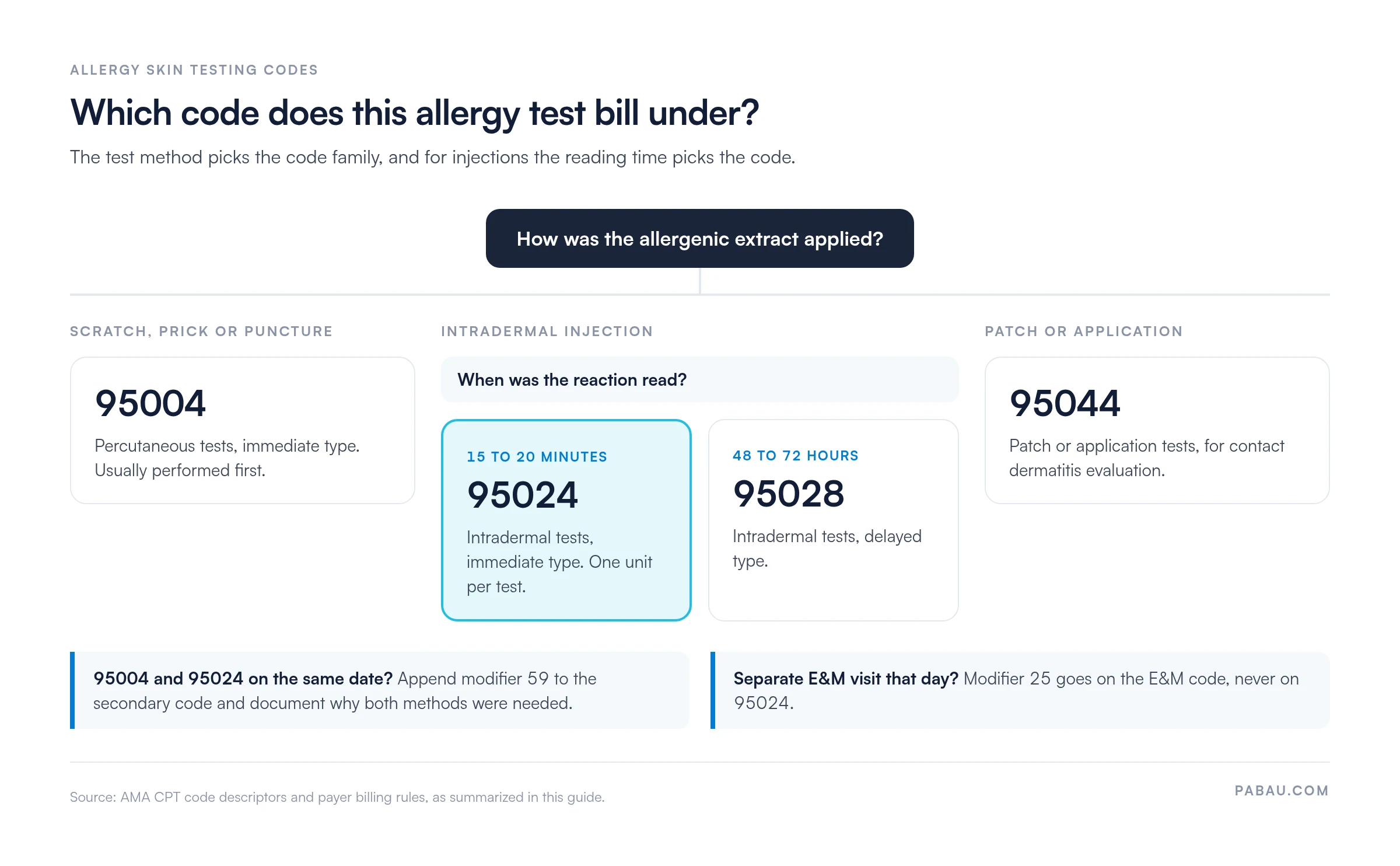
Each intradermal injection bills as one unit, and the reaction is read 15 to 20 minutes after injection. Scratch, prick and puncture tests belong to CPT 95004 instead. Billing both codes on the same date needs modifier 59 and documentation showing why each method was medically necessary.
Let Pabau's smart automation suggest the right codes, reduce claim denials, and keep your practice compliant—effortlessly.
Automate repetitive tasks and focus on what matters most—your patients.
Reduce coding errors and ensure compliance with the latest regulations.
Clean claims, fewer denials, and faster reimbursements.
Powerful insights and reporting to help your practice thrive.
HIPAA compliant SOC 2 certified GDPR-compliant Trusted by 4,000+ clinics worldwide

CPT code 95024 covers intradermal allergy tests with allergenic extracts for immediate-type reactions, distinct from percutaneous testing under 95004.
Units are counted per individual intradermal test administered, not per encounter or allergen set.
Modifier 25 goes on the evaluation and management (E&M) code, not on 95024. Modifier 59 may be needed when 95024 and 95004 share a date of service.
Medicare generally requires direct physician supervision, so name the supervising physician in every 95024 note.
Practice management software like Pabau links procedure codes to patient records, supporting clean claim submission for allergy testing.
CPT code 95024 is defined by the American Medical Association (AMA). It covers “intracutaneous (intradermal) tests with allergenic extracts, immediate type reaction, including test interpretation and report, specify number of tests.”
The key phrase is “immediate type reaction.” The reading happens 15 to 20 minutes after injection. A reading at 48 to 72 hours points to delayed hypersensitivity testing, which bills under different codes.
The procedure itself involves injecting a small volume of allergenic extract into the dermis, typically on the forearm or upper back. The clinician then observes and measures the wheal-and-flare response at the injection site. Each allergen tested generates a separate billable unit under 95024.
CPT 95004 covers percutaneous allergy tests, meaning scratch, prick, or puncture methods. CPT code 95024 covers intradermal injection tests. The two codes aren’t interchangeable, and billing the wrong one for the method used can trigger a payer audit.
Same-day billing of both 95004 and 95024 is possible when the patient genuinely needs both test methods. National Correct Coding Initiative (NCCI) edits bundle them by default, though.
Payers expect modifier 59 on the secondary code and documentation confirming why both were medically necessary on the same date. Without that, expect a denial or a request for medical records.
CPT code 95024 sits within the broader allergy testing and immunotherapy code family. Coders working in allergy and otolaryngology practices need to distinguish adjacent codes to avoid misreporting. Two facts from the note settle most testing claims: how the extract was applied, and when the reaction was read.
Before coding a multi-test session, verify the adjacent allergy codes in the AAPC Codify CPT lookup. The ones worth checking are 95017, 95018, 95052, 95056, 95060, 95065, 95070, 95120, 95125, 95130-95134, 95144, 95165 and 95180.
Every 95024 claim needs a medical record that can withstand a payer audit. Incomplete documentation is the most common root cause of denials, and it’s hard to fix once the claim has gone out.
The medical record must include all of the following for each 95024 unit billed:
Under Medicare, allergy skin testing, including CPT code 95024, generally requires direct supervision. A physician must be in the office suite and immediately available while the test is given, though not necessarily in the room. A nurse or medical assistant may perform the injection under that supervision.
For Medicare billing, the physician can’t be off-site during the procedure. Verify the current supervision indicator for 95024 against the CMS Physician Fee Schedule lookup tool, as supervision categories are updated annually.
Incident-to billing under Medicare applies only when the service is:
The physician must see new patients, and existing patients with new problems, before incident-to rules apply.
Document the supervising physician’s name in every 95024 note, even in practices where the supervising physician sees most patients directly. Payers audit incident-to compliance specifically because the supervision requirement is frequently underdocumented.
CPT code 95024 is billed per individual intradermal test administered, not per encounter and not per allergen panel. A session in which 12 separate intradermal injections are given bills as 12 units of 95024. That said, payer-specific unit caps apply and vary significantly.
Same-day bilateral testing does not automatically double the allowable unit count unless payer policy specifically permits it. Document the clinical rationale for bilateral testing in the record before billing additional units.
Modifier selection for 95024 is usually simple. Denials follow when a practice applies modifiers inconsistently, or leaves off one that’s required.
Modifier 25 belongs on the E&M code, not on 95024. It’s the most repeated modifier error in allergy practices, and payer systems catch it by matching modifier placement to code type. The FastRVU 2026 RVU lookup shows whether a modifier changes the reimbursable relative value unit (RVU).
Every 95024 claim must carry a diagnosis code that supports medical necessity for allergy testing. Payers cross-reference the ICD-10-CM code against the code’s LCD or coverage policy. An unspecified code, submitted when the record supports a specific one, can trigger a medical necessity denial.
Code to the highest specificity the clinical record supports. LCD L36402 lists the covered diagnoses for allergy testing under Medicare. A code outside that list is denied automatically, however appropriate the test was.
Medicare covers CPT code 95024 under Local Coverage Determination (LCD) L36402, which governs allergy testing billing guidelines for Medicare patients. Coverage has three conditions:
For 2026 reimbursement rates, check the same CMS Physician Fee Schedule lookup using code 95024 and your practice’s geographic locality modifier. Rates vary by location and may differ between facility and non-facility settings.
Traditional Medicare typically doesn’t require prior authorization for CPT code 95024, but other payers set their own rules. Medicare Advantage plans frequently impose prior auth requirements that differ from traditional Medicare, and Medicaid programs vary by state. Run insurance eligibility verification at scheduling rather than at check-in, so prior authorization requirements surface before the test.
Most 95024 denials fall into six predictable categories, and each one can be caught before the claim goes out. The table maps each denial to its root cause and the check that prevents it.
Check your practice’s denials against the list of medical billing denial codes every month to catch patterns early. A single root cause, such as missing supervisor documentation, can generate dozens of denials across a billing period before anyone notices.
Billing 95024 means tracking each allergen, counting units, naming the supervising physician and coding the diagnosis to full specificity. When the test log, the note and the billing system sit apart, a coder re-keys each unit by hand.
Practice management software like Pabau keeps those details in one record. Its claims management software connects treatment notes to procedure codes, so the information that supports medical necessity is captured before billing begins.

Claim.MD, Pabau’s US clearinghouse partner, handles CMS-1500 and 837P submissions across 4,000+ payers. For an allergy practice, that means:
Practices can also generate a superbill directly from the encounter. It carries the procedure codes, units, and diagnosis codes into the billing queue without manual re-entry.
Run eligibility checks at least 48 hours before the allergy testing appointment. Prior authorization requirements and unit caps are plan-specific and change at plan renewal. A missing auth caught the day before a session can still be fixed. Caught after a denial, it means an appeal and a resubmission.

Pabau links procedure codes to patient records and routes claims through Claim.MD so your allergy testing documentation supports every unit billed. See how it works in a live demo.

Treat 95024 as a documentation code first and a billing code second. When the note records each extract, its site, its wheal measurement and the supervising physician, the unit count holds up in an audit.
The trade-off is time at the front desk. Checking eligibility at scheduling adds a step, but it costs far less than appealing a session that has already happened.
Book a demo to see how Pabau carries each 95024 unit from the treatment note to a clean claim.

Need a framework for managing claims after they go out? Denial management in healthcare covers the full cycle from tracking to appeal workflows.
Unsure how your billing compliance holds up? Medical billing compliance practices outlines what payers audit and how to document defensively.
Want to understand how the clearinghouse connection works? Our Claim.MD clearinghouse guide explains payer enrollment, eligibility, and 835 remittance processing.
CPT code 95024 is the billing code for intracutaneous (intradermal) allergy tests using allergenic extracts to evaluate immediate-type reactions, including test interpretation and report. Each individual intradermal injection administered is billed as a separate unit under this code.
CPT 95004 covers percutaneous allergy tests (scratch, prick, or puncture), while CPT code 95024 covers intradermal injection tests. Intradermal testing is more sensitive but less specific than percutaneous testing. It’s often performed as a follow-up when percutaneous results are negative.
Units for CPT code 95024 are counted per individual intradermal test administered. A session with 12 separate injections bills as 12 units. Payer-specific unit caps apply, so verify the MUE value for Medicare and check commercial or Medicaid plan policies. NC Medicaid, for example, implemented new unit limitations effective 2025.
Yes, Medicare generally requires direct physician supervision for CPT code 95024. The physician must be in the office suite and immediately available during the procedure. Nurses or medical assistants may administer the test under this supervision. Verify the current CMS supervision indicator annually, as supervision categories are updated with each fee schedule.
Commonly paired ICD-10-CM codes include J30.1 (allergic rhinitis due to pollen), J30.89 (other allergic rhinitis) and J45.20 (mild intermittent asthma). L50.0 (allergic urticaria) and Z91.010 (allergy to peanuts) also appear often. For Medicare claims, the diagnosis must appear on LCD L36402’s covered indication list to avoid medical necessity denials.
The most frequent denial reason is an ICD-10 code that isn’t on the LCD covered diagnosis list. Others are units above the payer’s MUE or plan cap, and missing prior authorization, especially for Medicare Advantage and commercial plans. NCCI bundling with 95004 without modifier 59 and missing supervision documentation round out the list.
Medicaid unit limits for CPT code 95024 vary by state. North Carolina Medicaid implemented new unit limitations effective 2025 per NC DHHS policy. Those rules apply only to NC Medicaid, so don’t generalize them to other state programs. Check the billing manual for each state program where you bill.