CPT code 52648: Laser ablation of the prostate billing guide
What CPT code 52648 covers, and what it bundles in CPT code 52648 is the code fo...

Last Updated: Oct 21, 2026

CPT code 94640 describes pressurized or non-pressurized inhalation treatment for acute airway obstruction, or sputum induction for diagnostic purposes.
Documentation must capture the medication used, the dosage, the treatment duration, and the patient response to support medical necessity.
Medicare pays about $8.70 for 94640 in 2026. The rate is identical in office and facility settings, so check your locality in the CMS fee schedule.
NCCI allows one unit per episode of care, whatever the number of treatments given during that visit. A second episode the same day takes modifier 76.
A clearinghouse integration such as Claim.MD applies standard format and eligibility edits before submission. It does not choose codes or judge medical necessity.
CPT code 94640 covers a pressurized or non-pressurized inhalation treatment for acute airway obstruction, or sputum induction for diagnostic purposes. It is an episode-based code rather than a time-based one, which is what separates it from 94644 and 94645.
The American Medical Association (AMA) descriptor names two distinct clinical uses for the same code. Which one applies changes what the encounter note has to prove.
The two clinical scenarios 94640 covers are:
One episode of care equals one unit, whatever the number of separate treatments delivered during that visit. That boundary drives the unit rules below and the split between 94640 and the continuous-therapy codes.
Every CPT 94640 claim needs a supporting ICD-10-CM diagnosis that establishes medical necessity. Payer systems cross-reference the diagnosis against the procedure at claim adjudication. A mismatch between the diagnosis and the treatment context is one of the most common denial triggers.
Medical necessity is always payer-adjudicated. The pairings above are clinically appropriate, but coverage still depends on payer policy and local coverage determinations. COPD with acute exacerbation, coded as J44.1, is a common pairing when the treatment happens in the office. Verify each pairing against your payer’s requirements before submission.
Incomplete documentation is the leading cause of 94640 denials. Payers review inhalation therapy claims closely because the code is high-volume and cheap to add to a visit. Every element below should appear in the encounter note before the claim goes out.
Practice management software like Pabau captures medication name, dose, duration, and patient response inside the clinical note. The structured detail behind a clean 94640 claim gets recorded at the point of care, rather than reconstructed from memory days later.
Medicare reimbursement for CPT code 94640 is set annually through the CMS Physician Fee Schedule. Rates vary by geographic locality. Always check the current-year figure in the CMS lookup tool before you build your own fee schedule.
For CY2026, the national payment lands at roughly $8.70. The same figure applies in the office and in a hospital outpatient department, because 94640 carries no facility differential.
The payment is built from relative value units (RVUs) rather than set as a dollar figure. 94640 has no work RVU at all, so practice expense carries almost the whole amount. The breakdown below shows how the total gets to $8.70 and why the setting does not move it.
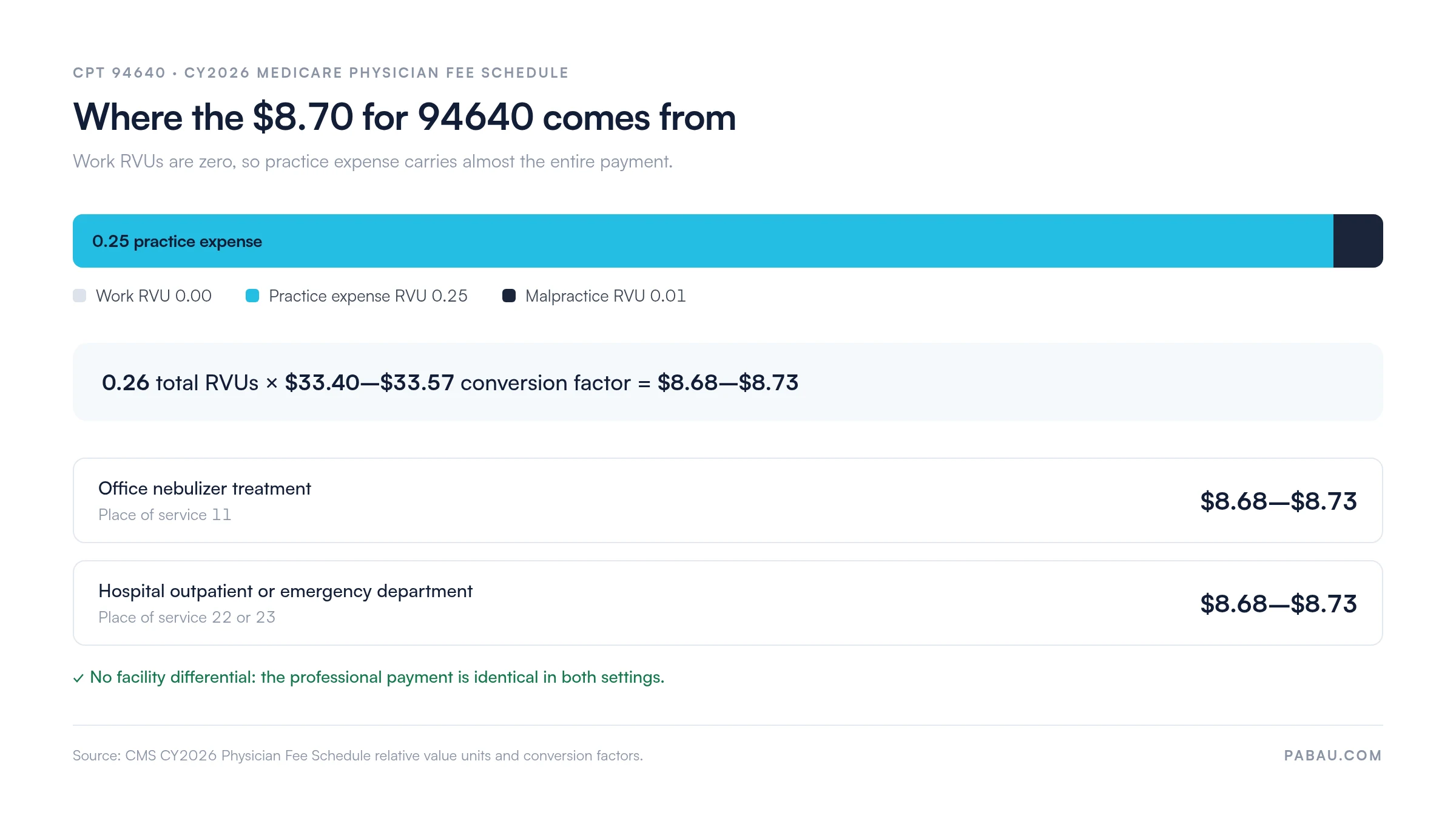
Important: Check these figures against the current CMS fee schedule for your locality before you rely on them. Geographic adjustors mean the rate differs across Medicare Administrative Contractor (MAC) jurisdictions.
In a facility setting the physician still bills 94640 and receives the same professional payment as in the office. The hospital bills the Outpatient Prospective Payment System separately for the supplies and equipment. A place-of-service error will not change your professional rate, but it can still trigger a post-payment review.
CPT 94640 is billed per episode of care, not per unit of time. National Correct Coding Initiative (NCCI) policy allows one unit for the whole episode, whatever the number of treatments given during it.
An episode of care starts when the patient arrives for treatment and ends when the patient leaves. It stays a single episode even when it runs past midnight into a second calendar day.
Where a second episode is billable, the note has to prove it. Record the arrival and departure times for each episode, the medication given, and the response documented separately. Medically Unlikely Edits (MUEs) also reject claims whose unit count passes the daily limit, so a high count fails before anyone reads the note.
Count episodes of care, not treatments. Three back-to-back nebulizer treatments in one visit are still one unit of 94640. A second episode on the same date needs modifier 76, plus its own arrival and departure times in the note.
Selecting between 94640, 94644, and 94645 is where inhalation therapy coding errors concentrate. The distinction comes down to treatment type and duration, not clinical severity.
Use 94640 for discrete, intermittent treatments. Use 94644 only when the nebulizer runs without interruption for at least the first hour. 94645 is an add-on to 94644 and cannot be billed on its own. Billing 94644 for a 15-minute intermittent treatment misrepresents the service, however sick the patient was.
94640 often shares an encounter with other respiratory codes, and NCCI decides which of them can be billed alongside it. The table below shows which pairings survive the edits and which need a modifier.
The pairing coders get wrong most often is 94060. When 94640 treats acute airway obstruction, the spirometry either side of it is not separately reportable. A 94060 line on the same claim invites a denial, and repeated attempts invite a review. Inhaler teaching under 94664 is billable with 94640, but only as a distinct service with modifier 59 appended.
94640 denials cluster around a handful of recurring patterns. Knowing them in advance beats working denials after the fact, and the denial codes on the remittance tell you which pattern you are looking at.
A clearinghouse catches format, eligibility, and duplicate-claim errors before the payer sees them. It does not decide a code or judge medical necessity, so the coding above still has to be right when the claim goes out. Pabau’s claims software for practices keeps the note, the codes, and the submission history in one record. A denied 94640 claim is then quick to trace back to the documentation it was missing.
Medicare covers CPT 94640 when the documentation meets Local Coverage Determination (LCD) L33446, which governs respiratory therapy and oximetry services. The LCD sets out covered diagnoses, documentation requirements, and limits on coverage in outpatient settings. Check that L33446 is still active for your MAC jurisdiction, since LCDs get revised and retired.
Because L33446 also governs oximetry, a practice billing 94762 for overnight monitoring works from the same coverage criteria. That code covers a full overnight recording, not the single determination reported under 94760.
Key Medicare coverage notes for 94640:
Medicaid coverage for inhalation therapy varies by state. No national rule governs unit limits, covered diagnoses, or prior authorization. Medi-Cal, for example, publishes its own respiratory therapy billing rules, and they differ from the Medicare LCD language. Check your state’s billing manual before you assume Medicare rules apply.
The documentation problems behind 94640 denials are workflow problems. Providers know what to record. The difficulty is capturing it at the point of care, before the next patient arrives and the detail fades.
Pabau records medication name, dose, duration, and patient response as part of the treatment workflow itself. The billable record then matches what happened clinically, so nobody is chasing the treating provider three days later.
For practices billing respiratory therapy codes regularly, three parts of the workflow make a material difference:
Practices with steady inhalation therapy volume gain more from one connected workflow than from a coding reference, a billing platform, and a clearinghouse kept apart.

Pabau captures the documentation a 94640 claim depends on at the point of care. It submits through the Claim.MD clearinghouse and traces each denial back to the note behind it.

94640 pays about $8.70, and that figure sets the economics of the whole workflow. Reworking a denied claim costs more staff time than the claim is worth. The only version that pays is the one that goes out right.
The work is all upstream. Bill one unit per episode and pair the code with a diagnosis that matches the indication. Record the medication, dose, duration, and response in the note. Do that at the point of care and the claim usually pays without a second touch.
Pabau keeps that note and the claim in one record, so respiratory billing stops depending on what someone remembers. Book a demo to see the 94640 workflow from encounter note to remittance.

Billing spirometry in the same practice? CPT code 94010 covers the standalone pulmonary function test and the documentation payers expect with it.
Need the diagnosis side of a COPD nebulizer claim? ICD-10 code J44.1 sets out what the record must show for an acute exacerbation.
Billing the nebulizer supply as well? HCPCS code A7003 explains how the disposable administration set is billed separately from the treatment.
Want fewer resubmissions? Clean claim submission outlines the coding and documentation elements that stop rejections across CPT billing.
Wondering how a claim reaches the payer? Claim.MD clearinghouse guide covers electronic submission and the edits applied along the way.
CPT code 94640 is a billing code used for pressurized or non-pressurized inhalation treatment for acute airway obstruction, or for sputum induction for diagnostic purposes. It covers discrete nebulizer treatments using bronchodilators such as albuterol. Practices report it from office, urgent care, and emergency department settings for asthma, COPD, or acute bronchospasm.
Medicare pays about $8.70 for CPT 94640 under the CY2026 fee schedule. The code carries 0.26 total RVUs, and the rate is the same in office and facility settings. Rates shift a little by locality, so check the CMS Physician Fee Schedule lookup for your MAC jurisdiction.
Medicare and Medicaid allow one unit per episode of care. NCCI policy treats every inhalation treatment given during a single visit as one reportable unit of 94640, however many treatments were delivered. If the patient leaves and returns the same day, the second episode can be reported with modifier 76. Medically Unlikely Edits reject claims whose unit count passes the daily limit.
Yes, CPT 94640 is commonly billed in an office setting with place of service 11. The professional payment is the same as in a hospital outpatient department, because 94640 has no facility differential. The difference is that the practice supplies the medication and the nebulizer equipment itself.