



HCPCS code E0198: Water pressure pad billing guide
HCPCS code E0198 is a water pad for a standard mattress HCPCS code E0198 is the ...

Last Updated: Oct 13, 2026

CPT Code 94010 covers spirometry with a graphic record, total and timed vital capacity, and expiratory flow rates, with or without maximal voluntary ventilation.
The interpretation must be physician-signed and clinically correlated, because a bare spirometry tracing is the leading denial cause.
Modifier TC bills the technical component alone, modifier 26 bills the interpretation alone, and global billing needs one provider doing both.
The 2026 work RVU is 0.17 in both office and facility settings, so only the practice expense component changes.
Pabau’s claims management software flags incomplete spirometry documentation before submission and tracks 94010 denials by reason.
CPT Code 94010 is spirometry, including the graphic record, total and timed vital capacity, and expiratory flow rate measurements. Maximal voluntary ventilation may be included or left out. It is the code for a baseline lung function test in an office or outpatient setting.
The descriptor is short. Getting paid for it is not, because the interpretation, the modifier, and the diagnosis all have to line up on the same claim. This guide covers the descriptor, covered indications, documentation, Medicare rates, modifiers, related pulmonary codes, and the common denial patterns.
The American Medical Association (AMA) defines CPT Code 94010 as follows. Spirometry, including graphic record, total and timed vital capacity, expiratory flow rate measurement(s), with or without maximal voluntary ventilation. The code sits in the Pulmonary Diagnostic Testing and Therapies section, which runs from 94010 to 94799.
In practical terms, 94010 is what most providers think of as a basic spirometry test. The table below shows which components the code expects and which one is optional.
The phrase “with or without” MVV carries some weight. You do not have to perform MVV to bill 94010. If you do perform it, the maneuver stays inside 94010 rather than being billed on its own.
CPT Code 94010 requires medical necessity. Payers expect a supported diagnosis before they approve payment, and Medicare sets its own rules through Local Coverage Determinations (LCDs).
The most commonly covered diagnoses are ICD-10-CM codes J44.x (COPD), J45.x (asthma), and J96.x (respiratory failure). Coverage still varies by Medicare Administrative Contractor (MAC) jurisdiction, so check your regional MAC LCD before you bill.
Spirometry records airflow volumes and rates, and it captures no blood oxygen saturation data. When a COPD or chronic respiratory failure patient is assessed for nocturnal desaturation, the overnight study is billed as 94762.
Pulmonologists, primary care physicians, internists, and occupational medicine providers all bill CPT 94010 regularly. Respiratory therapists may perform the technical component, but the interpreting physician has to be separately identifiable for split billing to apply.
Incomplete documentation is the most common reason CPT 94010 claims are denied on audit. The American Thoracic Society (ATS) publishes standardized spirometry performance criteria, and CMS MAC LCDs align closely with those standards. Your record needs all of the following before a claim goes out.
A structured encounter template does that enforcement for you. If the interpretation field is not required before the note closes, a missing interpretation goes unnoticed until the claim comes back denied. Capturing the tracing reference, the interpretation sign-off, and the ICD-10-CM code in one encounter record cuts audit risk considerably.
Eligible providers include physicians (MD or DO), nurse practitioners, and physician assistants who perform and interpret spirometry within their scope of practice. Respiratory therapists may perform the technical component but cannot independently bill the professional interpretation.
Medicare pays for CPT Code 94010 under the Medicare Physician Fee Schedule (MPFS). The national rates below are approximate. Your payment depends on the Geographic Practice Cost Index (GPCI) adjustment for your locality.
Pull your own figure from the CMS Physician Fee Schedule lookup tool. Commercial payer rates usually differ from Medicare and need checking against each payer’s fee schedule.
Those are approximate national figures, subject to GPCI adjustment. Verify the current values with the FastRVU 2026 RVU lookup tool for a locality-adjusted amount. Note that the work RVU of 0.17 does not move with the site of service. What changes is the practice expense component, which is why the office rate is the higher of the two.
Always pull your locality-specific 2026 MPFS rate from the CMS fee schedule lookup before quoting expected reimbursement to patients or administrators. The national average for CPT 94010 can vary by 20-30% between high-cost and low-cost geographic areas due to GPCI adjustments.
The modifier you append to CPT 94010 depends on who owns the equipment and who performs the interpretation. Two questions settle it, and the chart below runs through both.
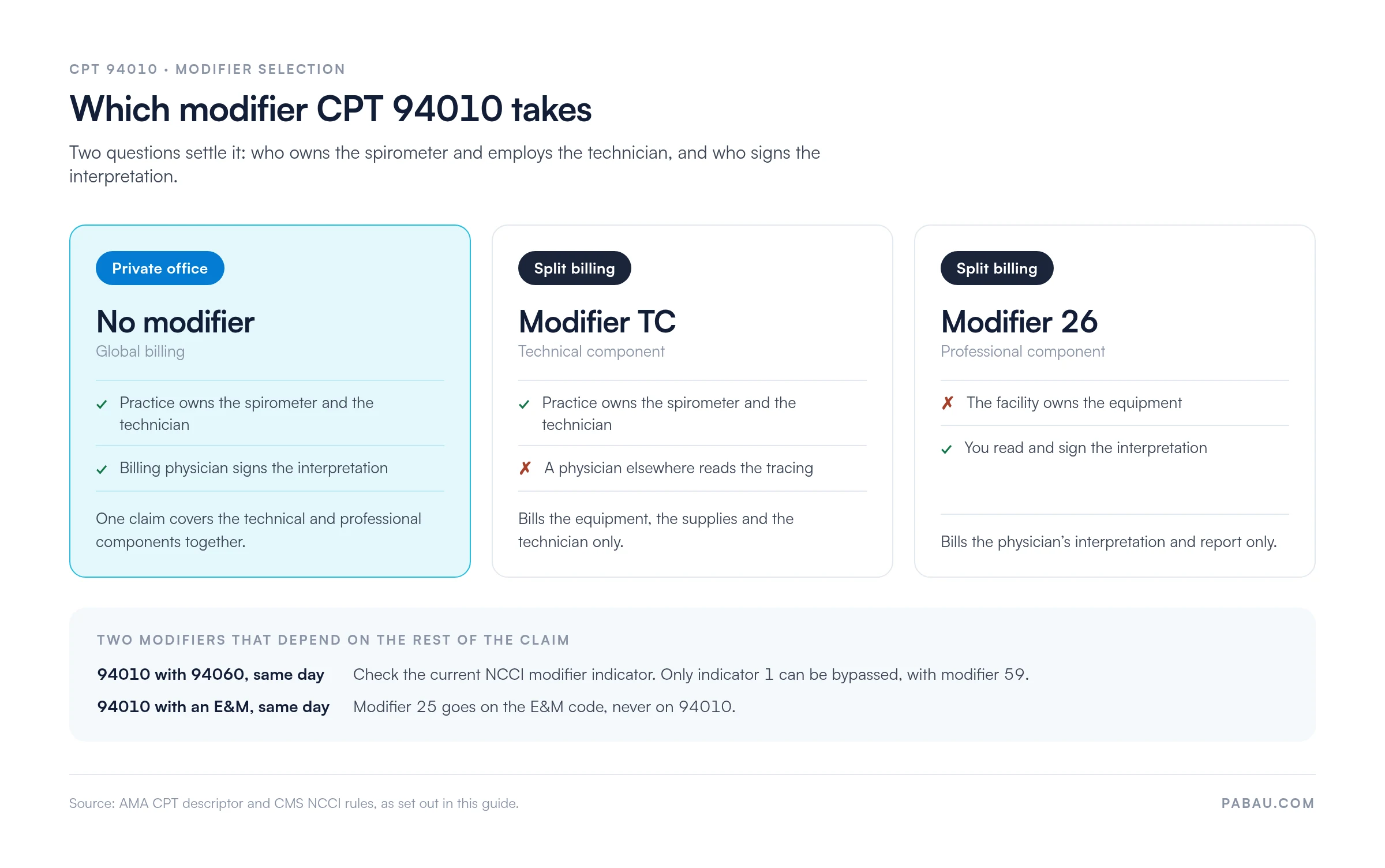
Never append TC or 26 in a private office that owns the spirometer and whose billing physician interprets the results. Splitting a global service into components when one entity performs both is a billing error. Payers can read it as overcoding during an audit.
Coders confuse CPT 94010 and CPT 94060 often, but the two describe different clinical services. CPT 94060 adds a bronchodilator administration step plus a repeat spirometry maneuver to assess responsiveness. That extra clinical work is what justifies its higher reimbursement rate.
Use 94010 when the clinical goal is a baseline lung function measurement. Use 94060 when you need to know whether the patient responds to a bronchodilator, typically to confirm asthma or to test COPD reversibility. Do not bill 94010 as a pre-step and add 94060 as a post-step without checking current NCCI edit status.
The National Correct Coding Initiative (NCCI), maintained by CMS, defines which code pairs may be billed together. For CPT 94010, the bundling concern that comes up most involves 94060. CMS updates NCCI edits quarterly, so work from the current quarterly file rather than prior-year information.
When 94010 and 94060 appear on one claim for the same date of service, the edit pair may trigger. The modifier indicator on the current NCCI table decides whether the edit can be bypassed with modifier 59, or with XS, XU, XP or XE. Indicator 1 means a modifier can bypass the edit, provided each service has a documented clinical reason. Indicator 0 means the codes are mutually exclusive and cannot be billed together at all.
Before billing both 94010 and 94060 on the same date, work through four steps.
Claim-validation rules can flag this code pair automatically before submission. That catches the error while the encounter is still open, rather than weeks later when the payer rejects it.
CPT 94010 is the foundation of pulmonary function testing, but a full workup usually involves more codes. The table below lists the codes most commonly ordered alongside 94010, or instead of it.
The same handful of errors drives most CPT 94010 denials. Knowing the pattern lets a billing team build prevention into the encounter instead of chasing claims one at a time. The common denial codes for procedure-based claims map directly onto the list below.
Catching these at the point of care beats catching them after submission. The clean claim requirements payers check are worth building straight into the spirometry encounter template.
Coding rules only work when they sit inside the daily workflow. A billing team that has to remember to check each element will miss one on a busy afternoon, and the denial arrives three weeks later.
Practice management software like Pabau moves the check into the template instead. Pabau’s claims management software connects procedure ordering to code selection and documentation capture in one workflow. For spirometry billing, that means three things.
Eligibility runs before the patient arrives and claims are scrubbed before they leave, so a missing interpretation surfaces while the chart is still open. Billing staff spend their time on the claims that need a human, not on re-reading the ones that were already correct.
Claim.MD, Pabau’s US clearinghouse partner, routes CPT and ICD-10 claims to thousands of payers. Claims sent through that integration carry real-time eligibility verification and electronic remittance advice, so payments reconcile against the expected fee schedule amount automatically.

Pabau’s claims management workflow flags incomplete spirometry documentation before submission and tracks claim outcomes by code. See how it works for pulmonology and primary care billing teams.

Three causes account for most CPT Code 94010 denials. They are an unsigned interpretation, a modifier that does not match the setting, and an NCCI conflict with 94060. The code itself is simple, and the workflow around it is where practices lose money.
So the fix belongs in the encounter template rather than in a reminder to the billing team. Require the interpretation before the note closes, and pre-link the diagnosis codes. Then check the current NCCI file before you bill 94010 and 94060 on one date. Get those three right and spirometry stops being a code your team argues with payers about.
Book a demo to see how Pabau builds those checks into a pulmonology or primary care encounter, so 94010 claims leave the building complete.

Need a structured approach to clean claim submission? Clean claim requirements and best practices walks through what payers check before processing a claim.
How does electronic remittance advice work in practice? Electronic remittance advice processing explains how ERA 835 files reconcile payments against expected fee schedule rates.
Looking for a complete overview of medical billing workflows? Revenue cycle management explained covers the full claim lifecycle from patient scheduling through payment posting.
Wondering what a superbill has to contain? Superbill requirements explained breaks down the fields a payer expects on an itemized encounter receipt.
Denials piling up faster than your team can work them? Denial management in healthcare sets out how to triage, appeal, and prevent recurring denial reasons.
CPT Code 94010 is spirometry testing that includes a graphic record, total and timed vital capacity (FVC and FEV1), and expiratory flow rate measurements. Maximal voluntary ventilation (MVV) may be included or left out. It represents a complete baseline spirometry study. Bill it globally when the same provider performs and interprets the test on practice-owned equipment.
The 2026 Medicare non-facility rate for CPT 94010 is approximately $30-$45 nationally, subject to Geographic Practice Cost Index (GPCI) adjustment by locality. Facility rates are lower, at roughly $15-$25, because the practice bills the professional interpretation only. The work RVU is 0.17 in both settings, so only the practice expense component changes. Verify your own rate with the CMS Physician Fee Schedule lookup tool at cms.gov.
CPT 94010 covers baseline spirometry only. CPT 94060 adds bronchodilator administration and a post-bronchodilator repeat spirometry to measure reversibility. Use 94010 for a standard lung function measurement. Use 94060 when you need to know whether the patient’s airflow obstruction improves after a bronchodilator, such as for asthma confirmation or COPD reversibility testing.
Required documentation includes a physician order with the clinical indication and the printed graphic spirometry tracing retained in the medical record. You also need technician qualifications per the applicable MAC LCD, plus a physician-signed interpretation with clinical correlation. The interpretation has to characterize the pattern as obstructive, restrictive, mixed, or normal, and relate that finding to the patient’s clinical picture. Raw data printouts without a signed interpretation are the most common audit finding.
Yes. CPT 94010 can share a date with an E&M service, but the E&M code has to carry modifier 25. That modifier shows the office visit was a significant, separately identifiable service, beyond the pre- and post-service work for the spirometry procedure. Without modifier 25 on the E&M, payers may deny one of the two services.
Five reasons account for most denials. The first is a missing physician-signed interpretation, and the second is an incorrect modifier for the place of service. The third is unbundling 94010 and 94060 without NCCI modifier documentation. The fourth is an unsupported ICD-10-CM diagnosis outside the MAC LCD, and the fifth is a same-day E&M billed without modifier 25. Addressing these at the template and claim-scrubbing level prevents the majority of 94010 denials.
Yes. Medicare covers CPT 94010 where medical necessity is established with a supported ICD-10-CM diagnosis and compliant documentation. Coverage criteria come from MAC-issued Local Coverage Determinations, which vary by jurisdiction. Medicaid coverage and reimbursement rates vary by state. Check your MAC LCD and your state Medicaid fee schedule before assuming coverage.



