CPT code 52648: Laser ablation of the prostate billing guide
What CPT code 52648 covers, and what it bundles in CPT code 52648 is the code fo...

Last Updated: Oct 21, 2026

CPT Code 87591 describes qualitative detection of Neisseria gonorrhoeae (gonorrhea) by nucleic acid amplification test (NAAT) using an amplified probe technique
87591 is paid under the Clinical Laboratory Fee Schedule at a single 2026 national rate of $35.09, with no facility split or locality adjustment
87591 is routinely co-billed with CPT 87491 (chlamydia NAAT) and CPT 87661 (trichomonas NAAT) in STI panels, where modifier 59 often prevents bundling denials
Practice management software like Pabau connects CPT code selection, documentation, and electronic claim submission, which cuts miscoding risk on STI panel claims
CPT Code 87591 is the billable code for qualitative detection of Neisseria gonorrhoeae by nucleic acid amplification test (NAAT), amplified probe technique. Medicare pays it under the Clinical Laboratory Fee Schedule, at one national rate with no locality adjustment. The code and the diagnosis pairing decide what gets paid, so a denial almost always starts in the chart rather than in the fee schedule.
This reference guide covers the official descriptor, the 2026 fee schedule, the ICD-10-CM crosswalk, documentation requirements, companion codes, and the denials that follow each. It draws on AMA CPT code set guidance and CMS payer policy.
Three CPT codes describe gonorrhea nucleic acid testing, and the methodology on the lab report decides which one applies. 87591 is the code for a qualitative amplified probe NAAT, which covers nearly every platform in current use.
NAAT is now the gold-standard detection method for gonorrhea according to AAPC coding guidance. The amplified probe technique copies target DNA sequences until even a low bacterial load is detectable. That makes it far more sensitive than culture-based methods. Because the test is qualitative, it reports a positive or negative result only, with no bacterial count.
Medicare pays CPT Code 87591 under the Clinical Laboratory Fee Schedule (CLFS), not the Physician Fee Schedule. That distinction decides everything else about the rate. A CLFS test carries one national amount, so there is no facility versus non-facility split, no national limiting charge, and no geographic adjustment.
National pricing replaced local carrier pricing for lab tests in 2018 under PAMA, which is why 87591 pays the same in every MAC jurisdiction. Verify the figure in the CMS clinical laboratory fee schedule files before you set your own fee schedule, because the rate updates each January.
One national rate makes the 87591 line easier to maintain than a physician fee schedule code. There is no locality file to reload each January and no facility variant to map against a place of service. What still needs attention is the payer mix, since a commercial contract sets its own figure for the same test.
87591 is a lab test, so the Physician Fee Schedule lookup tool will never return a rate for it. Search the CLFS file instead. Some point-of-care gonorrhea NAAT platforms hold a CLIA certificate of waiver, and those claims carry modifier QW. The payment does not change, but a missing QW on a waived test can still stop the claim.
Pairing CPT Code 87591 with the correct ICD-10-CM diagnosis code is what establishes medical necessity. Payers validate the diagnosis-to-procedure match on every claim. Two categories of codes apply: active infection codes in the A54 series, and the preventive screening encounter code Z11.3.
On a preventive STI screening claim, Z11.3 is the primary diagnosis code. It marks the encounter as screening, which is what triggers the cost-sharing waiver on a commercial plan under ACA Section 2713. Medicare pays clinical lab tests at 100% of the fee schedule either way. The pairing matters there for medical necessity, not for the patient’s bill.
An A54 code on an asymptomatic screening claim invites a medical necessity denial. On a commercial plan it can also push a deductible back onto the patient. The full ICD-10-CM code index covers the screening and infection codes that pair with the rest of an STI panel. Verify assignments each year against the CMS ICD-10 code update files.
Every CPT Code 87591 claim needs documentation that establishes medical necessity. Missing documentation is the fastest path to a denial. The requirements differ slightly between diagnostic testing in a symptomatic patient and preventive screening in an asymptomatic one.
Structured documentation in the patient chart maps to the fields payers audit, which makes appeals and prior authorization responses faster. Make sure every 87591 line carries the specimen source, the ordering provider NPI, and the diagnosis code that justifies it.
Medicare covers gonorrhea NAAT testing as a preventive service under the sexually transmitted infections (STI) screening benefit. Noridian Medicare’s LCD and CMS preventive services policy set the parameters, and claims that fall outside them are denied on medical necessity.
STI panels routinely test for several pathogens in one clinical encounter. CPT Code 87591 is almost always ordered alongside CPT 87491 and CPT 87661. The first covers chlamydia and the second covers trichomonas, both by amplified probe NAAT. How the three codes interact on a single claim is where panel billing goes wrong.
The biggest bundling risk comes from the specimen. Some payers treat 87491 and 87591 as a combination unit when both results come from one sample. If your lab runs a dual-target chlamydia and gonorrhea assay, check whether CPT 87801 applies instead of two separate lines. Billing both individual codes for a combined panel is a miscoding error that payers increasingly audit.
Three CPT codes describe gonorrhea NAAT testing, and picking the wrong one leads straight to a denial or an audit. The distinction comes down to the test methodology, not the organism detected.
Nearly every commercial NAAT platform in use today runs an amplified probe assay. Abbott Alinity, Hologic Panther and Roche cobas all fall into that group, which makes 87591 the correct gonorrhea code in most practices. Check your reference lab’s test report for “amplified” or “NAAT” in the methodology line before you assign the code. A report that says “DNA probe” with no amplification takes 87590.
The two decisions behind an 87591 claim run on separate inputs, and the chart below keeps them apart.
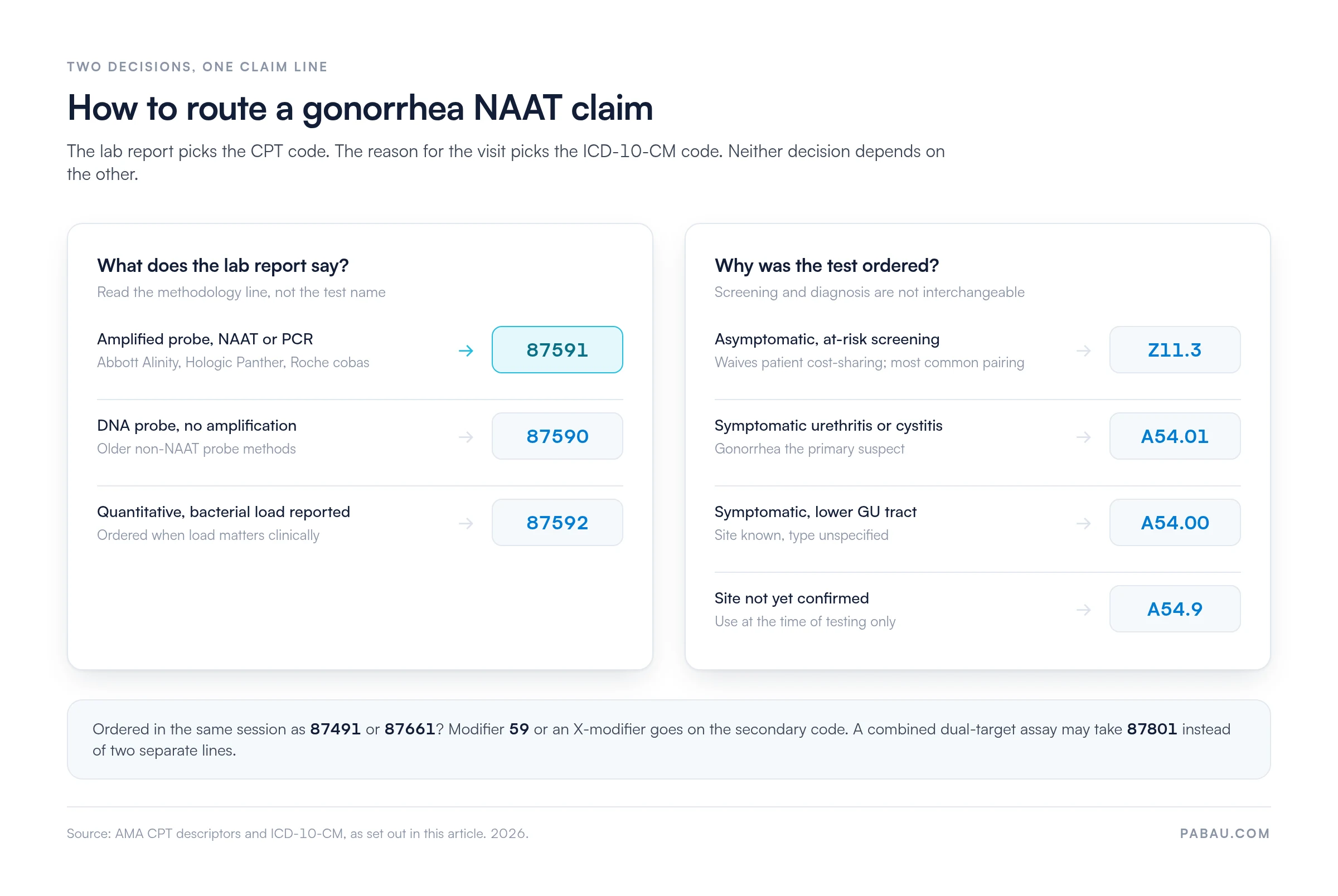
Gonorrhea NAAT claims fail in a predictable set of ways. Catching them before submission costs far less than working them after the remittance arrives. Most 87591 denials fall into one of five categories.
CO-4 and CO-97 are the two CARC codes 87591 denials return most often. CO-4 means the procedure code is inconsistent with the modifier, and CO-97 means payment was included in another service’s allowance. Review the claim for unbundling whenever a CO-97 lands.
Most of those appeals succeed once the corrected claim carries modifier 59 and a diagnosis that supports a distinct service. Name the separate specimen site, or the separate clinical rationale, in the appeal notes.
Before submitting any STI panel claim, run a claim scrub that checks the 87491 and 87591 pair for NCCI edits. Modifier 59 goes on 87591, the secondary code in the pair, when both appear on the same claim. The date of service has to match as well. Review payer-specific LCD policies at least quarterly, since BCBS policies on STI panel bundling changed in 2025.
Most sexual health and primary care teams assemble an STI panel claim in pieces. The lab result sits in one system, the chart note in another, and a coder rebuilds the panel by hand from both. Every handoff is a chance to lose the specimen source or the modifier.
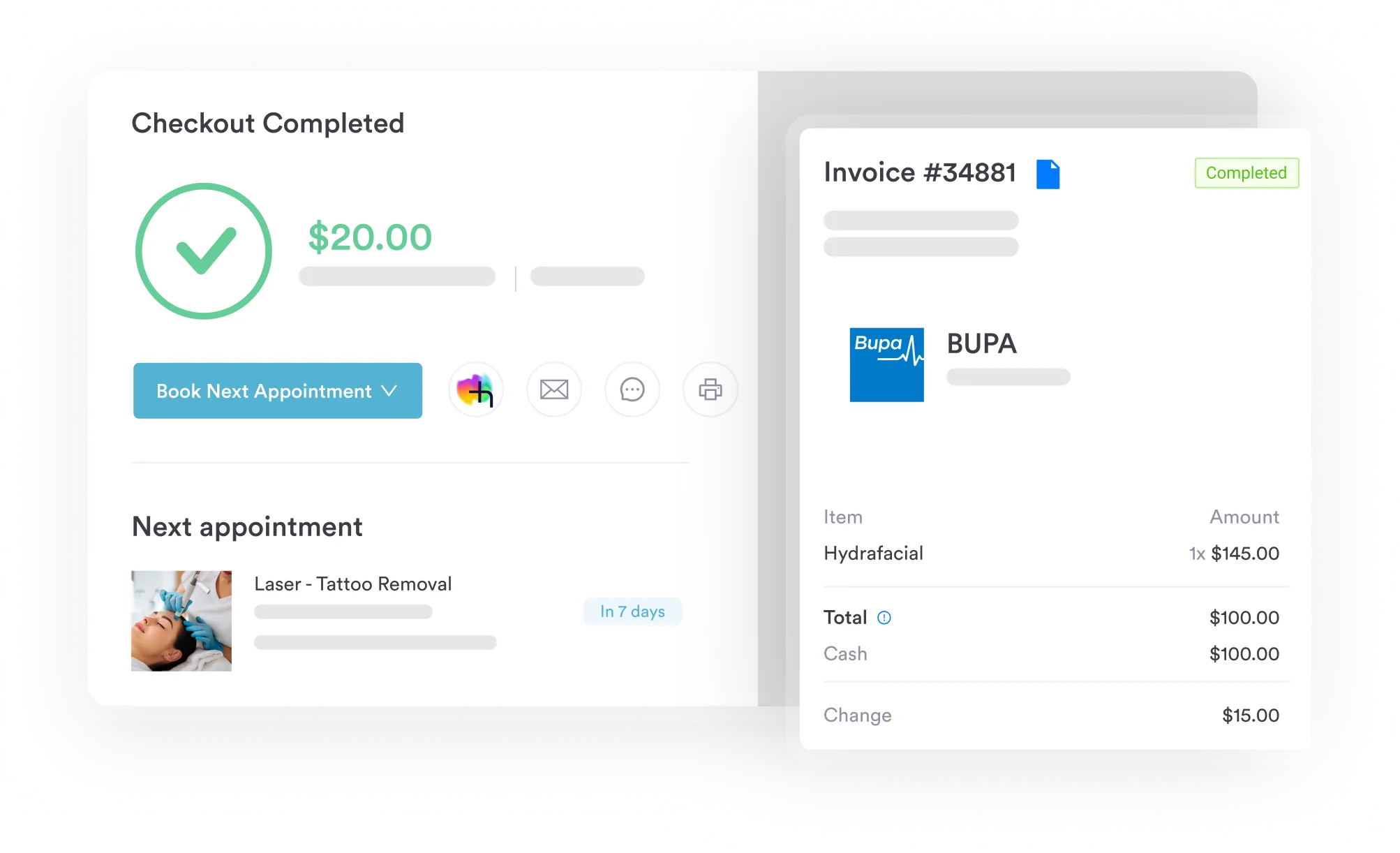
Practice management software like Pabau keeps the order, the note, and the claim in one patient record. Its claims management software builds each panel line from the documentation that supports it, then submits electronically through the Claim.MD clearinghouse.
Your coder sees the panel as the clinician ordered it. A missing modifier or an absent specimen source surfaces before submission, rather than on a remittance three weeks later.

Pabau connects documentation, CPT code selection, and claim submission in one workflow. Sexual health and primary care teams use it to cut denial rates on STI panel claims.

Two documents decide an 87591 claim: the lab report and the chart note. Confirm the assay is amplified before you assign the code, then let the encounter type choose between Z11.3 and an A54 diagnosis. Add modifier 59 when the panel carries 87491 or 87661, and hold the annual frequency limit.
One national CLFS rate means the payment side of gonorrhea NAAT billing is predictable, so what a practice loses here is process, not price. Fix the step where the panel gets assembled and the denials go with it. Book a demo to see how Pabau builds STI panel claims from the documentation behind them.

Need to understand the full STI panel claims workflow? What is medical billing walks through the end-to-end revenue cycle process for clinical practices.
Dealing with claim denials on STI codes? Submitting a clean claim covers the pre-submission checklist that prevents the most common denial triggers.
Want to understand how clearinghouse submission works? Claim.MD clearinghouse overview explains how electronic claims reach payers and return ERAs.
CPT Code 87591 is the billing code for qualitative detection of Neisseria gonorrhoeae (gonorrhea) using a nucleic acid amplification test (NAAT). The test must use an amplified probe technique. The code falls under the Pathology and Laboratory section of the CPT code set, within the Infectious Agent Detection by Nucleic Acid subsection. It reports a positive or negative result only, not a bacterial load measurement.
Medicare pays CPT 87591 under the Clinical Laboratory Fee Schedule at a single national rate of $35.09 in 2026. There is no facility versus non-facility split, no limiting charge, and no MAC or locality adjustment. The amount is the same with or without modifier QW. Check the CMS clinical laboratory fee schedule files each January, since the rate updates annually.
Z11.3 is the code for a screening encounter and the usual pairing on preventive claims. For a symptomatic patient, use A54.00 for the lower genitourinary tract, A54.01 for gonococcal cystitis or urethritis, and A54.9 when the site is unconfirmed. Z11.3 is the primary code for Medicare preventive STI screening.
Yes, CPT 87591 and CPT 87491 (chlamydia NAAT) are routinely co-billed in STI panels. NCCI bundling edits often apply, so modifier 59 or an appropriate X-modifier is typically required on the secondary code. Verify current NCCI edits for your MAC, since BCBS and other commercial payers updated STI panel bundling policies in 2025. Do not bill both separately if your lab performed a combined dual-target assay. That scenario may require CPT 87801 instead.
Yes. Medicare covers gonorrhea NAAT testing (CPT 87591) as a preventive STI screening benefit for at-risk beneficiaries. That includes patients with a history of STIs or multiple sexual partners, plus sexually active females 24 years and younger. Coverage is limited to once per year. When billed with ICD-10 code Z11.3, cost-sharing is waived under ACA Section 2713 preventive services rules.
A nucleic acid amplification test (NAAT) amplifies DNA or RNA sequences from a target organism to detect its presence. For gonorrhea, NAAT is the current gold-standard method and is far more sensitive than culture or non-amplified probe methods. CPT 87591 describes the amplified NAAT technique for Neisseria gonorrhoeae. Non-amplified probe tests use CPT 87590, and quantitative NAAT uses CPT 87592.
The most common STI panel CPT codes billed together are 87491 (chlamydia NAAT), 87591 (gonorrhea NAAT), and 87661 (trichomonas NAAT). Some panels also include 87389 (HIV-1 antigen/antibody). When multiple codes are billed in the same encounter, verify NCCI edits and apply modifier 59 as needed. If a combined multi-analyte assay is used, review whether CPT 87801 applies instead of individual codes.