CPT Code 62284: Injection procedure for myelography
CPT Code 62284: official descriptor and procedure overview The American Medical ...

Last Updated: Oct 19, 2026
CPT code 84144 bills a quantitative progesterone level, the blood test that confirms ovulation, tracks IVF cycles and checks early pregnancy support. It's a single-analyte chemistry code, paid under Medicare's Clinical Laboratory Fee Schedule at a national rate of $20.86 for 2026.
The code itself rarely causes trouble. The claim around it does. Most 84144 denials trace to a diagnosis that doesn't match the order, a missing fertility prior authorization, or a test billed twice. Get those wrong and a $20 test turns into rework and write-offs. Below, you'll find the ICD-10 pairings that hold up, who bills when a reference lab runs the assay, and a pre-submission checklist.
Let Pabau's smart automation suggest the right codes, reduce claim denials, and keep your practice compliant—effortlessly.
Automate repetitive tasks and focus on what matters most—your patients.
Reduce coding errors and ensure compliance with the latest regulations.
Clean claims, fewer denials, and faster reimbursements.
Powerful insights and reporting to help your practice thrive.
HIPAA compliant SOC 2 certified GDPR-compliant Trusted by 4,000+ clinics worldwide

CPT code 84144 covers a quantitative serum or plasma progesterone test, not 17-hydroxyprogesterone or tissue receptor assays.
Medicare pays 84144 at one national CLFS rate of $20.86 in 2026, with no locality adjustment.
A diagnosis code that doesn’t match the documented reason for the test is the most common denial trigger.
When a reference lab runs the test for a Medicare patient, the lab bills 84144 and the practice bills only the draw.
Fertility indications often need prior authorization, and Medicare may deny ART monitoring labs as non-covered.
CPT code 84144 is the AMA-maintained code for a quantitative progesterone assay on serum or plasma. It sits in the Chemistry subsection (82009-84999) of the Pathology and Laboratory section (80047-89398). Because it’s a lab code, Medicare pays it under the Clinical Laboratory Fee Schedule (CLFS) rather than the Physician Fee Schedule.
The official descriptor is a single word: Progesterone. The code doesn’t name a method, so chemiluminescent and electrochemiluminescent immunoassays bill the same way.
The quick-reference table below holds the details you’ll reach for at claim time.
A one-word descriptor makes wrong-code errors easy. So before 84144 goes on the claim, rule out its neighbors.
The 84144 and 84702 pair trips up fertility billing teams most often. Both are reproductive hormone tests, and they’re often drawn at the same visit. When both are ordered, each bills on its own line after an NCCI edit check for that date.
A progesterone claim gets paid when the chart shows why the test was needed. So the ordering provider’s note should name one of these indications before the claim leaves:
Payers draw the prior authorization line in different places, though. Private plans often want pre-authorization for ART and infertility workups. Routine cycle monitoring usually clears without it, as long as the ICD-10 code matches a covered indication.
A diagnosis the payer won’t accept for this test is the most common 84144 denial trigger. The code should reflect the reason for the test, not the patient’s broader history. Pick the most specific code the note supports.
Check the applicable ICD-10-CM codes against your MAC’s local coverage determinations (LCDs) and billing articles before you bill. That matters most for the N97 and Z31 families, where coverage for progesterone testing varies. And if your EHR pre-fills a diagnosis on lab orders, confirm it matches the reason in the visit note.
Medicare pays $20.86 for 84144 in 2026, according to the CMS Clinical Laboratory Fee Schedule (CLFS). Since 2018, the Protecting Access to Medicare Act (PAMA) has set one national rate per lab code, based on private-payer data. That means there’s no locality or MAC adjustment to apply.
Medicare patients also owe no deductible or coinsurance on clinical lab tests, so don’t collect a copay for 84144. Commercial plans pay whatever your contract says, so check the contract rather than assume the Medicare figure.
Pull CLFS rates straight from the CMS annual files, not third-party rate sites. CMS posts preliminary rates each September and final rates each November. Update your internal fee schedule before the new year’s claims go out.
Medicare covers 84144 when the note documents a covered indication and the claim carries a matching ICD-10 code.
Your MAC’s policies decide which indications qualify. Fertility work carries the most risk. Because ART itself is typically excluded, many MACs treat ART monitoring labs as non-covered too.
Build these checks into lab ordering, so coverage problems surface before the draw instead of after the denial.
Most 84144 claims follow the same five steps. The decision that changes the claim most is who performs the test, so settle that first.
The flow below shows where each step tends to break.
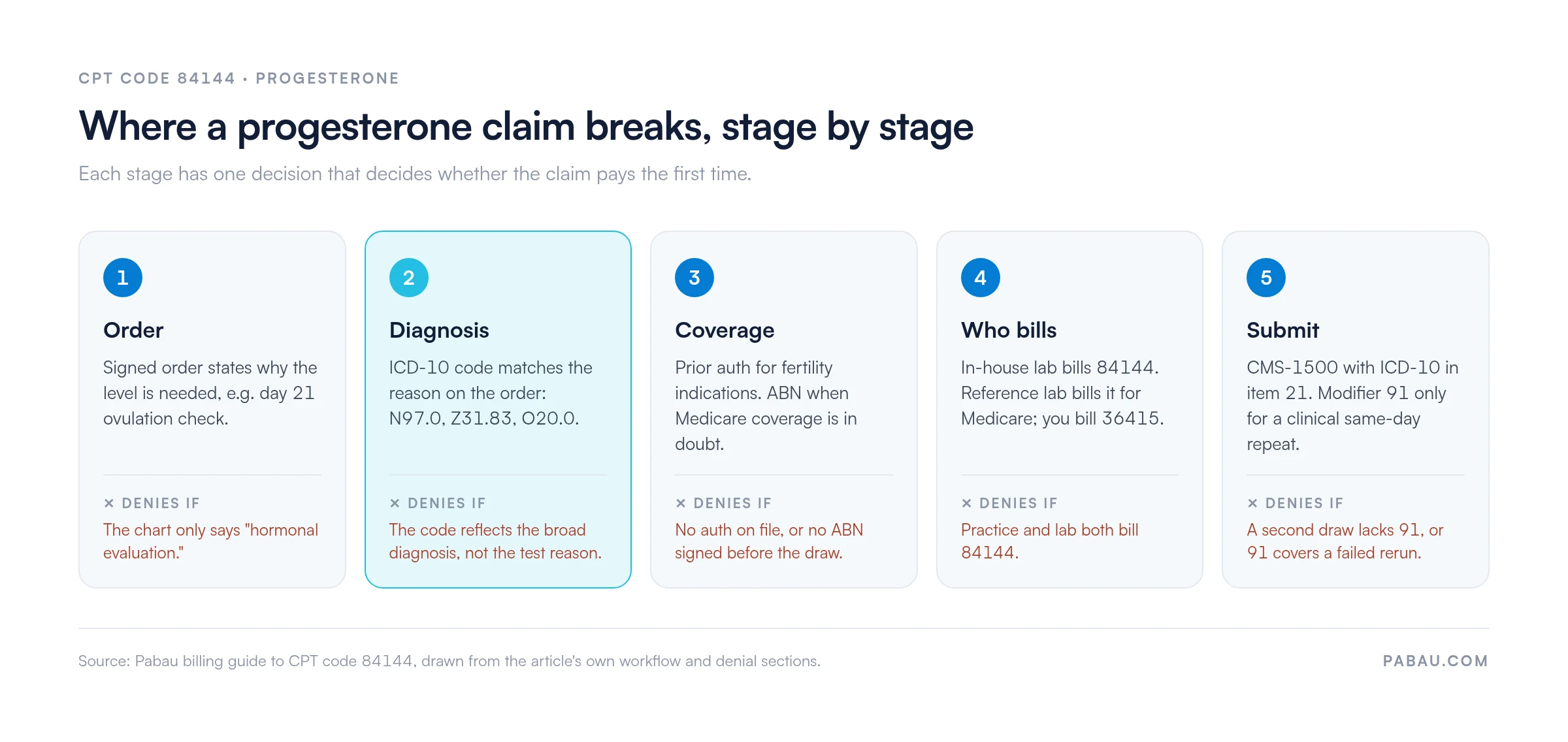
Reference lab billing is where practices take the most compliance risk. If the lab already billed 84144, your claim for the same test is a duplicate. So write a simple rule down. When a reference lab runs the assay, the practice bills the draw and stops there.
Denials on 84144 are predictable, and the same few reasons repeat across billing cycles. Denial-tracking claims software shows which ones are systemic and which are one-offs.
Start each fix by sorting denials by claim adjustment reason code (CARC). Decoding denial codes quickly shows which problems start at the front desk, like a missing auth. It also flags the ones that start in the back office. Most 84144 denials start at the front end, which makes them preventable.
The chart has to make the medical necessity case without the claim form. An auditor should find the reason for the test without reading between the lines. Four elements do that work.
Linking each lab order to its encounter note in the EHR keeps that record together. Practices running labs off paper requisitions, with no rationale on file, carry more audit exposure.
Build a progesterone order template in your EHR that makes the provider pick an indication before the requisition prints. The indication then pre-fills the matching ICD-10 code. That cuts mismatch denials at the source without adding charting time.
Most of the denials above can be caught in the minute before submission. Run each claim through these checks:
Reproductive endocrinology practices rarely order 84144 alone. Progesterone usually sits inside a hormone workup, with each analyte billed on the same date. Knowing which codes pair, and which edits apply, prevents both undercoding and accidental unbundling.
A standard fertility workup includes the codes below. According to the AAPC’s CPT code set reference, each code here describes a single analyte and bills per analyte when performed.
Check NCCI edits before billing any combination on one date. Most fertility hormone codes in the 82000-84999 range have no edits against each other, so each bills when independently indicated.
Some payers add their own bundling rules on top, so confirm by payer. When lab codes run alongside IVF CPT codes, keep each component on its own line to avoid bundling flags.
Nearly every fix in this guide happens before a claim exists. The reason for the test, the diagnosis and the performing lab all have to be on record at order time.
Pabau keeps those details on the patient record, and the claim form pre-fills from it. The CPT code attached to the service lands on the charge line. ICD-10 slots are seeded from the patient’s recorded problem list, with full CPT and ICD-10-CM libraries to search.
Before a claim can go, Pabau checks that required fields, like membership numbers and authorization codes, are complete. US claims then go out through Claim.MD, with eligibility checks, claim-status tracking and remittance posting. So your team stops retyping codes from the chart and chasing payers by phone.

Pabau pre-fills lab claims from the patient record, checks required fields before submission and sends US claims through Claim.MD. You spend less time reworking 84144 denials.

At $20.86, a progesterone test rarely justifies an appeal. So 84144 is a code you want paid on the first pass, and that effort belongs at the order.
Start with fertility work. It holds the prior auth rules, the Medicare exclusions and the same-day repeats, so one clear protocol there covers your riskiest claims. Then agree, in writing, who bills when a reference lab runs the assay.
Settle those two decisions and 84144 becomes one of the quieter lines on your remittance. Book a demo to see how Pabau carries order details straight onto a clean progesterone claim.

Billing hCG on the same draw? CPT code 84702 covers the quantitative hCG test that so often pairs with progesterone.
Billing only the draw for a reference lab? CPT code 36415 explains venipuncture billing when an outside lab runs the test.
Need to verify IVF-related CPT codes alongside 84144? IVF CPT codes covers the full ART procedure billing set for fertility practices.
Managing denials across your lab billing? Denial codes in medical billing explains CARC and RARC codes and how to resolve claim denials systematically.
Looking for a clearinghouse integration for lab claims? Medical claims clearinghouse guide explains how clearinghouses process lab claims and what to look for in an integration.
No. Progesterone testing has no national coverage determination (NCD), so your MAC decides medical necessity through its local policies. That differs from hCG testing, which has its own lab NCD, 190.27.
Yes. Serum progesterone is a moderate-complexity test, so a CLIA certificate of waiver isn’t enough. You’ll need a certificate that covers moderate-complexity testing, such as compliance or accreditation. The QW modifier doesn’t apply, because 84144 isn’t a waived test.
Not to Medicare. It treats 99000 as bundled, so sending a specimen to an outside lab earns no separate payment. Some commercial plans still pay 99000, so check the contract before adding it.
Medicare requires claims within 12 months of the date of service. Commercial plans set their own limits, which can be shorter, so track each payer’s filing window.
No. None of the organ or disease panel codes (80047-80081) includes progesterone. A fertility or hormone workup bills each analyte separately, so progesterone always goes on its own 84144 line.