

CPT Code 98981: RTM Treatment Management Billing Guide
CPT code 98981: Definition and official descriptor CPT code 98981 is an add-on c...

Last Updated: Nov 9, 2026
84112 is the CPT code for evaluating cervicovaginal fluid for specific amniotic fluid proteins, such as PAMG-1, qualitative, each specimen. It is used to confirm ruptured membranes.
OB-GYN and maternal-fetal medicine practices most often report it for a PAMG-1 test such as the AmniSure ROM Test. A clean claim pairs it with an O42 diagnosis code and the place of service where the test ran. Some commercial plans also require prior authorization.
Let Pabau's smart automation suggest the right codes, reduce claim denials, and keep your practice compliant—effortlessly.
Automate repetitive tasks and focus on what matters most—your patients.
Reduce coding errors and ensure compliance with the latest regulations.
Clean claims, fewer denials, and faster reimbursements.
Powerful insights and reporting to help your practice thrive.
HIPAA compliant SOC 2 certified GDPR-compliant Trusted by 4,000+ clinics worldwide

CPT code 84112 covers amniotic fluid protein tests such as PAMG-1 on cervicovaginal fluid, a distinct analyte from the phosphatidylglycerol test billed under CPT 84081.
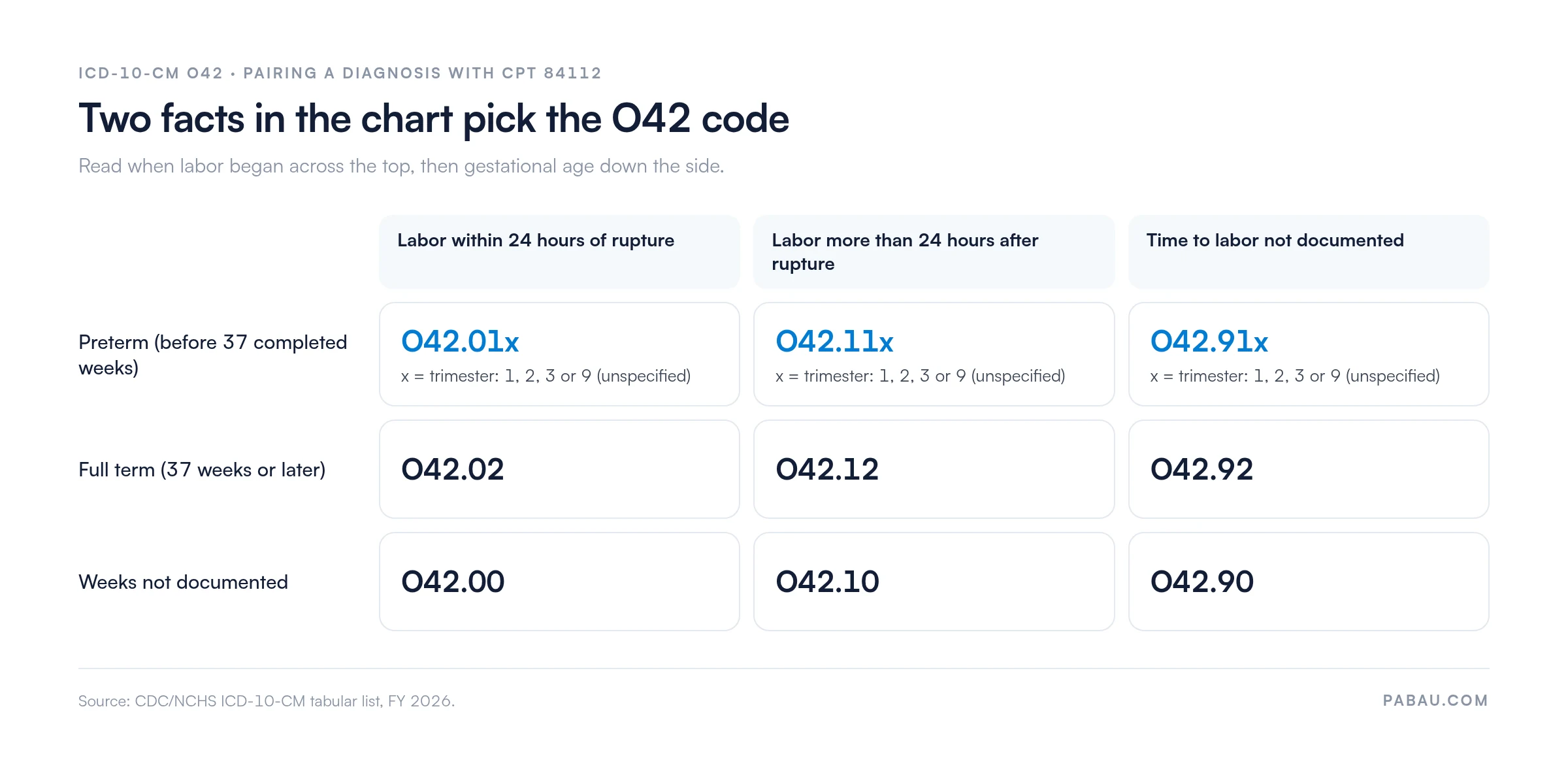
ICD-10-CM category O42 (premature rupture of membranes) is the primary supporting diagnosis, and the sub-code depends on gestational age and when labor began.
The performing lab or facility bills 84112 on one claim line with no professional or technical split. A physician bills it only from a CLIA-certified office lab.
Pabau, the practice management platform we build, submits CMS-1500/837P claims through Claim.MD and runs eligibility checks. It also warns when a case lacks its prior authorization code.
CPT code 84112 reports a qualitative test of cervicovaginal fluid for specific amniotic fluid proteins, billed once per specimen.
Practices use it to confirm or rule out ruptured membranes in a pregnant patient with suspected fluid leakage.
One of those proteins is placental alpha-microglobulin-1 (PAMG-1), found at high concentrations in amniotic fluid and at trace levels in vaginal secretions. When the membranes rupture, PAMG-1 leaks into the vagina in amounts a rapid immunoassay can detect within minutes. A positive result supports a diagnosis of premature rupture of membranes (PROM) or preterm premature rupture of membranes (PPROM).
The code covers qualitative testing for specific amniotic fluid proteins, for example PAMG-1, PP12 or AFP. The AmniSure ROM Test, a lateral flow immunoassay, reports PAMG-1.
CPT 84112 is medically necessary when a pregnant patient has symptoms that suggest membrane rupture. The physical exam alone must be unable to confirm it. Payers expect the medical record to document the specific clinical trigger for ordering the test.
Qualifying clinical presentations that support medical necessity include:
Ordering the test for routine prenatal screening without documented symptoms is not medically necessary and will typically result in a CO-50 denial. The chart must show the clinical reason for the order, and a standing order alone does not meet that bar.
CPT 84112 and CPT 84081 both relate to amniotic fluid, but they measure different analytes for different clinical questions. They cannot be used interchangeably.
Billing both on the same date of service for the same clinical encounter is rarely appropriate, because each answers a separate question. If a payer’s NCCI edits bundle them, bill only the code that answers the clinical question. Check current National Correct Coding Initiative (NCCI) edits on the CMS NCCI edits page, as edits change quarterly.
The wrong diagnosis code is the fastest route to a CO-11 denial on a CPT 84112 claim. ICD-10-CM category O42 (premature rupture of membranes) is the primary pairing, with sub-code selection driven by gestational age and the timing of labor onset.
Confirm valid codes against the CDC/NCHS ICD-10-CM web tool for the current fiscal year. ICD-10-CM codes are updated every October, and a deleted code triggers an automatic rejection. Avoid pairing CPT 84112 with routine prenatal encounter codes (Z34.x) unless the visit notes document a clinical indication for the test.
Two facts in the chart decide the O42 code. The first is how long after rupture labor began, and the second is the gestational age. Preterm codes then add a sixth character for the trimester, as the matrix below shows.
CPT 84112 is paid under the Medicare Clinical Laboratory Fee Schedule (CLFS) rather than the Physician Fee Schedule, because it is a clinical laboratory test. CMS sets CLFS rates separately from RVU-based physician payments and updates them every year.
Always verify the current-year rate on the CMS Clinical Laboratory Fee Schedule page before quoting a rate to a patient or in a contract negotiation. Rates published in third-party guides can lag by one or two years.
Key reimbursement considerations for OB and MFM practices billing CPT code 84112:
The place of service (POS) code tells the payer where the test ran, and that setting decides who bills CPT 84112. A POS that doesn’t match the location can cause a payment adjustment or a denial.
CPT 84112 is a clinical lab test on the CLFS, with no professional and technical component split under Medicare. The performing lab or facility bills it, so modifier 26 does not apply. A physician bills 84112 only when the practice runs the test in its own CLIA-certified office lab, as a global service.
Check the device’s test complexity in the FDA CLIA database before billing. A waived test billed under a certificate of waiver usually needs modifier QW on Medicare claims. A moderate-complexity test needs a certificate of compliance or accreditation instead.
Audit your POS codes quarterly against each location type. A wrong POS on a CPT 84112 claim can cause a payment adjustment or a denial.
Medicare generally does not require prior authorization for clinical laboratory codes, including CPT 84112. The test is ordered in an acute clinical situation where pre-authorization is not operationally feasible.
Commercial payers and Medicaid managed care organizations set their own rules. Many require authorization, particularly for non-emergent uses, and requirements change with plan year updates. Run insurance eligibility verification before the encounter to confirm coverage, then check the payer’s PA policy for the test.
Payer categories most likely to require PA for CPT 84112:
When PA is required, include the clinical indication (symptom onset, gestational age, exam findings) and the ordering provider’s credentials. Add prior test results if available, and name the assay used, such as AmniSure or another amniotic fluid protein test.
CPT 84112 claims fail for a predictable set of reasons. The table below maps the most common denial codes to their root causes and corrective actions. Understanding these patterns converts one-off appeals into systemic fixes.
Systematic denial management workflows reduce the rework load for OB practices. Tracking denials by code and root cause shows whether an error is systemic, such as a wrong default POS. It can also trace a denial to one chart note without exam findings. Review common billing denial codes to understand the full CARC taxonomy your team will meet when appealing CPT 84112 claims.
A clean claim for CPT 84112 starts with the chart note. It should make medical necessity obvious to a payer reviewer who has never seen the patient. The goal is a note that answers three questions: Why was the test ordered? What was the result? Who ordered it and where?
Documentation checklist for clean claim submission:
Medical necessity appeals usually fail when the chart lacks specific findings. If the chart says only “PROM suspected, AmniSure ordered,” a reviewer cannot tie the test to a clinical finding. Detailed symptom notes support the clinical decision and get claims paid on audit.
OB-GYN and MFM practices billing CPT 84112 juggle several details on every claim. The O42 sub-code, the POS and the PA status all have to be right before the claim goes out. One wrong detail means a denial, an appeal cycle and slower cash flow.
Pabau, the practice management platform we build, keeps that work next to the patient record. Its claims management software covers these steps for US practices:
For a lab code like 84112, that means fewer handoffs between the clinical note and the submitted claim. Our Claim.MD clearinghouse guide explains how those claims reach payers, and medical billing fundamentals covers the steps around them.

Pabau submits CMS-1500/837P claims through Claim.MD, runs eligibility checks and tracks prior authorization codes on each case. Your team spends less time chasing lab claims.

CPT code 84112 pays cleanly when three details agree. The O42 code matches gestational age and labor onset, the POS matches where the test ran, and the chart shows why the test was ordered.
Start with the setting, because it decides who bills. If a hospital or independent lab runs the test, 84112 stays off the physician’s claim. If your own office lab runs it, bill it globally and confirm the device’s CLIA status first.
Pabau keeps the claim, the eligibility check and the prior authorization code together. When a lab claim comes back, your team has one place to look. Book a demo to see how OB-GYN and MFM practices submit lab claims through Claim.MD with Pabau.

Need a refresher on how clearinghouses handle lab claims? Our Claim.MD clearinghouse guide explains how 837P files are routed and how ERAs return to your practice.
Seeing repeat denials across multiple CPT codes? Medical billing compliance best practices covers audit-readiness and documentation standards that reduce payer scrutiny.
Want to understand the full revenue cycle behind lab claims? What is revenue cycle management walks through every stage from order to payment posting.
CPT code 84112 covers a qualitative test of cervicovaginal fluid for specific amniotic fluid proteins, such as PAMG-1, PP12 or AFP, billed per specimen. Use it when a pregnant patient has symptoms of membrane rupture and the physical exam alone is inconclusive.
The Medicare Clinical Laboratory Fee Schedule (CLFS) sets the rate for CPT 84112 each year. Because CLFS rates change annually, check the current amount in the CMS Clinical Laboratory Fee Schedule files at cms.gov. Published guides may still show a prior year’s rate.
The O42 category (premature rupture of membranes) is the standard pairing, with the sub-code chosen by gestational age and the time from rupture to labor. For example, O42.013 covers preterm rupture in the third trimester with labor within 24 hours. Avoid routine prenatal Z34.x codes without a documented clinical indication, as these trigger CO-11 denials.
Yes, the AmniSure ROM Test (a PAMG-1 lateral flow immunoassay) is widely reported in coding literature as billed under CPT 84112. Confirm against your payer’s current local coverage determination (LCD) before billing, as some payers may specify acceptable device types in their coverage policy.
Medicare generally does not require prior authorization for lab codes including CPT 84112. Many commercial payers and Medicaid managed care organizations do require PA, particularly for non-emergent uses. Check the specific payer’s current policy before ordering, as requirements vary by plan and are updated annually.
No. CPT 84112 is a clinical lab test on the CLFS, so it has no professional or technical component split. The performing lab or office bills it on one claim line. A physician bills it only when the practice runs the test in its own CLIA-certified office lab.




