CPT Code 62284: Injection procedure for myelography
CPT Code 62284: official descriptor and procedure overview The American Medical ...

Last Updated: Oct 19, 2026

CPT code 81001 covers automated urinalysis with microscopy. It requires an automated analyzer and a documented microscopic examination of the urine sediment.
81001 is not interchangeable with 81002 (non-automated, no microscopy) or 81003 (automated, no microscopy). Billing 81001 without performed and reported microscopy is upcoding.
CPT 81001 is not CLIA-waived, so the QW modifier does not apply. Medicare pays a single national rate of about $3.20 under the Clinical Laboratory Fee Schedule.
Pabau’s claims management software links clinical documentation to billing, so practices can flag a missing ICD-10 code before the 81001 claim reaches the clearinghouse.
CPT code 81001 describes a urinalysis performed by dip stick or tablet reagent, automated, with microscopy. The full descriptor in the American Medical Association’s CPT code set names ten analytes. They are bilirubin, glucose, hemoglobin, ketones, leukocytes, nitrite, pH, protein, specific gravity, and urobilinogen.
Two requirements must both be met for 81001 to apply. The dipstick panel has to run on an automated analyzer rather than a manual read. A microscopic examination of the urine sediment also has to be performed and reported. If either element is missing, a different code applies.
The three most commonly confused urinalysis codes differ on exactly two axes. The first is whether the dipstick reading is automated. The second is whether microscopy is included. That pair of answers is what separates a clean urinalysis claim from an upcoded one.
Key rule: if your lab runs an automated analyzer but does not perform or report microscopy, bill CPT 81003. Billing 81001 without documented microscopy findings is upcoding, whatever the intent behind it. The matrix below turns that rule into two questions you can answer straight off the finished lab report.
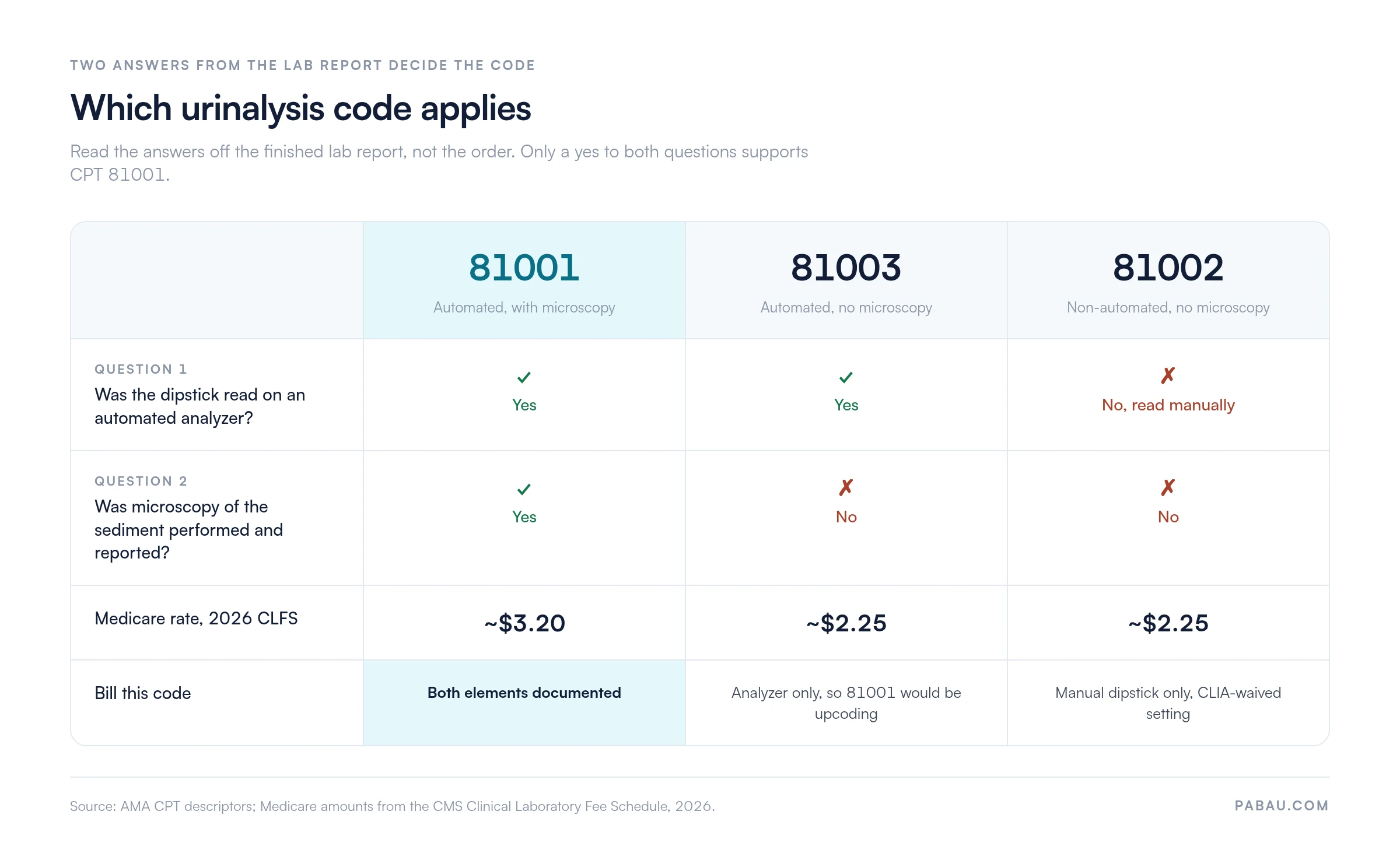
CPT code 81001 applies when a provider orders a complete automated urinalysis that includes microscopic examination of the urine sediment. The following clinical scenarios commonly justify this service:
Medical necessity must be documented for each encounter. A standing order for “routine UA” is not sufficient on its own. The clinical indication has to appear in the record.
Linking CPT code 81001 to the correct ICD-10-CM diagnosis code is what gets the claim accepted. The diagnosis has to support medical necessity for a complete automated urinalysis with microscopy, not for any urinalysis. Payer Local Coverage Determinations (LCDs) usually define which diagnoses qualify.
CMS ICD-10 coding guidance requires each diagnosis code to reflect the clinical condition documented in the patient record. Every code in the table below has its own entry in our ICD-10-CM code library, with the documentation each one expects.
No ICD-10 code guarantees coverage. Coverage depends on payer LCD policies, and on whether the clinical documentation supports the diagnosis listed on the claim.
Medicare pays CPT code 81001 at a single national amount of roughly $3.20 for 2026. Laboratory tests are priced on the Clinical Laboratory Fee Schedule (CLFS), not the Physician Fee Schedule. A CLFS amount is not adjusted by Geographic Practice Cost Index (GPCI) locality, and it does not split into facility and non-facility values.
Check the current figure in the CMS CLFS files rather than a third-party listing. Practice management software like Pabau routes CPT 81001 claims through the Claim.MD clearinghouse to thousands of US payers. Its CPT catalogue validates the code before transmission.
Medicare Administrative Contractors (MACs) govern coverage for their jurisdictions. Noridian Healthcare Solutions (JF Part A) covers CPT 81001 when medical necessity is documented and an appropriate ICD-10 diagnosis code supports the claim. Consult your MAC’s LCD for frequency limitations. Some payers restrict urinalysis billing to defined visit frequencies or clinical indications.
Check the current CPT 81001 payment amount in the CMS Clinical Laboratory Fee Schedule files before you update your billing system’s annual fees. CMS republishes the CLFS each year and issues quarterly updates in between. A cached figure from a third-party site can leave you underbilling for months.
Accurate CPT code 81001 billing depends on a short list of requirements being met before the claim goes out. Confirm each element at the point of care, because reconstructing it after a denial rarely satisfies an auditor. The same discipline underpins medical billing compliance across every lab code your practice reports.
The medical record must contain four elements to withstand a payer audit on CPT code 81001 claims. All four are captured at the point of care, not assembled afterwards.
Few modifiers apply to CPT 81001, and the one coders reach for most often is the one that triggers a denial. The table below shows which modifiers a payer will accept on this code.
Urinalysis billing generates a predictable set of errors, and most are preventable at the point of documentation rather than at claim submission. These are the patterns that trigger automatic edits and audits.
Reviewing your denial reports weekly is the fastest way to see the pattern. When a run of 81001 claims shares one denial reason code, the cause is almost always one of the errors above.
A positive urinalysis frequently triggers a reflexive urine culture, whether the trigger is leukocyte esterase, nitrites, or significant pyuria on microscopy. CPT 87086 (culture, bacterial, urine, colony count) is the code for a urine culture that is separately ordered and performed. Both codes can be billed on the same date of service, and each needs its own medical necessity documentation.
Practices that handle high volumes of UTI workups benefit from building the 81001 and 87086 reflex sequence directly into their lab order set. Recording which result triggered the reflex culture is what prevents a medical necessity dispute on the 87086 claim.
Most CPT 81001 billing errors start upstream of the billing department, in the documentation workflow. A clinician marks a urinalysis as performed without recording whether microscopy was run. The biller then codes 81001 by default, and the claim goes out unsupported.
Pabau’s claims management software connects the clinical record to the billing workflow. When a lab result is documented, the system prompts for the ICD-10 code that supports the order. It also flags incomplete documentation before the claim is finalized, so nobody has to chase the analyzer or microscopy detail after a denial.
For CPT 81001 specifically, the workflow records whether microscopy was performed rather than only ordered. The lab report attaches to the patient record, and both sit in front of the biller before submission. The same documentation chain carries across the other lab codes your practice reports.

Pabau connects clinical documentation to billing in one platform. Flag a missing ICD-10 code before submission, route claims through Claim.MD, and keep your 81001 billing clean.

The most common CPT 81001 problem is a documentation problem. Microscopy gets performed but never reported in a form that survives a payer audit. Fix the documentation workflow and the coding follows it.
At roughly $3.20 a claim, no single 81001 denial is worth the time it takes to appeal. Volume is what makes the workflow worth fixing. A practice running urinalysis on most visits writes off the same small amount hundreds of times a year.
Pabau captures the order, the analyzer confirmation, the microscopy findings, and the ICD-10 linkage. It then routes the finished claim through Claim.MD to thousands of US payers. Book a demo to see how urinalysis documentation reaches the claim before it leaves your practice.

Need a framework for reducing lab billing denials? Claim.MD clearinghouse overview explains how US clearinghouse validation catches CPT errors before they reach the payer.
Managing multiple CPT code families? Coaching CPT codes reference guide shows the same billing structure applied to a different CPT family.
Want to understand the 837P transaction behind every lab claim? 837 file format guide covers how CPT codes like 81001 travel from your practice management system to the payer.
CPT code 81001 is a laboratory billing code for automated urinalysis with microscopy. It covers a dipstick or tablet reagent panel run on an automated analyzer, plus a microscopic examination of the urine sediment. The panel reports ten analytes: bilirubin, glucose, hemoglobin, ketones, leukocytes, nitrite, pH, protein, specific gravity, and urobilinogen. Both automated processing and documented microscopy must be performed for 81001 to apply.
CPT 81001 requires automated processing and includes microscopic examination. CPT 81002 is a manually read dipstick with no microscopy. 81002 is CLIA-waived and suits small physician offices or urgent care settings with simple dipstick readers. 81001 needs an automated analyzer and a lab that can perform microscopy. Billing 81001 when only the 81002 criteria are met is upcoding.
Medicare pays roughly $3.20 for CPT 81001 in 2026. The code is priced on the Clinical Laboratory Fee Schedule (CLFS), which sets one national payment amount. That amount is not adjusted by locality or GPCI, and there is no separate facility rate. Check the CMS CLFS files for the current figure, and expect commercial payer rates to sit above Medicare.
No. Billing CPT 81001 and CPT 81003 together on the same specimen is not appropriate. 81003 describes automated urinalysis without microscopy, while 81001 includes microscopy. They describe mutually exclusive services on one sample, so billing both signals either a duplicate charge or miscoding. If automated microscopy was performed, bill 81001 only.
Modifier QW (CLIA-waived) does not apply, because CPT 81001 is not CLIA-waived and requires an automated analyzer. Modifier 90 (reference laboratory) applies when an outside reference lab performs the service and the ordering provider bills it. Modifier 91 (repeat test) may apply when the test runs more than once on the same date for a distinct clinical reason. Payer acceptance of modifier 91 varies.
The most common ICD-10 codes paired with CPT 81001 are N39.0 (urinary tract infection), R31.0 (gross hematuria), and R31.1 (microscopic hematuria). Also common are R80.0 (proteinuria), E11.65 (type 2 diabetes with hyperglycemia), and Z34.00 (prenatal care). The diagnosis must reflect the clinical indication documented in the record. Always check your MAC’s Local Coverage Determination for the current approved diagnosis list.
Yes. CPT 81001 and CPT 87086 can be billed on the same date of service when both are ordered and performed separately. A reflex culture ordered on the basis of positive urinalysis findings has its own medical necessity. Each code needs its own supporting ICD-10 diagnosis code and documentation. NCCI edits do not bundle the two codes.
Yes. A signed physician order must be in the medical record before CPT 81001 is billed. Most payers accept standing orders, but they must be reviewed and renewed periodically per payer policy. The order has to be tied to a documented clinical indication. An undated or unsigned standing order is a common audit finding that can lead to retroactive payment recovery.