Pabau Engage inbox

Pabau Engage is here: every patient conversation in one inbox.

Learn more
CPT Code

CPT code 67113 – Complex retinal detachment repair with membrane peeling


Code Definition

67113 is the CPT code for repair of complex retinal detachment with vitrectomy and membrane peeling. Complex means proliferative vitreoretinopathy stage C-1 or greater, diabetic traction detachment, retinopathy of prematurity, or a retinal tear larger than 90 degrees.

The code includes tamponade, cryotherapy, endolaser, subretinal fluid drainage, scleral buckling and lens removal when performed. Membrane removal codes 67041-67043 and the non-complex repair code 67108 are not billed with it on the same eye. The operative note must document both the complexity factor and the peel.

Section
10004-69990 Surgery
Subsection
65091-68899 Eye and ocular adnexa
Code range
67101-67229 Retina or choroid
Billable
No
Code also known as
vitrectomy for complex retinal detachment, PPV for PVR, complex PPV, vitreoretinal surgery coding
Save time. Improve accuracy. Get paid faster.
Automate coding with Pabau

Let Pabau's smart automation suggest the right codes, reduce claim denials, and keep your practice compliant—effortlessly.

  • AI-powered code suggestions
  • Real-time compliance checks
  • Faster claims, fewer denials
Why practices choose Pabau
Save hours every week

Automate repetitive tasks and focus on what matters most—your patients.

Improve accuracy

Reduce coding errors and ensure compliance with the latest regulations.

Get paid faster

Clean claims, fewer denials, and faster reimbursements.

Grow with confidence

Powerful insights and reporting to help your practice thrive.

HIPAA compliant SOC 2 certified GDPR-compliant Trusted by 4,000+ clinics worldwide

Key takeaways

Key takeaways

CPT code 67113 covers complex retinal detachment repair with vitrectomy and membrane peeling, so the peel is part of the code.

Membrane removal codes 67041-67043, the wider 67036-67043 family and 67108 are not billed with 67113 on the same eye, even with modifier 59.

The operative note must name the complexity factor and document the membrane peel to support 67113 over 67108.

Every 67113 claim needs an RT or LT modifier, and a 90-day global period covers routine postoperative care.

Pabau, the practice software we build, sends 67113 claims through Claim.MD, runs eligibility checks and receives ERA remittances.

CPT code 67113: Official descriptor and procedure overview

CPT code 67113 is the code for repair of a complex retinal detachment with vitrectomy and membrane peeling.

The CGS Medicare fact sheet for 67113 quotes the full descriptor, which the American Medical Association maintains:

Repair of complex retinal detachment (eg, proliferative vitreoretinopathy, stage C-1 or greater, diabetic traction retinal detachment, retinopathy of prematurity, retinal tear of greater than 90 degrees), with vitrectomy and membrane peeling, including, when performed, air, gas, or silicone oil tamponade, cryotherapy, endolaser photocoagulation, drainage of subretinal fluid, scleral buckling, and/or removal of lens.

Two conditions define the code. The detachment must be complex, and the surgeon must peel a membrane during the vitrectomy. Because the peel is built into 67113, the membrane removal codes 67041-67043 are never added on top for the same eye.

Code elementDetail
Code number67113
Code typeCPT surgical procedure (Category I)
SectionSurgery — Eye and ocular adnexa — Retina or choroid (67101-67229)
Global period90 days (major surgery)
Laterality modifier requiredYes (RT or LT)
Membrane peel includedYes — membrane peeling is part of the code descriptor

Indications for CPT code 67113

67113 applies when the detachment carries one of the complexity factors named in the descriptor. The descriptor and the CGS fact sheet together point to these indications:

  • Proliferative vitreoretinopathy (PVR), stage C-1 or greater
  • Diabetic traction retinal detachment
  • Retinopathy of prematurity (ROP) with detachment
  • Retinal tear larger than 90 degrees
  • Detachment secondary to vitreous strands, proliferative retinopathy or vitreous retraction

A straightforward rhegmatogenous detachment repaired by vitrectomy does not qualify, even when the surgery runs long. That case belongs under 67108.

What CPT code 67113 covers and what it excludes

67113 is a surgical package. These items are part of the code when performed in the same session on the same eye, so none is billed separately.

Included in the 67113 package

  • Pars plana vitrectomy (the core surgical approach)
  • Membrane peeling
  • Air, gas or silicone oil tamponade
  • Cryotherapy
  • Endolaser photocoagulation
  • Drainage of subretinal fluid
  • Scleral buckling
  • Removal of the lens, so cataract and lens removal codes (66830-66984, 66986-66988) are not reported separately
  • Extended ophthalmoscopy (92201, 92202) performed during surgery or later on the same date

Not included — separately reportable

  • Silicone oil removal at a later session, reported with 67036 when removed with a vitrectomy, or 67121 when removed without one. Add modifier 58 when the removal is planned within the global period.
  • Scleral buckle removal at a later session, reported with 67120
  • An unrelated E/M visit during the global period, with modifier 24
  • A staged or related procedure during the global period, with modifier 58 or 78

Do not report 67041, 67042 or 67043 with 67113 for the same eye in the same session. NCCI edits bundle the 67036-67043 vitrectomy family into 67113, and modifier 59 is not a valid way to unbundle them. CMS updates the NCCI tables quarterly, so check the current edit pair before submitting.

67113 vs 67108: How to choose the right code

67108 is repair of a retinal detachment with vitrectomy when no complexity factor is present. 67113 is complex repair, and membrane peeling is part of it. The two are mutually exclusive on the same eye on the same date, so only one is reported.

67113 carries more work RVUs than 67108, which is why payers read the operative note closely before paying it. Billing 67113 without documented complexity is an audit risk. Billing 67108 for a documented complex repair with a peel leaves payment unclaimed.

Factor6710867113
Clinical pictureRetinal detachment without a complexity factorPVR stage C-1 or greater, diabetic traction, ROP or a tear larger than 90 degrees
Membrane peelNot part of the code descriptor; 67041-67043 are not separately billed with 67108 under current NCCI edits, so check the quarterly PTP tableIncluded in the code and must be documented
TamponadeAir or gas, when performedAir, gas or silicone oil, when performed
Lens removalIncluded when performedIncluded when performed
Documentation focusDetachment and repair techniqueNamed complexity factor plus the membrane peel
Work RVULowerHigher (reflects complexity and time)

The practical test is whether the operative note names both elements, and the decision path below runs in that order.
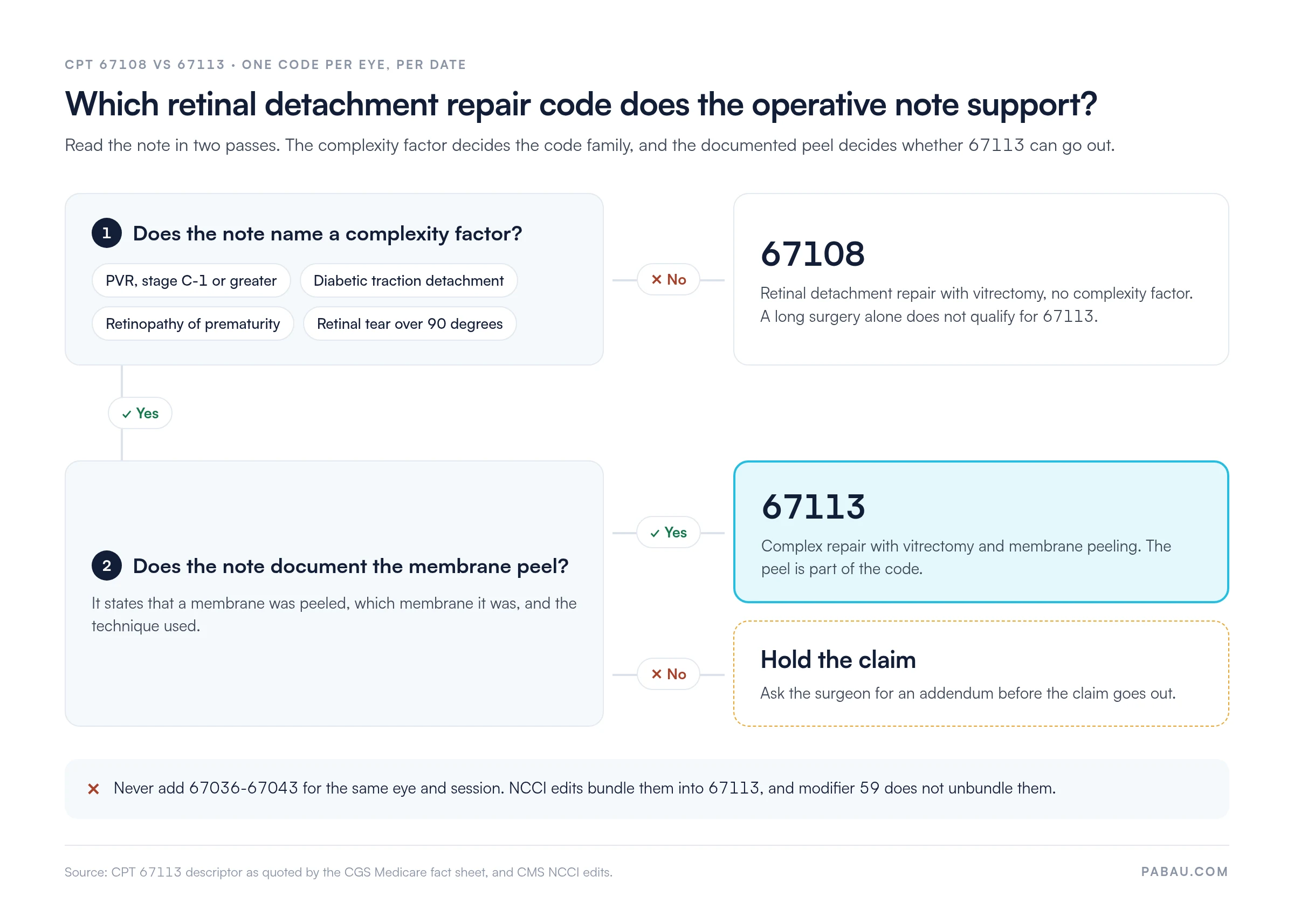
Decision diagram for CPT 67108 vs 67113: if the operative note names no complexity factor (PVR stage C-1 or greater, diabetic traction detachment, retinopathy of prematurity, tear over 90 degrees), bill 67108; if it does and documents the membrane peel, bill 67113; if the peel is undocumented, hold the claim for a surgeon addendum. Never add 67036-67043 for the same eye.
The complexity factor picks the code family, and the documented peel decides whether 67113 can be billed. Logic follows the CGS Medicare 67113 fact sheet and CMS NCCI edits.

First look for the complexity factor: PVR with its grade, a tractional or diabetic traction detachment, ROP, or a tear over 90 degrees. Then look for the peel itself, with the membrane removed and the technique used. A diagnosis on its own does not support 67113.

Pro Tip

Run a documentation audit before billing 67113. Search the operative report for the complexity factor and for the membrane peel. If either one is missing, ask the surgeon for an addendum before the claim goes out. An addendum written after a denial carries far less weight with reviewers.

CPT code 67113 sits within a family of vitreoretinal procedure codes. Knowing the neighboring codes prevents both undercoding and unbundling errors.

CPT codeShort descriptorRelationship to 67113
67039Vitrectomy, mechanical, pars plana approach; with focal endolaser photocoagulationNo detachment repair; bundled into 67113 on the same eye
67040Vitrectomy, mechanical, pars plana approach; with endolaser panretinal photocoagulationNo detachment repair; bundled into 67113 on the same eye
67041Vitrectomy with removal of preretinal cellular membrane (eg, macular pucker)Standalone membrane removal code; not billed with 67113
67042Vitrectomy with removal of internal limiting membrane of retinaStandalone membrane removal code; not billed with 67113
67043Vitrectomy with removal of subretinal membrane (eg, choroidal neovascularization)Standalone membrane removal code; not billed with 67113
67108Repair of retinal detachment with vitrectomyNon-complex repair; mutually exclusive with 67113 on the same eye and date
67113Repair of complex retinal detachment with vitrectomy and membrane peelingComplexity factor and peel both documented
67120Removal of implanted material, posterior segment; extraocularLater removal of a scleral buckle
67121Removal of implanted material, posterior segment; intraocularLater removal of intraocular implanted material, including silicone oil when no vitrectomy is used

Surgical documentation requirements for CPT code 67113

Documentation is where most 67113 claims succeed or fail. The operative report has to justify complexity and show the peel before the claim reaches a reviewer. Building a clean claim submission for CPT code 67113 starts with confirming these elements are in the note.

Required documentation elements

  • Complexity factor: Name it — PVR with its grade (C-1 or greater), diabetic traction detachment, ROP with its stage, or a tear larger than 90 degrees. Describe how it affected the surgery.
  • Membrane peeling: State that a membrane was peeled, which membrane it was and the technique used. The CGS fact sheet expects the note to show both vitrectomy and peeling.
  • Extent of detachment: Record the quadrants involved and whether the macula is on or off.
  • Surgical approach: Confirm pars plana vitrectomy and note the gauge (23g, 25g or 27g).
  • Tamponade: Record air, gas (type and concentration) or silicone oil.
  • Lens removal: Note it when performed, since it is part of 67113 and not billed separately.
  • Laterality: Specify the right eye (OD) or left eye (OS). The record has to support the RT or LT modifier.

ICD-10-CM diagnosis codes commonly paired with CPT code 67113

Every CPT code 67113 claim needs a supporting ICD-10-CM diagnosis that matches the documented complexity. Payers cross-check the diagnosis against the operative report, and a mismatch triggers a medical necessity review.

ICD-10-CM codeDescriptionUse with 67113 when…
H33.4-Traction detachment of retina, which includes proliferative vitreoretinopathy with retinal detachmentPVR or a non-diabetic tractional detachment drives the repair
H33.03-Retinal detachment with giant retinal tearThe tear is larger than 90 degrees
E08, E09, E10, E11 or E13 with .352-, .353- or .354-Diabetes with proliferative diabetic retinopathy and traction retinal detachment (eg, E11.352-)Diabetic traction detachment — the classic 67113 indication
H35.10-H35.17Retinopathy of prematurityROP with detachment; the stage must match the operative findings

Always code to the highest specificity the record supports, including laterality. An unspecified-eye diagnosis on a claim that carries RT or LT invites an edit, so match the laterality character to the modifier.

Modifiers for CPT code 67113

Modifiers on CPT code 67113 claims do two jobs. They tell the payer which eye was treated, and they change billing rules for work inside the global period.

Laterality modifiers (required on every claim)

  • RT: Right eye. CMS and most commercial payers expect it on every 67113 claim.
  • LT: Left eye, with the same requirement as RT.
  • 50: Bilateral procedure. It is rarely used in retinal surgery and applies only when both eyes are operated on in one session.

Postoperative and global period modifiers

  • 58: Staged or related procedure during the global period, such as a planned silicone oil removal.
  • 78: Unplanned return to the operating room for a related complication within 90 days. Payment covers the intraoperative portion only.
  • 79: Unrelated procedure during the global period, such as surgery on the other eye.
  • 24: Unrelated E/M service during the postoperative period. Document the unrelated condition explicitly.
  • 76: Repeat procedure by the same physician. It needs strong documentation that the repeat was necessary.

Bundling rules: codes not billed with CPT code 67113

67113 has no add-on codes. Most procedures performed alongside complex repair are already inside the code, and National Correct Coding Initiative (NCCI) edits block them from being billed again.

Companion codeDescriptionBillable with 67113 on the same eye?
67036-67040Vitrectomy, mechanical, pars plana approach, with or without endolaserNo — included in 67113
67041Vitrectomy with removal of preretinal cellular membraneNo — membrane peeling is part of 67113, and modifier 59 does not unbundle it
67042Vitrectomy with removal of internal limiting membraneNo — membrane peeling is part of 67113, and modifier 59 does not unbundle it
67043Vitrectomy with removal of subretinal membraneNo — membrane peeling is part of 67113, and modifier 59 does not unbundle it
67108 and other repair codes (67101-67112)Retinal detachment repair by other methodsNo — retinal detachment repairs are mutually exclusive on the same eye and date
66830-66984, 66986-66988Lens removal and cataract extractionNo — lens removal is included when performed
92201 / 92202Extended ophthalmoscopyNo, when performed during surgery or later the same day
67120 / 67121Removal of implanted material, posterior segment (extraocular / intraocular)Yes, at a separate later session, with modifier 58, 78 or 79 inside the global period. Silicone oil removal is reported with 67036 when removed with a vitrectomy, or 67121 when removed without one. A planned removal within the global period takes modifier 58.

Prior authorization requirements for CPT code 67113

Many commercial payers require prior authorization for CPT code 67113, given its high reimbursement and complexity threshold. Rules differ between carriers, so confirm them plan by plan before scheduling. Insurance eligibility verification before the case prevents authorization problems that cannot be fixed after surgery.

Typical prior authorization submission package

  • Clinical indication letter naming the complexity factor (PVR grade, tractional detachment, ROP stage or giant tear)
  • Preoperative best-corrected visual acuity
  • Fundus imaging or OCT confirming the extent and complexity of the detachment
  • Operative plan, including the planned membrane peel and tamponade
  • The ICD-10-CM diagnosis codes that will appear on the claim

Traditional Medicare generally does not require prior authorization for retinal surgery, but Medicare Advantage plans often do. Treat each Medicare Advantage plan as a commercial payer for authorization. Our medical claims clearinghouse guide explains how a clearinghouse screens claims before they reach the payer.

Medicare reimbursement rates and RVUs for CPT code 67113

CMS sets reimbursement for CPT code 67113 each year through the Medicare Physician Fee Schedule (MPFS). Rates vary by locality and update each January. Check the exact figures in the CMS Physician Fee Schedule lookup tool.

RVU componentValueNotes
Work RVU (wRVU)Higher than 67108Check the current-year value in the MPFS lookup
Practice expense RVU (PE)Varies by facility vs non-facility setting67113 is performed in a hospital or ASC, so the facility rate applies
Malpractice RVU (MP)Relatively highReflects the risk profile of vitreoretinal surgery
Locality adjustmentGPCI varies by localityUrban localities usually carry higher adjustments

The FastRVU lookup tool returns the current work, practice expense and malpractice RVUs for 67113, along with your locality’s GPCI. AAPC Codify also provides reimbursement benchmarks and crosswalk data for vitreoretinal codes.

Global period and postoperative billing for CPT code 67113

CPT code 67113 carries a 90-day global surgical period. Routine preoperative and postoperative care is bundled into the 67113 payment for 90 days after the procedure. Routine follow-up visits billed separately in that window are denied.

What is bundled in the 90-day global

  • Postoperative office visits related to the retinal repair
  • Routine intraoperative services by the operating surgeon
  • Uncomplicated postoperative care, including pressure checks

What can still be billed during the global period

  • E/M visits for a condition unrelated to the retinal repair, with modifier 24 and the unrelated condition documented
  • A planned, staged procedure such as silicone oil removal, with modifier 58
  • A return to the operating room for a related complication, with modifier 78
  • An unrelated surgical procedure, such as surgery on the other eye, with modifier 79
  • Services by a different physician who did not perform the original surgery

Common denial reasons for CPT code 67113 and how to fix them

Denial patterns for CPT code 67113 are consistent across payers. The denial management workflow for vitreoretinal claims starts with the six most common triggers. Each has a specific fix, and most can be prevented before submission.

Denial reasonRoot causeCorrective action
Missing or invalid laterality modifierRT or LT omitted or entered incorrectlyResubmit with the correct modifier in the modifier field
Insufficient documentationOperative report does not name the complexity factor or does not document the membrane peelRequest a surgeon addendum, then appeal with the corrected record and a letter of medical necessity
Missing prior authorizationCommercial or Medicare Advantage authorization not obtained before surgeryFile a retrospective authorization appeal with clinical records. Success varies, so prevention is the dependable fix.
ICD-10-CM mismatchDiagnosis does not reflect the documented complexityRecode to the most specific ICD-10-CM code and resubmit as a corrected claim
NCCI bundling edit67113 billed with 67041-67043, 67108 or another bundled code on the same eyeRemove the bundled code. Modifier 59 is not appropriate for these pairs.
Global period conflictPostoperative visit billed without a modifier inside the 90-day windowIf the visit was unrelated, resubmit with modifier 24. If it was routine follow-up, the denial stands.

Reviewing denial codes in medical billing alongside the payer’s explanation of benefits helps staff match each CARC/RARC reason code to its fix.

Pro Tip

Build a 67113 pre-submission checklist in your billing system. Confirm the RT or LT modifier, the named complexity factor and the documented peel. Check that the ICD-10 code matches the etiology and the prior auth number is on the claim. Make sure no 67036-67043 or 67108 code is billed for the same eye. Running it before submission removes the most common denial triggers for vitreoretinal claims.

How Pabau supports CPT code 67113 claims

Vitreoretinal billing often runs across separate tools. The operative note lives in one system, the claim goes out through a clearinghouse portal and remittances land somewhere else. Each handoff is a chance to drop a modifier or attach the wrong diagnosis.

Pabau keeps that cycle in one place. With claims management, your team builds CMS-1500 claims and sends them electronically through Claim.MD, with eligibility checks before the case. Prior authorization codes and dates sit on the patient’s case, with a warning when one is missing.
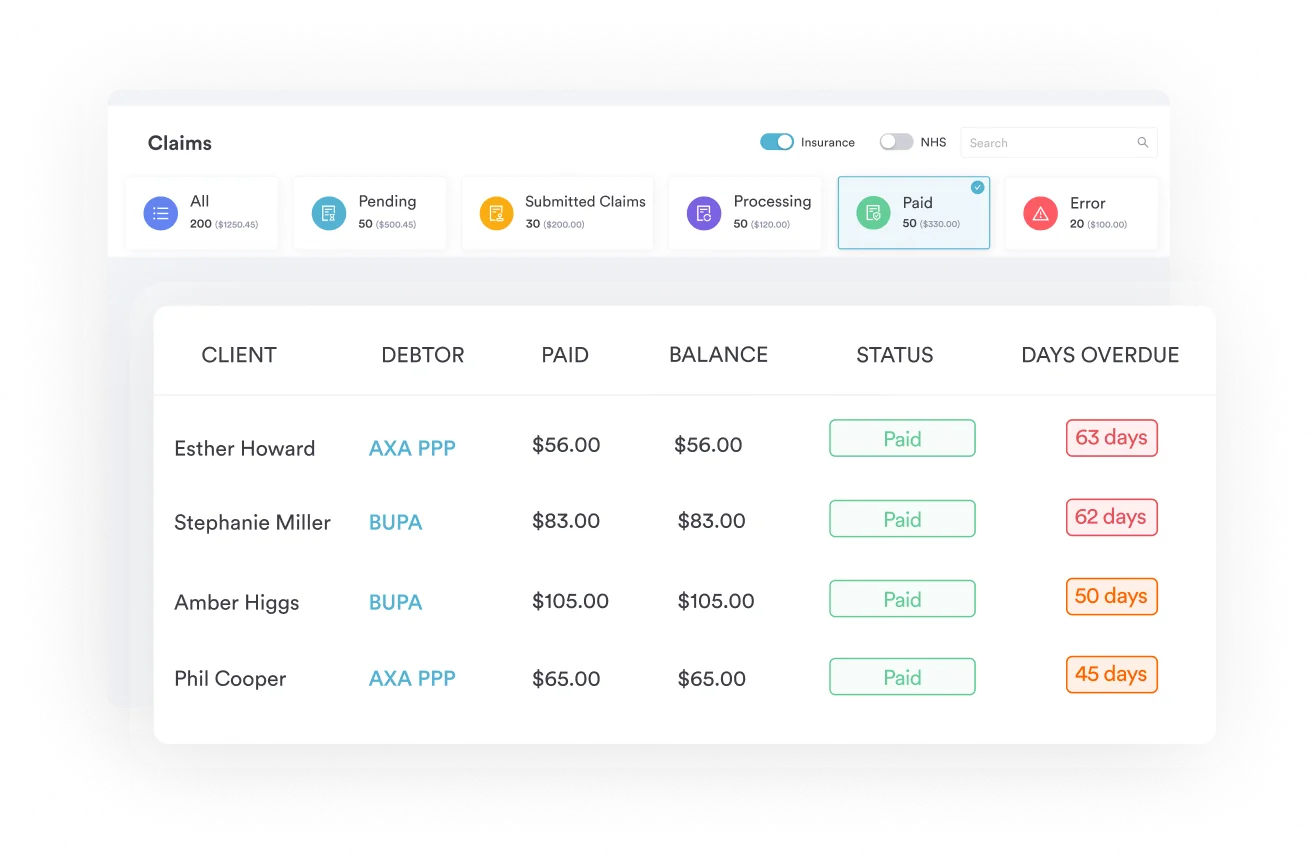
Pabau claims management screen tracking claims from submission to payment
Claims management in Pabau tracks each 67113 claim from submission to remittance, so staff can see which claims still need follow-up.

ERA remittances come back through the same connection. Staff read the reason code on a denied 67113 claim in the system that sent it, so corrections go out sooner.

Manage ophthalmology claims in one place

Pabau sends CMS-1500 claims through Claim.MD, checks eligibility before the case and brings ERA remittances back, so your team can follow each claim.

Pabau claims management dashboard

Conclusion

CPT code 67113 pays for the hardest retinal detachment repairs, and its value already includes the membrane peel. A peel code billed next to it trips an NCCI edit and can hold up the whole claim. Practices that get paid on the first submission write operative notes that name the complexity factor and the peel in plain terms.

If your team is still building its billing foundations, our medical billing overview covers the full revenue cycle. To see how Pabau runs claims, eligibility checks and remittances for surgical specialties, book a demo.

Continue your research

Continue your research

Need a step-by-step overview of medical billing fundamentals? Medical billing overview covers the full revenue cycle from charge entry to payment posting.

Struggling with claim submission errors and electronic filing? Understanding the 837 file format explains how electronic claim files are structured and submitted to payers.

Want to reduce denials across your practice, not just for 67113? Clean claim submission best practices outlines the payer-side requirements that every claim must meet before adjudication.

No complexity factor in the operative note? CPT code 67108 covers retinal detachment repair with vitrectomy when the case is not complex.

Membrane peel without a detachment repair? CPT code 67041 explains billing vitrectomy with epiretinal membrane removal on its own.

Frequently asked questions

What does CPT code 67113 cover?

CPT code 67113 covers repair of a complex retinal detachment with vitrectomy and membrane peeling. Complex cases include PVR stage C-1 or greater, diabetic traction detachment, retinopathy of prematurity and retinal tears larger than 90 degrees. Tamponade, cryotherapy, endolaser, subretinal fluid drainage, scleral buckling and lens removal are included when performed.

What is the difference between CPT 67108 and CPT 67113?

67108 is vitrectomy repair of a retinal detachment without a complexity factor, while 67113 is complex repair that includes membrane peeling. 67113 needs a documented complexity factor and a documented peel. The two codes are mutually exclusive on the same eye on the same date, so only one is reported.

Can 67041, 67042 or 67043 be billed with CPT 67113?

No. Membrane peeling is part of 67113, so the membrane removal codes 67041-67043 are bundled into it for the same eye and session. Modifier 59 does not unbundle them. They are billed on their own only when no retinal detachment repair is performed.

What ICD-10 codes are used with CPT 67113?

Common pairings are H33.4- for traction detachment, which includes proliferative vitreoretinopathy with detachment, and H33.03- for a giant retinal tear. Diabetic traction detachment uses the diabetes combination codes, such as E11.352-. Retinopathy of prematurity is coded H35.10-H35.17. Always code to the highest specificity with the correct laterality.

Does CPT 67113 require prior authorization?

Many commercial payers and Medicare Advantage plans require it, while traditional Medicare generally does not. Check each plan before the case is scheduled, because a missing authorization is hard to recover after surgery.

What is the global period for CPT code 67113?

CPT code 67113 carries a 90-day global surgical period. Routine postoperative care related to the retinal repair is bundled into the procedure payment for 90 days. A visit billed in that window needs modifier 24 if unrelated, and a related return to the operating room needs modifier 78.

Can silicone oil removal be billed with CPT 67113?

Silicone oil placed during the 67113 procedure is included in the code. Removing the oil at a later session is billed separately. It is reported with 67036 when removed with a vitrectomy, or 67121 when removed without one. Inside the 90-day global period, a planned removal takes modifier 58.


Tanja Lepcheska
Content Writer

Tanja is a Senior Content Writer who has a skill to turn complex med spa topics into easy, engaging reads that actually make sense. She loves helping clinic owners feel confident about growing their business. When she’s not writing, you’ll probably find her rewatching her favorite romantic movies, working on a new crochet project, or rearranging her home decor “just one more time.”
×