HCPCS code A4714: Treated water for peritoneal dialysis billing guide
HCPCS code A4714: Official descriptor, code type, and payment status HCPCS code ...

Last Updated: Oct 15, 2026

CPT code 67108 reports repair of retinal detachment with vitrectomy, any method, including gas tamponade, endolaser, cryotherapy, scleral buckling, and same-surgeon lens removal.
The 2026 national Medicare rate is about $992, from 29.70 total facility RVUs at a $33.40 conversion factor.
Those RVUs split into 16.70 work, 11.67 facility practice expense, and 1.33 malpractice, before geographic adjustment.
Modifier 50 does not apply to 67108. Use RT or LT for laterality, 78 for a related return to the OR, and 79 for unrelated procedures.
Practice management software like Pabau submits claims electronically and posts electronic remittance advice, so payment data lands in the practice record without rekeying.
CPT code 67108 is the procedure code for repair of retinal detachment with vitrectomy, any method.
It covers the adjuncts the same surgeon performs in the same session. Those include air or gas tamponade, focal endolaser photocoagulation, cryotherapy, drainage of subretinal fluid, scleral buckling, and lens removal.
Medicare pays roughly $992 for 67108 in a facility setting in 2026, national and unadjusted. That figure comes from 29.70 total facility RVUs at a $33.40 conversion factor. The code carries a 90-day global period and takes RT or LT for laterality, never modifier 50.
Complex repairs and re-operations belong to 67113 instead. This guide covers 2026 rates and RVUs, applicable modifiers, supporting ICD-10-CM diagnoses, related codes, documentation requirements, and the errors that draw audits.
CPT code 67108 describes repair of retinal detachment with vitrectomy, any method. The descriptor covers air or gas tamponade, focal endolaser photocoagulation, cryotherapy, drainage of subretinal fluid, scleral buckling, and lens removal by the same surgeon. The American Medical Association (AMA) maintains it inside the retina and choroid procedures subsection (67101-67228).
The words “any method” widen the descriptor to every pars plana vitrectomy (PPV) technique used in detachment repair. The surgeon’s choice of instrumentation or gauge does not change the code. The tamponade can be silicone oil, perfluorocarbon liquid, or gas such as SF6 or C3F8.
The listed adjuncts are bundled when the same surgeon performs them in the same session. Billing them separately is improper unbundling under National Correct Coding Initiative (NCCI) edits.
Medicare reimburses 67108 under the Medicare Physician Fee Schedule (MPFS). Retinal surgery almost always happens in a facility setting, so the facility rate applies to most practices. The CMS Physician Fee Schedule lookup tool publishes rates by locality, and the figures below are national 2026 amounts before geographic adjustment.
Unlike most surgical codes, 67108 carries the same practice expense RVUs in both settings, so the payment does not rise in the office. There is no site-of-service premium to chase here. Rates still move with the Geographic Practice Cost Index (GPCI). Reimbursement in high-cost markets such as Manhattan or San Francisco differs from the national figure.
RVUs are how Medicare turns the relative complexity of a procedure into a dollar amount. The formula is total RVU × conversion factor × GPCI = payment. For 2026 the conversion factor is $33.40 for clinicians who are not qualifying APM participants, and $33.57 for those who are. You can look up values for your locality with the FastRVU 2026 RVU lookup tool.
The work RVU of 16.70 reflects the pre-service, intra-service, and post-service physician effort in retinal detachment repair. It sits among the higher values in the ophthalmology code set. The 90-day global period means routine follow-up is already inside this single payment.
Before submitting CPT 67108 claims, pull your MAC’s local coverage determination (LCD) for retinal procedures. Some Medicare Administrative Contractors publish documentation requirements beyond the standard NCCI edits. Checking the LCD before the first denial is faster than appealing one after.
Modifier selection is where ophthalmology billing teams pick up the most avoidable denials. CPT 67108 has a defined set of applicable modifiers. Applying the wrong one, or omitting a required one, produces either a denial or an overpayment finding at audit. Commercial payers sometimes diverge from Medicare’s NCCI rules, so confirm the payer’s policy before surgery.
A retinal detachment affects one eye at a time. Billing 67108 with modifier 50 tells a payer’s edit system that bilateral retinal surgery happened in one session. That is almost never clinically accurate, and the Office of Inspector General (OIG) flags the pattern in its ophthalmology billing work plans.
CPT 67108 carries a 90-day global surgical period and is classified as major surgery. Medicare’s payment covers pre-operative care on the day before and the day of surgery, the procedure, and all routine postoperative care for 90 days. Practices that misread the window lose money twice. They miss services they could have billed, and they bill services already inside the package.
The clock below shows which events sit inside that single payment, and which modifier moves an event outside it.
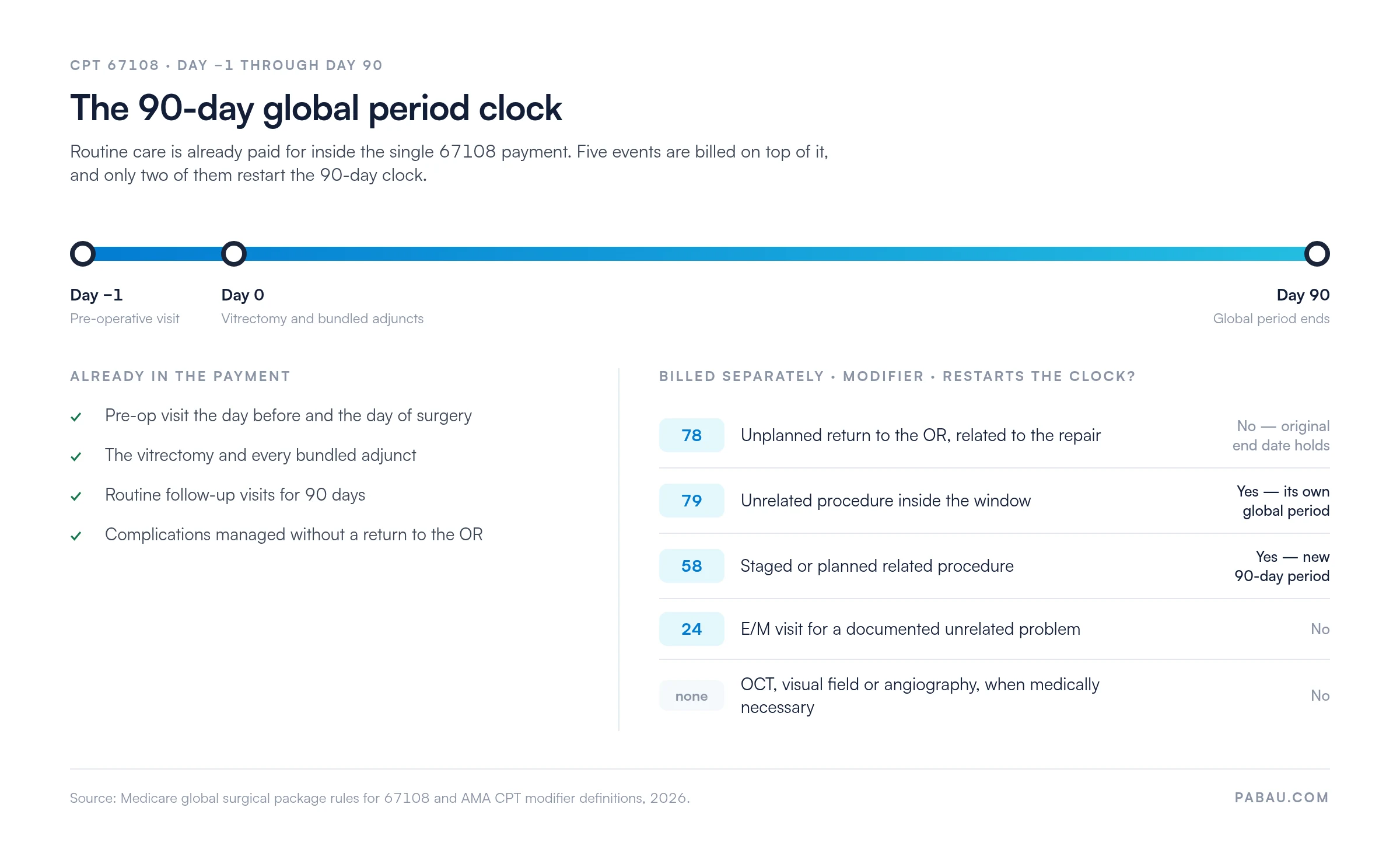
What the 90-day global package for 67108 already includes:
What can still be billed separately during those 90 days:
Tracking the global period calendar per patient is what separates a billed modifier 78 return from a written-off one. Practices that do not track it lose revenue on returns to the OR they have already performed.
Every 67108 claim needs a supporting ICD-10-CM diagnosis that establishes medical necessity. The primary options come from the H33 category, which covers retinal detachments and breaks. Laterality is mandatory, so the code must name the right eye, the left eye, both, or unspecified. The AAPC Codify CPT lookup gives a starting crosswalk, but verify coverage against your MAC’s local coverage determination.
Code to the highest level of specificity the operative report documents. If the detachment involved multiple breaks, use H33.02x rather than the unspecified H33.00x. Payers treat specificity as a proxy for documentation quality, and a habit of defaulting to unspecified codes on complex surgery attracts scrutiny.
CPT 67108 sits inside a family of retinal surgery codes. Picking the right one depends on the surgical approach, the complexity, and the clinical indication. Selection errors between these neighbors are among the most common findings in ophthalmology billing audits.
CPT 67112 is absent from that table because it no longer exists. It covered repeat ipsilateral detachment repair by buckle or vitrectomy, and the AMA deleted it from the 2016 code set.
Repeat repairs are now reported with the code for the procedure performed, plus modifier 58, 78, or 79. Billers working from a pre-2016 crosswalk still submit 67112, and the claim comes back rejected as an invalid code.
One more vitrectomy code sits outside the table above. Vitrectomy performed for a macular indication, with internal limiting membrane removal rather than detachment repair, is reported as CPT 67042. The operative note’s stated indication is what separates the two codes.
That code has a close neighbor, and the layer peeled separates them. Removing a preretinal cellular membrane and leaving the internal limiting membrane in place is CPT 67041.
That table answers the question code first. The decision path below runs the other way, from what the operative note describes to the code that fits it.
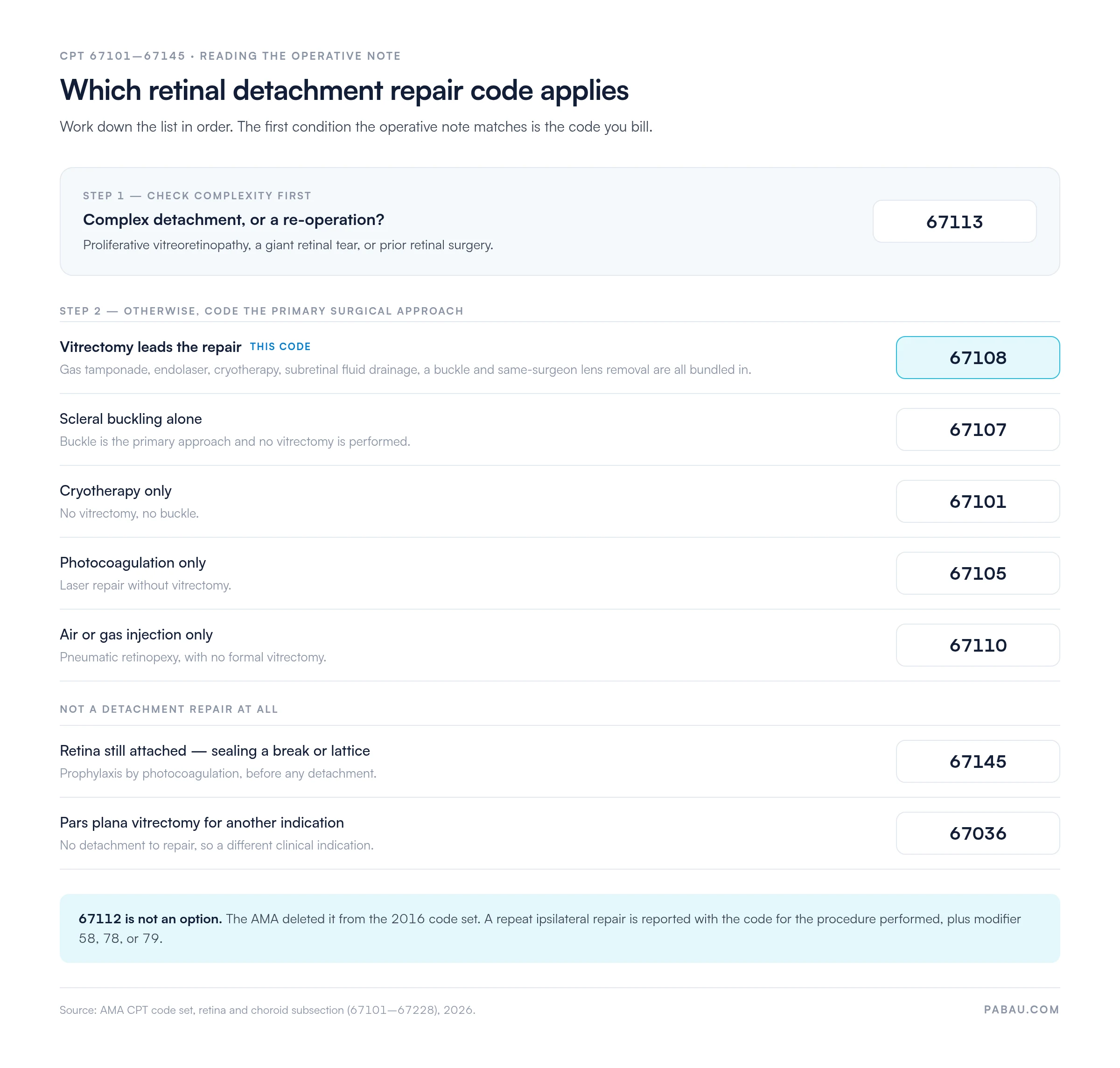
CPT 67108 applies to the initial repair of a retinal detachment using vitrectomy. CPT 67113 applies to complex cases or to secondary, re-operation vitrectomy. If the patient has had prior retinal surgery, or the case involves proliferative vitreoretinopathy (PVR) or a giant retinal tear, 67113 is usually correct.
67113 reimburses higher than 67108 because the case takes more time and more surgical skill. The operative note has to document the specific factors that justify it. A generic claim of “complex case” without supporting detail will not survive review.
CPT 67107 describes repair of retinal detachment using scleral buckling as the primary approach. When the surgeon leads with vitrectomy and also places a buckle, 67108 is correct. Vitrectomy is the lead procedure, and the buckle is an adjunct already named in the 67108 descriptor.
67107 applies only when scleral buckling stands alone, without vitrectomy. NCCI edits bundle 67107 components into 67108 when both are billed together, so the combined case is reported with 67108 alone.
A clean claim for 67108 starts with a complete operative note. Payers and auditors treat that note as the primary evidence of medical necessity and of what was performed. Missing elements are the top reason for post-payment audits and refund demands. Every element below belongs in the note before the claim leaves the practice, which is the baseline for clean claim submission.
Ophthalmology billing is an OIG priority area, and retinal surgery codes sit near the top of the list. The mistakes below drive most denials in retinal practices, and each one is avoidable with a claim-scrubbing step before submission. When a claim comes back denied, reading the denial reason codes on the remittance is the fastest route to the cause.
Run a quarterly audit of your 67108 claims. Pull every claim submitted in the last 90 days, check the modifier attached to each one, and confirm the operative note documents the adjuncts billed. A 15-minute review usually surfaces the recurring errors before a payer audit does.
An active retinal surgery practice runs several of these checks on every case. Modifier selection, the global period calendar, ICD-10 laterality, NCCI bundle rules, and documentation review all happen before a claim goes out. At volume, running those checks from memory is where the errors above start.
Practice management software like Pabau handles the submission end of that work. Pabau’s claims management software sends 67108 claims electronically through the Claim.MD clearinghouse, so the biller is not rekeying them into a payer portal.

Remittance comes back the same way. Pabau posts electronic remittance advice against the claim, so payment and adjustment data lands in the practice record without manual keying. Claim scrubbing and clearinghouse tools flag issues, but they do not replace coder review of the operative note or guarantee payer acceptance.

Pabau’s claims management software submits your claims electronically through the clearinghouse and posts electronic remittance advice back against them. Your billing team stops rekeying and starts reconciling.

CPT 67108 is a high-value code that gets read closely. The 90-day global period, the bundled adjuncts, the modifier 50 prohibition, and the 67113 decision each have to be settled before the claim goes out. Settling them after a denial costs a rework cycle, and sometimes the payment.
Practices with a clean 67108 record run the same checks before every submission. They confirm laterality, confirm no adjunct was billed on its own line, and confirm the operative note supports 67108 rather than 67113.
They also keep the global period calendar somewhere the billing team can see it, rather than in one person’s head. That calendar is what turns a modifier 78 return into a paid claim instead of a write-off.
If your retinal billing is generating avoidable denials, or your team tracks global periods on a spreadsheet, the submission side is worth automating first. Book a demo to see how Pabau submits ophthalmology claims and posts remittances for practices your size.

Need a faster route from operative note to clean claim? Medical billing fundamentals covers how each step connects, from charge capture through to remittance posting.
Unsure which denial codes are hitting your retinal surgery claims? Denial management in healthcare breaks down the most common payer denial patterns and the workflow fixes that prevent them.
Looking for a clearinghouse that handles ophthalmology surgical claims? Medical claims clearinghouse explains how clearinghouse choice affects first-pass acceptance rates and remittance speed.
Want the charge capture step to carry every adjunct you performed? Superbill sets out what belongs on the form so surgical adjuncts are not written off by accident.
Still posting payments by hand after each remittance? Electronic remittance advice explains how ERA files reconcile against the claim and what the adjustment codes are telling you.
CPT code 67108 is the procedure code for repair of retinal detachment with vitrectomy, any method. It covers the intraoperative adjuncts the same surgeon performs in the same session. Those include air or gas tamponade, focal endolaser photocoagulation, cryotherapy, drainage of subretinal fluid, scleral buckling, and lens removal. Use it for initial retinal detachment repairs where vitrectomy is the primary surgical approach.
The 2026 national Medicare rate for CPT 67108 is roughly $992 in a facility setting, before geographic adjustment. Practice expense RVUs are the same in the office, so the non-facility rate is also about $992. The figure comes from 29.70 total RVUs at a $33.40 conversion factor, or $33.57 for qualifying APM participants. Verify your locality’s rate with the CMS Physician Fee Schedule lookup tool.
RT (right eye) or LT (left eye) is required on every 67108 claim. Modifier 50 does not apply, because retinal detachment is an inherently unilateral condition. Modifier 78 covers an unplanned return to the OR for a related complication inside the 90-day global period. Modifier 58 covers a staged or planned related procedure and starts a new global period. Modifier 79 covers unrelated procedures, and modifiers 54 and 55 split postoperative care between surgeons.
CPT 67108 covers the initial repair of a retinal detachment with vitrectomy in a standard case. CPT 67113 covers complex detachments and secondary, re-operation vitrectomy cases. That includes proliferative vitreoretinopathy (PVR), giant retinal tears, and patients with prior retinal surgery. CPT 67113 reimburses higher than 67108, and the operative note must document the specific complexity factors that separate the case from a standard repair.
CPT code 67108 carries a 90-day global surgical period. Medicare’s payment includes the pre-operative visit on the day before and the day of surgery. It also covers the procedure itself and all routine postoperative follow-up for 90 days. Several services stay separately billable inside the window. They include returns to the OR with modifier 78, staged related procedures with modifier 58, and unrelated procedures with modifier 79. E/M visits for a documented unrelated problem use modifier 24, and medically necessary diagnostic tests remain billable.
No. Modifier 50 (bilateral procedure) does not apply to CPT 67108. Retinal detachment is an inherently unilateral condition. Bilateral retinal surgery in a single session is uncommon enough that billing 67108 with modifier 50 is a documented audit trigger. Use RT or LT to indicate laterality on each claim.
The primary supporting ICD-10-CM codes for CPT 67108 come from the H33.0xx series, which covers retinal detachment with retinal break and carries laterality. Traction detachment is coded H33.40-H33.49, serous detachment H33.20-H33.23, and retinoschisis and retinal cysts H33.10-H33.19. Code to the highest specificity the operative note documents, including laterality, and verify the codes against your MAC’s local coverage determination.