CPT code 71552: MRI chest without and with contrast billing guide
CPT code 71552 is a chest MRI without, then with, contrast CPT code 71552 report...

Last Updated: Oct 22, 2026

CPT code 66821 reports discission of a secondary membranous cataract by laser surgery, the Nd:YAG capsulotomy that clears posterior capsule opacification after cataract surgery.
Medicare reimbursement runs roughly $350-$500 depending on setting and geography. Verify current rates in the CMS Physician Fee Schedule lookup tool.
Modifier -79 is required when billing CPT 66821 during the 90-day global period of a prior cataract surgery on the same eye.
One unit of 66821 covers the whole treatment episode, however many laser stages or sessions it takes.
Pabau’s claims software checks code pairing, prompts for missing modifiers, and keeps fee schedule data current for ophthalmology billing.
CPT code 66821 is the billable code for an Nd:YAG laser capsulotomy, the laser procedure that clears a clouded posterior lens capsule after cataract surgery. One unit covers the whole treatment episode, however many laser stages it takes.
Official AMA descriptor: Discission of secondary membranous cataract (opacified posterior lens capsule and/or anterior hyaloid); laser surgery (eg, YAG laser) (1 or more stages).
The condition behind the code is posterior capsule opacification, or PCO, and it is common. Pooled data across studies put visually significant opacification at about 12% of patients one year after cataract surgery, rising to roughly 28% by five years.
Posterior capsule opacification is the most common late complication of modern cataract surgery. After phacoemulsification and intraocular lens (IOL) implantation, residual lens epithelial cells migrate across the posterior capsule. They proliferate there and form a fibrous membrane that scatters incoming light.
Patients report progressive blurring, glare, and reduced contrast sensitivity. Those symptoms are clinically identical to their original cataract, which is why PCO is sometimes called a secondary cataract.
Nd:YAG laser capsulotomy creates a central opening in the opacified membrane, restoring the optical pathway without an incision. Before the claim goes out, PCO has to be documented as the indication and linked to the laterality-specific ICD-10 code.
The Nd:YAG laser delivers short, high-energy pulses that photodisrupt the opacified posterior capsule. The surgeon focuses the beam on the membrane using a slit-lamp delivery system. The procedure typically takes 5-15 minutes, requires no incision, and is performed under topical anesthesia.
One code covers the entire capsulotomy episode. If the surgeon stages the procedure across two visits because the initial opening is insufficient, a single unit of 66821 still applies. Billing two units for staged treatment is a common audit trigger.
A separate evaluation and management (E/M) service on the same day takes a -25 modifier on the E/M code, not on 66821 itself. It also has to reflect a distinctly separate, medically necessary encounter.
Reimbursement varies by setting and geographic locality. The CMS Physician Fee Schedule lookup tool publishes the current national and locality-specific rates. The approximate 2025 Medicare national averages below are reference figures, so verify them against current CMS data before submitting claims.
The same CMS tool carries the work, practice expense, and malpractice RVU values behind those rates. Checking them each January is the quickest way to see what has moved before the first claims of the year go out.
Commercial payers typically reimburse at Medicare-equivalent rates or apply a negotiated multiplier. Some plans pay 110-130% of the Medicare fee schedule, particularly for preferred providers in ophthalmology networks.
A few plans require prior authorization for YAG capsulotomy, especially when it falls fewer than 90 days after cataract surgery. Check your payer contracts and confirm authorization before scheduling. Retroactive denials on this code are common in practices that verify eligibility by hand.
Run an insurance eligibility check on every YAG capsulotomy patient before the procedure date. Some commercial plans impose a waiting period or a specific PCO severity threshold before authorizing 66821. Catching a missing authorization the day before avoids the write-off.
Every claim for CPT code 66821 needs a linked diagnosis code that confirms medical necessity, and the right one depends on which eye was treated. Submitting a non-specific or bilateral code when only one eye was treated is a common audit finding. CMS Article A56792 lists the diagnosis codes Medicare accepts for YAG capsulotomy, all of them drawn from the ICD-10-CM code set.
Note that H26.49 itself is a category header, not a billable code. The billable unspecified-eye code is H26.499, and payers routinely deny it when the procedure note names the treated eye. Code to the highest level of specificity and that denial never happens.
Modifier selection is where YAG capsulotomy claims most frequently go wrong. Three modifiers apply to this code, and each has a specific triggering condition.
Not every payer wants laterality modifiers on every claim. Medicare does not universally mandate -RT or -LT for 66821, but many commercial plans do. Check your payer matrix before assuming the ICD-10 laterality code is enough on its own. AAPC’s CPT code reference sets out modifier guidance by payer category.
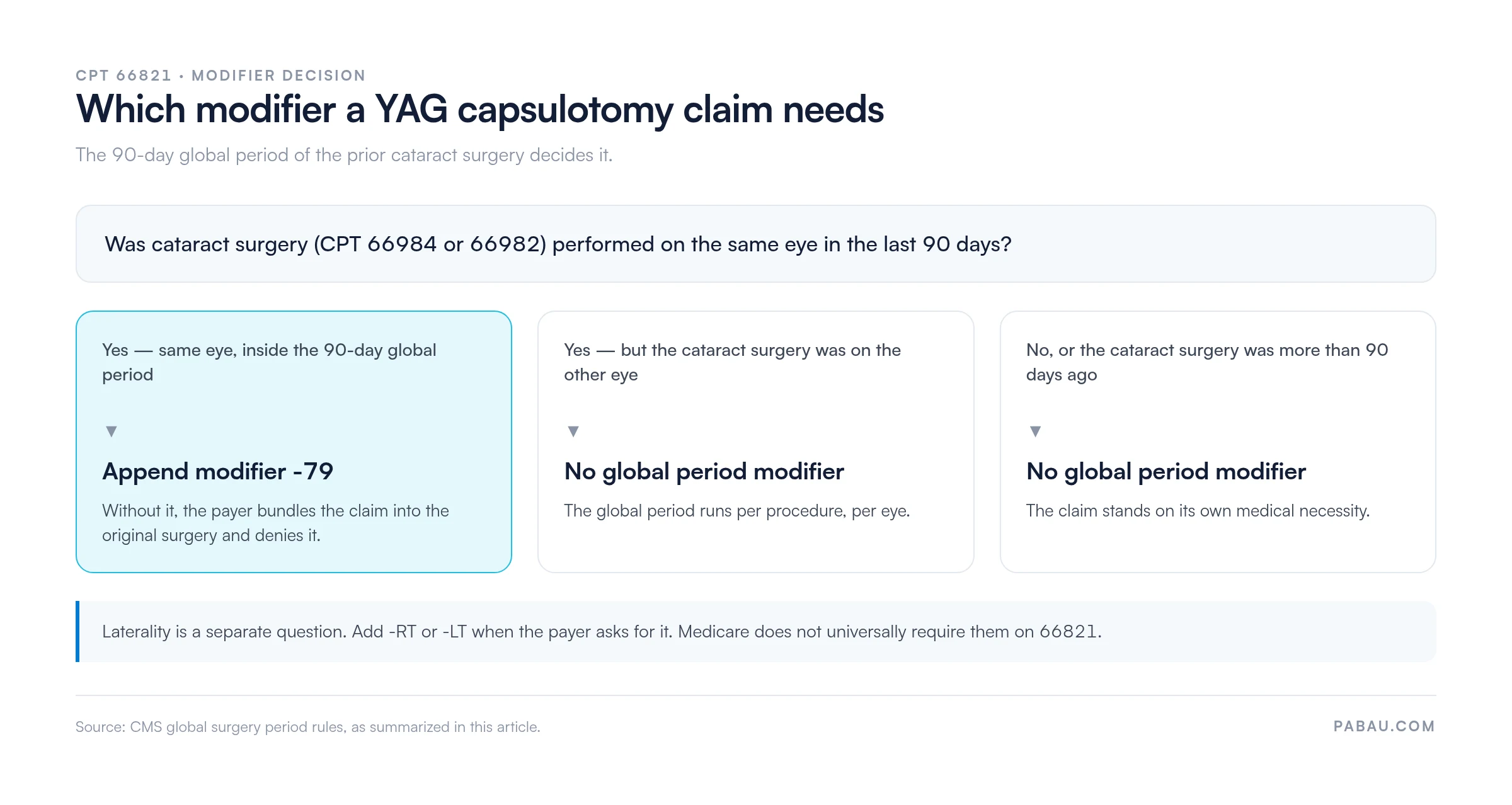
The 90-day global surgery period is the single biggest source of denials on YAG capsulotomy claims. Cataract surgery carries that 90-day window, whether the surgeon billed CPT 66984 or 66982.
If a patient develops PCO inside that window, billing 66821 without modifier -79 produces an automatic denial. The payer treats the claim as bundled into the original surgery.
An IOL exchange billed under CPT 66986 opens a 90-day global of its own, so a YAG inside it needs modifier -79 or -78.
A secondary IOL implantation billed as CPT 66985 carries the same 90-day window on that eye.
An aqueous drainage device placed under CPT 66183 also runs a 90-day global, so a YAG in that window still needs modifier -79.
Modifier -79 tells the payer the YAG procedure is unrelated to the original surgery, which is clinically accurate. PCO is a separate complication rather than a continuation of the cataract procedure. Three cases cover almost every claim you will see.
Payer audits on YAG capsulotomy focus on whether the medical record supports the diagnosis. They also look for evidence that non-surgical alternatives were considered or do not apply. The chart note does the heavy lifting long before the claim is submitted.
Required documentation elements for CPT code 66821 include:
An encounter form that prompts for BCVA and IOP keeps a claim from leaving before the chart note is complete. Incomplete diagnosis linkage is a top-10 denial reason for ophthalmic surgery codes, and it is the easiest one to design out.
A handful of error patterns drive most YAG capsulotomy denials. These are the ones billing teams run into again and again.
Set up a billing rule that flags any CPT 66821 claim where the patient had cataract surgery, 66984 or 66982, in the prior 90 days. The rule should prompt the biller to add modifier -79 before the claim reaches the clearinghouse.
Tracking global periods by hand across a busy ophthalmology schedule goes wrong sooner or later. A practice seeing 40-60 post-cataract patients a week cannot watch 90-day windows patient by patient without a system that flags them automatically.
Practice management software like Pabau handles that watch for you. Claims are validated against built-in CPT and ICD-10 catalogs before they leave. A 66821 claim sitting inside a prior surgery’s global period gets stopped for its missing modifier, rather than denied a month later.
Pabau’s software for billing teams also runs real-time eligibility checks, posts electronic remittance advice, and tracks denials by CARC reason code. Your billers see a modifier or diagnosis error on the day it happens, not when the remittance arrives.
Claims reach payers through Claim.MD, our US clearinghouse partner, as CMS-1500 or 837P files. For a practice billing 66821 alongside cataract and glaucoma codes, that means less rework and a cleaner first-pass rate across a high-volume schedule.

Pabau’s claims management software tracks global periods, flags missing modifiers before submission, and links ICD-10 codes to CPT claims automatically. See how it handles CPT 66821 and dozens of other ophthalmic codes.

Almost every denial on this code traces back to three checks. They are the global period modifier, the laterality of the diagnosis, and whether the chart note proves medical necessity. None of them are hard. They just have to happen on every claim, which is exactly what hand-checking cannot guarantee at volume.
Build the three checks into the claim workflow instead of the biller’s memory, and 66821 stops being a code that generates rework. Book a demo to see how Pabau catches a missing -79 before the claim reaches the payer.

Need to understand how clearinghouse claim scrubbing works? How Claim.MD clearinghouse works with Pabau explains the real-time validation process for CPT and ICD-10 claims before they reach the payer.
Want to reduce ophthalmology claim denials across your team? Denial codes in medical billing covers the most common CARC codes and how to resolve them systematically.
Looking to verify claim submission accuracy before the ERA arrives? Medical claims clearinghouse guide outlines how 837P files are validated, scrubbed, and routed to payers for faster reimbursement.
CPT code 66821 reports discission of a secondary membranous cataract by laser surgery, most commonly an Nd:YAG capsulotomy. It treats posterior capsule opacification (PCO) after cataract extraction, and one unit covers the procedure in 1 or more stages.
Approximate 2025 Medicare reimbursement is $420-$500 in a non-facility (office) setting and $350-$420 in a facility or ASC setting. Rates vary by geographic locality and change annually. Verify current amounts using the CMS Physician Fee Schedule lookup tool.
Modifier -79 (unrelated procedure during postoperative period) is required when billing CPT 66821 during the 90-day global period of a prior cataract surgery. Laterality modifiers -RT (right eye) and -LT (left eye) are required by some commercial payers to confirm which eye was treated.
The laterality-specific PCO codes are H26.491 (right eye), H26.492 (left eye), and H26.493 (bilateral). H26.499 is the billable unspecified-eye code, and it should only be used when the record genuinely does not document which eye was treated.
Yes. CPT 66821 can be billed during the 90-day global period of a prior cataract surgery by appending modifier -79. That modifier tells the payer the YAG capsulotomy is an unrelated procedure. Without -79, the claim is automatically denied as bundled into the original surgery.
Required documentation includes pre-procedure best corrected visual acuity, posterior capsule opacification documented on slit-lamp examination, and patient symptom history with an onset date. You also need the prior cataract surgery date, a medical necessity statement, and a post-procedure intraocular pressure measurement.
Yes, Medicare covers the procedure under CPT 66821 when PCO following cataract extraction is documented as the medical indication. The claim also has to be linked to an appropriate ICD-10-CM PCO diagnosis code. Coverage is addressed in CMS Local Coverage Article A56792.