HCPCS code V2600: Hand held low vision aids billing guide
What is HCPCS code V2600? HCPCS code V2600 is the Level II supply code for hand ...

Last Updated: Nov 13, 2026
50432 is the CPT code for percutaneous placement of a nephrostomy catheter. The code includes a diagnostic nephrostogram and/or ureterogram when performed, imaging guidance, and all associated radiological supervision and interpretation.
It reports one drainage catheter placed through the skin into the kidney's collecting system, usually through a newly created tract, to relieve obstruction or infection. An exchange through an existing tract is 50435, and a catheter that runs on into the ureter is 50433 or 50434.
Let Pabau's smart automation suggest the right codes, reduce claim denials, and keep your practice compliant—effortlessly.
Automate repetitive tasks and focus on what matters most—your patients.
Reduce coding errors and ensure compliance with the latest regulations.
Clean claims, fewer denials, and faster reimbursements.
Powerful insights and reporting to help your practice thrive.
HIPAA compliant SOC 2 certified GDPR-compliant Trusted by 4,000+ clinics worldwide

CPT code 50432 reports a percutaneous nephrostomy catheter placed in one kidney, usually through a newly created tract.
The code already includes the diagnostic nephrostogram, imaging guidance, routine tract dilation and radiological supervision and interpretation.
An exchange through an existing nephrostomy is 50435, and a catheter that runs on into the ureter is 50433 or 50434.
Medicare lists 50432 with a zero-day global period and a work RVU of 3.90.
Most denials trace back to a wrong tract code, separately billed guidance, missing laterality or a diagnosis that doesn’t match the note.
CPT code 50432 is the code for percutaneous placement of a nephrostomy catheter to drain one kidney. As the 2016 CPT code update in Reviews in Urology sets out, the code bundles the diagnostic nephrostogram and imaging guidance. Radiological supervision and interpretation are included too.
The American Medical Association (AMA) owns the official wording, so check the current CPT codebook before you quote it on an appeal. Interventional radiologists and urologists place the catheter for obstruction, infection or stone disease. In practice the operator usually creates a new percutaneous tract, and that is what separates 50432 from an exchange.
Start with what you can’t add. Every item in the left column is paid inside 50432, so billing one of them again is an unbundling error. The right column lists the services that can still stand on their own.
Two codes trip people here. A nephrostogram (50430 or 50431) isn’t reported on the same side as 50432, because the placement already includes it. Tract dilation codes 50436 and 50437 aren’t add-ons to 50432 either, since routine dilation is part of the placement.
You don’t place the catheter, but you do have to match each step in the note to the code. Here is the usual sequence and what each step should leave on the page.
The six codes from 50430 to 50435 look alike on a fee schedule, and that’s where most miscoding starts. Ask what was left in the patient, then which tract the operator used. The chart below turns those two answers into a code.
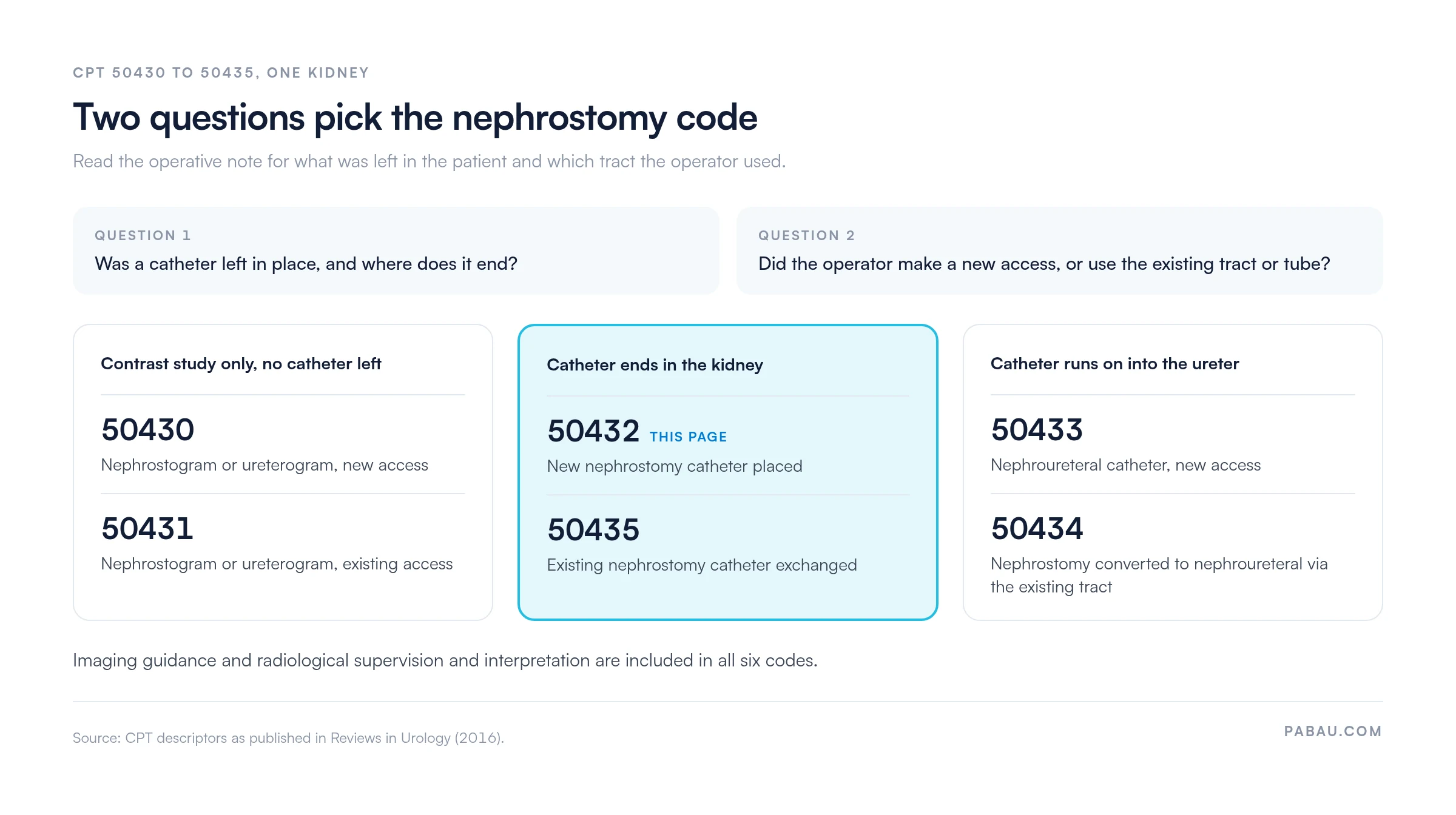
The pair coders confuse most is 50432 and 50435. If the patient arrives with a working tube and leaves with a new one through the same tract, that’s an exchange. If the old tract has closed and the operator makes a fresh puncture, the note supports 50432 again. Neighboring urinary system codes sit in our CPT code library.
The answer is simple. Ultrasound, fluoroscopic or CT guidance used to place the nephrostomy is included in 50432 and isn’t reported separately. That holds whichever modality the operator used, and modifier 59 doesn’t change it.
A guidance code belongs on the claim only when it supports a different procedure, such as a biopsy elsewhere, with its own documentation. The 77002 page covers where fluoroscopic guidance can stand alone.
50432 describes one kidney, so every claim needs to say which one. Bilateral work is where payer rules split, so treat modifier 50 as something to confirm, not assume.
Percutaneous nephrolithotomy (PCNL) removes stones through a nephroscope. Nephrostomy placement only drains the kidney. Coding a drainage-only procedure as PCNL is upcoding, and auditors look for it.
The overlap runs the other way too. Since 2023, the PCNL codes include nephrostomy tube placement when performed. A tube left through the PCNL tract is therefore part of 50081 or 50080, not a separate 50432.
Run the procedure note and radiology report against this list before the claim leaves. If an item is missing, query the operator now rather than after a denial.
The diagnosis has to explain why the kidney needed draining. A stone case might carry N20.0, while an infected system often leads with N39.0 plus the obstruction code.
Watch for “urosepsis” in the note. ICD-10-CM treats it as a nonspecific term with no default code, so query the provider for sepsis or a urinary tract infection before you code.
Medicare pays 50432 under the Medicare Physician Fee Schedule (MPFS), which updates each January 1. Facility rates apply in a hospital or ambulatory surgical center. Non-facility rates apply in an office setting, which is uncommon for this procedure.
A zero-day global means related follow-up care on later days isn’t bundled into the placement. Use the CMS Physician Fee Schedule Look-Up Tool for current rates by locality. The FastRVU 2026 RVU lookup breaks out work, practice expense and malpractice RVUs. Both update each year when CMS releases the final rule.
Original Medicare doesn’t generally require prior authorization for 50432. Medicare Advantage and commercial plans set their own rules, and many cover interventional radiology procedures.
Run the prior authorization check against the patient’s specific plan ID, not just the payer name. Medicare Advantage plans from the same insurer can carry different authorization lists, so confirm the plan before the procedure is scheduled.
With the checklist done, the claim itself follows a fixed order. Getting it clean the first time is faster than working an appeal later.
Most rejections fall into six patterns. Each one is cheaper to catch before submission, which is the core of good denial management.
A lot of nephrostomy rework starts with re-keying. The CPT code, diagnosis and authorization number already sit in the procedure record, then get typed again into a claim form. One slip sends the claim back.
Pabau, the practice management platform we build, pre-fills the claim from the patient record. The CPT code attached to the service lands on the charge line, and ICD-10 codes come from the recorded problem list. Required fields such as authorization numbers must be complete before the claim can be sent.
For US practices, our claims management software submits CMS-1500 and 837P claims through Claim.MD. It also checks eligibility before the procedure and posts ERA remittances back to the patient account.
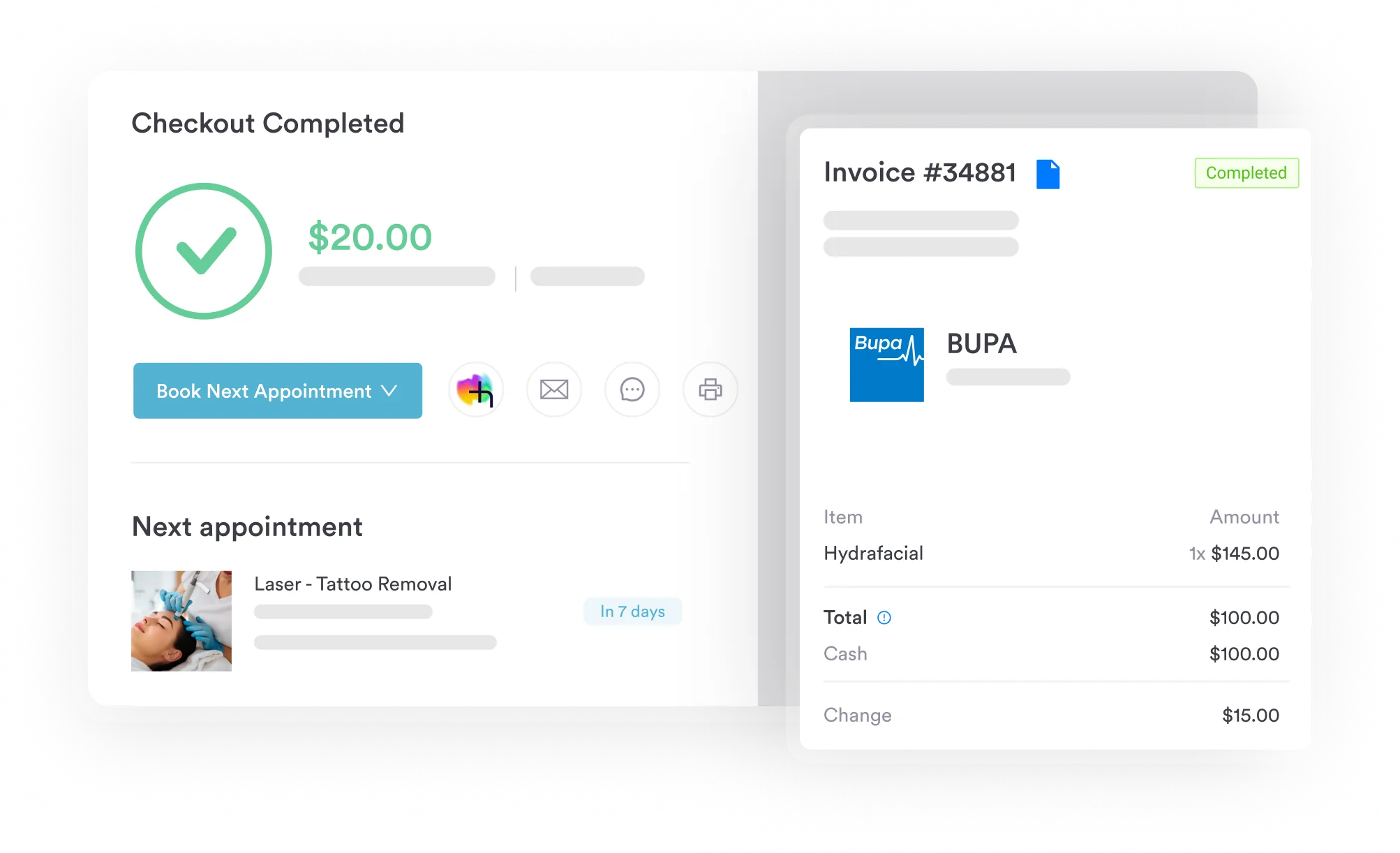

Pabau pre-fills claims from the patient record, checks eligibility and required fields, and submits through Claim.MD with ERAs posted back. Your billing team re-keys less and chases fewer rejections.

Code 50432 rewards a careful read of the operative note more than any coding trick. If the note shows a new tract and a catheter ending in the kidney, 50432 is the whole bill for that side. The nephrostogram, guidance and dilation are already paid inside it.
The catch is that the code forgives little at the edges. An exchange billed as a placement, a guidance code added on top or a missing RT or LT will come back. Build the two-question check and the laterality step into your pre-submission routine, and those denials largely stop.
Book a demo to see how Pabau pre-fills your CPT and ICD-10 codes into each claim and follows it through to the remittance.

Billing the ultrasound-guided procedures around the placement? CPT code 76942 explains when ultrasonic needle guidance is reported on its own.
Want the full workflow behind a procedure claim like 50432? What is medical billing walks through the process from encounter to payment posting.
Checking your coding against payer and federal rules? Medical billing compliance covers the audits and safeguards that keep claims defensible.
Looking at the bigger revenue picture? What is revenue cycle management connects coding, claims and collections.
Not for the same access. Since 2023, PCNL codes 50080 and 50081 include nephrostomy tube placement when performed. Report 50432 only for a separate, distinct access, in the same or the other kidney.
No. 50432 includes all radiological supervision and interpretation and the imaging guidance. Neither the operator nor a second radiologist reports a separate guidance or interpretation code for the placement.
Report 50432 for each kidney. Many payers want two lines with RT and LT, while others accept modifier 50. Check the CMS fee schedule’s bilateral indicator and the payer’s policy before you file.
50432 places a new nephrostomy catheter. 50435 exchanges a catheter already in place through its existing tract. If the old tract has closed and a fresh puncture is made, the note supports 50432.
Generally no. 50432 includes the diagnostic nephrostogram, so 50430 and 50431 aren’t reported with it on the same side. Work on the opposite kidney can be reported with laterality modifiers.