HCPCS Code L0472: Hyperextension TLSO billing guide
HCPCS code L0472: Official descriptor and device definition HCPCS code L0472 des...

Last Updated: Nov 5, 2026
50081 is the CPT code for complex percutaneous nephrolithotomy or pyelolithotomy. It includes lithotripsy, stone extraction, antegrade ureteroscopy, stent and nephrostomy tube placement when performed, plus imaging guidance.
A case is complex when it involves stones over 2 cm, branching stones, stones in multiple locations, ureteral stones or complicated anatomy. Simple cases go to 50080, and each kidney is reported once.
Let Pabau's smart automation suggest the right codes, reduce claim denials, and keep your practice compliant—effortlessly.
Automate repetitive tasks and focus on what matters most—your patients.
Reduce coding errors and ensure compliance with the latest regulations.
Clean claims, fewer denials, and faster reimbursements.
Powerful insights and reporting to help your practice thrive.
HIPAA compliant SOC 2 certified GDPR-compliant Trusted by 4,000+ clinics worldwide

CPT code 50081 reports complex percutaneous nephrolithotomy, such as stones over 2 cm, branching stones, stones in multiple locations, ureteral stones, or complicated anatomy.
Since January 2023, the choice between 50080 and 50081 is simple versus complex. Adding up the sizes of several small stones does not decide the code.
Report one unit of 50081 per kidney, whatever the stone count or number of accesses. Bill a bilateral case as one line with modifier 50.
Lithotripsy, stone extraction, antegrade ureteroscopy, stent and nephrostomy tube placement, and imaging guidance are included when performed.
Access creation or tract dilation is reported separately with 50436 or 50437, usually with modifier 59 or an X modifier.
CPT code 50081 reports a complex percutaneous nephrolithotomy or pyelolithotomy, the keyhole removal of kidney stones through a tract in the patient’s back. The surgeon reaches the collecting system under imaging, breaks up the stones, and removes the fragments.
CPT revised the code pair effective January 1, 2023. The descriptor now lists lithotripsy, stone extraction, antegrade ureteroscopy, antegrade stent placement and nephrostomy tube placement, each when performed, and includes imaging guidance. Tract dilation is no longer part of the descriptor.
The complex level is defined by examples: stone[s] over 2 cm, branching stones, stones in multiple locations, ureter stones, or complicated anatomy. That wording is quoted from coding coverage of the 2023 revision in Urology Times, so check it against your current CPT code book.
CPT 50080 reports a simple percutaneous nephrolithotomy, and CPT 50081 reports a complex one. The descriptors give examples of each level rather than a single size cutoff.
A simple case looks like stone[s] up to 2 cm in a single location of the kidney or renal pelvis, with no branching. A complex case shows at least one of the complex features:
Before 2023, the codes split at 2 cm and some coders summed small stones to reach that line. That approach no longer applies. Two 0.9 cm stones in the renal pelvis remain a simple case, while the same stones in two separate calyces count as multiple locations.
The decision path below checks one complex feature at a time, and a single yes moves that kidney to 50081.
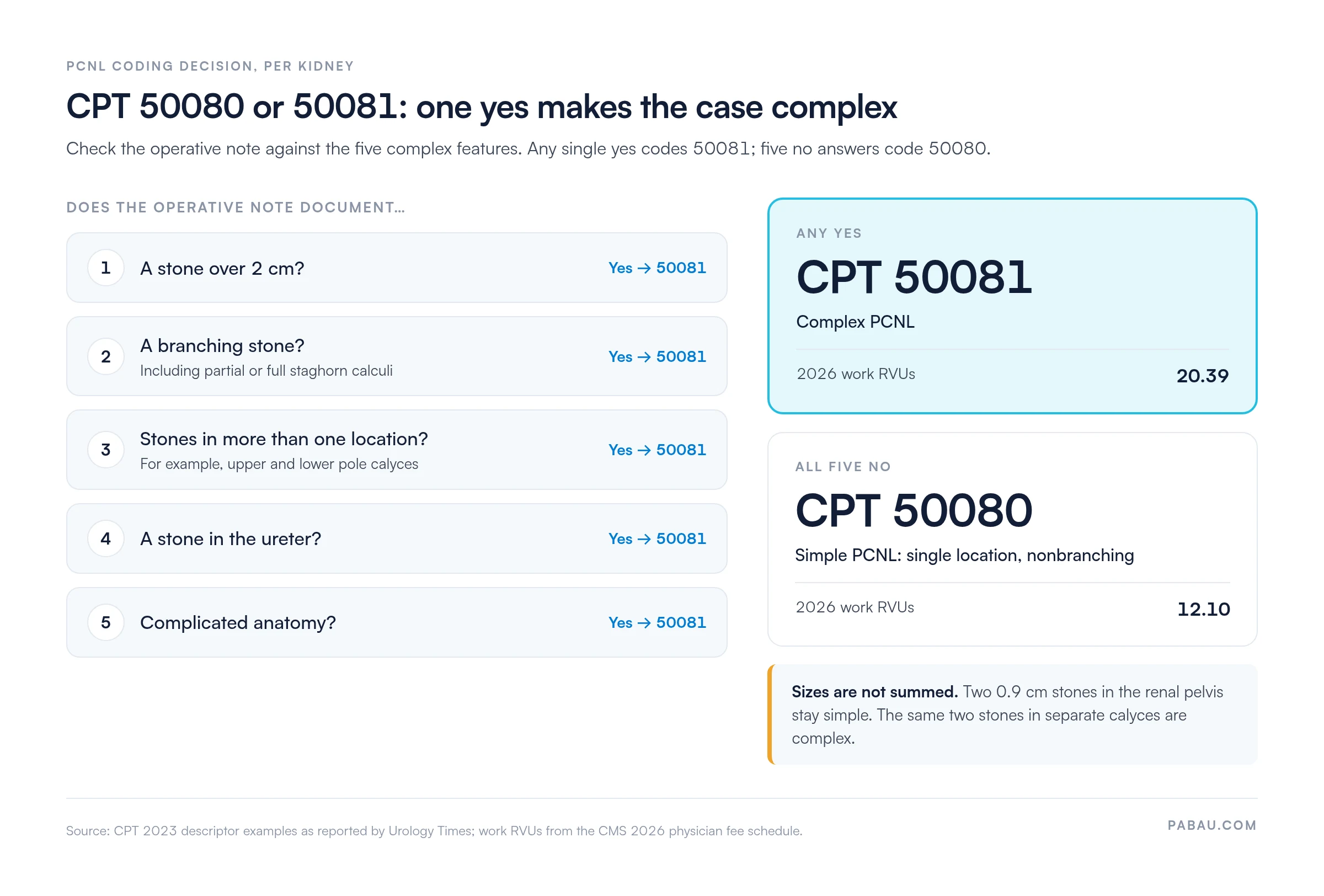
Ask surgeons to name the complex feature in the operative note. Examples are a 2.6 cm stone, a partial staghorn, or stones in the upper and lower pole calyces. A coder can then match the note to the descriptor without guessing.
CPT code 50081 includes most steps of the stone-clearing session. Access creation and tract dilation are the main exception, because the 2023 revision moved them to their own codes.
CPT also instructs coders not to report 50080 or 50081 with 50430, 50431, 50433, 50434 or 50435 on the same side. Review payer edits before you add any other code to a PCNL claim, and keep the medical billing compliance basics in view.
Most CPT code 50081 claims pair with a code from ICD-10-CM category N20, calculus of kidney and ureter. Pick the code that matches where the stones were found, since unspecified N20.9 is a common audit finding when the location is documented.
Staghorn calculi are coded N20.0, because ICD-10-CM has no separate staghorn code. N20 codes carry no laterality, so the kidney treated is shown on the CPT line instead.
Modifiers on CPT code 50081 show which kidney was treated, whether both were, and whether extra codes or extra work belong on the claim.
In the 2026 Medicare physician fee schedule, CPT code 50081 carries 20.39 work RVUs and 29.99 total facility RVUs, with a 90-day global period. Those figures come from the CMS physician fee schedule relative value files.
At the 2026 non-QP conversion factor of $33.4009, that is about $1,002 nationally before geographic adjustment. Confirm the figure for your locality before you quote it.
Original Medicare does not routinely require prior authorization for CPT code 50081, but many commercial payers and Medicare Advantage plans do. Requirements vary by payer, plan, and site of service, so check them at scheduling as part of the wider medical billing process.
When a payer asks for authorization, the request usually needs:
Most CPT code 50081 denials trace back to the code level, units, or companion codes. A denial management workflow that groups denial codes by cause shows which of these keeps recurring.
A CPT code 50081 claim stands or falls on the operative report. Coders cannot add detail after the fact, so the surgeon needs to capture these points at dictation.
Every operative report for a 50081 claim should contain:
Audit 10 recent CPT 50081 operative reports against this checklist. If notes rarely name the complex feature or the tract type, a short dictation prompt fixes it before claims go out.
A few clinical situations raise coding questions beyond the standard case. Each one needs documentation that matches the code you choose.
Stones in the ureter make the case complex, so report CPT code 50081 for the session. Pair it with N20.2 when stones were treated in both the kidney and the ureter.
When both kidneys have a complex PCNL in one session, bill 50081-50 on one line with one unit. Document each kidney’s access, stones and findings separately, so each side supports the code.
If one side is simple and the other complex, do not use modifier 50. Report 50080 for one kidney and 50081 for the other, each with its side modifier where the payer wants one.
A second look through an established nephrostomy tract to remove remaining stones is reported with CPT 50580. That code describes renal endoscopy through an established nephrostomy, with removal of foreign body or calculus.
Append modifier 58 when the second look was planned at the first procedure and falls within the 90-day global period. Use modifier 78 for an unplanned return to the operating room, and document the reason either way.
A short pre-submission review catches most errors on a 50081 claim. Run each claim through these checks to send a clean claim the first time.
Many urology practices keep the operative note in one system and build the claim in another. Coders then retype stone details, side and diagnosis, and a missing detail surfaces only as a denial.
Pabau, the practice management platform we build, keeps clinical notes, diagnoses and invoices in the same patient record. Its claims management software submits US claims through a Claim.MD clearinghouse connection, using the data your team has entered.
Your billers then track each claim’s status in one place and follow up on rejections without switching tools. That leaves more time to check the documentation that supports the complex code.

Pabau keeps operative notes, diagnoses and billing in one patient record, then submits and tracks US claims through Claim.MD. Your team spends less time hunting for missing details.

Code CPT 50081 by asking one question: does the operative note name a complex feature? If it does, bill 50081 once per kidney and add any access code with the right modifier. If it does not, 50080 is the safer code.
The practices that get paid first time treat the operative note as the claim’s evidence. Book a demo to see how Pabau keeps PCNL notes and claims in one record for your billing team.

Need to understand clearinghouse claim validation? Medical claims clearinghouse guide explains how electronic claim scrubbing works and why it cuts denials.
Want to see how ERA remittances work? Electronic remittance advice explained covers how 835 files map CARC denial reason codes back to specific claim lines.
Looking for credentialing guidance for urology billing? Getting credentialed with insurance companies walks through the enrollment steps that gate access to payer fee schedules.
CPT code 50081 covers complex percutaneous nephrolithotomy or pyelolithotomy. It includes lithotripsy, stone extraction, antegrade ureteroscopy, stent and nephrostomy tube placement when performed, plus imaging guidance. Access creation or tract dilation is reported separately with 50436 or 50437.
CPT 50080 is a simple PCNL, such as stones up to 2 cm in a single location with no branching. CPT 50081 is complex, covering stones over 2 cm, branching stones, multiple locations, ureteral stones or complicated anatomy.
No. Since 2023 the code depends on simple versus complex features, not on the summed size of the stones. Small stones in several locations make the case complex, while small stones in a single location stay simple.
In the 2026 Medicare physician fee schedule, CPT code 50081 carries 20.39 work RVUs and 29.99 total facility RVUs. It has a 90-day global period, and payment varies by locality.
Yes. Access creation and tract dilation are not included in 50081, so report 50436 for an existing tract or 50437 for new access. Most payers need modifier 59, XU or XS on that line. A nephrostomy tube placed at the end of the case is included in 50081.
Bill one line, 50081-50, with one unit, and Medicare pays 150% of the fee schedule amount. If one kidney is simple and the other complex, report 50080 and 50081 separately without modifier 50.