



CCSD code G5100: Bypass of duodenum billing guide
CCSD code G5100 bills a bypass that leaves the duodenum in place CCSD code G5100...

Last Updated: Oct 16, 2026

CPT code 36556 covers insertion of a non-tunneled centrally inserted central venous catheter in patients age 5 years or older.
Use CPT 36555 for patients under age 5, since the wrong age code is a leading cause of claim denials.
Medicare pays roughly $78 in a facility setting and $238 in a non-facility setting for 2026, before geographic adjustment.
Practice management software like Pabau links CPT codes, modifiers, and ICD-10 diagnoses in one billing workflow.
CPT code 36556 describes the insertion of a non-tunneled centrally inserted central venous catheter (CVC) for patients age 5 years or older. Specifically, it covers percutaneous placement through the subclavian, internal jugular, or femoral vein. In both cases, the catheter tip sits in the superior vena cava or the right atrium.
Notably, the procedure supports fluid administration, medication delivery, hemodynamic monitoring, and blood sampling. In addition, non-tunneled CVCs are temporary devices, usually placed in acute care, emergency, or ICU settings. Unlike tunneled catheters and peripherally inserted central catheters, they are designed for short-term acute use. Specifically, the official AMA CPT code set descriptor reads: Insertion of non-tunneled centrally inserted central venous catheter; age 5 years or older.
Where peripheral IV access is sufficient, the placement is reported with 36000 instead. That code covers introducing a needle or intracatheter into a vein, which keeps the access peripheral rather than central.
The most common denial trigger on central line insertion claims is an age-code mismatch. Specifically, CPT 36555 applies to patients under 5 years, and CPT code 36556 applies to patients age 5 or older. That boundary, however, is not clinical judgment. Rather, it is a hard AMA descriptor rule, so submitting 36555 for a 7-year-old generates an automatic edit.
For that reason, document the patient’s date of birth and confirmed age in the procedure note. Some payers cross-reference the date of birth on the eligibility file against the code submitted. In fact, a discrepancy triggers an automated denial before a human reviewer sees the claim.
CPT code 36556 sits within a family of central venous access codes. Specifically, the right sibling code depends on catheter type, insertion approach, and patient age. Together, the grid below splits the four centrally inserted codes along those axes. A PICC enters through an arm vein, and that insertion without imaging guidance is 36569 at age 5 or older.
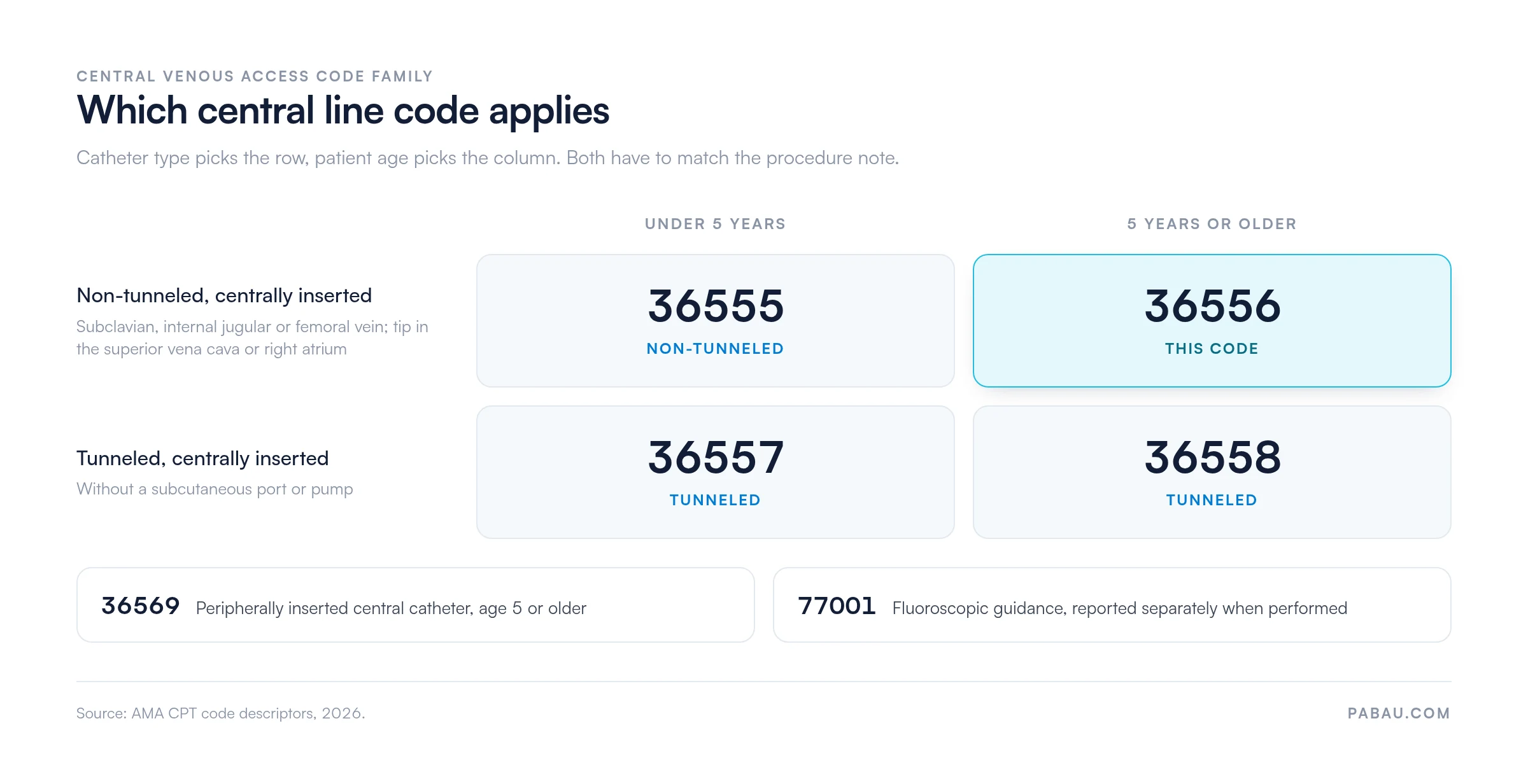
Additionally, CPT 77001 may be reported alongside CPT code 36556 when real-time imaging guided the placement. However, verify the current NCCI edit status before reporting it, because bundling rules change quarterly. In addition, when guidance is performed, record the imaging modality, who performed it, and the finding that confirmed tip position.
Modifier use with CPT code 36556 decides whether a claim pays in full, pays at a reduced rate, or denies. Therefore, apply a modifier only when the clinical documentation supports it. In particular, appending one without matching documentation is an audit risk.
Of the five, the -59 modifier is the most commonly misapplied. Specifically, use it only when an NCCI edit exists and its modifier indicator is 1, meaning the modifier may override the bundle. By contrast, using -59 against a 0-indicator edit is a compliance violation.
Check the NCCI edit indicator before appending modifier -59 to CPT code 36556. If the bundled pair carries a modifier indicator of 0, the procedures cannot be unbundled under any circumstance. Appending -59 to a 0-indicator edit changes no payment outcome and creates a compliance flag.
Medicare reimburses CPT code 36556 under the Physician Fee Schedule, and rates vary by place of service and geographic locality. As a result, verify current figures with the CMS Physician Fee Schedule lookup tool before submitting claims, since CMS updates the schedule each January. In addition, the place-of-service code on the claim must match the setting where the procedure was performed.
The facility and non-facility split changes what Medicare pays the physician. Specifically, in a hospital, ASC, or other facility setting, the facility bills for overhead separately, so the physician’s payment is lower. In contrast, in an office setting the physician absorbs the overhead and is paid more.
Together, both figures are national unadjusted 2026 rates, calculated as total RVUs multiplied by the CY2026 conversion factor of roughly $33.40. Notably, the work RVU is identical in both settings. Specifically, what changes is the practice expense RVU, which is why the office rate runs about three times the facility rate. Furthermore, Geographic Practice Cost Indices then adjust the payment by locality, and private payer rates are negotiated separately.
Medical necessity has to be established with a supporting ICD-10-CM diagnosis code. Otherwise, the claim denies regardless of how accurately you selected the procedure code. For reference, our ICD-10-CM code directory carries the descriptors and coding notes for the diagnoses coders pair with central line claims. The diagnoses below are commonly accepted when a non-tunneled CVC is clinically indicated.
As a rule, always code to the highest level of specificity available. For example, sepsis, unspecified (A41.9) is acceptable while the causative organism is unknown, but update the code once culture results return. Consequently, payers review diagnosis specificity as part of their medical necessity criteria, and non-specific codes attract higher audit rates.
The National Correct Coding Initiative governs which codes may be billed together with CPT code 36556. Importantly, the NCCI procedure-to-procedure edit files are updated quarterly. As a result, a pairing that was separately billable in the first quarter can be bundled by the third.
In particular, key bundling rules to know:
An occlusion that develops later in the catheter’s dwell falls outside these same-day bundles. Clearing it by instilling a thrombolytic is reported as CPT code 36593, with the drug supply billed separately under its own HCPCS code.
A complete procedure note is what keeps these claims paid. In particular, each element below maps to a denial reason when it goes missing from the record.
Together, a structured procedure note hands the billing team every element the charge needs. When physicians dictate notes for later transcription, therefore, check that the transcription captured the tip position confirmation. In practice, that is the element most often missing from denied claims.
These are the most frequent reasons CPT code 36556 claims are rejected, along with the corrective action for each.
Run a denial analysis on every CPT code 36556 claim from the previous 90 days. Filter by Claim Adjustment Reason Code to find the top three denial categories. One or two root causes usually account for the bulk of rejections, so fixing those first recovers revenue fastest.
Practices performing central line insertions need a billing workflow that connects the procedure, the diagnosis, and the payer rules without manual re-entry at each step. In practice, that usually means a coder retyping the code, the modifier, and the diagnosis into a separate billing system.
Pabau is claims software for practices as well as a full practice management system. As a result, billing staff attach CPT codes such as 36556, apply the modifiers the note supports, and link the ICD-10 diagnosis from the same patient record. Consequently, that removes the re-keying behind several of the denials described above.
For US claims, Pabau connects to Claim.MD. Consequently, practices submit CMS-1500 and 837P claims to more than 4,000 payers, check eligibility in real time, and retrieve electronic remittance advice inside Pabau. Moreover, when a 36556 claim comes back denied, the remittance lands in the system that built the claim.
In addition, reporting in Pabau shows denial rates by CPT code, so a practice manager can see whether 36556 is a recurring problem rather than a one-off. Furthermore, the built-in CPT and ICD-10 catalogues cut look-up time before submission.

Pabau helps practices attach the right CPT codes, modifiers, and ICD-10 diagnoses to every procedure before the claim leaves the office. Book a demo to see how the workflow runs.

Ultimately, the age boundary in this code family is the cheapest denial to prevent and the one practices lose most often. It costs one field check at intake. Similarly, the tip-position line in the note costs the physician one sentence, and it decides whether the payer treats the procedure as complete.
In short, none of these checks help once the claim has left the building. Consequently, rework costs staff time that the reimbursement never covers, so the controls belong in front of submission. Book a demo to see how Pabau keeps code selection, modifiers, and diagnosis linking in one billing workflow.

Need to understand how claim submissions flow to payers? Medical claims clearinghouse overview explains how clearinghouses validate and route claims before they reach Medicare and commercial payers.
Dealing with recurring denial codes on vascular access claims? Denial codes in medical billing breaks down the most common CARC and RARC codes and what corrective actions they require.
Looking to benchmark your clean claim rate? Submitting a clean claim covers the elements every claim must include to pass payer edits on first submission.
Placing a tunneled catheter with a port instead? CPT code 36561 covers the tunneled centrally inserted catheter with a subcutaneous port for patients age 5 or older.
CPT code 36556 reports the insertion of a non-tunneled centrally inserted central venous catheter in patients age 5 years or older. Specifically, it covers percutaneous placement via the subclavian, internal jugular, or femoral vein, with the tip confirmed in the superior vena cava or right atrium. Common indications include sepsis management, hemodynamic monitoring, vasopressor delivery, chemotherapy infusion, and total parenteral nutrition.
The only difference is patient age. Specifically, CPT 36555 applies to patients younger than 5 years, and CPT 36556 applies to patients age 5 years or older. The catheter type, insertion technique, and tip position requirements are identical. As a result, submitting the wrong code for the patient’s age is a leading cause of automated denials and a common audit finding.
The most commonly applied modifiers are -LT and -RT for the laterality of the insertion site. In addition, modifier -59 reports a distinct procedural service where an NCCI edit allows unbundling, and -52 covers reduced services when the procedure was not completed. Similarly, modifier -76 applies when the same physician replaces the catheter that day after a documented complication. By contrast, modifier -50 is rarely applicable to CVC insertion.
The procedure note must record the date of birth confirming age eligibility, the clinical indication, the vein accessed, and the confirmed catheter tip position. In addition, it needs the technique used, whether imaging guidance was employed, and the performing physician’s name and signature. Notably, missing tip position confirmation is the most frequently cited documentation deficiency in denied claims.



