CCSD code H4430: Examination of rectum under anaesthetic
CCSD code H4430 pays for the examination alone CCSD code H4430 is the UK private...

Last Updated: Oct 20, 2026
CPT code 36245 reports selective catheter placement in one first-order abdominal, pelvic, or lower extremity artery branch, within a vascular family. In plain terms, the catheter leaves the aorta and stops in a vessel that branches straight off it. The celiac trunk and the superior mesenteric artery are common examples.
The rule to hold onto is simple. Each vascular family gets one base code for the deepest branch reached, so a push into a second-order branch moves the claim to 36246. Coders most often confuse 36245 with 36246, and that mix-up causes underpaid or denied claims. The sections below cover the order ladder, the operative note payers expect, and the checks that keep 36245 claims paid.
Let Pabau's smart automation suggest the right codes, reduce claim denials, and keep your practice compliant—effortlessly.
Automate repetitive tasks and focus on what matters most—your patients.
Reduce coding errors and ensure compliance with the latest regulations.
Clean claims, fewer denials, and faster reimbursements.
Powerful insights and reporting to help your practice thrive.
HIPAA compliant SOC 2 certified GDPR-compliant Trusted by 4,000+ clinics worldwide

CPT code 36245 reports selective catheter placement in one first-order abdominal, pelvic, or lower extremity artery branch, within a vascular family.
Each vascular family gets one base code for its deepest branch: 36245 for first order, 36246 for second, and 36247 for third or beyond.
Add-on 36248 is the only add-on in the family, and it rides with 36246 or 36247 for each extra deeper branch.
The operative note must name the vessel and confirm the catheter tip position, or payers treat the work as non-selective.
Practice management software like Pabau pre-fills claims and checks required fields, while coders still own order assignment and modifier choice.
CPT code 36245 reports selective catheter placement in each first-order abdominal, pelvic, or lower extremity artery branch, within a vascular family.
That wording comes from the American Medical Association (AMA), which maintains the CPT code set. “Selective” means the catheter leaves the aorta and sits inside a named branch, confirmed on imaging. A catheter left in the aorta is non-selective work, which is coded as 36200.
Here’s how 36245 sits next to the rest of its family. Notice that only one code in the set is an add-on.
Think of the family as a ladder with three rungs and one add-on. 36245 is the base code for a first-order branch. Once the catheter reaches a second-order branch, 36246 becomes the base code instead.
At third order or beyond, 36247 takes over. Add-on 36248 then counts each extra deeper branch in the same family.
Every 36245 case follows the same basic path, and the coder needs evidence of each step in the note. Access usually starts at the common femoral artery or the radial artery.
So which vessels count as first order? They’re the branches that come straight off the aorta. Common examples are the celiac trunk, the superior mesenteric artery (SMA), and the inferior mesenteric artery (IMA).
From a femoral puncture, the opposite-side common iliac artery is also first order, because the catheter crosses the aortic bifurcation to reach it.
Payers check this point closely. A catheter parked at the bifurcation without entering a named branch doesn’t support 36245. The report has to name the vessel and state where the tip ended up.
Count the branch points from the aorta, then bill one base code for the deepest vessel in each family. 36245 covers first order, 36246 covers second order, and 36247 covers third order or more. Each major aortic branch, such as the celiac trunk, the SMA, or one iliac system, starts its own vascular family.
The ladder below shows how the code changes as the catheter moves deeper into one family.
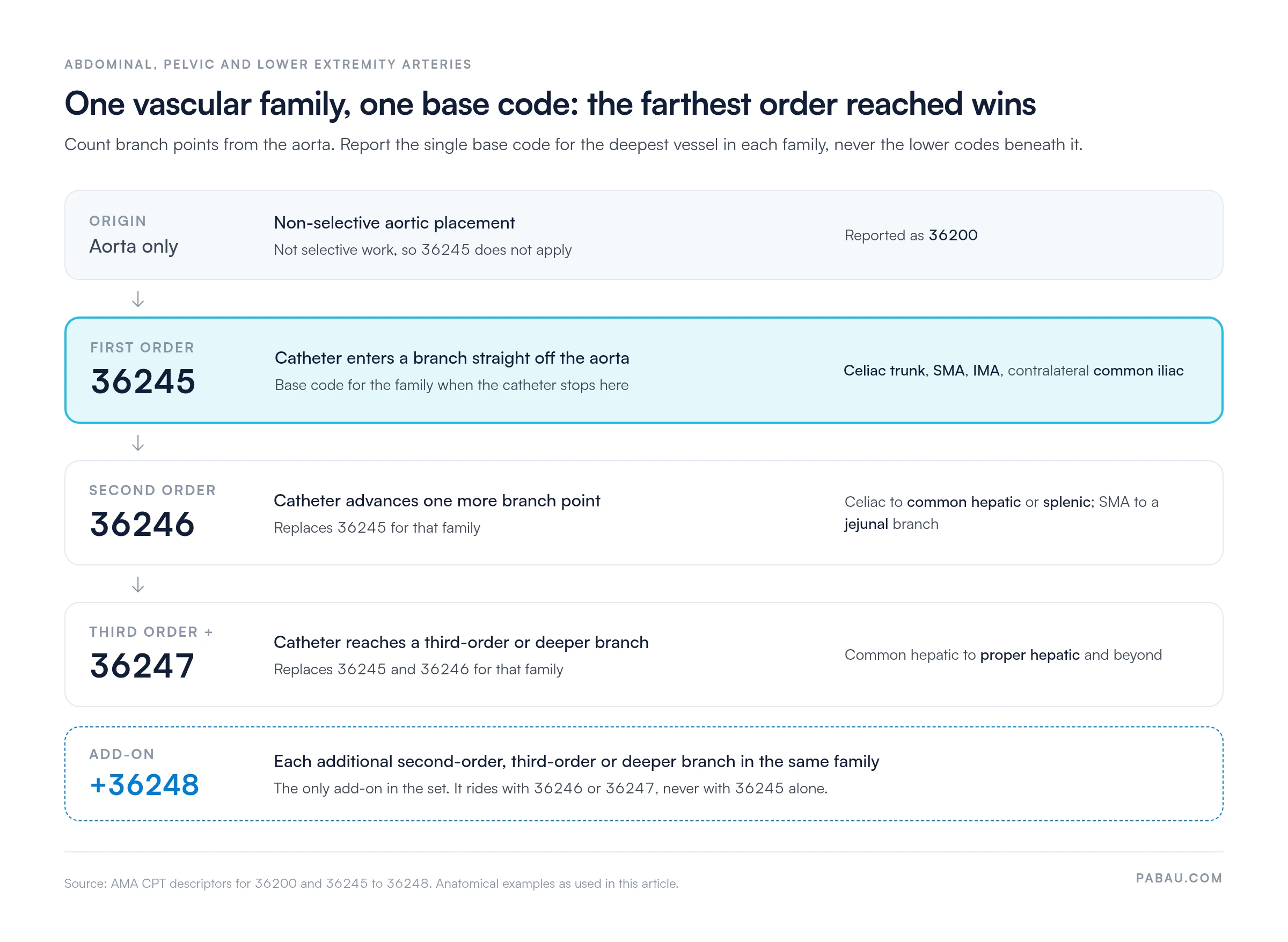
Say the catheter enters the celiac trunk, then advances into the common hepatic artery. That’s a first-to-second-order move, so the family bills 36246, not 36245.
If the operator then pushes on into the proper hepatic artery, the family moves up to 36247. In both cases, 36245 never goes on the claim for that family.
A second family in the same session gets its own base code. Take a celiac run to the common hepatic artery, plus a separate SMA run. The celiac family bills 36246, and the SMA family bills 36245.
The second line usually needs modifier 59 or XS to show a separate vessel. Third-order runs carry their own documentation traps, and the 36247 guide walks through them.
A payer reviewing 36245 wants five things in the operative report. If one is missing, expect a medical necessity denial or a records request that holds up payment.
Coders should review all five before charge entry, not after a denial. The diagnosis also has to point to the vessel entered, rather than to a downstream condition the study was meant to rule out.
Medical necessity for 36245 rests on a diagnosis that explains why that specific vessel was selected. A leg-artery diagnosis won’t support a mesenteric run, and the reverse is also true. These pairings come up most often.
Payers with Local Coverage Determinations (LCDs) for peripheral vascular disease often list the diagnoses they’ll accept. Check your contractor’s LCD before you finalize the code.
Laterality matters too. An unspecified-side code like I70.219 is weaker when the report names the leg, so look up the side-specific code in the ICD-10-CM code set instead.
Check the CMS LCD database for your MAC jurisdiction before billing 36245 for mesenteric ischemia diagnoses. Several contractors require non-invasive imaging (CT angiography or duplex ultrasound) documented as insufficient before approving invasive catheterization for K55.x codes.
Catheter placement and imaging are separate services, so most 36245 claims carry both. The skill lies in picking the right imaging codes and spotting when the catheter work is already built into another code.
The National Correct Coding Initiative (NCCI) edits set those pairing rules, and CMS updates them every quarter.
Radiological supervision and interpretation (S&I) codes report the imaging work. They’re billed separately from 36245 when images are taken and read.
Pick them by territory:
These S&I codes split into professional and technical parts. A physician reading in a hospital adds modifier 26, while the facility bills the technical side. 36245 is a surgical code with no such split, so it never takes 26 or TC.
Watch for codes that absorb selective catheter placement. The lower extremity revascularization codes, 37220 to 37235, include accessing and selectively catheterizing the treated vessel.
So billing 36245 for that same vessel is unbundling. If a diagnostic study of a different family happens in the same session, that family may still be coded on its own.
Modifier 59 flags a distinct procedural service. For 36245, it fits when a second, separate vascular family is catheterized in the same session.
CMS also offers the more specific XS modifier for a separate structure, and many payers prefer it. The HHS Office of Inspector General (OIG) has reported on modifier 59 misuse, so auditors look hard at it.
Pull a quarterly report of 36245 lines that carry modifier 59 or XS, then spot-check each one against the operative note. The note should name two separate vascular families. If it names one family at a deeper order, the claim needed 36246 or 36247 instead.
Bundling denials also leave a trail on the remittance. A line denied as bundled usually shows claim adjustment reason code (CARC) 97 or 236. CARC B15 on 36248 means the add-on reached the payer without its 36246 or 36247 base code.
Medicare pays 36245 under the Medicare Physician Fee Schedule (MPFS), with separate facility and non-facility rates. The non-facility rate is higher because the physician’s practice carries the cost of staff and equipment.
Work, practice expense, and malpractice relative value units (RVUs) add up to a total. CMS then multiplies that total by the annual conversion factor.
Rates change every year, so skip the static figures you find online. Use the CMS Physician Fee Schedule lookup for the current year and filter it to your locality. The Geographic Practice Cost Index (GPCI) moves the rate by region, so the same code pays differently in Manhattan and in rural Mississippi.
Commercial contracts often set their rate as a percentage of Medicare. Check each contract’s own schedule rather than assuming it tracks Medicare. Then compare every payment against the contracted rate, by payer and by location, so underpayments surface quickly.

There’s no single prior authorization rule for 36245. It depends on the payer, the plan, and the plan year. The safe habit is to check requirements for every patient before the case is scheduled.
For peripheral artery disease, payers often look for three things. They want symptoms, an ankle-brachial index (ABI) of 0.90 or lower, and a documented trial of conservative therapy.
When you verify eligibility, ask about prior authorization for the procedure code as well. Also submit the request under the same diagnosis you plan to bill, or the authorization may not match the claim.
Most 36245 denials trace back to five fixable problems. Each one has its own correction, so a generic appeal letter rarely works.
Track denials by reason and by payer. When the same category keeps coming back from one payer, fix the step that produces it rather than reworking each claim.
Many vascular billing teams still build each claim by hand from the operative note. Someone retypes the CPT code, re-enters the diagnoses, and chases missing payer fields after the claim bounces back.
Practice management software like Pabau shortens that loop. Its medical claims management tools pre-fill the claim from the patient record, so the 36245 charge line and its ICD-10 codes carry straight across.
Before the claim can be sent, Pabau checks that required fields, such as member IDs and authorization numbers, are filled in.
In the US, claims go out through the Claim.MD clearinghouse, with real-time eligibility checks, claim-status tracking, and ERA posting.
The coding decisions stay with your coders, including order assignment, S&I pairing, and modifier choice. What changes is the rework, because fewer claims come back for missing data.

Pabau pre-fills claims from the patient record, checks required fields before submission, and posts remittances automatically. See how it fits your interventional billing workflow.

Coding 36245 well comes down to one habit. Count the branch points in every family before you pick a code. Once that count is right, the modifiers, imaging codes, and diagnosis links usually fall into place.
The cost is a few extra minutes per case, because the coder reads the full note before charge entry. That’s still far cheaper than a corrected claim, an appeal, and a 36246 that should have gone out the first time.
Want your team to spend less of its day on claim data entry? Pabau can pre-fill claims and catch missing fields before they reach the payer.
Book a demo to see how it handles vascular claims from charge entry to payment posting.

Coding a run that reaches third order? CPT code 36247 covers third-order selective placement and how it pairs with add-on 36248.
Catheter stayed in the leg artery it entered? CPT code 36140 explains non-selective extremity artery catheterization.
Billing the leg angiogram that goes with it? CPT code 75710 covers unilateral extremity angiography supervision and interpretation.
Waiting on an authorization before the case? The prior authorization process walks through each step from request to approval.
Working a denied 36245 line? Denial codes in medical billing maps common CARC and RARC codes to corrective actions.
Not for the same catheter run. Placing the catheter in the aorta is part of reaching the first-order branch, so 36245 already includes that work. Bill 36200 on its own only when the catheter never leaves the aorta.
No. Diagnostic renal angiography has its own codes, 36251 to 36254. They bundle the renal catheter placement, the imaging, and the interpretation into one code. Use 36245 for a renal artery only when it’s selected without diagnostic renal angiography, such as an intervention on a later day.
No. Order is counted from the aorta, wherever the puncture was made. A catheter that comes down from a radial or brachial approach still codes the abdominal branch it ends in. The vessels it only passes through on the way aren’t coded as selective work.
It carries a 0-day global period on the Medicare Physician Fee Schedule. Follow-up visits after the day of the procedure can be billed on their own. A significant, separate E/M visit on the same day needs modifier 25 and its own documentation.