HCPCS code A4714: Treated water for peritoneal dialysis billing guide
HCPCS code A4714: Official descriptor, code type, and payment status HCPCS code ...

Last Updated: Oct 15, 2026
36247 is the CPT code for selective catheter placement into a third-order or more selective abdominal, pelvic, or lower extremity artery branch. It is the deepest catheterization code in that vascular family, with 36245 covering first-order placement and 36246 covering second-order. The thoracic and brachiocephalic vessels use a separate series, 36215 through 36218.
Most denials on this code trace back to two habits. The first is billing the lower-order stops made on the way to the third-order vessel, which are not separately payable in the same family. The second is reporting 36247 twice in one family, when the second and each subsequent vessel belongs on 36248.
Let Pabau's smart automation suggest the right codes, reduce claim denials, and keep your practice compliant—effortlessly.
Automate repetitive tasks and focus on what matters most—your patients.
Reduce coding errors and ensure compliance with the latest regulations.
Clean claims, fewer denials, and faster reimbursements.
Powerful insights and reporting to help your practice thrive.
HIPAA compliant SOC 2 certified GDPR-compliant Trusted by 4,000+ clinics worldwide

CPT 36247 is the third-order or more selective catheterization code for the abdominal, pelvic and lower extremity vascular family
First order in that family is 36245 and second order is 36246. Thoracic and brachiocephalic vessels use 36215 through 36218
Report one unit per vascular family. Each additional second-order or higher vessel in the same family goes on add-on code 36248
CY2026 Medicare pays $260.15 in a facility and $1,362.84 in a non-facility setting at the $33.5675 conversion factor
Catheterizing a treated lower extremity artery is bundled into the new 37254 to 37299 revascularization codes
The American Medical Association’s CPT code set gives 36247 this descriptor. Selective catheter placement, arterial system; initial third order or more selective abdominal, pelvic, or lower extremity artery branch, within a vascular family.
Two words in that descriptor decide most billing questions. The first, Initial, means one unit per vascular family. The second, Third order or more selective, means the code also covers fourth-order and deeper vessels, with no separate code for going further.
A vascular family starts at a named branch of the aorta and takes in every vessel that arises from it. Within one family you report only the highest order the catheter reached. So reaching a third-order vessel replaces 36245 and 36246 rather than adding to them.
Order is counted outward from the aorta, one named vessel at a time. The first named vessel arising from the aorta is first order. From there, a vessel arising from that one is second order, and a vessel beyond that point is third order or more selective.
The common femoral artery is treated as the continuation of the external iliac, so it does not consume an order of its own.
Worked through on a typical contralateral lower extremity case, the count runs like this:
So the same count applies in the abdomen. Celiac axis is first order, common hepatic is second order, and the proper or right hepatic artery is third order. A uterine artery reached through the internal iliac is likewise third order, which is why uterine fibroid embolization access usually codes to 36247.
In short, both territories run on the same ladder. The table below sets them side by side, from the aorta outward.
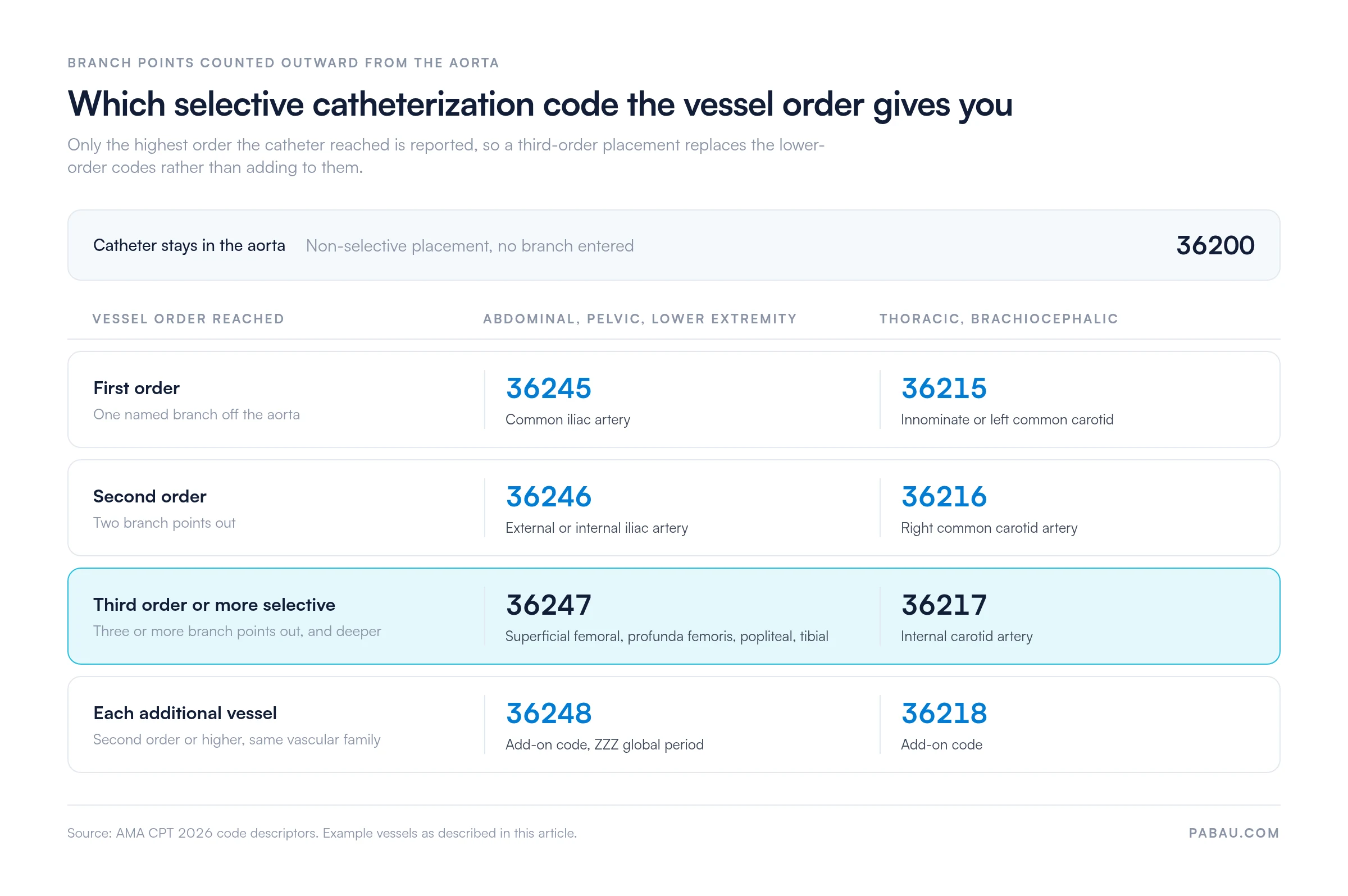
CPT 36247 applies wherever the catheter has to travel two branch points past the aorta to reach the target vessel. Those cases are usually therapeutic rather than purely diagnostic. For example, common scenarios include uterine fibroid embolization, prostatic artery embolization, and hepatic chemoembolization or radioembolization. It also covers gastrointestinal bleed embolization and below-the-knee runoff studies from a contralateral groin puncture.
Billing for vascular procedures starts with knowing which specialties report each code. For 36247, the reporting specialties are:
Every scenario needs documented medical necessity tied to a supporting ICD-10-CM diagnosis. Local Coverage Determinations from the Medicare Administrative Contractors set out which diagnoses support selective catheterization in each jurisdiction. So a claim submitted without an LCD-supported diagnosis is a routine medical necessity denial.
CY2026 payment for 36247 depends heavily on place of service. CMS publishes the Physician Fee Schedule each November for the year ahead. CY2026 is the first year with two conversion factors: $33.5675 for qualifying APM participants and $33.4009 for everyone else. So the figures below use the qualifying rate and carry no geographic adjustment.
Those locality figures come from applying each locality’s GPCIs to the published RVU components, using CMS Addendum E and the CY2026 relative value file. The spread is worth planning around. For example, an office-based lab in San Jose collects over $680 more per case than one in Arkansas, mostly because of the practice expense index.
Verify locality-specific rates with the CMS Physician Fee Schedule lookup tool before quoting reimbursement to physicians or coders. Also, electronic claim submission through Claim.MD adds eligibility checks that confirm coverage before the procedure is booked.
Every CPT code carries three relative value components. Each one is adjusted by its own geographic practice cost index, added together, then multiplied by the conversion factor. The values below are the published CY2026 national figures for 36247.
Check every rate you quote before it reaches a physician. Multiply the total RVUs by the CY2026 conversion factor, then check the result against the CMS fee schedule lookup. For 36247 that is 7.75 times $33.5675, which gives $260.15 in a facility. In other words, a number that does not add up has come from a stale conversion factor or a third-party aggregator.
Modifier selection for 36247 decides whether a claim pays, bundles or draws an audit. The code has a 0-day global period, so an E/M service on the same day can be billed separately with modifier 25. The table below covers the modifiers used most often.
Bundling with lower extremity revascularization: CPT 2026 replaced the deleted 37220 to 37235 range, including 37226, with 37254 to 37299. Femoral and popliteal work sits in 37263 to 37279, and those codes bundle catheterizing the treated artery, so 36247 is not separately reportable there.
Embolization works differently. Codes 37241 to 37244 cover imaging supervision and completion angiography but not the catheterization, so 36247 stays separately reportable and often pairs with 37243.
CPT 36247 sits inside a hierarchy, and mapping it correctly prevents both undercoding and overbilling. So the table below shows where each code in the family stops.
Vessels above the diaphragm use a parallel series with the same order logic. Mixing the two ranges is a frequent coding error, so treat the territory as the first decision and the order as the second.
Several companion codes are reported alongside 36247. For example, they include 75710 for unilateral extremity angiography supervision and interpretation and 75716 for the bilateral version. Ultrasound guidance of vascular access is 76937, and embolization is 37242 or 37243. Each carries its own edits. Check current pairings against the AAPC CPT code lookup and the NCCI Policy Manual before billing them together.
These are common pairings rather than a coverage list. Select the diagnosis that reflects the reason the procedure was performed, and confirm it against the applicable LCD. Also, codes with laterality or ulceration site axes need the full character string, not the truncated parent shown here. Our ICD-10-CM codes library carries each complete entry.
The operative note is what proves the order level, and auditors read it closely. Four elements have to be on the page before a coder can support 36247 over a lower-order code.
A note that says only “catheter advanced into abdominal aortic branches” supports 36200 and no higher code. Instead, naming the vessels turns the same procedure into a defensible 36247 claim.
CPT 36247 draws more denial letters than its volume suggests. The unit rules trip up billers who do not work in vascular coding every day. So solid medical billing compliance here comes down to matching the claim to what the note records.
Many of these are catchable before a claim leaves the practice. Pabau routes claims through the Claim.MD clearinghouse, which validates place-of-service codes and modifier combinations ahead of transmission. Also, posting remittance advice promptly afterwards keeps appeals inside the timely filing window.
Ask your interventionalists to dictate the vessel path as a list rather than a sentence. Access site first, then each named vessel in order, then the vascular family reached. The habit costs a few seconds per case. It is also what separates a $260 facility claim on 36247 from a $124 one on 36200.
The operative note and the claim often live in separate systems. A coder reads a dictation that reached the chart hours later, queries the physician by email, and the claim sits unbilled while that thread runs. Instead, practice management software like Pabau keeps the note and the claim in one record. The person coding 36247 then reads the signed note itself.
Every Pabau subscription includes every feature, so a single-operator office-based lab and a hospital-affiliated group work from the same toolset. Pabau’s claims management software centralizes submission, tracking and remittance against the record the procedure was documented in. As a result, this shortens the distance between a finished case and a posted payment.

Pabau connects structured procedure notes to claim submission, so the coder reading a 36247 case sees the vessels the physician named. Clean claims then go out through our Claim.MD clearinghouse integration.

CPT 36247 is the third-order or more selective code for the abdominal, pelvic and lower extremity vascular family. Every billing decision follows from that identity. Count the branch points, report one unit per family, and send additional vessels in the same family on 36248. Then check the territory, because every vessel above the diaphragm belongs to 36215 through 36218.
Place of service is the other decision worth money, at roughly $260 in a facility against roughly $1,363 outside one.
Pabau’s revenue cycle tools connect eligibility checks, claim submission and ERA posting in one workflow. In turn, that removes the manual handoffs that create errors on codes like this. To see how Pabau handles vascular and interventional billing for your practice, book a demo with the team.

Need to understand how clearinghouse claims submission works? Claim.MD clearinghouse integration covers how Pabau routes CPT claims to payers with real-time validation.
Managing denials on complex procedure codes? Denial codes in medical billing breaks down the CARC and RARC codes that appear on remittance advice for vascular procedures.
Want a structured billing compliance framework? Clean claim submission outlines what a clean-claim checklist covers for high-complexity interventional codes.
CPT 36247 reports selective catheter placement into a third-order or more selective branch of the abdominal, pelvic, or lower extremity vascular family. For example, interventional radiologists and vascular surgeons report it during uterine fibroid embolization, prostatic artery embolization, hepatic chemoembolization and selective below-the-knee angiography.
It is the third-order or more selective code. First-order placement in the same vascular family is 36245 and second-order placement is 36246. Only the highest order the catheter reached is reported, so 36247 replaces the lower-order codes rather than adding to them.
CPT 37226 was deleted for 2026 dates of service, along with the rest of the 37220 to 37235 range. Femoral and popliteal revascularization now uses 37263 to 37279, and those codes include accessing and catheterizing the treated artery. So catheter placement in that vessel is not separately reportable.
Modifier 59 or an X modifier supports a distinct service in a separate vascular family, where documentation backs it up. RT and LT identify the side when both legs are catheterized. Modifiers 26 and TC are not valid, because the PC/TC indicator for 36247 is 0.
The global period is 000, so no post-operative period is bundled into the code. Evaluation and management work on the same day can be reported separately when it is documented and modifier 25 is appended to the E/M line.