HCPCS code Q4154: Biovance billing, Medicare rate and denial guide
HCPCS code Q4154: definition and code details HCPCS code Q4154 is a Level II cod...

Last Updated: Oct 6, 2026
CPT code 75710 is the AMA CPT code set entry for angiography, extremity, unilateral, radiological supervision and interpretation. It is a radiology-only code covering the physician’s supervision and interpretation (S&I) of imaging for one extremity per encounter, upper or lower. Catheter placement, contrast injection, and any interventional work are reported separately with the appropriate surgical codes.
Two operational facts decide most 75710 claims. A laterality modifier, LT or RT, is mandatory on every claim line. Medicare pays roughly $149.30 nationally in 2026. That figure is the same in facility and non-facility settings, because the code has no technical component to split.
Coders meet CPT code 75710 most often in vascular surgery, interventional radiology, and cardiology. The typical case is a single limb imaged to evaluate peripheral artery disease (PAD), arterial stenosis, occlusion, aneurysm, or arteriovenous malformation. The imaging may happen in a hospital outpatient department, an ambulatory surgical center (ASC), or an office-based lab.

CPT code 75710 describes angiography of an extremity, unilateral, with radiological supervision and interpretation, and sits in the AMA’s Diagnostic Radiology subsection (codes 70010-76499).
Medicare pays roughly $149.30 nationally for 75710 in 2026, and the rate is identical in facility and non-facility settings.
Modifier LT or RT is required to indicate laterality. Billing 75710 twice for a bilateral study is a common CCI error, so report 75716 instead.
Pabau’s claims management software links CPT codes, ICD-10 diagnoses, and modifiers in a single claim record, reducing transcription errors on peripheral angiography claims.
Medicare pays CPT code 75710 at a single national rate, wherever the service is performed. The CMS Physician Fee Schedule prices it as a supervision-and-interpretation code, and its practice expense RVUs do not change with the setting. So a radiologist billing from a hospital outpatient department and one billing from an office-based lab are paid the same amount.
Dollar figures change with each annual MPFS final rule. The figure below reflects approximate 2026 national fee schedule data. Verify it against the current CMS MPFS file before you submit.
Important: Rates still vary by geography through GPCI (Geographic Practice Cost Index) adjustments. A practice in Manhattan receives a higher locality adjustment than one in rural Mississippi. Use FastRVU’s 2026 RVU lookup to calculate location-specific rates before budgeting.
Verify current figures against the CMS MPFS RVU data file each January. The practice expense RVU explains why the payment holds steady. It carries the same value in a hospital and in an office.
Because 75710 pays one national rate, a place-of-service error will not change the payment, though it can still fail a claim edit. The exposure that costs money is laterality. Pull a sample of paid 75710 claims each quarter and confirm the modifier on each line matches the extremity named in the radiology report.
Correct modifier use on CPT code 75710 claims is where many vascular billing teams lose reimbursement. Four modifiers apply routinely, and a fifth requires careful compliance review before use.
Laterality is not optional. Many MACs will reject CPT code 75710 without an LT or RT modifier, treating the absence as incomplete documentation. Apply laterality on every claim. If the operative report states left lower extremity, modifier LT must appear on the claim line.
Medicare will not pay CPT code 75710 without a diagnosis that establishes medical necessity under CMS LCD L36767. That determination governs coverage for aortography and peripheral angiography. It names the ICD-10-CM codes CMS considers medically necessary for this service.
The following ICD-10-CM diagnosis codes are commonly paired with CPT 75710. Payer acceptance varies, so confirm with your specific MAC and commercial payer policies before submission.
LCD L36767 is administered by Medicare Administrative Contractors (MACs), so coverage criteria can have jurisdiction-level variations. A code acceptable under one MAC’s version of the LCD may require additional documentation under another. Check your regional MAC’s version of L36767 before assuming universal coverage.
When both extremities are imaged in the same session, the correct code is 75716, not two units of CPT code 75710. Billing 75710 twice is the most common coding error in peripheral vascular imaging, and it triggers automatic NCCI review. The decision below turns on one line in the radiology report.
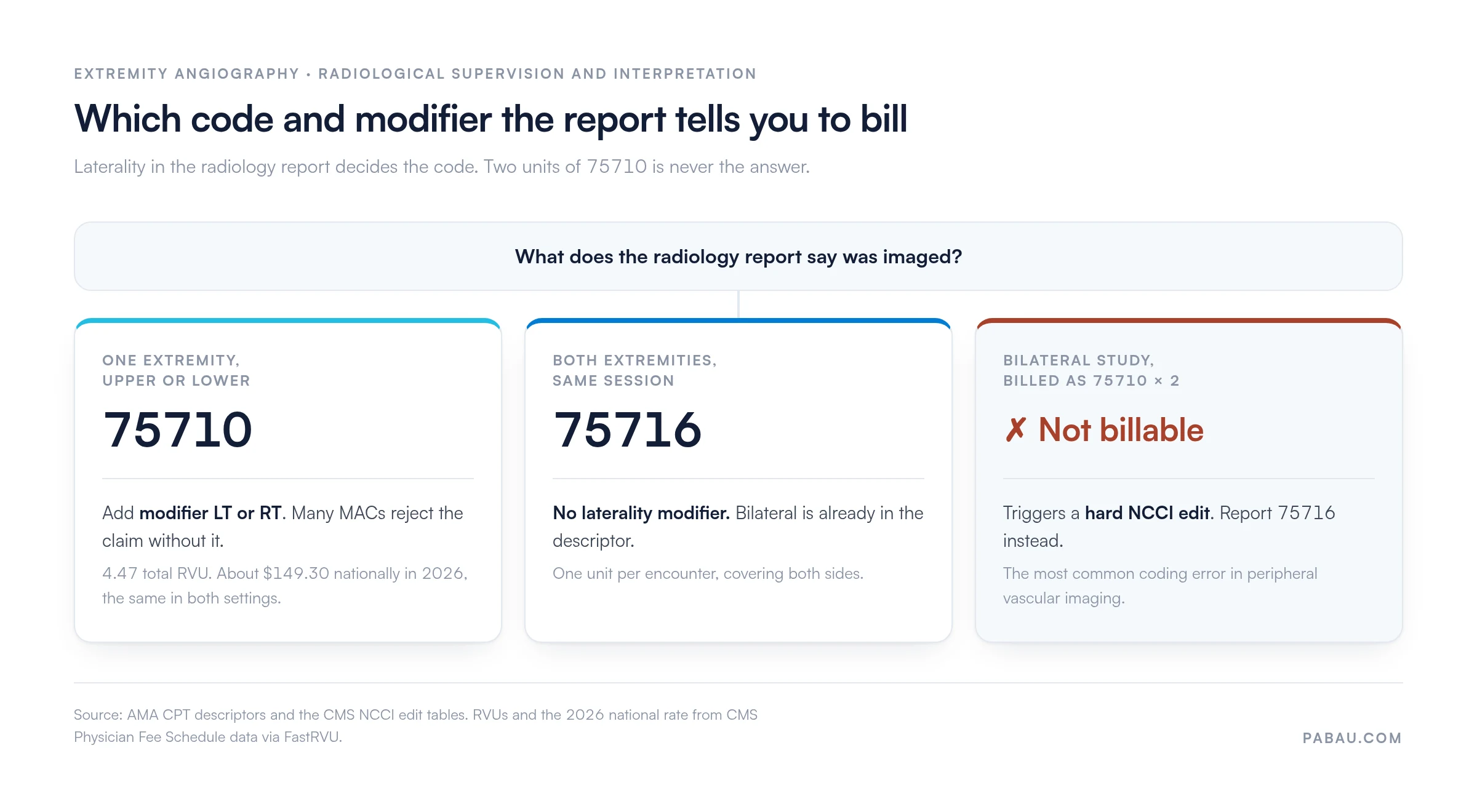
The radiology report must state whether one or both extremities were imaged. If the report says “bilateral lower extremity runoff,” the correct code is 75716. If it says “left lower extremity,” the correct code is CPT code 75710 with modifier LT. Auditors look at this first.
The National Correct Coding Initiative (NCCI) publishes bundling edits quarterly. Several edit pairs affect CPT code 75710 directly, particularly when aortography or catheter placement codes appear in the same encounter. CCI-related denials on vascular imaging are also among the slowest to overturn on appeal.
Abdominal aortography carries its own supervision and interpretation rules. The descriptor, modifier requirements and Medicare coverage criteria for 75625 are set out in a separate billing guide.
NCCI edits update quarterly. Review the current CMS NCCI edit tables before you finalize each quarter’s coding protocols. What was separately reportable in Q1 may be bundled by Q3.
Run a quarterly audit of your top 10 CPT code pairings with 75710. Pull every claim where 75710 appears alongside another radiology code, then cross-reference it against the current NCCI edit table. Catching a new bundling edit before it generates a denial saves far more time than working the denial afterwards.
CPT code 75710 belongs to a family of vascular imaging codes. Coders in interventional radiology or vascular surgery need to recognize each code’s scope to avoid overlap or missed charges. You can search the full range using the AAPC Codify CPT lookup tool.
Inadequate documentation is the second-largest cause of CPT 75710 claim denials, after CCI errors. Under CMS LCD L36767, the record must support both the medical necessity for the study and the technical performance of the procedure. A clean claim for 75710 requires all of the following elements to be traceable in the medical record.
LCD L36767 also requires documentation that less invasive diagnostic modalities were considered where applicable. In some MAC jurisdictions, failing to note prior ABI testing or duplex ultrasound can produce a coverage denial even when the angiography was clinically appropriate. Check your MAC’s version of L36767 for this requirement, because it is jurisdiction-dependent.
Reference tools give coders the code description. They do not connect that code to the claim, the diagnosis, and the documentation in one workflow. Re-keying between a lookup tool and a billing system is where CPT code 75710 denials accumulate.
Practice management software like Pabau closes that loop. Pabau’s claims management software links CPT codes, ICD-10 diagnosis codes, and modifiers directly to the procedure record. A coder assigns CPT code 75710 with modifier LT and diagnosis I70.202 once. That combination is stored as a single claim record, not re-entered after a manual lookup.
Claims then route to a clearinghouse from that same record. Pabau’s Claim.MD integration handles electronic claims for thousands of US payers. It supports CMS-1500 and 837P submission, real-time eligibility checks, and electronic remittance advice (835) processing.

For vascular practices submitting high volumes of peripheral angiography claims, the practical benefit is less rework. Remittance advice feeds straight back into the billing workflow. Denials tied to CCI edits or a missing laterality modifier surface within days rather than weeks. Coders act on CARC denial reasons without switching between systems.
The same record produces the charge slip, so nobody re-types the code, the modifier, and the diagnosis into a separate billing platform. That removes the transcription risk a reference-only tool cannot address.

Pabau connects CPT codes, ICD-10 diagnoses, and modifiers in one record, then submits claims through Claim.MD to thousands of US payers. See how it works for your vascular billing team.

CPT code 75710 is simple in concept and dense in operational detail. The laterality modifier and the 75710-versus-75716 distinction each create their own point of failure. So do the quarterly NCCI edit cycle and the LCD L36767 documentation demands.
Two habits prevent most of those failures. Read laterality off the radiology report before you choose the code, and re-check your 75710 pairings against the NCCI table every quarter. A coder who does both will rarely see this code denied.
The trade-off worth remembering is that a code lookup cannot verify what the claim actually carries. Only the system holding the code, the modifier, and the note can do that. To see how Pabau handles radiology S&I codes like 75710, book a demo.

Need to understand how clearinghouses validate claims before submission? How medical claims clearinghouses work explains the 837P validation and payer routing process end to end.
Want to reduce the time spent working denial queues? Denial management in healthcare billing covers CARC reason code interpretation and appeal workflows for radiology claims.
Need a reference on 837 file structure for electronic submissions? 837 claim file guide explains transaction segments, NPI placement, and common rejection reasons.
CPT code 75710 is used to bill radiological supervision and interpretation (S&I) for unilateral extremity angiography. It covers the physician’s imaging interpretation when a single limb is studied. It applies in diagnostic and pre-interventional settings for conditions including peripheral artery disease, arterial occlusion, aneurysm, and arteriovenous malformation affecting one extremity.
CPT 75710 covers angiography of a single extremity and requires a laterality modifier, LT or RT. CPT 75716 covers angiography of both extremities in the same session and uses no laterality modifier. Billing two units of 75710 for a bilateral study is a CCI coding error, so report 75716 instead.
Modifier LT (left) or RT (right) is required on every CPT 75710 claim to indicate which extremity was imaged. Modifier 26 flags the professional interpretation where a payer requires it, and TC belongs on the facility’s own equipment and staff charges. Modifier 59 may apply where a legitimate exception to a CCI edit exists, but it needs compliance review before use.
Yes, CMS LCD L36767 governs Medicare coverage for peripheral angiography including CPT code 75710. Coverage requires a documented clinical indication such as PAD, arterial stenosis, or occlusion, a supporting ICD-10-CM diagnosis code, and a signed physician interpretation. Coverage criteria can vary by MAC jurisdiction, so verify against your regional MAC’s version of L36767.
CPT 75710 and 75625 (abdominal aortography by serialography) are generally separately reportable when both studies are clinically distinct, though some payers bundle them. CPT 75710 and 75630 (abdominal aortography plus bilateral iliofemoral runoff) may overlap where the runoff covers the same extremity already captured by 75710. Review whether the extremity study added distinct clinical information before billing both.
The 2026 Medicare national rate for CPT code 75710 is approximately $149.30, and it is the same in facility and non-facility settings. The code has no technical component to carve out, so there is no separate office rate. Verify exact figures against the current CMS MPFS final rule or the CMS Physician Fee Schedule lookup tool before billing.