CCSD code H4430: Examination of rectum under anaesthetic
CCSD code H4430 pays for the examination alone CCSD code H4430 is the UK private...

Last Updated: Oct 20, 2026
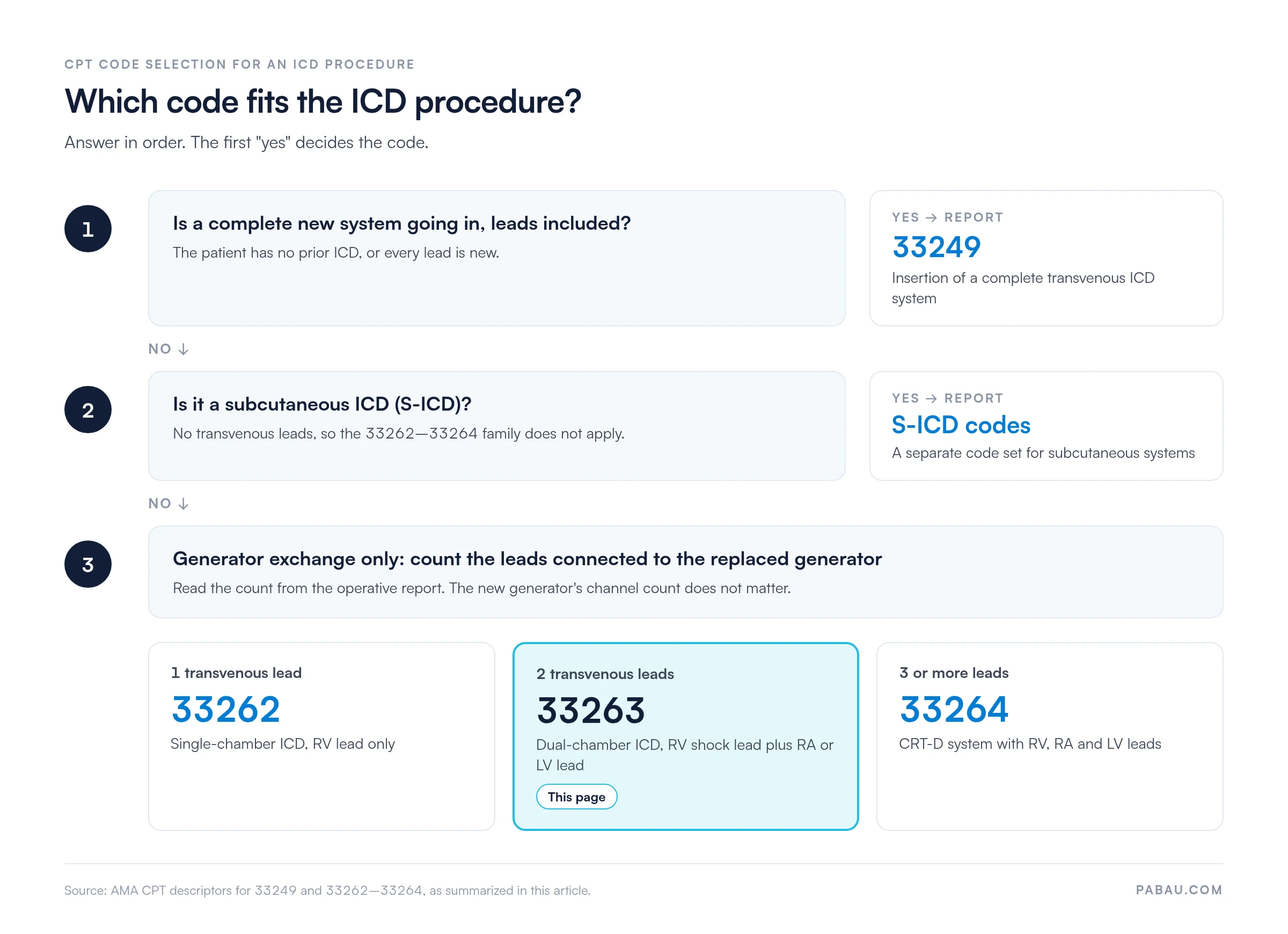
33263 is the CPT code for removal of implantable defibrillator pulse generator with replacement of implantable defibrillator pulse generator; dual lead system. It covers exchanging the generator of a transvenous ICD while its two existing leads stay in place.
Lead count decides the code: 33262 for one lead, 33263 for two, and 33264 for three or more. Battery depletion to the elective replacement indicator (ERI) is the most common reason for the exchange. The device interrogation report showing it is the key document for the claim.
Let Pabau's smart automation suggest the right codes, reduce claim denials, and keep your practice compliant—effortlessly.
Automate repetitive tasks and focus on what matters most—your patients.
Reduce coding errors and ensure compliance with the latest regulations.
Clean claims, fewer denials, and faster reimbursements.
Powerful insights and reporting to help your practice thrive.
HIPAA compliant SOC 2 certified GDPR-compliant Trusted by 4,000+ clinics worldwide

CPT Code 33263 covers removal and replacement of an ICD pulse generator on a dual-lead (two-lead) transvenous system. Single-lead replacements use 33262, and systems with three or more leads use 33264.
Medicare covers generator replacement under NCD 20.4, applied through billing and coding article A56391, when ERI or end-of-life (EOL) battery status is documented.
A missing device interrogation report is the leading cause of 33263 denials, so it belongs in the record before the claim goes out.
The 90-day global period applies. A same-day lead revision or addition needs its own code, plus modifier 59 or an X-modifier where an NCCI edit requires one.
Practice management software like Pabau submits claims to thousands of US payers through Claim.MD and runs eligibility checks before a claim is sent.
CPT Code 33263 describes the removal and replacement of an implantable cardioverter-defibrillator (ICD) pulse generator on a dual-lead system. The American Medical Association’s CPT code set places it in the cardiovascular surgery section, inside the ICD generator replacement family of 33262 through 33264.
“Dual-lead” means the transvenous system has just two leads in place at the time of the exchange. The surgeon removes the old generator from its subcutaneous pocket, disconnects it, and reconnects a new device to those same two leads.
The procedure does not include new leads, moving a lead, or adding a lead unless the surgeon separately records and codes those services. It also does not apply to subcutaneous ICD (S-ICD) systems, which use their own codes because the system involves no transvenous leads.
In short, knowing where the bundle ends prevents both underbilling and unbundling audit risk.
In addition, the 90-day global surgical period applies to 33263. The global period bundles related services inside that window. They are billable only when the record shows a distinct condition with no link to the surgery.
Lead count at the time of generator exchange decides the code. Count the transvenous leads connected to the system being replaced. The new generator’s channel count doesn’t matter if the leads themselves aren’t changing.
The operative report must state the number of leads connected to the replaced generator. If the op note is unclear, ask the surgeon before submitting. Billing the wrong lead count again and again on a costly device code also draws payer audits and repayment demands.
CPT 33249 covers insertion or replacement of a complete ICD system, including the pulse generator and transvenous leads. Use 33249 when the patient has no prior ICD and the surgeon implants a complete new system. Use 33263 when the surgeon exchanges a current dual-lead generator and the leads stay in place.
So the first question is whether the leads are new, and the second is how many there are. The decision path below puts those questions in order.
Medicare covers ICD generator replacement under National Coverage Determination (NCD) 20.4 for implantable automatic defibrillators. Medicare Administrative Contractors (MACs) apply it through billing and coding articles such as A56391. Article A56340 is another contractor’s version of the same article.
For a generator exchange, medical necessity often means the record shows one of these reasons:
The condition that first called for the ICD must also still be present. Take a patient whose ICD went in for prior ventricular fibrillation (VF) but who no longer qualifies. The payer may deny that claim even with a drained battery.
The ERI is a device-programmed alert that triggers when battery voltage drops to a threshold the device’s maker sets. It signals that the surgeon should replace the generator within a set window, often three to six months, before the battery runs out. EOL status means the battery is nearly empty and needs quick replacement.
For billing, the device clinic interrogation report from the pre-operative follow-up is the main proof of ERI or EOL status. That report must appear in the medical record. Medicare contractors often reject a surgeon’s note that only says “battery depleted” without the device printout behind it.
Every item below should be in the record before the claim goes out. Each missing item is a likely reason for denial.
A clean claim for a costly cardiac device procedure needs the practice to match all of the above before it leaves. Staff can often retrieve a missing interrogation report from the device maker’s remote monitoring platform, so don’t submit without it.
Modifier selection for 33263 depends on the surgical setup and payer rules. The AMA’s modifier definitions are the starting point, and payer policy articles govern any exceptions.
CMS calculates Medicare reimbursement for CPT Code 33263 from the relative value units (RVUs) it publishes in the Physician Fee Schedule. The values below are the CY2026 national facility RVUs.
Multiply the total RVU by the CY2026 conversion factor. That factor is $33.4009 for most clinicians and $33.5675 for qualifying alternative payment model (APM) participants. Geographic Practice Cost Indices (GPCIs) then adjust payment by MAC locality, so check your own locality in the CMS lookup tool.
However, Medicare pays the facility for the ICD generator itself, through the DRG on inpatient cases or the APC on outpatient claims. The physician fee schedule RVUs don’t capture it.
Pull fee schedule figures from the current year’s CMS relative value files, since RVUs and the conversion factor change every January.
Traditional Medicare does not require prior authorization for CPT Code 33263 when done in a facility setting. Medicare Advantage plans may set their own rules, so check with the plan before scheduling.
Commercial payers vary widely. Most require pre-certification for elective ICD generator replacements. This matters more when the patient’s cardiac diagnosis has changed since the first implant. Usual rules include:
For payers that require pre-certification, log each authorization number and its expiry date, and enter the number on the claim before you submit it. Claims software for cardiologists can check that the number is present before the claim goes out. An expired or missing authorization on a high-dollar device claim takes a lot of staff time to appeal.
Diagnosis coding supports medical necessity for the generator replacement. For an elective replacement, the encounter code is Z45.02. Coders should also report the cardiac condition that called for the first ICD, to show the condition is still active.
For an elective replacement, sequence Z45.02 first and the cardiac condition second. The encounter code says what was done, and the condition code says why. When the generator has malfunctioned, T82.111A takes the first-listed position instead, because category Z45 excludes device complications.
Overall, most 33263 denials trace to a small set of record-keeping and code-choice errors. Catch them before the claim leaves the practice, rather than decoding claim denial codes on a remittance afterward.
The National Correct Coding Initiative (NCCI) bundles certain same-day services into 33263 as part of the surgery. Common bundled codes include peri-procedural ICD evaluation and programming (93287) and ICD programming or interrogation evaluations (93282-93284, 93289). They are not separately payable on the operative date when bundled with the replacement.
A truly distinct service, such as a same-day lead procedure with its own documentation, takes modifier 59 or the right X-modifier on the extra code. The operative report must show that service was separate from the generator exchange. Check the current CMS NCCI edit tables before submitting, since they update quarterly.
Before submitting any 33263 claim, confirm three details in the chart. First, the device interrogation report showing ERI or EOL status is present. Second, the operative report states the number of transvenous leads connected to the replaced generator. Third, the ICD-10-CM code for the underlying cardiac condition pairs with Z45.02. These checks head off the most common 33263 denials before anyone ever needs an appeal.
A 33263 claim often depends on three documents that live in three places. They are the device clinic’s interrogation printout, the surgeon’s op note, and the payer’s authorization letter. Staff chase each one by hand, and a missing piece tends to surface weeks later as a denial.
Instead, Pabau keeps those documents on the patient record, next to the appointment and the invoice. When the claim is ready, Pabau runs validation checks in the background to confirm details such as authorization codes are in place. It then submits the claim through Claim.MD to thousands of US payers.
Real-time eligibility checks, claim status tracking, and ERA posting run from the same dashboard. Your billing team sees a stalled or rejected 33263 claim while it’s still fresh, instead of finding it on an aged receivables report.
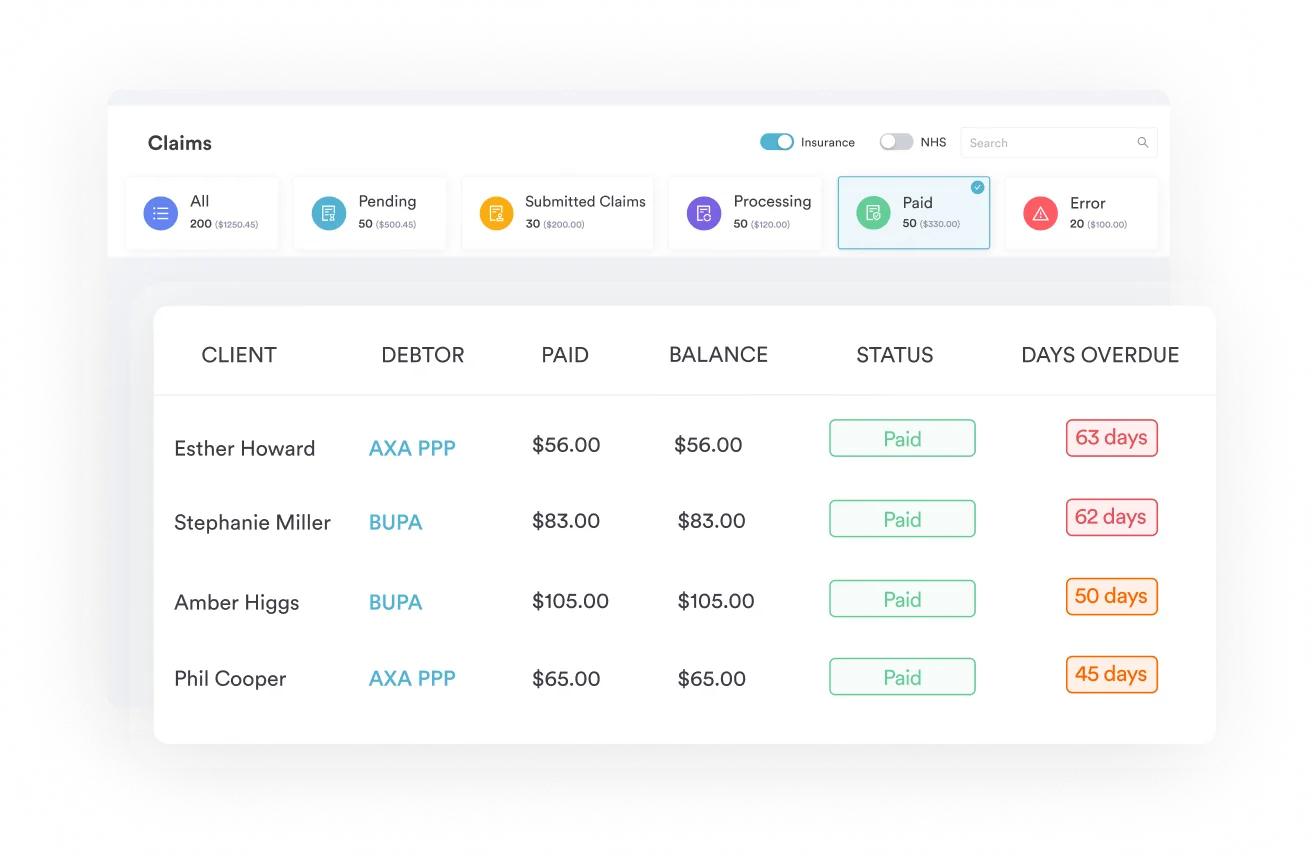

Pabau checks that required claim details are in place, submits through Claim.MD to thousands of US payers, and tracks each claim to payment. Your team spends less time on rework and more time on patients.

The lead count in the op note decides the code, and the interrogation printout decides whether it pays. Settle both before the claim goes out, and 33263 behaves like any other well-recorded surgical claim.
In the end, the trade-off is a few minutes of coder review on every case. An appeal on a denied device claim costs far more staff time than that check ever will.
Book a demo to see how Pabau keeps cardiac device claims recorded, submitted, and tracked in one place.

Need a clean claim checklist for high-value procedures? Clean claim submission standards covers what every surgical claim must include before it leaves the practice.
Exploring how clearinghouses process cardiac device claims? Medical claims clearinghouse guide explains how payer routing, eligibility checks, and ERA processing work end to end.
Weighing Claim.MD for your billing team? Claim.MD clearinghouse overview walks through what the clearinghouse handles and how practices use it.
Working through a denied ICD claim? Denial codes in medical billing breaks down the most common CARC codes and how to respond to each one.
CPT Code 33263 covers removal and replacement of an implantable cardioverter-defibrillator (ICD) pulse generator on a dual-lead transvenous system. The new generator connects to just two current leads. The code includes the exchange and routine intraoperative testing, but excludes lead revision, lead addition, and services outside the surgery.
The elective replacement indicator (ERI) is a device alert that fires when battery voltage drops to a threshold the maker sets. It signals the surgeon should replace the generator within three to six months. The interrogation printout showing ERI status is the main proof of medical necessity, and payers deny the claim without it.
Yes, but NCCI bundling edits apply. A lead procedure that the surgeon performs and records separately, such as a lead addition, can go alongside 33263 with modifier 59 or an X-modifier. The operative report must show the extra work was separate from the generator exchange. Check current NCCI edit pairs first, since the tables update quarterly.
The most common denial is a missing ERI or EOL interrogation report. Others are the wrong code from an incorrect lead count and NCCI bundling conflicts without a modifier. Diagnosis pairings that don’t support medical necessity are the fourth. A pre-submission documentation checklist prevents each of them.