

CPT Code 98981: RTM Treatment Management Billing Guide
CPT code 98981: Definition and official descriptor CPT code 98981 is an add-on c...

Last Updated: Nov 9, 2026
L8110 is the CCSD code for creation of a peritoneo-venous shunt (Levine/Denver), the operation that drains refractory ascites into a vein through a one-way valve. UK private medical insurers such as Bupa, AXA Health and Aviva use CCSD codes to identify the procedure on a claim. The CCSD Group does not set fees, so each insurer pays its own fee for the code.
Let Pabau's smart automation suggest the right codes, reduce claim denials, and keep your practice compliant—effortlessly.
Automate repetitive tasks and focus on what matters most—your patients.
Reduce coding errors and ensure compliance with the latest regulations.
Clean claims, fewer denials, and faster reimbursements.
Powerful insights and reporting to help your practice thrive.
HIPAA compliant SOC 2 certified GDPR-compliant Trusted by 4,000+ clinics worldwide

CCSD Code L8110 covers creation of a peritoneovenous shunt, whether the surgeon implants a LeVeen or a Denver device.
UK private medical insurers such as Bupa, AXA Health and Aviva use CCSD codes, and each insurer sets its own fee for L8110.
Pair L8110 with the WHO ICD-10 ascites code R18 (R18.X in the UK), plus a code for the cause, such as K74.6, C78.6 or I82.0.
Check each insurer’s pre-authorisation requirements before surgery, and keep the authorisation reference with the claim.
Pabau’s practice software keeps the patient record, operative notes and claim status for each L8110 case together, so insurer queries are answered from one record.
CCSD Code L8110 is the code for creation of a peritoneovenous shunt in the schedule published by the Clinical Coding & Schedule Development Group (CCSD). The official descriptor reads: “Creation of peritoneo-venous shunt (Levine/Denver).” The descriptor names both devices because the code describes the operation, whichever implant the surgeon uses. “Levine” refers to the LeVeen shunt.
UK private medical insurers, including Bupa, AXA Health, Aviva and Vitality, use CCSD codes to identify procedures on claims. The CCSD Group does not set fees. Each insurer attaches its own fee to the code, and NHS hospital activity is coded separately in OPCS-4. See CCSD procedure codes for a broader introduction to the schedule.
L8110 covers the operation for an initial shunt insertion. Shunt revision, shunt removal and a standalone paracentesis each take a separate code.
A peritoneovenous shunt redirects ascitic fluid from the peritoneal cavity into the venous system, typically the superior vena cava via the internal jugular vein.
The surgeon places a silicone tube with a one-way, pressure-sensitive valve in the abdomen. The venous limb is tunnelled under the skin to the neck and anchored in the target vein. When intra-abdominal pressure exceeds venous pressure, the valve opens and ascitic fluid drains into the bloodstream.
The two device types differ in valve mechanics. The LeVeen shunt uses a pressure-differential valve that opens passively. The Denver shunt adds a subcutaneous pump chamber the patient can compress to clear the valve if it clogs. Both are captured by CCSD Code L8110, so document which device was implanted in the operative note.
Insurers review the indication when they assess an L8110 claim, and the accepted clinical scenarios are narrow. Submit L8110 only when the operative record confirms one of the following:
Contraindications documented in the clinical file protect the claim from post-payment audit. Note the absence of active infection, coagulopathy beyond acceptable thresholds, heart failure that would not tolerate sudden volume loading, and loculated ascites. Peritoneovenous shunting carries meaningful morbidity in cirrhotic patients. The operative note should show that the risk-benefit discussion took place.
Billing an L8110 claim correctly takes a sequence of decisions before the claim reaches the insurer. Each step below is a potential rejection point if skipped.
Use claims management software to track each L8110 claim from submission to payment. When authorisation references and insurer queries are tracked by hand across several insurers, a lost reference or an unanswered query turns into a rejection.
UK insurers expect WHO ICD-10 diagnosis codes alongside the CCSD procedure code. WHO ICD-10 has a single ascites code, R18, which the UK 5th edition writes as R18.X. The US ICD-10-CM codes R18.0 and R18.8 do not exist in it.
So the primary code reflects the ascites, and a second code for the cause carries the malignant or non-malignant detail. The diagram shows how the two combine for each cause.
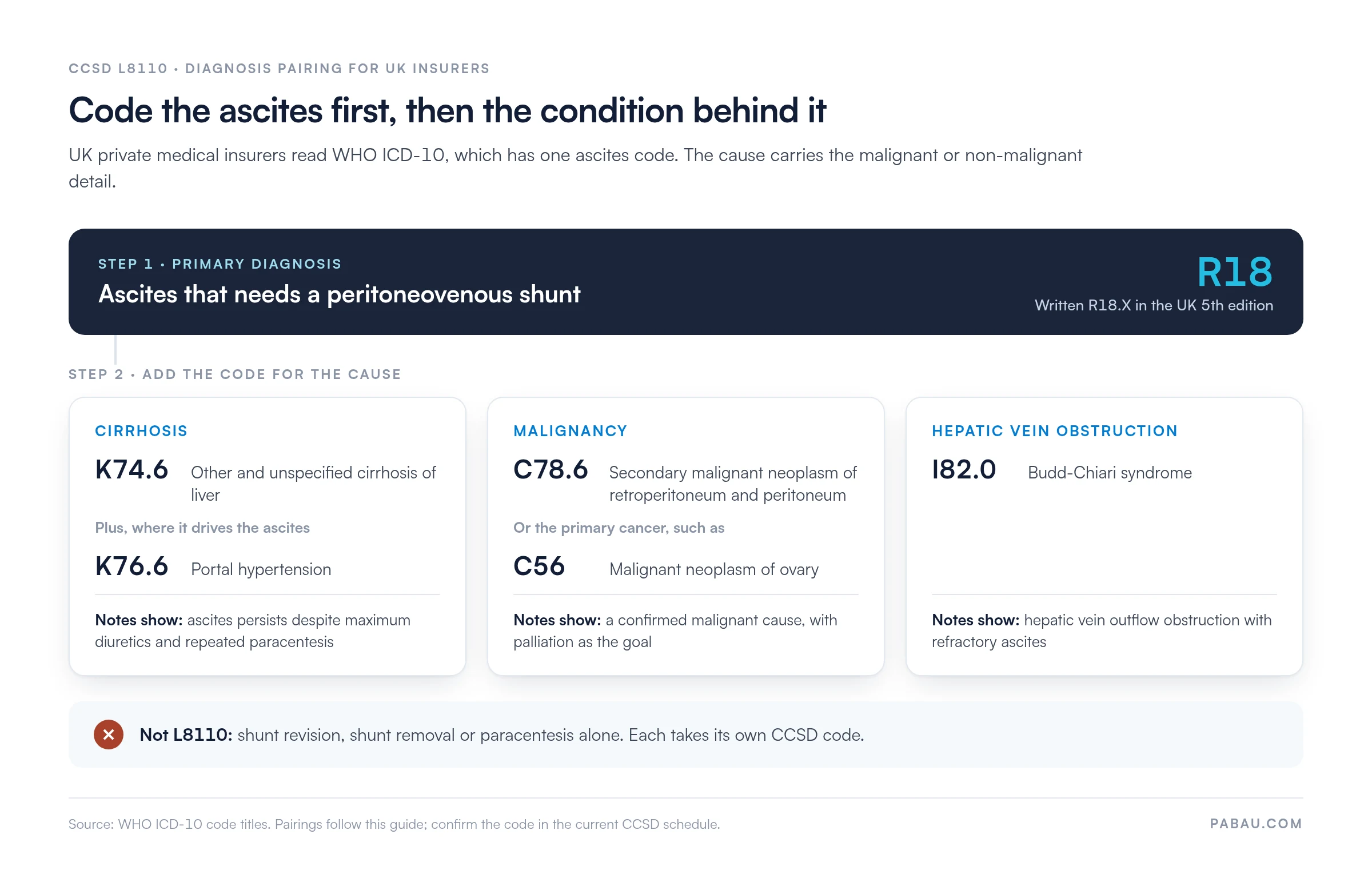
Treat each pairing as guidance. Policies differ, and insurers may apply their own clinical criteria. When a claim describes malignant ascites without a cancer code or notes confirming the malignancy, expect a query or a rejection.
UK private medical insurers do not apply CPT-style numeric modifiers to CCSD codes. Each insurer sets its own rules for a surgical assistant, a second procedure in the same session, or urgent surgery.
The anaesthetist bills separately for L8110, against the insurer’s anaesthetist fee for the procedure. The surgeon’s and anaesthetist’s claims belong to the same episode but are assessed separately. Do not include anaesthesia charges on the surgeon’s L8110 line. The Healix fee schedule is one example of a payer publishing its own fees against CCSD codes.
Before claiming a surgical assistant fee for L8110, check that the patient’s insurer recognises one for this procedure. Make sure the operative note names the assistant and records their role. Insurers may ask for the full operative record before they pay an assistant fee.
UK private medical insurers generally expect patients to obtain pre-authorisation before planned surgery. Requirements differ by insurer and by policy, so check each insurer’s process rather than relying on a general rule. A claim for an operation the insurer has not authorised may not be paid.
For urgent cases, contact the insurer once the patient is stable and follow its process for authorising treatment after the event. Confirm the rules in each insurer’s current provider guidance, and check the code against the current CCSD schedule.
Knowing where L8110 sits among related procedures prevents upcoding and downcoding errors. The table below shows the procedures most often confused with it. Use the Bupa code search to see Bupa’s current descriptor text and fees for each.
Confirm the exact codes for shunt revision and removal in the current CCSD schedule, as codes and descriptors can change in updates. Never bill L8110 for a revision or removal. Doing so is upcoding and invites an insurer audit. Our CCSD codes library covers neighbouring liver and vascular procedures, code by code.
L8110 is a major surgical code, so insurers review these claims closely. The rejection patterns are predictable. Address each of the following before submission.
Turn the table above into a pre-submission checklist for every L8110 claim. Catching these errors before submission is faster than managing appeals afterwards.
An L8110 claim that survives audit depends on the operative note. Insurers carrying out post-payment audits may request the full clinical file. The operative note should contain:
Supplementary documents to retain include hepatology or gastroenterology letters confirming failed conservative management, paracentesis logs and the anaesthetic record. Digital clinical documentation reduces the risk of key fields being left out at the time of dictation.
Dictate the operative note straight after L8110 surgery, while the details are fresh. Notes completed the next day often miss the device-specific details insurers request during audit. A same-day note with the device type, approach and catheter placement is your strongest defence.
Billing a complex surgical code like L8110 puts pressure on manual workflows. Authorisation references, operative notes and insurer queries often live in different places, and the claim waits while someone gathers them.
Pabau keeps the patient record, clinical notes and claim tracking for each case in one place. When the operative note is captured digitally, the billing team can check the device type, indication and approach before the claim leaves the practice. Authorisation references sit on the patient record, where the team can find them at submission.
Pabau sends private medical insurance claims through Healthcode and tracks each one until it is settled. When an insurer queries an L8110 claim, the biller finds the operative note on the same record. The answer does not wait on a paper archive.

Pabau keeps the patient record, operative notes and claim tracking in one place, and sends private medical insurance claims through Healthcode. Your team can answer insurer queries on complex codes like L8110 without chasing paper files.

Most L8110 rejections trace back to three problems: a diagnosis that does not explain the shunt, a missing pre-authorisation, or a thin operative note. All three are settled before the patient reaches theatre, long before the claim comes back.
That makes the booking, not the billing, the place to protect an L8110 claim. Check the insurer’s requirements and the current CCSD schedule when surgery is planned, and the claim leaves the practice complete. To see how Pabau handles CCSD billing for UK private practices, book a demo.

Need a broader CCSD reference for private insurer billing? Bupa CCSD codes guide explains how the CCSD schedule works and how UK insurers apply it.
Billing another liver procedure? CCSD code J1400 covers open puncture of the liver, with ICD-10 pairings and UK insurer requirements.
Working up the liver disease behind the ascites? CCSD code J1300 covers percutaneous biopsy of a liver lesion, with diagnosis pairings and UK insurer requirements.
CCSD Code L8110 is the code for the surgical creation of a peritoneovenous shunt using either a LeVeen or a Denver device. It covers the operation for an initial shunt insertion. It does not include revision, removal or a standalone paracentesis.
Both devices are billed under CCSD Code L8110. The LeVeen shunt uses a passive pressure-differential valve, while the Denver shunt adds a pump chamber the patient can compress. Record which device was implanted in the operative note, because the hospital usually bills the implant separately.
Most UK private medical insurers expect pre-authorisation before planned surgery, but requirements differ by insurer and policy. Check each insurer’s current process before the operation and keep the authorisation reference with the claim. For urgent surgery, follow the insurer’s process for authorising treatment after the event.
Shunt revision and removal take separate CCSD codes, not L8110. Using L8110 for a repeat procedure is upcoding. Confirm the revision and removal codes in the current CCSD schedule, as codes and descriptors can change in updates.
No. The surgeon bills L8110, and the anaesthetist bills separately against the insurer’s anaesthetist fee for the procedure. Both claims belong to the same episode but are assessed independently. Do not include anaesthesia charges on the surgeon’s L8110 line.




