

HCPCS Code E0272: Foam rubber mattress billing guide
HCPCS Code E0272: official descriptor and code overview HCPCS Code E0272 is the ...

Last Updated: Nov 6, 2026
CCSD code K6082 is the code for removal of a pacing system, generator only. It covers taking the pulse generator out of its pocket while the pacing leads stay in place. Cardiologists, cardiac surgeons and private hospitals use it when they bill UK private medical insurers for this procedure.
The code sits in CCSD Chapter 8, sub-chapter 8.9.0 Heart - Cardiology, and was added to the schedule on 20 January 2010. If the leads come out as well, the right code is K6080, or K6040 when bypass is used. CCSD lists K6040, K6060 and K6080 as unacceptable combinations with K6082.
Let Pabau's smart automation suggest the right codes, reduce claim denials, and keep your practice compliant—effortlessly.
Automate repetitive tasks and focus on what matters most—your patients.
Reduce coding errors and ensure compliance with the latest regulations.
Clean claims, fewer denials, and faster reimbursements.
Powerful insights and reporting to help your practice thrive.
HIPAA compliant SOC 2 certified GDPR-compliant Trusted by 4,000+ clinics worldwide

CCSD code K6082 covers removal of a pacing system’s generator only, with the leads left in place.
It sits in CCSD Chapter 8, sub-chapter 8.9.0 Heart – Cardiology, and has been in the schedule since 20 January 2010.
CCSD lists K6040, K6060 and K6080 as unacceptable combinations with K6082, and each insurer decides whether to apply them.
Removing a leadless pacemaker is not K6082, because it has its own code, K6121, from CCSD Bulletin 203.
Most K6082 claims come back for a mismatched authorization, a note that doesn’t confirm the leads stayed, or a same-date clash.
CCSD code K6082 is the code for removal of a pacing system, generator only. You use it when the pulse generator comes out and the leads stay where they are. It is a cardiac code, listed in Chapter 8 (Thorax and intra-thoracic organs) under sub-chapter 8.9.0, Heart – Cardiology.
CCSD stands for the Clinical Coding and Schedule Development group. UK private medical insurers set it up to keep one shared schedule of procedure codes and narratives. The group decides the codes and their wording. Fees are a separate matter, and each insurer sets its own for K6082.
K6082 joined the schedule on 20 January 2010. The people who bill it are cardiologists and cardiac surgeons in private practice, plus the private hospitals where the procedure takes place. To check the codes around it, use our searchable CCSD code index.
K6082 is narrow on purpose. It describes one step, taking the generator out, and none of the work on the leads. Use it when all three of these are true:
Reach for a different code when the procedure goes further:
Check those cases in order after the procedure, and the first match decides the code.
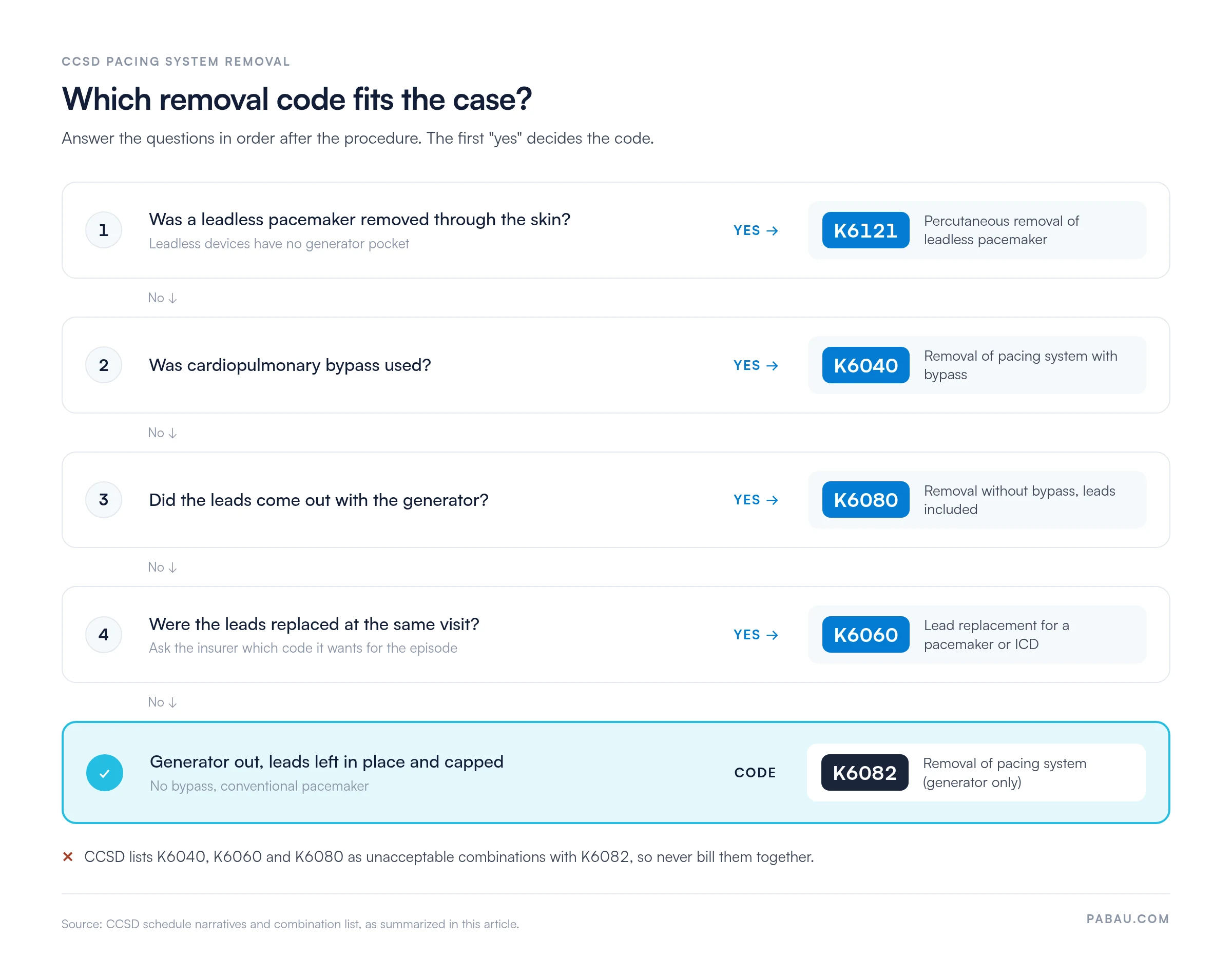
One more check is worth doing. The K6082 narrative names a pacing system, so read the schedule before you use it for a defibrillator.
The code depends on what happened to the leads, so decide it after the procedure, not before. Here’s how three common cases play out.
Scenario 1: Generator out, leads capped and left in place. This is K6082 on its own. The operative note should say the leads were left in situ and capped.
Scenario 2: Generator out, then the leads extracted in the same session without bypass. Bill K6080 alone. K6080 already includes the leads, and CCSD lists it as an unacceptable combination with K6082.
Scenario 3: Generator out and a lead replaced at the same visit. K6060 is also on K6082’s unacceptable-combination list. Ask the insurer which code it wants for the episode before you submit.
A generator change needs the same care. Before you bill it as K6082 plus an insertion code, look for a schedule code that describes the whole replacement. Then confirm the coding with the insurer.
Insurers pay K6082 against the operative note. That note has to show three facts clearly: the generator came out, the leads stayed, and no bypass was used. Build your record around this checklist:
Write the lead status in plain words. A line such as “leads left in situ and capped” removes any doubt about whether the case should have been K6080.
The removal codes sit close together in the schedule, and the difference comes down to leads, bypass and device type. Use this table to check your choice.
K6121 is the newest code here. CCSD approved it in Bulletin 203, dated 14 August 2025, with a recommended adoption date of 10 October 2025. The same bulletin changed the K6040 narrative to exclude leadless devices. Check the current CCSD schedule for the full narratives before you code.
Three codes can’t sit on the same claim as K6082, according to CCSD. They are K6040, K6060 and K6080.
CCSD publishes these combinations, but it doesn’t enforce them. Each insurer decides whether to apply them, so check the insurer’s own rules. A procedure that isn’t on the list may still be billable on the same date, subject to that insurer’s policy.
Most UK private claims travel electronically through Healthcode, the clearing service that links providers to insurers. A K6082 claim usually follows five steps:
Each insurer adds its own requirements on top. For Bupa’s version of these rules, see Pabau’s Bupa CCSD codes guide.
Most K6082 problems start with a plan that changed during the procedure. These are the mistakes that come up most often:
Run through this short check before the claim leaves your system. It takes a minute and saves a resubmission.
Generator-removal claims rarely stall on the code itself. They stall when the authorization number lives in an email and the operative note lives in another system.
Pabau, the practice software our team builds for private practices, keeps the patient record and the claim together. With its Healthcode-connected claims management, you submit CCSD-coded claims straight from the record. Required fields, such as membership and authorization numbers, are checked before the claim can be sent.
Digital clinical forms sit in the same record. That way your pre-procedure checklist and consent are on file when the claim goes out.
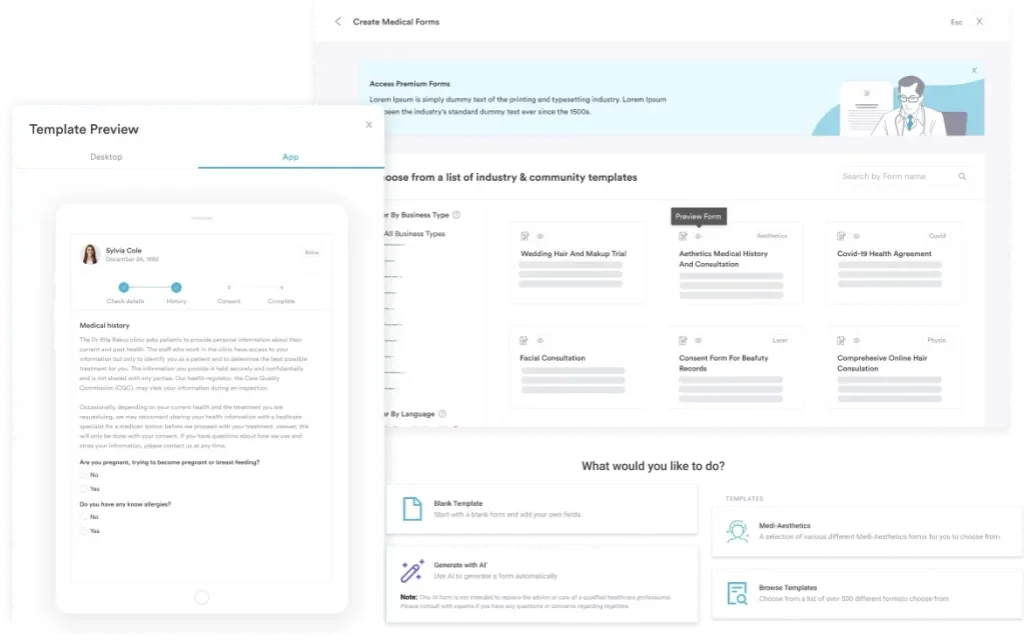

Pabau sends your CCSD-coded claims to Healthcode from the patient record, with required fields checked first. See the workflow in a live demo.

K6082 rewards precision. The code covers one step, and the claim succeeds when the note proves the leads stayed put.
Settle the code after the procedure, then update the authorization if the plan changed. Keep K6082 off any claim that already carries K6080, K6040 or K6060. Those two habits head off the usual reasons a K6082 claim comes back.
Book a demo to see how Pabau keeps your notes, authorizations and Healthcode claims in one place.

Billing Bupa for a cardiac procedure? Pabau’s Bupa CCSD codes guide explains how Bupa uses the CCSD schedule and what its claims need.
Want fewer returned insurer claims? Pabau’s claims management software submits CCSD-coded claims through Healthcode from the patient record.
Sending a claim on paper? Medical insurance claim form template sets out the patient, policy and procedure details an insurer asks for.
Coding other cardiac surgery? CCSD code K2310 covers excision of a cardiac tumor and how to bill it.
The closest US equivalent is CPT code 33233, removal of a permanent pacemaker pulse generator only. CPT codes don’t apply to UK private insurer claims, which use the CCSD schedule.
No. CCSD Bulletin 203, dated 14 August 2025, did not change the K6082 narrative. It added K6121 for leadless pacemaker removal and changed K6040 to exclude leadless devices.
There is no single fee. CCSD sets codes and narratives, not fees, so each insurer publishes its own rate. Check the insurer’s fee schedule or provider portal before you quote the patient.
The K6082 narrative names a pacing system. Before you use it for a defibrillator, check the schedule for a code that names the device, and confirm the choice with the insurer.
Read the return reason first. If the code changed during the procedure, ask the insurer to amend the authorization. Then correct the claim and resubmit it through Healthcode.




