

HCPCS Code E0272: Foam rubber mattress billing guide
HCPCS Code E0272: official descriptor and code overview HCPCS Code E0272 is the ...

Last Updated: Nov 6, 2026
Billable Code Specific Code
K6000 is the CCSD code for a cardiac pacemaker system introduced through vein (single chamber). It covers a new implant of one pulse generator and one transvenous lead in a single operative episode, billed to UK private medical insurers.
The pacemaker unit, theater fees and the anesthetist's fee are billed on separate lines. A dual-chamber system takes K6010, and a generator or lead replacement on an existing system takes its own replacement code.
Let Pabau's smart automation suggest the right codes, reduce claim denials, and keep your practice compliant—effortlessly.
Automate repetitive tasks and focus on what matters most—your patients.
Reduce coding errors and ensure compliance with the latest regulations.
Clean claims, fewer denials, and faster reimbursements.
Powerful insights and reporting to help your practice thrive.
HIPAA compliant SOC 2 certified GDPR-compliant Trusted by 4,000+ clinics worldwide

CCSD code K6000 covers a new single-chamber cardiac pacemaker system introduced through a vein, with one pulse generator and one transvenous lead.
A dual-chamber system is K6010, while a generator or lead replacement on an existing system takes a replacement code such as K6030 or K6060.
The code covers venous access, lead placement and generator insertion, but the device cost, theater fees and the anesthetist’s fee are billed separately.
Most UK private insurers require pre-authorization before an elective implant, and a missing pre-auth number is a common reason for outright denial.
Pabau tracks each pre-authorization against the appointment and checks claims for missing details before they go to insurers through Healthcode.
CCSD code K6000 is defined as “cardiac pacemaker system introduced through vein (single chamber)” by the Clinical Coding and Schedule Development Group. That body maintains the CCSD schedule used across UK private healthcare. The code describes a procedure in which a pulse generator and a single transvenous lead are implanted as a complete system during one operative episode.
CCSD codes are distinct from NHS OPCS-4 procedure codes. Both systems describe the same clinical procedures, but they are maintained separately and must never be cross-submitted. CCSD applies only to UK private healthcare billing, including PMI claims and self-pay invoicing. The full schedule, chapter by chapter, sits in our CCSD code library.
Single-chamber pacemaker implantation via the transvenous route involves venous access, lead advancement under fluoroscopic guidance, lead fixation, and pulse generator pocket creation. The operative sequence maps directly to what CCSD code K6000 covers.
A valid K6000 claim rests on documentation of each step, including fluoroscopy time, pacing parameter measurements, and device serial numbers. When any of these is missing, the insurer has grounds for an audit or a denial.
Not every bradyarrhythmia qualifies for pacemaker implantation. Insurers expect the clinical record to show that the indication meets accepted guideline thresholds. The following conditions are the primary drivers of K6000 claims in UK private practice.
These ICD-10 codes belong in the diagnosis field of every K6000 claim. A claim with no supporting diagnosis code, or with one that doesn’t match the documented presentation, is a leading cause of insurer queries. Verify the exact codes against the NHS Classifications Browser for the ICD-10 5th edition used in UK practice.
Where the cause of a slow or intermittent rhythm is still unclear, the cardiologist may first run an intracardiac electrophysiological study, billed as K5810. That study is a separate episode with its own claim and its own pre-authorization.
K6000 covers the procedural work of implanting the complete single-chamber pacemaker system: Venous access, lead placement, generator insertion, wound closure, and intraoperative device programming. Under standard CCSD bundling conventions, the pacing lead and the pulse generator are both components of a single implantation episode.
Several charges are routinely billed alongside K6000 on the same invoice, but as separate line items.
Confirm device cost authorization separately with the insurer before the procedure. Pacemaker devices cost enough that most insurers want explicit prior approval. Device costs submitted under K6000 without that approval are a frequent source of partial payment.
Four CCSD codes cover most pacemaker claims: K6000, K6010, K6030 and K6060. Billing K6010, the dual-chamber code, for a single-chamber device is upcoding. Billing a replacement code such as K6030 for a new implant is a wrong-code selection, because the claim then describes a different operation. The diagram below traces the two questions that separate the four codes.
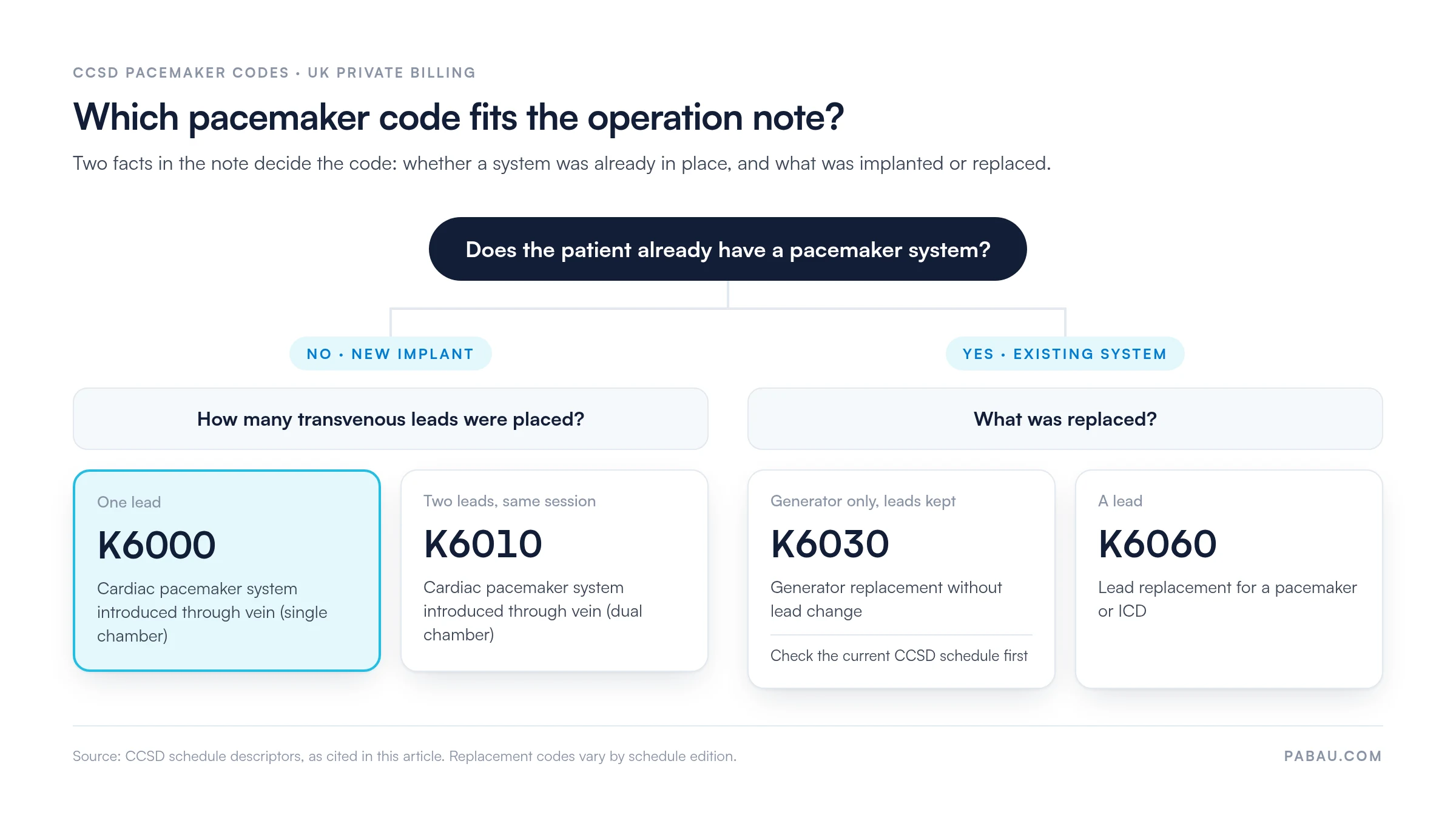
The operation note decides the code. One lead placed in a new system is K6000, and two leads placed in the same session is K6010. A generator change on an existing system points to K6030. CCSD’s legacy data flags K6030 as inactive, so check the current CCSD schedule before billing any replacement. The CCSD Technical Guide sets out the coding conventions behind these distinctions.
A complete K6000 claim needs specific clinical documentation. When any of the following elements is missing, insurers routinely query the claim, which delays payment on a high-value procedure.
Cardiology practices whose claims software for cardiologists attaches the operation note at submission avoid a common audit failure. In that failure, a coder submits the CCSD code but can’t find the matching operation note when the insurer asks for it.
Audit your K6000 operation note templates against this checklist before the procedure happens, not after. A standardized dictation template for single-chamber implants captures every required field at the time of surgery. That removes the risk of a documentation denial weeks later, when the case is cold.
Most UK private medical insurers require pre-authorization before elective pacemaker implantation. A missing or incomplete pre-authorization is one of the commonest reasons a K6000 claim is denied outright, rather than queried for more information.
For an emergency or urgent implant where pre-authorization can’t be obtained in advance, document the clinical urgency explicitly in the admission notes and operation record. Most insurers have a retrospective authorization pathway for cases where delay would have caused clinical harm. Submit the retrospective request with its clinical justification within 24 to 48 hours of the procedure where possible.
Healthcode is the primary electronic claims clearinghouse for UK private healthcare, connecting consultant invoicing systems to PMI claims processing. Most K6000 claims travel through Healthcode’s portal before reaching the insurer.
Practices billing for several consultants can compare the systems that handle this workflow in our review of UK medical billing software. Bupa adds its own conventions on top of the schedule, and our guide to Bupa CCSD codes covers them.
K6000 claims are denied for a predictable set of reasons, and most of them are fixed by process changes rather than clinical ones. Once a claim does come back, a structured approach to denial management decides how quickly it gets paid.
CCSD and OPCS-4 are parallel procedure coding systems used in UK healthcare. The distinction matters for any coder who works across NHS and private practice settings. Neither the NHS nor UK private insurers accept a code cross-submitted from the other system.
CCSD is maintained by the Clinical Coding and Schedule Development Group. It is used only for UK private healthcare billing, including PMI claims and self-pay invoicing. OPCS-4 is the NHS procedure coding classification, maintained by NHS England. It feeds HES (Hospital Episode Statistics) data, NHS tariff calculations, and NHS provider returns.
NHS OPCS-4 codes can be browsed in the NHS Classifications Browser linked above. Coders trained in NHS settings may default to OPCS-4 descriptors when they move into private billing, and those claims are rejected at once. When in doubt, verify the code against the CCSD schedule directly.
In most private cardiology practices, the K6000 claim is assembled by hand after the procedure. Someone copies the CCSD code from the operation note and finds the pre-auth number in an email. Then they key the diagnosis code into the Healthcode portal. A missed step only surfaces when the insurer queries or denies the claim.
Pabau, the practice management platform we build, keeps those pieces on one patient record. Each insurer pre-authorization is stored as a case and follows the appointment through to the invoice. Claims go to Bupa, AXA Health, Vitality and other insurers through Healthcode. Claim validation flags missing or invalid details before you submit.
The outcome is a K6000 claim that leaves complete, with its authorization reference and diagnosis code in place. If an insurer still rejects it, Pabau shows the reason, so you can correct the claim and resubmit.

Pabau tracks each pre-authorization against the appointment, checks claims for missing details, and sends them to insurers through Healthcode. Your K6000 submissions go out complete, with fewer queries and resubmissions.

K6000 claims fail for administrative reasons far more often than clinical ones. Missing pre-authorization, selecting K6010 instead of K6000, or leaving out the ICD-10 diagnosis code accounts for most avoidable denials on a well-defined procedure.
That puts the fix before the procedure date, not after the denial. Confirm pre-authorization and device approval at booking, and use an operation note template that records lead count and serial numbers in theater. A claim built that way rarely needs a second submission.
Pabau keeps the pre-authorization, the operation note and the Healthcode claim on one record, so those checks happen as part of the workflow. Book a demo to see how Pabau handles CCSD billing for UK private cardiology practices.

Need a complete CCSD billing reference for Bupa procedures? Bupa CCSD codes covers Bupa-specific code requirements, bundling rules and fee schedule conventions for UK private practice.
Billing an electrophysiology study before the implant? CCSD code K5810 explains how to code and document an intracardiac electrophysiological study.
Coding an ablation for a ventricular arrhythmia? CCSD code K5740 sets out the descriptor, documentation and claim checks for that procedure.
CCSD code K6000 covers a new single-chamber cardiac pacemaker system introduced through a vein. The code includes venous access, lead placement, pulse generator insertion and wound closure. Device costs, theater fees and anesthetist charges are billed separately.
K6000 is a new single-chamber pacemaker implanted through a vein. K6010 is a new dual-chamber system, with atrial and ventricular leads placed in the same session. K6030 is a generator replacement without lead change on an existing system. Check the current CCSD schedule before billing it.
The most common reason is a missing or unrecorded pre-authorization. Insurers also reject claims that select K6010 instead of K6000 for a single-chamber device, or that leave out the ICD-10 diagnosis code. Thin operation notes and device costs billed inside the K6000 fee cause rejections too.
K6000 covers the full single-chamber system. Implanting both the pulse generator and the single transvenous lead is part of the procedure. The physical pacemaker unit is a separate charge, billed as a prosthesis line item alongside K6000.
Yes, for elective procedures most UK private medical insurers require pre-authorization before pacemaker implantation, including Bupa, AXA Health and Aviva. For emergency cases, document the clinical urgency in the admission notes. Then apply for retrospective authorization within 24 to 48 hours of the procedure.
The most common supporting ICD-10 codes are I49.5 (sick sinus syndrome), I44.2 (complete AV block), I44.1 (Mobitz II AV block) and R00.1 (bradycardia). The diagnosis on the claim should match the indication documented in the clinical record. It should also meet the insurer’s medical necessity criteria.




