HCPCS Code E0272: Foam rubber mattress billing guide
HCPCS Code E0272: official descriptor and code overview HCPCS Code E0272 is the ...

Last Updated: Nov 6, 2026
G2400 is the CCSD code for transthoracic fundoplication and gastroplasty, billed as one combined procedure in UK private healthcare. It covers an anti-reflux wrap placed through an open thoracotomy together with a Collis gastroplasty that lengthens a short oesophagus.
Both parts must be performed and documented for G2400 to apply. A transthoracic wrap without a gastroplasty takes a different code, and laparoscopic hiatus hernia repair with a wrap is G2331.
Let Pabau's smart automation suggest the right codes, reduce claim denials, and keep your practice compliant—effortlessly.
Automate repetitive tasks and focus on what matters most—your patients.
Reduce coding errors and ensure compliance with the latest regulations.
Clean claims, fewer denials, and faster reimbursements.
Powerful insights and reporting to help your practice thrive.
HIPAA compliant SOC 2 certified GDPR-compliant Trusted by 4,000+ clinics worldwide

CCSD code G2400 covers transthoracic fundoplication combined with gastroplasty as one bundled procedure. The open thoracic approach separates it from laparoscopic codes such as G2331.
The operative note must document both components. Confirm the thoracotomy, the wrap technique (Nissen, Toupet or Belsey) and the Collis gastroplasty that lengthens the oesophagus.
Missing gastroplasty documentation and the wrong approach code are the two most frequent denial triggers for G2400 claims with UK private payers.
Pabau, the practice management platform we build, gives surgical practices structured operative forms and claims tools that capture the detail G2400 claims require.
CCSD code G2400 is the Clinical Coding and Schedule Development (CCSD) code for transthoracic fundoplication and gastroplasty. It is billed as a single combined procedure in UK private healthcare. The code sits in the G section of the CCSD schedule, which covers upper gastrointestinal surgical procedures.
CCSD files G2400 under chapter 8.1.0 Oesophagus, with schedule reference Fh.010, and our CCSD code library lists the codes around it. Unlike laparoscopic anti-reflux procedures, G2400 requires an open transthoracic approach, typically a left posterolateral thoracotomy. It is the correct code only when the chest has been entered.
The two components of G2400 are inseparable for billing purposes. Transthoracic fundoplication wraps the gastric fundus around the lower oesophagus to reinforce the lower oesophageal sphincter (LOS) and prevent acid reflux.
Gastroplasty, most commonly a Collis gastroplasty, lengthens a short or strictured oesophagus by creating a neoesophagus from the gastric cardia before the wrap is applied. Both steps must be performed to justify CCSD code G2400. A fundoplication without a gastroplasty component needs a different code.
Transthoracic fundoplication is an open anti-reflux operation performed through a thoracotomy incision, most often a left posterolateral approach. The surgeon reaches the distal oesophagus and gastro-oesophageal junction (GOJ) through the chest cavity rather than the abdomen. That route separates it from laparoscopic or open transabdominal fundoplication, and it is what points the claim to CCSD code G2400.
The gastroplasty component addresses a short oesophagus. When gastro-oesophageal reflux disease (GORD) has caused fibrosis and oesophageal shortening, a standard wrap placed under tension will fail and herniate back into the chest.
Collis gastroplasty resolves this by creating a tubular extension of the oesophagus from the gastric cardia, lengthening the food pipe before the wrap is applied. The combined G2400 procedure therefore treats two problems in a single operative session.
G2400 is a specialist anti-reflux procedure for cases where laparoscopic fundoplication has failed or is unsuitable, or where the transthoracic route offers a clear advantage. The indications matter to billers because the operative note must link the approach to a documented clinical reason. Insurers may scrutinize whether the thoracic route was justified.
Coders should note that GORD alone, without one of the above complicating factors, is not typically sufficient to justify a transthoracic approach. The operative note and pre-operative documentation should explicitly record the clinical rationale. UK private payers including Bupa and AXA Health may request clinical notes to confirm medical necessity, particularly for reoperation cases.
Two facts settle the code: The surgical approach, and whether a gastroplasty was performed. When the operation stays in the abdomen, the claim moves away from G2400. Laparoscopic hiatus hernia repair with an anti-reflux wrap is G2331, and transabdominal hiatus hernia repair is G2330.
The decision path below shows how those two questions route a claim. For the wider schedule, the Bupa CCSD codes guide covers fee-schedule structure and code lookup.
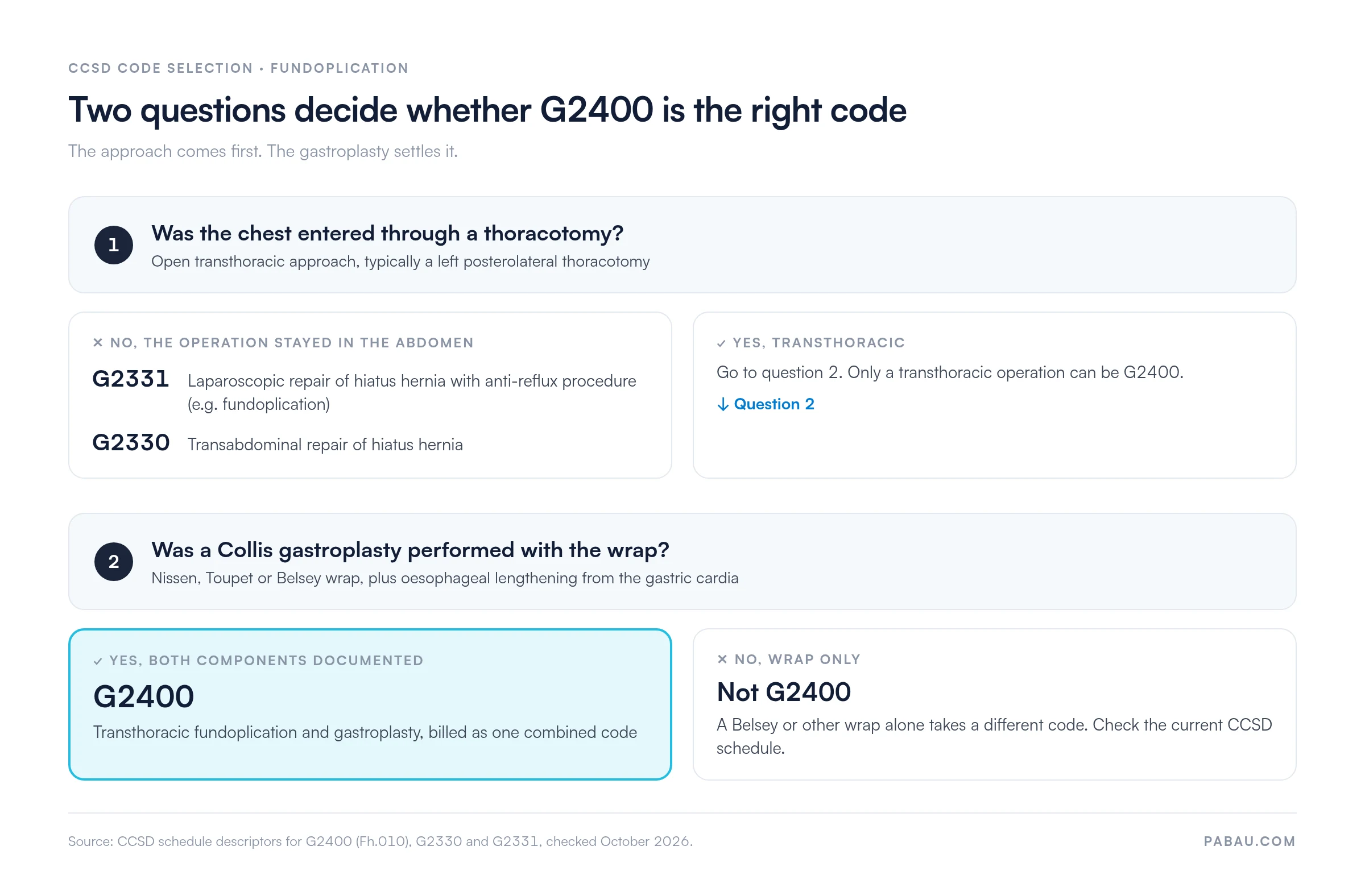
The table compares G2400 with the codes it is most often confused with.
*Check the current CCSD schedule for the code that covers a transthoracic wrap without a gastroplasty. CCSD codes are revised periodically, so confirm G2400 is current in the latest edition before you submit a claim.
Usually not. Most CCSD payer schedules treat a hiatal hernia repair that prepares the field for the wrap as part of G2400. They will not reimburse it separately. The answer is still payer-specific, so don’t assume a blanket yes or no.
Some payers will consider a separate code alongside G2400 when the hernia repair is a substantial, clinically distinct procedure. That means a significantly enlarged or complicated hernia that needed surgical attention beyond standard crural dissection.
To support a dual-code submission, the operative note must show the hernia repair as a discrete and significant part of the operation. Describe the hernia separately from the fundoplication narrative, including its size, type, contents and repair technique. Submit the claim with a covering letter explaining the clinical distinction.
Consult the CCSD technical guide for the current bundling framework, and verify with each insurer’s provider portal before submitting a dual-code claim.
A G2400 claim that lacks evidence of both procedure components will be queried or denied on clinical grounds. UK private insurers audit the operative note first, and it must contain each element below to support the claim. Structured digital forms make it harder to leave a required field out at dictation.
Prior authorization is standard for elective surgery under UK private medical insurance, and G2400 is no exception. Requirements vary by insurer and policy, so verify them on the provider portal before booking the procedure. The table below reflects general practice as of early 2026.
Authorization must be obtained before the procedure date. Late or retrospective requests are frequently declined or paid at a reduced rate. The authorization number must appear on the invoice, and the CCSD code authorized must match the code billed.
If the surgeon changes the approach during the operation, contact the insurer’s medical assessment team before the claim is submitted.
Most G2400 denials are avoidable. The table below maps the most frequent denial reasons to their root cause and the corrective action. With surgical practice claims software, incomplete operative note fields get flagged before submission instead of after a denial.
CCSD bundling policy decides which procedures in the same operative session fall within G2400’s reimbursement scope and which may be billed separately. The CCSD technical guide sets the framework, but individual payer schedules may apply stricter or more permissive rules. Keep each insurer’s bundling position on file so coders check it before submission.
Most CCSD payers do not publish a fixed global period for G2400 in the way that CMS defines global surgical packages for US CPT codes. Post-operative outpatient follow-up visits are generally billed separately under the appropriate consultation code. Confirm the specific global period, if any, with the individual insurer’s provider schedule before submitting follow-up claims.
Before submitting any dual-code claim alongside G2400, call the insurer’s provider helpline. Ask whether the concurrent procedure falls within G2400’s bundling scope for that policy type. A verbal confirmation with a reference number is your first line of appeal evidence if the claim is subsequently denied. Document the call date, agent name, and reference number in the patient billing record immediately.
A G2400 claim depends on four records lining up. They are the approach, both procedure components, the surgeon grade and an authorization obtained before surgery. When one slips, the denial arrives weeks later and takes consultant time to resolve.
In Pabau, the surgical team completes a structured operative form instead of free-text dictation. The approach, the wrap, the Collis gastroplasty, the anatomical findings and the surgeon grade are required fields. A missing-gastroplasty note gets caught before the claim is raised.
The note, the invoice and the authorization number sit on the same patient record, so the coder builds the claim from complete documentation. Claims then go to insurers through Healthcode without re-keying.

Pabau helps UK private surgical practices capture operative documentation and submit CCSD-coded claims to insurers. Denial reasons across Bupa, AXA Health and Aviva are tracked in one system.

G2400 rewards the practice that documents in theatre. If the operative note names the thoracotomy and the Collis gastroplasty, the code holds up in audit. If it doesn’t, an appeal letter rarely repairs the damage in full.
The trade-off is a few minutes of structured note-taking against weeks of addenda and appeals. Settle any dual-code hiatal hernia claim with the insurer before surgery as well, and log the call reference.
Book a demo to see how Pabau’s structured operative forms keep G2400 claims complete before they reach the insurer.

Need a broader CCSD billing reference? Bupa CCSD procedure codes guide covers the Bupa fee schedule structure, how to look up codes, and submission requirements across the CCSD schedule.
Looking to reduce claim rejections across your practice? Claims management software from Pabau tracks submission status, denial reasons, and resubmission workflows for UK private insurer claims.
Billing a laparoscopic anti-reflux repair instead? CCSD code G2331 covers laparoscopic hiatus hernia repair with an anti-reflux procedure.
Working through a denial? Denial codes in medical billing explains what each denial reason means and how to resubmit.
CCSD code G2400 covers transthoracic fundoplication and gastroplasty, performed as one combined procedure through an open thoracotomy. It includes the anti-reflux wrap around the lower oesophagus and a Collis gastroplasty that lengthens a short oesophagus. Both are billed under a single code in the CCSD schedule used in UK private healthcare.
Transthoracic fundoplication (CCSD code G2400) is billed when the procedure is performed through an open thoracotomy and includes a gastroplasty. Laparoscopic hiatus hernia repair with an anti-reflux wrap is coded G2331 instead. Submitting a laparoscopic code for a transthoracic procedure, or the reverse, is a common cause of claim denial.
Yes. The gastroplasty is a mandatory component of G2400 rather than a separately billable add-on. Both the fundoplication wrap and the Collis gastroplasty must be performed for G2400 to be the correct code. A fundoplication performed without a gastroplasty needs a different CCSD code.
A Collis-Nissen procedure combines Collis gastroplasty (oesophageal lengthening) with a Nissen 360-degree fundoplication wrap, performed through a transthoracic approach. It is one of the named techniques billed under CCSD code G2400, alongside Collis-Belsey, Collis-Toupet and Belsey Mark IV with a Collis gastroplasty. Each pairs a gastroplasty with a wrap via thoracotomy, which is what the code requires.
Most G2400 denials trace back to four problems. The operative note omits the gastroplasty, or a laparoscopic code is submitted for a transthoracic operation. Prior authorization was never obtained, or a concurrent hiatal hernia repair was billed separately when the payer counts it as part of G2400.
Insurers that use the CCSD schedule, such as Bupa, AXA Health and Aviva, typically recognize G2400. Confirm with each insurer. Each one applies its own fee schedule rate and prior authorization rules, so reimbursement and submission requirements differ. Check current rates and authorization pathways on each insurer’s provider portal before you submit a claim.