

HCPCS Code Q4175: Billing, coverage, and documentation guide
HCPCS Code Q4175: Code Description and Product Identity HCPCS Code Q4175 is the ...

Last Updated: Nov 20, 2026
G2402 is the CCSD code for transthoracic fundoplication, an open anti-reflux operation done through a left thoracotomy. UK private insurers use it when the surgeon wraps the top of the stomach around the lower esophagus from inside the chest.
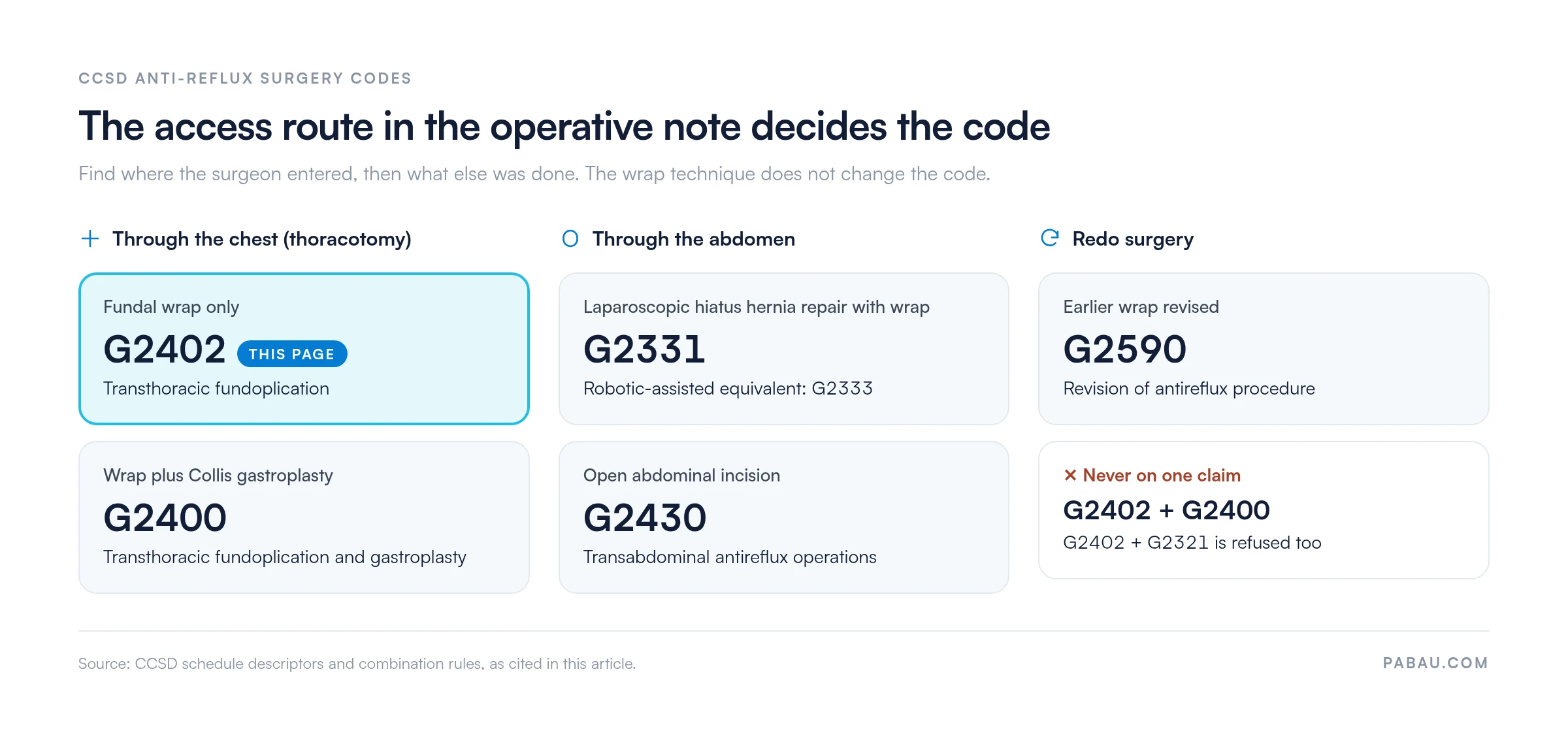
The surgical approach decides the code. A wrap combined with a Collis gastroplasty is G2400, and laparoscopic hiatus hernia repair with a wrap is G2331. G2402 cannot be billed on the same claim as G2400.
Let Pabau's smart automation suggest the right codes, reduce claim denials, and keep your practice compliant—effortlessly.
Automate repetitive tasks and focus on what matters most—your patients.
Reduce coding errors and ensure compliance with the latest regulations.
Clean claims, fewer denials, and faster reimbursements.
Powerful insights and reporting to help your practice thrive.
HIPAA compliant SOC 2 certified GDPR-compliant Trusted by 4,000+ clinics worldwide

CCSD Code G2402 covers transthoracic fundoplication only, the open anti-reflux operation performed through a thoracotomy.
Confirm the thoracotomy in the operative note before coding, because laparoscopic, robotic and open abdominal wraps take G2331, G2333 or G2430.
G2402 cannot be billed on the same claim as G2400 (transthoracic fundoplication and gastroplasty) or G2321.
Most UK private insurers, including Bupa, AXA Health and Aviva, expect pre-authorization before this elective thoracic procedure.
Pabau’s claims workflow attaches the CCSD code, pre-authorization number and operative note before a G2402 claim goes to Healthcode.
CCSD Code G2402 is the CCSD procedure code for transthoracic fundoplication, an open anti-reflux operation performed through a thoracotomy. It comes from the CCSD Schedules, the standard procedure codes for UK private healthcare. G2402 sits in section 8.1.0 (Oesophagus) of chapter 8, Thorax and intra-thoracic organs.
The descriptor is approach-specific. G2402 applies only when the surgeon reaches the esophagogastric junction through the chest. A fundoplication performed through an abdominal incision or laparoscopic ports takes a different code.
Transthoracic fundoplication is an open anti-reflux operation performed through a left thoracotomy. The incision gives the surgeon direct access to the lower esophagus and esophagogastric junction from inside the chest. It is performed under general anesthesia with the patient in the right lateral decubitus position.
The key surgical steps that must appear in the operative note to substantiate G2402 are:
The Belsey Mark IV is the classic transthoracic technique. It produces a 240-degree anterior wrap and suits patients with a shortened esophagus or complex redo anti-reflux surgery. The operative note may name the wrap degree and technique, and all three wraps fall under G2402 once the thoracotomy is documented. Add a Collis gastroplasty to lengthen the esophagus, and the procedure becomes G2400.
G2402 is correct when the operative record confirms the thoracotomy approach. The clinical scenarios that lead a surgeon to choose transthoracic access over laparoscopic surgery are:
NICE guideline CG184 recommends considering fundoplication only for adults with a confirmed diagnosis of acid reflux. Private insurers usually want that confirmation in the record: 24-hour ambulatory pH monitoring, esophageal manometry and a record of proton pump inhibitor (PPI) treatment. Confirm these investigations are documented before coding G2402, because insurers may request them at audit.
Before assigning G2402, check the operative note for two things. Look for the words ‘thoracotomy’ or ‘thoracic approach’ confirming chest access, and for the wrap technique performed. If the note describes port sites, CO2 insufflation or laparoscopic instruments, do not use G2402. A laparoscopic wrap with hiatus hernia repair is coded G2331 instead.
A frequent fundoplication coding error is applying G2402 to a laparoscopic procedure. The CCSD schedule gives laparoscopic hiatus hernia repair with an anti-reflux procedure its own code, G2331. The documented surgical approach decides between them, not the wrap technique. Not every CCSD code splits by route. In gynecology, CCSD Q2080 covers ventro-suspension of uterus done open or laparoscopically under one code. Closer to this operation, T1620 in CCSD covers plication of a paralysed diaphragm by thoracotomy or VATS under one code.
Coders reviewing any fundoplication operative note should locate the access description before assigning a code. When the approach is ambiguous or the note does not specify thoracotomy, query the surgeon before submitting. Submitting G2402 for a laparoscopic procedure is miscoding and may be treated as fraudulent billing under insurer audit.
Several neighboring codes in the CCSD esophageal surgery section are often confused with G2402. Knowing where each one starts helps practices avoid mis-assignment and claim rejection. The Bupa CCSD procedure codes reference is a useful cross-check when coding for Bupa-insured patients. Upper GI ulcer surgery sits in its own codes further down the schedule, such as G5320 for closure of a perforated duodenal ulcer. Surgery for pyloric stenosis is separate again, with pyloromyotomy billed as code G4010.
The descriptors above are checked against the CCSD schedule at ccsd.org.uk, which is updated annually. The searchable CCSD code library covers the rest of the oesophagus section when a note describes another procedure.
An open wrap through the abdomen is G2430, so a laparotomy never supports G2402. The chart below maps each anti-reflux code to the access route the operative note describes.
CCSD Code G2402 is a comprehensive surgical code. The thoracotomy, any intraoperative fluoroscopy and standard general anesthesia time are integral to the procedure and are not separately billable. The anesthetist bills independently, using their own CCSD codes.
The CCSD tables also list two codes as unacceptable combinations with G2402. It cannot be billed with G2400 (transthoracic fundoplication and gastroplasty) or with G2321. Claim one or the other, never both.
Hiatal hernia repair raises the most common bundling question. A crural repair that closes the hiatus as part of the fundoplication is generally part of G2402 and is not coded separately.
A large para-esophageal hernia repair may be a distinct additional procedure, documented as such in the operative note. Some insurers then permit a separate hernia repair code. Bupa, AXA Health and Aviva each publish their own bundling policies, so verify the insurer’s rules before claiming extra codes alongside G2402.
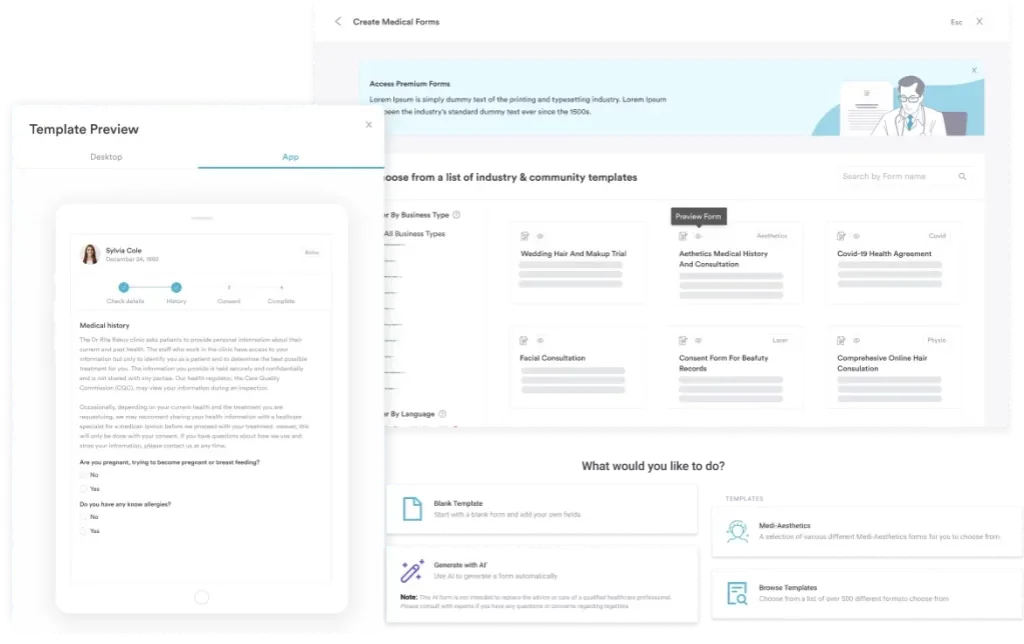
An operative note that never states the thoracotomy approach is a common cause of G2402 audit failure. Structured operative templates, like the digital forms in Pabau’s practice management platform, capture the mandatory elements on every case.
The operative note must contain all of the following to substantiate a G2402 claim:
The clinical record should also hold the pre-operative investigation results (endoscopy, 24-hour pH study, esophageal manometry). They support medical necessity and answer any retrospective audit request from the insurer.
Major UK private medical insurers (PMIs) typically require pre-authorization before elective thoracic surgery. For G2402, treat pre-authorization as mandatory unless the insurer’s current policy says otherwise. Billing without pre-authorization approval is a common reason for outright denial of this code.
Pre-authorization approval does not guarantee payment. It confirms benefit eligibility at the time of authorization, and payment still depends on the operative note showing G2402’s transthoracic approach was performed. Check each insurer’s policy documents for current rules, as pre-auth requirements change with annual contract reviews.
G2402 denials cluster around a small number of avoidable errors. Checking for each one before submission makes a rejection far less likely.
Run a five-point check before every G2402 claim. Confirm the thoracotomy in the operative note, the pre-auth reference, the wrap type and a current-year fee schedule. Then check any add-on code against the insurer’s bundling policy. Five checks before submission cut denials and avoid slow retrospective appeals.
CCSD codes sit within insurer-specific fee schedules rather than a single national tariff. Each PMI publishes its own agreed rates for G2402, and those rates change with annual fee negotiations. Transthoracic fundoplication is a major elective thoracic procedure. It typically sits in a higher value band than laparoscopic anti-reflux surgery, reflecting open chest access and longer operating time.
Private practices billing G2402 should keep a separate fee schedule file for each contracted insurer. Update each one on 1 January (or the insurer’s stated effective date). A mismatch between the submitted fee and the insurer’s current agreed rate causes underpayments that are easy to miss without an annual update routine.
Consultant fees and hospital or facility fees are billed separately in UK private healthcare. G2402 on a consultant invoice covers the surgeon’s professional fee. The hospital or independent surgical center invoices the operating theater, any implants and the inpatient stay as a separate facility claim. Billing teams should make sure each invoice carries only its own component of the claim.
Healthcode is the main electronic billing clearinghouse for UK private medical insurers. Using private practice claims management software that integrates with Healthcode reduces manual entry errors and speeds up the claim cycle.
G2402 claims usually fail on paperwork kept in different places. The operative note lives in one system, the pre-auth number in an email, and the code on a separate invoice.
Pabau keeps all three in one patient record. Operative templates built in its digital forms make the thoracotomy, wrap type and drain placement required fields. The note then supports the code before it is signed.
When the invoice is raised, the CCSD code, pre-authorization reference and ICD-10 diagnosis travel with it to Healthcode or Bupa. Your billing team checks one screen before submission instead of chasing three sources.

Pabau supports CCSD code entry, operative documentation, and Healthcode-ready claim workflows for UK private surgical practices. See how it works for your team.

Code G2402 only when the operative note shows the surgeon opened the chest and built a wrap without a gastroplasty. Every other route has its own code, and G2400 or G2321 never share a claim with it.
The checks that protect the claim happen before surgery and before submission. Pre-authorization goes on file, the operative note follows a structured template, and the ICD-10 diagnosis matches the procedure. Build those checks into the workflow, and your team spends its time on new claims rather than appeals.
Book a demo to see how Pabau links operative notes, pre-authorization and CCSD codes so G2402 claims reach Healthcode complete.

Need a full Bupa CCSD code reference? Bupa CCSD procedure codes covers the complete Bupa fee schedule and code lookup for private practice billing.
Building a compliant private practice? Claims management software from Pabau supports CCSD code submission, pre-auth tracking, and Healthcode-integrated workflows.
Coding an open abdominal wrap instead? CCSD code G2430 covers transabdominal antireflux operations and how they differ from the thoracic route.
CCSD Code G2402 is the UK private healthcare billing code for transthoracic fundoplication, the open anti-reflux operation performed through a left thoracotomy. It covers any wrap done through a chest incision (Nissen, Toupet or Belsey Mark IV) when the operative note confirms thoracic access.
G2402 applies only when the operative note documents a thoracotomy. Laparoscopic fundoplication with hiatus hernia repair, performed through abdominal ports with CO2 insufflation, is coded G2331. The wrap technique does not decide the code. The surgical approach does.
Yes, in most cases. Bupa, AXA Health and Aviva typically require pre-authorization before elective thoracic surgery, including G2402. Obtain approval before listing the patient and record the reference number for the Healthcode claim. Check each insurer’s current policy, because rules vary and change annually.
The operative note must state the thoracotomy approach and intercostal space, plus the extent of esophageal mobilization. It must also record the wrap type and degree, the crural repair and any concurrent procedures. Pre-operative pH study, manometry and endoscopy results should sit in the clinical record to support medical necessity at audit.
It depends on the insurer. A routine crural repair done as part of the fundoplication is bundled into G2402. A large para-esophageal hernia repair documented as a distinct procedure may be separately billable with some insurers. G2402 can never be billed with G2400 or G2321, which the CCSD tables list as unacceptable combinations.
The usual reasons are a laparoscopic procedure billed as G2402, a missing pre-authorization reference, or an operative note that never confirms the thoracotomy. Unbundled thoracotomy charges, unacceptable code pairs and out-of-date fee schedules cause denials too. Start with approach verification and the pre-auth process, which head that list.





