

CCSD Code D1010: Radical mastoidectomy including meatoplasty
CCSD Code D1010: Definition and clinical scope CCSD Code D1010 is the UK private...

Last Updated: Nov 25, 2026
G2312 is the CCSD code for transthoracic repair of paraoesophageal hiatus hernia. It covers surgery through a left thoracotomy to reduce a type II, III or IV paraoesophageal hernia and repair the diaphragmatic hiatus.
UK private insurers such as Bupa, AXA Health, Vitality and Aviva use CCSD codes for consultant claims. The access route decides the code: an open abdominal repair is billed as G2330, and a laparoscopic repair with an anti-reflux procedure as G2331.
Let Pabau's smart automation suggest the right codes, reduce claim denials, and keep your practice compliant—effortlessly.
Automate repetitive tasks and focus on what matters most—your patients.
Reduce coding errors and ensure compliance with the latest regulations.
Clean claims, fewer denials, and faster reimbursements.
Powerful insights and reporting to help your practice thrive.
HIPAA compliant SOC 2 certified GDPR-compliant Trusted by 4,000+ clinics worldwide

CCSD Code G2312 covers transthoracic repair of paraoesophageal hiatus hernia, and the chest access route separates it from neighboring G23xx codes.
UK private insurers expect pre-authorization before this elective procedure, and a missing or expired authorization is a frequent denial trigger.
The operative note must state the transthoracic approach and the paraoesophageal hernia type, or the insurer may downcode the claim to an abdominal repair code.
Pabau, a practice management platform, supports UK insurance billing through Healthcode and Bupa, with prior authorization tracked on the case.
CCSD Code G2312 is the procedure code for transthoracic repair of paraoesophageal hiatus hernia in UK private healthcare billing. It sits in the CCSD Schedules, the standard set of procedure codes for the UK private healthcare sector.
The schedule is maintained by the Clinical Coding and Schedule Development (CCSD) Group, which brings together Bupa, Vitality, AXA Health, and Aviva. Consultants put G2312 on claims sent through Healthcode to these and other private medical insurers (PMIs). Insurer tables such as the Bupa CCSD procedure codes list it too. CCSD codes apply only to UK private healthcare, not NHS billing.
The official descriptor is: Transthoracic repair of paraoesophageal hiatus hernia. “Transthoracic” names the chest access route, which separates this code from the abdominal and laparoscopic codes in the same G23xx block. “Paraoesophageal” names the hernia type. In a pure paraoesophageal (rolling) hernia, the gastric fundus herniates through the diaphragmatic hiatus while the gastro-oesophageal junction (GOJ) stays in position.
The transthoracic approach uses a left thoracotomy incision to reach the lower oesophagus and diaphragm from above, bypassing the abdomen. Surgeons choose it when the anatomy demands thoracic exposure. Typical cases are a giant hernia in the lower chest, a failed abdominal repair with adhesions, severe obesity, or complex mediastinal anatomy.
The key operative steps are:
Evidence on mesh in hiatal repair is still developing in the UK, so the decision rests on the surgeon’s clinical judgment for each patient.
G2312 applies to symptomatic type II, III, or IV paraoesophageal hernias where the transthoracic route is clinically indicated. It does not apply to sliding hiatus hernias (type I) managed conservatively, or to laparoscopic repairs of any hernia type. Surgeons in CQC-regulated independent hospitals in England should document the clinical indication before requesting pre-authorization.
Appropriate clinical scenarios for this code:
The access route decides the correct code within the G23xx hiatus hernia repair block. G2312 sits alongside codes for abdominal and laparoscopic approaches to the same hernia. Choosing the wrong access-route code is a frequent billing error for this procedure, and the chart below maps the operative note’s wording to the code.
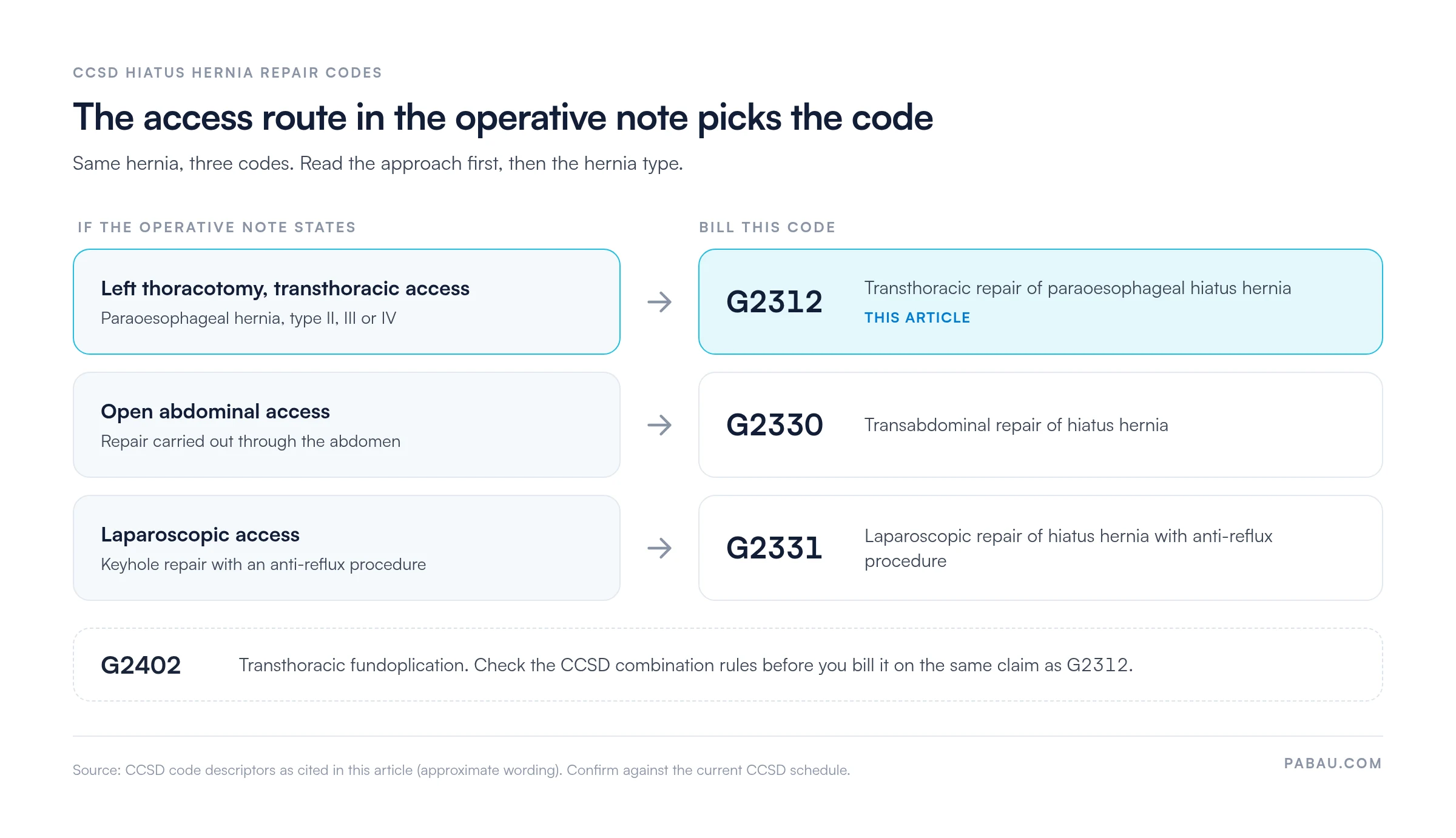
If the note describes a laparoscopic repair with an anti-reflux procedure, the claim belongs under G2331 rather than G2312. The table adds the surgical approach and the deciding detail for each neighboring code.
Important: Adjacent code descriptors and bundling rules change with annual CCSD schedule updates. Verify current descriptors in the CCSD official schedule before submitting claims, and compare neighboring codes in our CCSD code library. The table reflects the G23xx block structure, so confirm each neighboring code number against the current version.
Verify the surgical approach in the operative note before selecting a G23xx code. If the note says ‘laparoscopic’, the code is not G2312, whatever the hernia type. If it says ‘left thoracotomy’ or ‘transthoracic’, G2312 is the correct selection. This one check stops an abdominal or laparoscopic repair being billed as G2312, and the reverse.
G2312 covers the primary hernia repair. Where a separately identifiable procedure is performed in the same session, a concurrent code may apply, subject to insurer unbundling rules. A transthoracic fundoplication, for example, has its own code, G2402.
Unbundling caution: Do not separately bill components that form part of the primary repair, such as mediastinal dissection, crural suturing, or hernia sac reduction. These are included within G2312. Billing them separately can trigger an audit by insurers such as Bupa and AXA Health.
UK private insurers require a compatible ICD-10 diagnosis code on every CCSD claim to establish medical necessity. For G2312, the primary diagnosis codes come from the K44 diaphragmatic hernia block. Add a GORD code where reflux is a concurrent or contributing diagnosis.
K44.9 fits an elective G2312 claim for an uncomplicated hernia. K44.0 and K44.1 apply to complicated or emergency presentations, and they may trigger closer scrutiny or a different pre-authorization pathway. Check complex cases against the ICD-10 UK fifth edition in the NHS Classifications Browser. Emergency hernia repairs outside the hiatus have their own codes, such as CCSD T2280 for a strangulated femoral hernia.
Inadequate operative documentation is a frequent reason G2312 claims are downcoded or denied. Insurers reviewing this code look for explicit evidence that the transthoracic approach was used and that the hernia type warranted it. A documentation checklist prevents costly rework.
Required documentation elements:
Critical operative note language: The note must not say “repaired hiatus hernia via thoracotomy” in isolation. It should state: “transthoracic repair of paraoesophageal hiatus hernia via left thoracotomy, with [crural repair/fundoplication/mesh as applicable].” Vague or generic language gives the insurer grounds to downcode to G2330, G2331, or another less complex code.
Bupa, AXA Health, Vitality, and Aviva all expect pre-authorization before an elective G2312 procedure. The authorization number must appear on the claim form, and a claim without it is rejected whatever the clinical documentation shows. Request it early enough to allow for the insurer’s clinical review, and confirm the fee in the insurer’s schedule, such as the Bupa fee schedule.
Coverage depends on individual policy terms and the pre-authorization decision. Never assume a code is covered without written authorization from the specific insurer for the specific patient.
Insurers review transthoracic surgical claims closely. The denials below can usually be prevented with complete documentation and a current pre-authorization.
Run three checks before you submit any G2312 claim. The pre-authorization reference is on the form, and the operative note names the transthoracic approach. The primary ICD-10 code comes from the K44 block. These three checks prevent most avoidable denials before the claim leaves the practice.
A G2312 claim passes through several hands before it is paid. The secretary chases the authorization number, the operative note sits in the hospital system, and the invoice goes to Healthcode on its own. A missing reference at any of those steps sends the claim back.
Pabau supports UK insurance billing through Healthcode and Bupa, with prior authorization tracked on the case. Its claims software for consultants keeps the claim on the same patient record that holds the referral, the operative note, and the diagnosis codes.
What this covers for G2312 billing:
The claim then carries its authorization reference and supporting notes from the start, which leaves an insurer fewer reasons to return it.

Record authorization codes, dates and sessions against the case, and Pabau warns when one is missing. UK claims then go out through Healthcode and Bupa.

Code G2312 only when the operative note names the transthoracic approach and the paraoesophageal hernia type in plain words. If the note is vague, fix it before the claim goes out, because an addendum after a denial adds a full resubmission cycle.
The trade-off sits at the front end. A pre-submission check on the authorization, the approach wording, and the K44 diagnosis takes minutes per claim. Skipping it moves that work into appeals, where the operating surgeon has to get involved.
For UK practices, Pabau keeps the authorization record and the claim on the same case. Book a demo to see how it handles a complex surgical claim like G2312, from pre-authorization to Healthcode submission.

Need a full reference for Bupa procedure codes? Bupa CCSD procedure codes covers the full Bupa code schedule, fee structure, and submission requirements for UK private consultants.
Looking for broader CCSD billing guidance? Bupa procedure codes fee schedule explains how UK private insurer fee schedules are structured and how to read them for consultant invoicing.
Billing a fundoplication with gastroplasty? CCSD code G2400 covers transthoracic fundoplication and gastroplasty, with the documentation its claims need.
Was the hernia repaired laparoscopically? CCSD code G2331 covers laparoscopic repair of hiatus hernia with an anti-reflux procedure.
CCSD Code G2312 covers transthoracic repair of paraoesophageal hiatus hernia. It applies to a type II, III, or IV paraoesophageal hernia repaired through a left thoracotomy. It is used in UK private healthcare billing only, and insurers expect pre-authorization before the procedure.
G2312 is for transthoracic repair through a left thoracotomy. G2330 and G2331 cover abdominal and laparoscopic hiatus hernia repair. G2330 is the transabdominal repair, and G2331 is the laparoscopic repair with an anti-reflux procedure. Confirm the approach from the operative note before choosing a code.
The transthoracic approach is chosen when laparoscopic access is not feasible or safe. Typical reasons are a failed laparoscopic repair with significant adhesions, a giant hernia in the lower chest, or extensive previous abdominal surgery. The clinical indication should be documented in the pre-operative assessment.
The minimum set is the pre-authorization letter with its reference number, the consultant referral letter, and the operative note. Add the anesthetic record, a discharge summary with a K44 ICD-10 code, and pre-operative CT or endoscopy. The operative note must state the transthoracic approach and the hernia type, because vague notes are a frequent reason for downcoding.
A Nissen fundoplication may be separately billable when it is a distinct concurrent procedure justified by a GORD diagnosis. Transthoracic fundoplication has its own code, G2402. The CCSD combination rules decide whether it can sit on the same claim as G2312. Check them, and ask whether the insurer needs a separate pre-authorization.
Yes. The anesthetist bills independently using CCSD anesthetic codes on a time-unit basis, which does not conflict with the surgeon’s G2312 claim. Both claims reference the same pre-authorization number and procedure date. The independent hospital bills its facility fee separately.




