CPT Code 62284: Injection procedure for myelography
CPT Code 62284: official descriptor and procedure overview The American Medical ...

Last Updated: Oct 19, 2026
E4230 is the CCSD code for mini-tracheostomy (percutaneous), a small cuffless tube placed through the cricothyroid membrane so secretions can be suctioned. It is mainly used for patients with sputum retention who cannot cough effectively, often after major chest or abdominal surgery.
UK private medical insurers accept E4230 on CCSD-coded claims. It sits under Larynx and trachea in Chapter 5 (Ear, nose and throat). Open surgical tracheostomy, percutaneous dilatational tracheostomy and cricothyrotomy are coded separately.
Let Pabau's smart automation suggest the right codes, reduce claim denials, and keep your practice compliant—effortlessly.
Automate repetitive tasks and focus on what matters most—your patients.
Reduce coding errors and ensure compliance with the latest regulations.
Clean claims, fewer denials, and faster reimbursements.
Powerful insights and reporting to help your practice thrive.
HIPAA compliant SOC 2 certified GDPR-compliant Trusted by 4,000+ clinics worldwide

CCSD Code E4230 covers percutaneous mini-tracheostomy, not open surgical tracheostomy, which has a separate CCSD code.
The main indications are sputum retention and short-term post-operative airway support, not long-term ventilation.
The operative note must confirm the percutaneous technique, the kit used (for example, Minitrach II), the anatomical approach and the clinical indication.
Pre-authorisation rules vary between Bupa, AXA Health, Aviva and Vitality, so check them before any elective insertion.
Pabau’s practice management software keeps the operative note, insurer details and Healthcode claim on one patient record.
CCSD Code E4230 is the procedure code for mini-tracheostomy (percutaneous) in the Clinical Coding and Schedule Development schedule used by UK private medical insurers. It covers placing a small-bore, cuffless tube into the airway through the cricothyroid membrane, mainly so staff can suction secretions.
“Percutaneous” means the tube goes in through the skin over the membrane, usually after a small scalpel stab incision or over a guidewire. Also, the CCSD descriptor does not tie E4230 to one insertion kit. However, formal open tracheostomy falls outside it, because the surgeon dissects the neck and opens the tracheal wall. That carries a separate CCSD code, whatever tube size you use.
Within the schedule, E4230 sits in Chapter 5 (Ear, nose and throat), under Larynx and trachea. You can browse its neighbours in our CCSD code guides. Consultants and anaesthetists use it in private hospitals, independent treatment centres and private intensive care units.
NHS OPCS-4 codes cover the same procedure in the public sector, but they belong to a different classification. Putting E4230 on an NHS record, or an OPCS-4 code on a private insurer claim, is a coding error that leads to rejection.
A mini-tracheostomy is a small-bore airway procedure that places a narrow cuffless tube, typically 4 mm internal diameter, through the cricothyroid membrane. The membrane sits between the thyroid and cricoid cartilages at the front of the neck. It is the preferred landmark because it lies close to the skin, with little soft tissue over it.
In fact, the procedure involves no open dissection and no formal tracheostomy stoma. The most widely used kit in UK practice is the Minitrach II, made by Portex (Smiths Medical). With the standard kit, a guarded scalpel makes a short stab incision through the membrane. A curved introducer then guides the 4 mm cuffless tube, which has a 15 mm connector, into the trachea.
A Seldinger version of the kit swaps the stab incision for a needle, guidewire and dilator, and the operator advances the tube over the wire. Both versions place the same small tube at the same site, so both fall under E4230.
Because the tube is cuffless and small-bore, a mini-tracheostomy cannot deliver positive-pressure ventilation. Its primary function is suction access for clearing secretions, with limited access for emergency oxygenation. So it does not replace a cuffed tube for a patient who needs ventilation. That matters for coding too, because E4230 is the wrong code for a ventilated patient’s tracheostomy.
CCSD Code E4230 applies when the documented clinical reason is one of the accepted indications below. Insurers judge medical necessity on that match, so the indication in the note has to line up with the code.
Published anaesthetic and critical care literature describes these as the main indications. The procedure is not appropriate for patients who need continuous mechanical ventilation or long-term airway protection. It is also avoided with uncorrected coagulopathy or a known neck mass over the cricothyroid membrane.
The sequence below follows the standard Minitrach II kit and notes where the Seldinger version differs. Each step maps to content a valid E4230 operative note should capture.
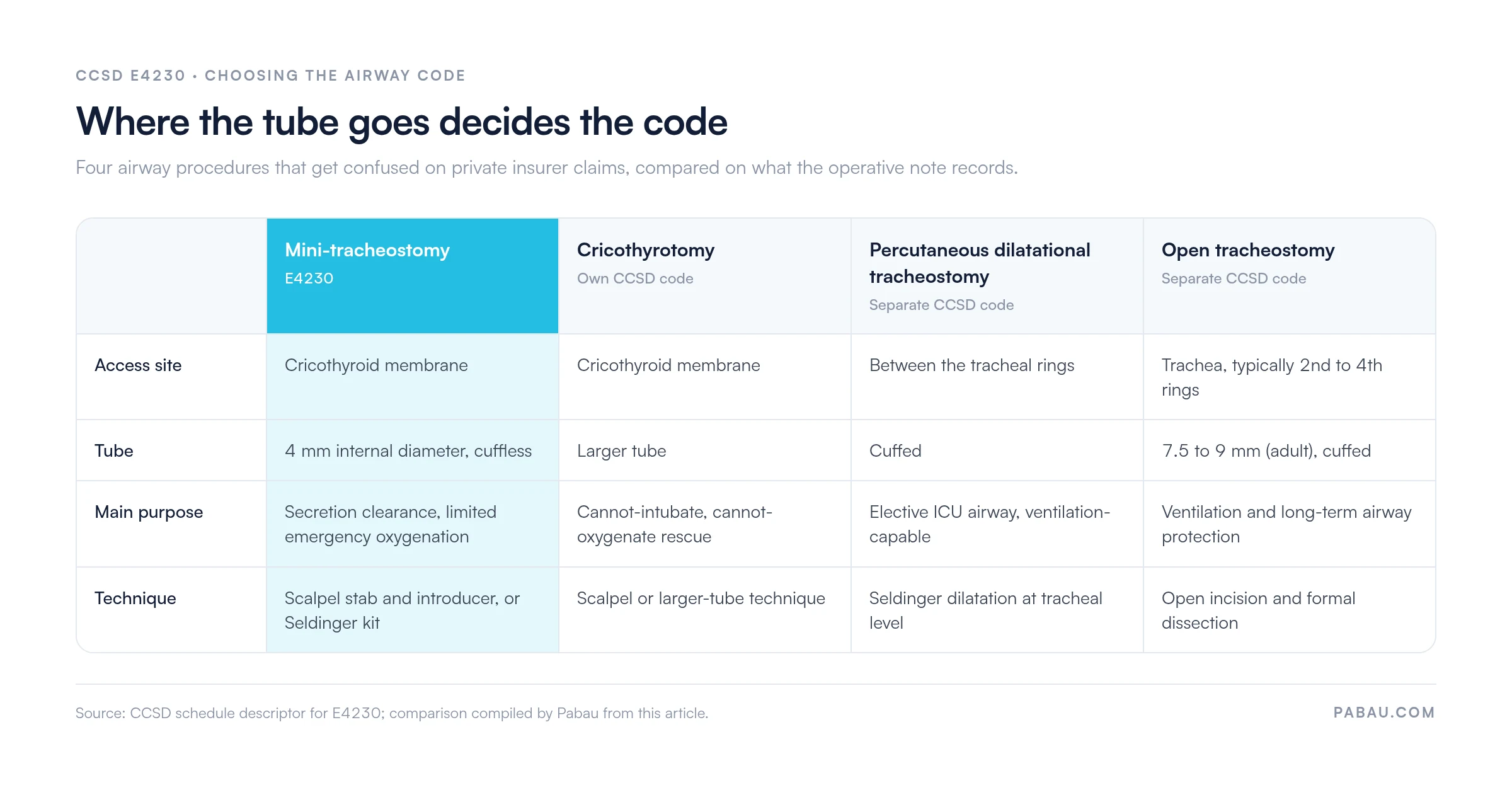
Coders choosing between E4230 and the standard tracheostomy code need to weigh the technique, tube size, functional purpose and anaesthetic approach. The table below sets out the distinguishing features.
Coders often confuse three airway procedures, plus endoscopy, with E4230. So knowing how they differ prevents miscoding and the insurer rejections that follow.
Percutaneous dilatational tracheostomy (PDT) causes the most confusion, because both procedures can use a Seldinger technique. In short, the anatomy settles it. PDT places a cuffed tube between the tracheal rings, while E4230 places a 4 mm cuffless tube through the cricothyroid membrane.
Laid side by side, the access site and the tube separate all four airway procedures at a glance.
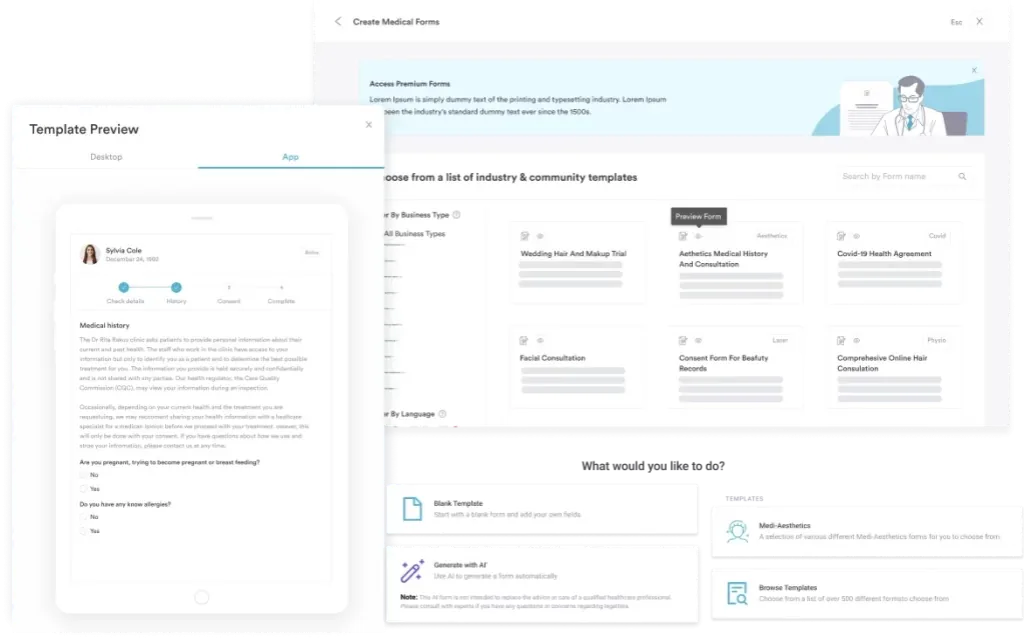
A complete operative note is the foundation of a valid E4230 claim. Insurers may request it during an audit, or with the first submission on high-value claims. Digital operative note forms with structured fields make it harder to miss a required element at the time of dictation.
The operative note must include each of the following:
Draft the operative note immediately after the procedure, before leaving the clinical area. Rebuilding it from memory later makes you likelier to miss the device name or the exact indication. Those are the first details an insurer queries when auditing an E4230 claim.
CCSD Code E4230 goes on a standard private practice invoice with the date of service and the consultant’s name. Also add any co-coded items, such as an anaesthesia code. All major UK private medical insurers accept the code. Our Bupa CCSD procedure codes reference covers Bupa-specific fees and submission rules. Confirm current rates on the Bupa code search portal before invoicing.
When the clinician does a mini-tracheostomy under local anaesthesia only, no separate anaesthesia code is billable. Instead, the procedure fee covers the local anaesthetic.
E4230 is sometimes performed alongside another procedure under general anaesthesia, for example at the end of a thoracotomy. The anaesthetist then bills the anaesthetic code for the primary procedure. The operating surgeon or intensivist who placed the tube may add E4230.
Unbundling rules decide whether an insurer pays both a surgical code and E4230 in one episode, and they vary by insurer. Check the fee schedule guidelines before you submit several codes for the same admission.
Many UK private medical insurers require pre-authorisation for elective procedures. Whether that covers a planned mini-tracheostomy depends on the insurer’s rules and the patient’s policy terms. For emergency insertions, however, insurers often accept retrospective notification if you document the clinical urgency.
The Vitality fee finder gives procedure-level pre-authorisation guidance for Vitality policyholders. Check the payer’s rules before every planned E4230 case.
Private medical insurers and their clinical auditors look closely at airway procedure claims, because the codes sit near higher-value surgical procedures. These are the problems that come up most often.
Many private practices still write the operative note in one system, raise the insurer invoice in another, and key claims into Healthcode by hand. Each handover is a chance for the kit name, the indication or the authorisation code to drop out.
In Pabau’s practice management software, the operative note, the patient’s insurer details and the invoice sit on one patient record. In addition, a note template can prompt for each element an insurer checks on an E4230 claim. The finished invoice goes to Healthcode through Pabau’s claims management software, where you can track its status.
So when an auditor asks for the note behind a claim, you pull it from the same record instead of rebuilding it from memory.
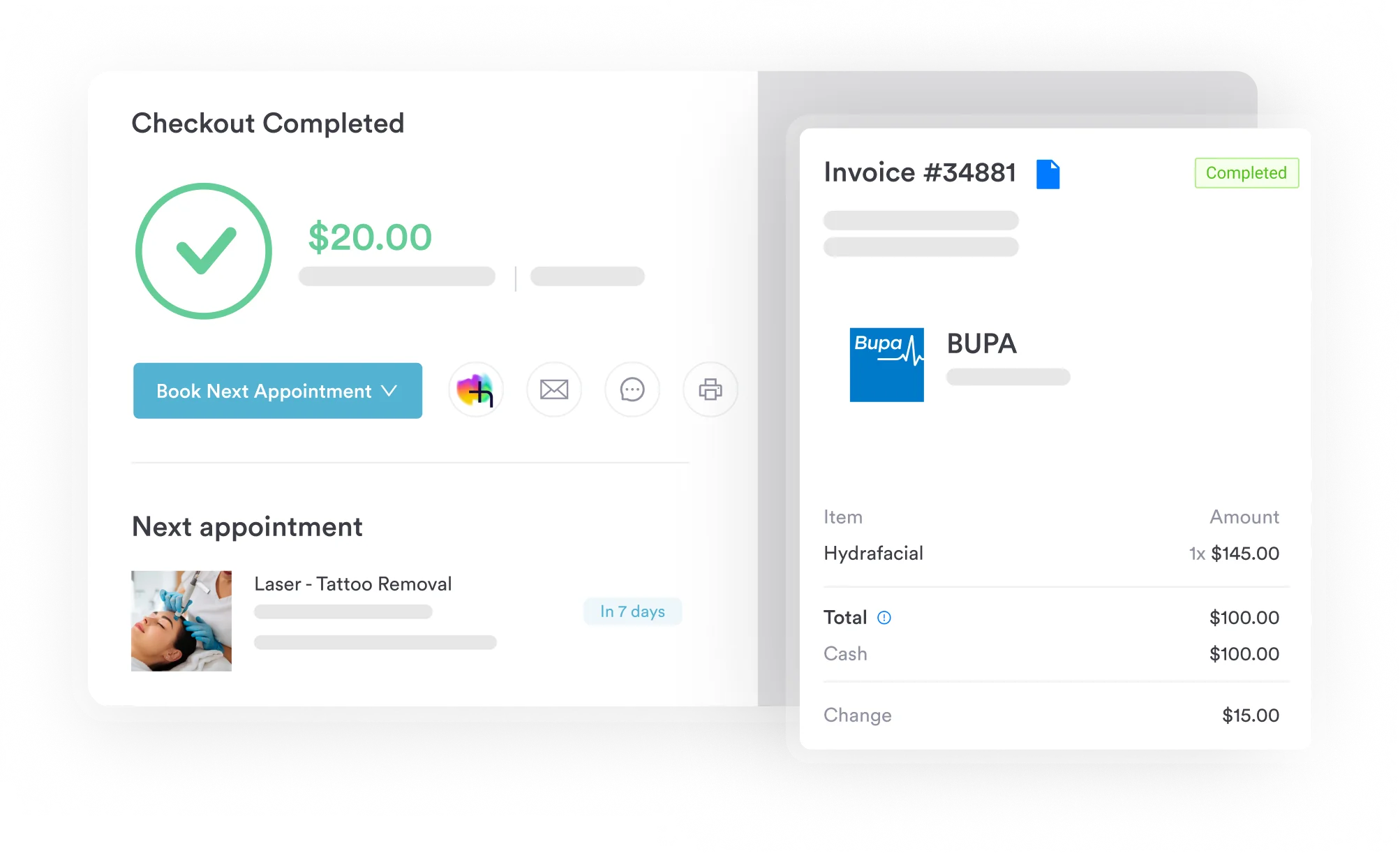

Pabau keeps operative notes, insurer details and Healthcode claims on one patient record. UK practices can submit CCSD-coded invoices without chasing missing details.

Decide the code from the operative note, not from the kit box. A note naming the cricothyroid membrane, a 4 mm cuffless tube and the secretion problem it solves supports E4230. In contrast, a note describing ventilation or a tracheal-ring placement points to a different code.
The trade-off is a few minutes of documentation at the bedside against a claim queried weeks later. Write the note straight after the procedure, and check the insurer’s pre-authorisation rules before every planned insertion.
Book a demo to see how Pabau keeps CCSD operative notes and Healthcode claims together on one patient record.

Need a reference for Bupa-specific CCSD codes and fees? Bupa CCSD procedure codes covers the Bupa schedule structure, fee chapters, and how to navigate the Bupa provider portal.
Coding other airway procedures in the same chapter? CCSD code E4030: tracheoplasty explains how open tracheal reconstruction is coded and billed to UK private insurers.
Billing ENT procedures on the larynx? CCSD code E4100: voice prosthesis insertion walks through documentation and billing for voice restoration after laryngectomy.
Looking for another CCSD code? CCSD code guides collects our billing guides for CCSD procedure codes across every chapter.
CCSD Code E4230 is the Clinical Coding and Schedule Development code for mini-tracheostomy (percutaneous). It covers inserting a small-bore cuffless tube, typically 4 mm, through the cricothyroid membrane via a small stab incision or a Seldinger kit. It does not cover open tracheostomy, cricothyrotomy, or percutaneous dilatational tracheostomy between the tracheal rings.
Mini-tracheostomy (E4230) places a 4 mm cuffless tube through the cricothyroid membrane, mainly for secretion clearance. Standard tracheostomy places a cuffed tube through the tracheal wall for ventilation and long-term airway protection. The two have separate CCSD codes, and billing E4230 for a standard tracheostomy is a miscoding error that leads to rejection.
No separate anaesthesia code is billable when the procedure is done under local anaesthesia alone. When it is done alongside another procedure under general anaesthesia, the anaesthetist bills the anaesthetic for the primary procedure. The surgeon or intensivist who placed the tube may then add E4230. Unbundling rules vary by insurer, so check co-billing with the payer first.
Three are commonly confused with it. The open tracheostomy code involves surgical dissection and a cuffed tube. The percutaneous dilatational tracheostomy code also uses a Seldinger technique, but its cuffed tube sits between the tracheal rings. Cricothyrotomy is an emergency rescue procedure with its own CCSD code.