HCPCS Code A4709: Acid concentrate solution for hemodialysis
What is HCPCS code A4709? HCPCS code A4709 is the Healthcare Common Procedure Co...

Last Updated: Oct 15, 2026
E4100 is the CCSD code for insertion of voice prosthesis (TOF), the operation that restores speech after a total laryngectomy. A surgeon places a one-way valve in a puncture between the trachea and the oesophagus. Air from the lungs then drives the oesophageal wall and produces voice.
CCSD is the procedure coding schedule used by UK private medical insurers, and invoices reach them through Healthcode. Insurers band E4100 as a major procedure, with published specialist fees of roughly £500 to £618. The prosthesis, the anaesthetic and the hospital charges are invoiced separately, and the schedule holds no code for replacing an existing prosthesis.
Let Pabau's smart automation suggest the right codes, reduce claim denials, and keep your practice compliant—effortlessly.
Automate repetitive tasks and focus on what matters most—your patients.
Reduce coding errors and ensure compliance with the latest regulations.
Clean claims, fewer denials, and faster reimbursements.
Powerful insights and reporting to help your practice thrive.
HIPAA compliant SOC 2 certified GDPR-compliant Trusted by 4,000+ clinics worldwide

CCSD code E4100 covers insertion of a tracheo-oesophageal voice prosthesis after a total laryngectomy
CCSD is the UK private medical insurance coding schedule, and invoices reach insurers through Healthcode
UK insurers band E4100 as a major procedure and publish specialist fees of roughly £500 to £618
The prosthesis itself, the anaesthetist fee and the hospital charge are invoiced separately from E4100
The schedule holds no code for replacing an existing prosthesis, so a routine change is not an E4100 claim
Pair the invoice with a UK ICD-10 code such as Z90.0 and a valid pre-authorisation reference
CCSD code E4100 is the UK private billing code for insertion of a voice prosthesis (TOF). The descriptor covers placing a tracheo-oesophageal voice prosthesis, the small one-way valve that restores speech after a total laryngectomy. It sits in chapter 5 of the CCSD schedule, Ear, nose and throat, under the larynx and trachea category.
CCSD stands for Clinical Coding and Schedule Development. The group publishes the procedure code schedule that UK private medical insurers bill against, and maintains it at ccsd.org.uk. Its membership includes the major insurers, among them Bupa, AXA Health, Aviva and Vitality. The main private hospital groups sit alongside them, including Circle, HCA, Nuffield Health, Ramsay and Spire.
CCSD owns the codes and their narratives, not the money. Each insurer sets its own complexity band and fee for E4100, then publishes both in its own schedule of procedures. Invoices travel to the insurer through Healthcode, the clearing house that carries most UK private medical billing. Our wider guide to CCSD procedure codes explains how the schedule is organised.
A tracheo-oesophageal voice prosthesis is a one-way valve that sits in a surgically created puncture between the trachea and the oesophagus. A total laryngectomy removes the larynx, so the patient can no longer produce voice through the airway. The valve lets air from the lungs pass into the oesophagus when the patient occludes the tracheostoma.
The oesophageal wall then vibrates and produces speech.
Tracheo-oesophageal speech is widely regarded as the reference standard for voice rehabilitation after laryngectomy. E4100 applies to the insertion itself, whether that is a primary puncture made during the laryngectomy or a secondary puncture in a later planned operation. The ENT surgeon sizes and places the prosthesis, usually alongside a speech and language therapist who leads the rehabilitation afterwards.
Where the larynx is removed together with the pharynx, the index operation is a pharyngolaryngectomy, coded AA378 rather than E2910. E4100 still covers the puncture and the prosthesis, so check which index code the pre-authorisation names before invoicing.
The two principal prosthesis families in UK ENT practice are Provox, made by Atos Medical, and Blom-Singer, made by InHealth Technologies. Device choice follows fistula size, patient anatomy and hospital stock. Both are one-way valves, and neither is paid for through the E4100 fee.
The scope of the code decides what else can be invoiced alongside it. The code pays the consultant for placing the prosthesis, including any dilation of the fistula tract needed at the time. It does not cover the rest of the episode.
The most frequent error is adding the device cost to the E4100 line. In UK private practice the prosthesis normally appears on the hospital invoice, not the consultant’s, so an insurer reads the combined line as a duplicate. Confirm who invoices the device with the hospital billing team before the admission.
Every insurer publishes its own schedule, so the fee attached to E4100 varies. The figures below come from insurer schedules published for UK private practice, and they cover the consultant only. Anaesthetic fees sit on a separate line in the same schedules.
Insurers reissue these schedules, so treat the figures as a guide and check the version in force on the date of treatment. A consultant who charges above the published fee creates a shortfall. The patient settles that difference, unless the insurer agreed the higher amount in advance.
Bupa sets its own complexity bands on top of the CCSD schedule, and the band decides the fee rather than the code itself. Our guide to Bupa CCSD codes sets out how that banding works across specialties.
E4100 is the only voice prosthesis code in the CCSD schedule. There is no separate insertion code for a secondary puncture, no replacement code, and no standalone code for creating the tracheo-oesophageal puncture. Billing a code that looks close enough gets the invoice rejected. The codes below are the ones that sit around E4100 in the schedule.
The replacement question is the one that costs practices money. A prosthesis is a consumable that needs changing every few months, and each change is a short clinic appointment rather than a return to theatre.
Because the schedule holds no replacement code, billing E4100 again reads as a repeat operation. Agree the approach with the insurer, and invoice the appointment under the consultation codes. The chart below maps each scenario to the code that carries it.
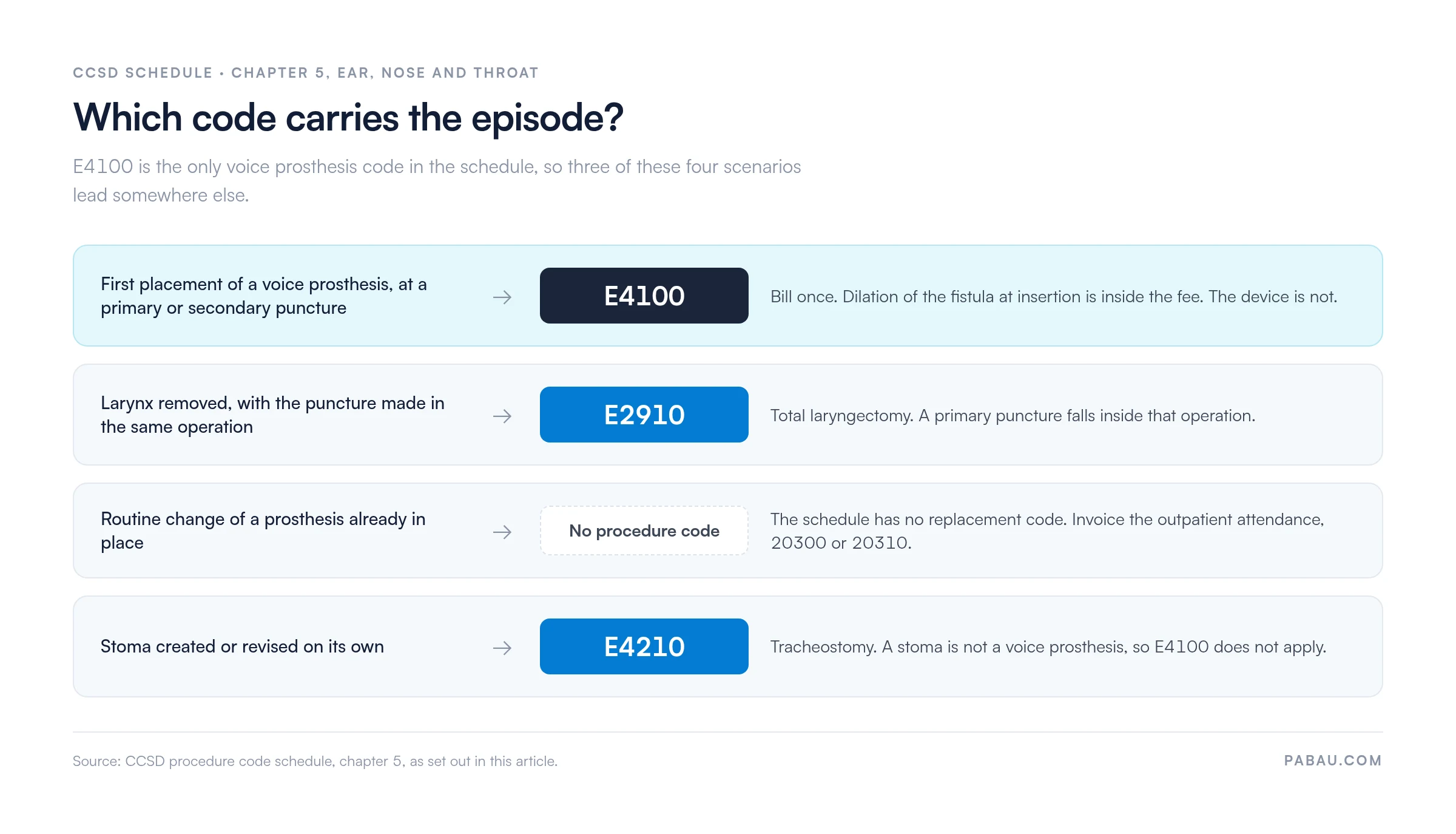
Where a secondary puncture and the prosthesis insertion happen in the same sitting, the invoice still carries one code. Where a separate procedure is performed alongside E4100, insurers apply their own multiple-procedure rules. The second code is usually paid at a reduced percentage. Check the rule in the insurer’s provider guide before the invoice goes out.
UK insurers expect an ICD-10 diagnosis on the invoice, and a mismatch between the procedure and the diagnosis is a common reason for a query. The UK works from ICD-10 fifth edition, published in the NHS classifications browser. That edition is not the same as the American ICD-10-CM, and codes borrowed from a US reference site will not validate.
Z90.0 carries almost every E4100 invoice. In the UK edition the absence of the larynx is coded at that four-character level. The American subdivision Z90.02 does not exist in the UK classification, so do not use it. Where a second diagnosis matters clinically, add it after Z90.0 rather than in place of it.
UK insurers treat E4100 as a planned procedure that needs authorisation before admission. The patient usually calls the insurer, quotes the CCSD code and the ICD-10 code, and receives an authorisation reference. An invoice submitted without that reference is held or refused until the practice supplies it.
Authorisation is not a promise of full payment. Benefit limits, excesses and outpatient therapy caps are applied when the invoice is assessed. Ask for the reference in writing and store it against the patient record. The billing team can then quote it without chasing the consultant’s secretary.
Check the consultant’s recognition status with the insurer before the theatre date, not after the invoice is rejected. A consultant who is recognised but not fee-assured can invoice above the published fee, and the patient covers the difference. Telling the patient that figure beforehand prevents most billing complaints on ENT work.
Insurers auditing ENT invoices look for a record that matches the code billed. Sound documentation means the operation note, the device details and the therapy notes all describe the same episode. Inconsistent paperwork triggers a manual review even when the coding is correct.
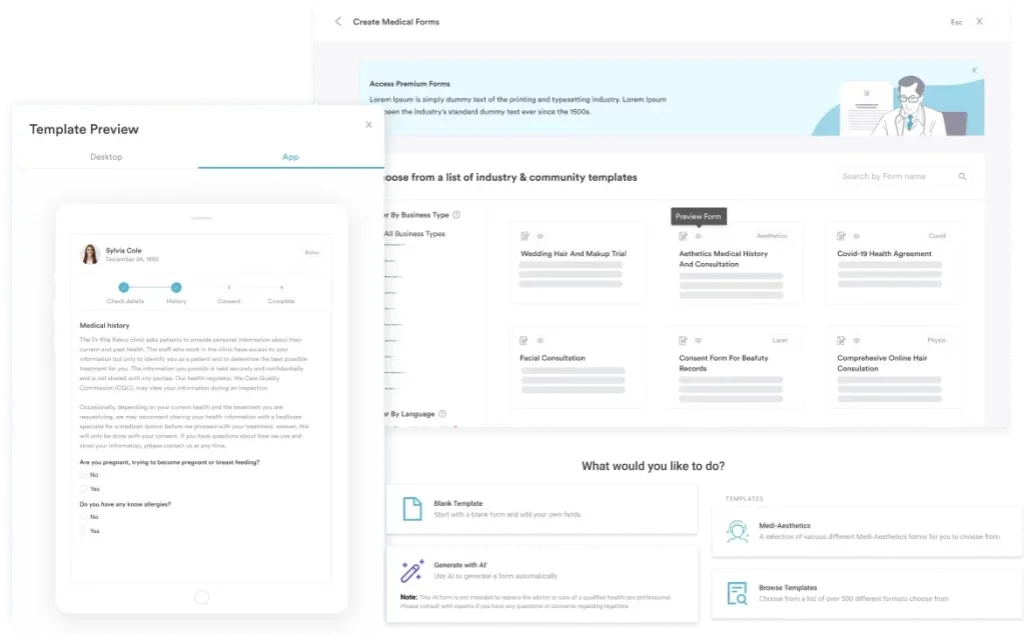
Capture the operation note and the device label on a digital form at the point of care. That removes the scramble for paperwork when the invoice is raised days later.
E4100 invoices fail for a short and predictable list of reasons. Each one is caught by a check before submission rather than an appeal afterwards.
A settled routine from clinic to remittance prevents most E4100 problems. The steps below describe how a UK ENT practice bills the procedure to a private medical insurer.
Billing a single E4100 episode touches the clinic appointment, the authorisation call, the theatre note, the device label and the remittance. Practice management software like Pabau holds those pieces against one patient record, so the person raising the invoice is not rebuilding the episode from memory.
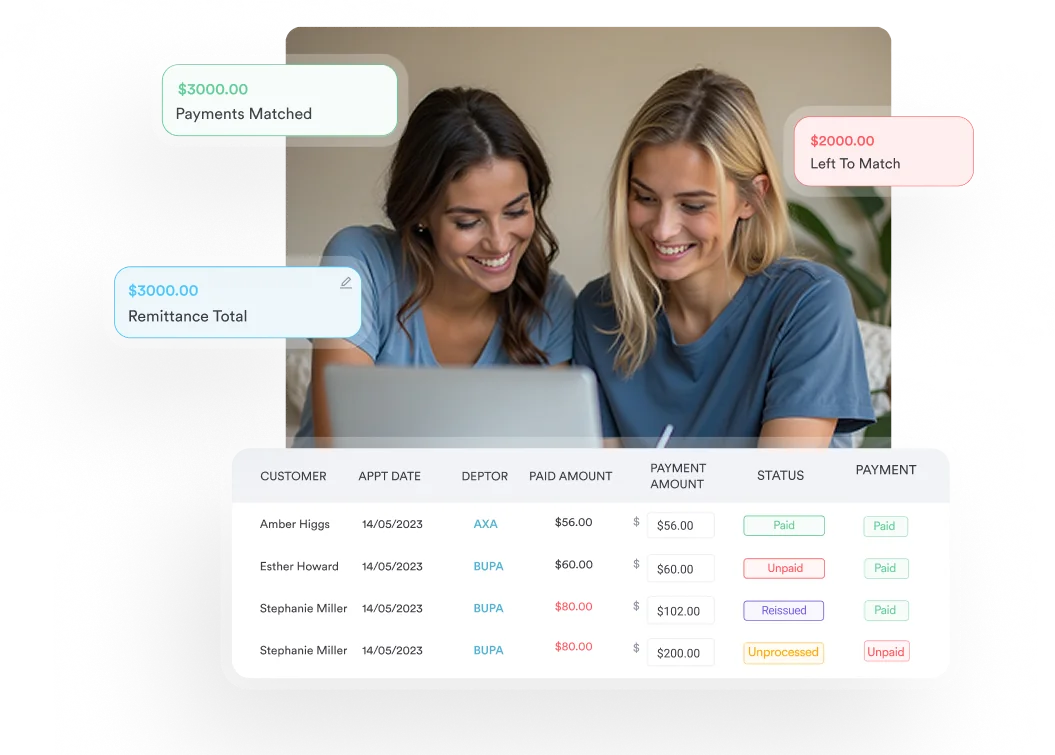
Pabau’s claims management software sends invoices to Healthcode without leaving the system, which spares the billing team a second round of data entry.
Documents attach to the patient record at the point of care, and claim status is visible as the insurer works through it. For a practice running several ENT consultants, that means fewer invoices sitting unsent while someone hunts for an operation note.

Pabau helps UK ENT practices capture operation notes, track authorisation references, and send CCSD-coded invoices to Healthcode with the right supporting records attached.

CCSD code E4100 covers one defined procedure. It pays for inserting a tracheo-oesophageal voice prosthesis in a patient who has had a total laryngectomy.
Four habits keep the invoice clean. Bill the fee without the device, and pair it with Z90.0 from the UK edition of ICD-10. Hold the authorisation reference before the theatre date, and file the operation note on the day. The schedule has no replacement code, so a routine change belongs under the consultation codes instead.
Pabau keeps the clinical record and the insurer invoice in the same place, so ENT teams spend less time reassembling evidence for a query. To see how it handles CCSD coding and Healthcode submission, book a demo with the team.

Need the wider CCSD picture? CCSD procedure codes explains how the UK schedule is organised and how practices bill against it.
Billing Bupa patients? Bupa CCSD codes sets out how Bupa bands procedures and what its published fees mean for your invoices.
Losing money to refused invoices? Denial management in healthcare covers the checks and appeal routines that keep surgical billing moving.
CCSD code E4100 covers insertion of a tracheo-oesophageal voice prosthesis for a patient who has had a total laryngectomy. It pays the consultant for placing the device, including any dilation of the fistula tract at the time. It does not cover the prosthesis itself, the anaesthetic, the hospital charges, or speech and language therapy.
No. E4100 is the only voice prosthesis code in the CCSD schedule, and there is no replacement or change-out code. A routine prosthesis change is a short clinic appointment, so practices generally invoice it under the outpatient consultation codes, 20300 or 20310. Agree the approach with the insurer before the appointment.
No. The prosthesis, whether a Provox, a Blom-Singer or another brand, is charged separately from the consultant fee. In UK private practice the hospital normally invoices it as a prosthesis or consumable item. Adding the device to the E4100 line usually produces a duplicate charge that the insurer refuses.
Published specialist fees sit between roughly 500 and 620 pounds, and every insurer sets its own. Bupa lists E4100 at 533 pounds as a Major 2 procedure, and National Friendly at 618 pounds. Allianz Care UK publishes 520 pounds and Freedom Health Insurance 500 pounds. Anaesthetic fees are published separately, and schedules are reissued, so check the current version.