Pabau Engage inbox

Pabau Engage is here: every patient conversation in one inbox.

Learn more
CCSD Code

CCSD code E1910 – Total pharyngectomy


Code Definition

E1910 is the CCSD code for total pharyngectomy, the surgical removal of the whole pharynx. UK private medical insurers use it to identify the operation on a claim, and E1911 covers the robotic-assisted version.

Total pharyngectomy is major head and neck surgery, so insurers check the claim closely. A mismatched auth, a thin operative note or a stray add-on code can hold up payment for weeks. Below, you'll find what the code covers, the paperwork insurers want, and a check to run before you submit.

Chapter
5 Ear, nose and throat
Category
Throat and Voicebox
Subcategory
Pharynx
Billable
No
Code also known as
ear nose throat procedure billing, ENT CCSD billing, private ENT billing UK
Save time. Improve accuracy. Get paid faster.
Automate coding with Pabau

Let Pabau's smart automation suggest the right codes, reduce claim denials, and keep your practice compliant—effortlessly.

  • AI-powered code suggestions
  • Real-time compliance checks
  • Faster claims, fewer denials
Why practices choose Pabau
Save hours every week

Automate repetitive tasks and focus on what matters most—your patients.

Improve accuracy

Reduce coding errors and ensure compliance with the latest regulations.

Get paid faster

Clean claims, fewer denials, and faster reimbursements.

Grow with confidence

Powerful insights and reporting to help your practice thrive.

HIPAA compliant SOC 2 certified GDPR-compliant Trusted by 4,000+ clinics worldwide

Key takeaways

Key takeaways

CCSD code E1910 is total pharyngectomy, and E1911 is the robotic-assisted version of the same operation.

Get preauthorization for E1910 before surgery, and make sure the code on the auth matches the code on the invoice.

E1910 is a single-organ procedure, so there is no bilateral billing and no second-side fee.

The CCSD schedule lists E1910 with E2320 as an unacceptable combination, so never bill the two together.

Pabau’s Healthcode integration lets you record the auth reference against the appointment, so it’s on hand when you build the claim.

CCSD code E1910 is total pharyngectomy, billed once per operation

CCSD code E1910 is total pharyngectomy, the surgical removal of the whole pharynx. If the operation is robotic-assisted, use E1911 instead. Both codes sit in the Pharynx section, under Throat and Voicebox, in the CCSD schedule’s ear, nose and throat codes.

CCSD stands for the Clinical Coding and Schedule Development Group. Its members are Bupa, AXA Health, Aviva and Vitality. The group maintains the procedure schedule UK private insurers use to identify surgery on a claim. Our CCSD codes reference shows where E1910 sits in it.

The detailed scope notes for each code sit behind the CCSD login, so check them there before you code a borderline case. Here are the key facts at a glance.

AttributeDetail
CodeE1910
DescriptorTotal pharyngectomy
Schedule sectionThroat and Voicebox, Pharynx
Robotic-assisted versionE1911
Code systemCCSD (Clinical Coding and Schedule Development Group) schedule
Billing routeHealthcode, for electronic claims to UK private insurers
Recognized byBupa, AXA Health, Aviva, Vitality, Cigna, WPA and other UK insurers, with cover set by each policy
PreauthorizationExpected by most insurers, so confirm with each one before surgery

What E1910 covers, and what you bill separately

E1910 pays for one operation: removing the pharynx. Steps that form an integral part of that operation sit inside the code. Any other procedure needs its own code, its own documentation and, usually, its own auth.

  • Included in E1910: the total pharyngectomy itself, with the standard intra-operative steps that form part of it.
  • Billed by someone else: the anesthetist’s fee, which the anesthetist claims on their own invoice.
  • Coded separately: another procedure in the same session, but only if it has its own CCSD descriptor and isn’t an unacceptable combination with E1910.
  • Never billed with E1910: E1911 and E2320, which the CCSD schedule lists as unacceptable combinations.
  • Usually outside the code: outpatient follow-up appointments after discharge, which insurers tend to treat as separate consultations.

Two errors cause most scope problems. Teams either fold a separate procedure into E1910, or they split out a step the code already includes. Both draw insurer queries, so confirm the scope notes in the CCSD schedule whenever the operation went beyond the plan.

The paperwork insurers want for an E1910 claim

Insurers can ask for clinical records to back up any E1910 claim. Have these ready before the invoice goes out, so a records request doesn’t stall payment.

  1. Operative note: dated and signed on the day of surgery. Name the approach, the findings and any intra-operative decisions. It must describe a total pharyngectomy, not just say the procedure went as planned.
  2. Consent form: signed before surgery, naming the procedure and its main risks.
  3. Anesthetic record: the type of anesthetic and the anesthetist’s details, if they’re submitting their own claim.
  4. Post-operative note: the patient’s status after surgery. Some insurers query inpatient claims where the record stops at the end of the operation.
  5. Auth reference: recorded on the invoice and in the claim record before you submit.

Pro Tip

Write the operative note on the day of surgery. Notes written days later can be questioned in an insurer audit, even when the operation itself was clinically appropriate.

Preauthorization for E1910 comes before the surgery date

Most UK insurers expect preauthorization before a total pharyngectomy. A claim sent without the right auth reference is one of the quickest routes to a denial. The table shows what each insurer typically asks for, but rules change, so confirm with the insurer before surgery.

InsurerPreauthorization typically required?Key invoice requirementsFee schedule reference
BupaYes, for most surgical proceduresAuth reference, Bupa membership number, consultant recognition number, E1910, ICD-10 diagnosis codeBupa code search
AXA HealthYes, check per procedureAuth number, AXA member reference, E1910, diagnosis code, facility detailsAXA Health procedure codes
AvivaYes, as pre-treatment approvalPre-treatment authorization reference, Aviva policy number, E1910 with diagnosisAviva’s provider fee schedule
VitalityYes, check per procedureAuth reference, Vitality member number, E1910, diagnosis codeVitality’s provider fee schedule
CignaOften, depending on the member’s planAuth reference, Cigna member ID, CCSD code, consultant detailsCigna UK fee schedule
WPAVaries by plan typeWPA member reference, E1910, diagnosis. Some plans reimburse the patient rather than settling directly.WPA medical fees

If you bill Bupa often, our Bupa CCSD codes guide explains its code search and fee schedule. With every insurer, check the patient’s eligibility and remaining benefit when you request the auth.

How an E1910 claim moves through Healthcode

Healthcode is the main clearinghouse for UK private medical insurance claims, and most insurers expect electronic submission through it. Each stage of the claim has one slip that sends it back, as the diagram below shows.
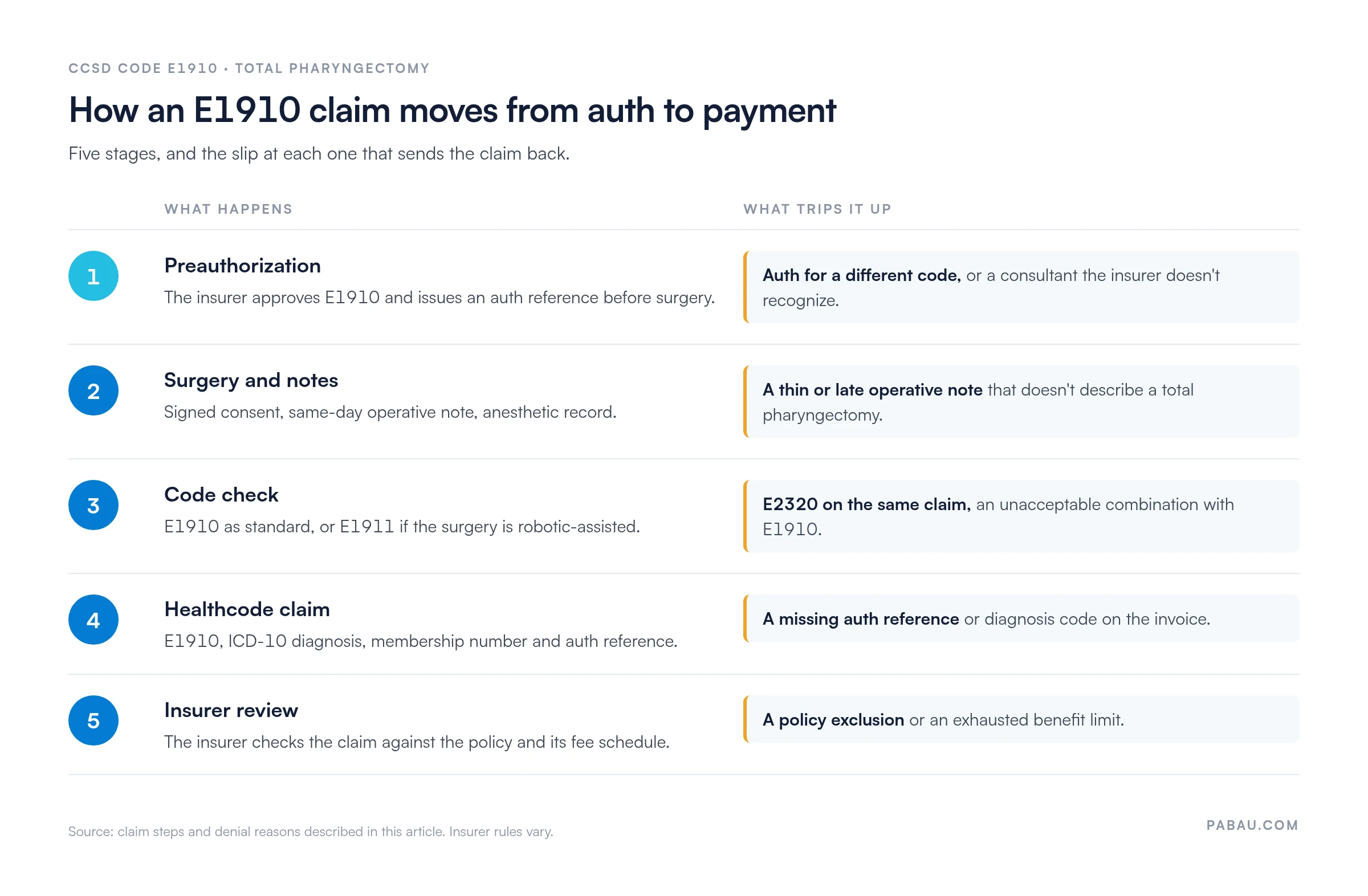
Five-stage claim path for CCSD code E1910 total pharyngectomy
Each stage pairs a step with the slip that sends an E1910 claim back, so you can catch it before submission. Built from the claim steps and denial reasons in this guide.

Here’s the walkthrough for the submission itself, from opening the claim to keeping its reference.

  1. Open a new claim for the patient’s episode. Check that the insurance details match the insurer’s records.
  2. Select E1910 from the code lookup rather than typing it. The lookup fills in the descriptor for you.
  3. Add the ICD-10 diagnosis code that justifies the surgery. Most UK insurers expect at least one on surgical claims.
  4. Enter the auth reference in its own field. Claims missing a required reference are usually returned unprocessed.
  5. Attach or reference clinical records if the insurer asks for them. Some request the operative note at submission, not only on audit.
  6. Review and submit. Keep the claim reference Healthcode generates, so you can track the claim. Processing times vary by insurer and claim complexity.

Codes that get confused with E1910

Pick the wrong pharynx code and the claim describes a different operation. The table covers the neighbors that matter most, plus the combination the CCSD schedule won’t accept.

CCSD codeProcedure scopeKey differentiator from E1910
E1910Total pharyngectomyUse for a total pharyngectomy without robotic assistance.
E1911Robotic-assisted total pharyngectomyUse only when the operation is robotic-assisted. Never bill it alongside E1910.
E2320Open operation(s) on pharyngeal pouchA different operation. The CCSD schedule lists E1910 with E2320 as an unacceptable combination.
E1910 + add-on codeE1910 billed with a second code for another procedure in the same sessionValid only when the second procedure has its own CCSD descriptor and was performed and documented.

Look codes up in the CCSD schedule each time rather than billing from memory. Voice restoration has its own codes too, such as E4100 for inserting a voice prosthesis. Check the combination rules before you bill it in the same session as E1910.

No bilateral billing, and add-ons need their own descriptor

A total pharyngectomy removes a single organ, so E1910 has no bilateral version and no second-side fee. Don’t flag the claim as bilateral.

  • Bill E1910 once per operation.
  • Add a second code only for a separately described procedure that was performed and documented.
  • Never add a code for a step the E1910 descriptor already includes.
  • Check each insurer’s fee schedule to confirm it recognizes the add-on code alongside E1910.

Run this six-point check before you submit E1910

A couple of minutes with this list catches the usual reasons an E1910 claim comes back. Run it on every claim, even if your team bills total pharyngectomies regularly.

  • The auth reference names E1910, or E1911 for robotic surgery, and matches the invoice.
  • The patient’s insurer recognizes the operating consultant.
  • The operative note is signed, dated on the day and describes a total pharyngectomy.
  • An ICD-10 diagnosis code supports the surgery.
  • No unacceptable combination, such as E2320, sits on the same claim.
  • The patient’s policy covers the procedure and still has benefit left.

Example: the auth came through for a smaller pharynx operation, but the surgeon found more disease and removed the whole pharynx. Call the insurer and update the auth to E1910 before you invoice. Otherwise the claim and the auth name different codes, and the insurer will likely return it.

Why E1910 claims get denied, and the fix for each

E1910 denials tend to fall into the same six groups. Each one has a fix you can make before the claim goes out.

Denial reasonWhy it happensCorrective action
Missing preauthorization referenceClaim sent without a valid auth number, or the auth covers a different codeGet preauthorization for E1910 before surgery. Enter the reference on the Healthcode claim before you submit.
Insufficient clinical documentationOperative note too brief, missing findings, or written days laterWrite a detailed operative note on the day. Include the approach, the findings and the post-operative status.
Incorrect code selectionA neighboring pharynx code entered instead of E1910, or E1910 used for a different operationCheck the E1910 descriptor against the operation performed before you enter the code.
Bundling errorA separate procedure folded into E1910, or an add-on the insurer treats as includedReview the CCSD scope notes for E1910. Remove the add-on if it’s included, then resubmit.
Consultant not recognizedThe operating consultant isn’t recognized by the patient’s insurerConfirm recognition with each insurer before surgery. Most offer an online provider search.
Policy exclusion or benefit limit reachedThe policy doesn’t cover the procedure, or the benefit limit is used upCheck eligibility and benefit before surgery. Ask the insurer for a benefit check that quotes E1910.

How Pabau keeps the E1910 auth and claim in one record

On many ENT teams, the auth reference sits in an email, the operative note in another system and the invoice in a third. Every copy-and-paste step is a chance to drop the reference or mistype the code.

Pabau, the practice management platform we build, connects directly to Healthcode. Its claims management software builds CCSD-coded claims from the patient record and checks required fields before you send.
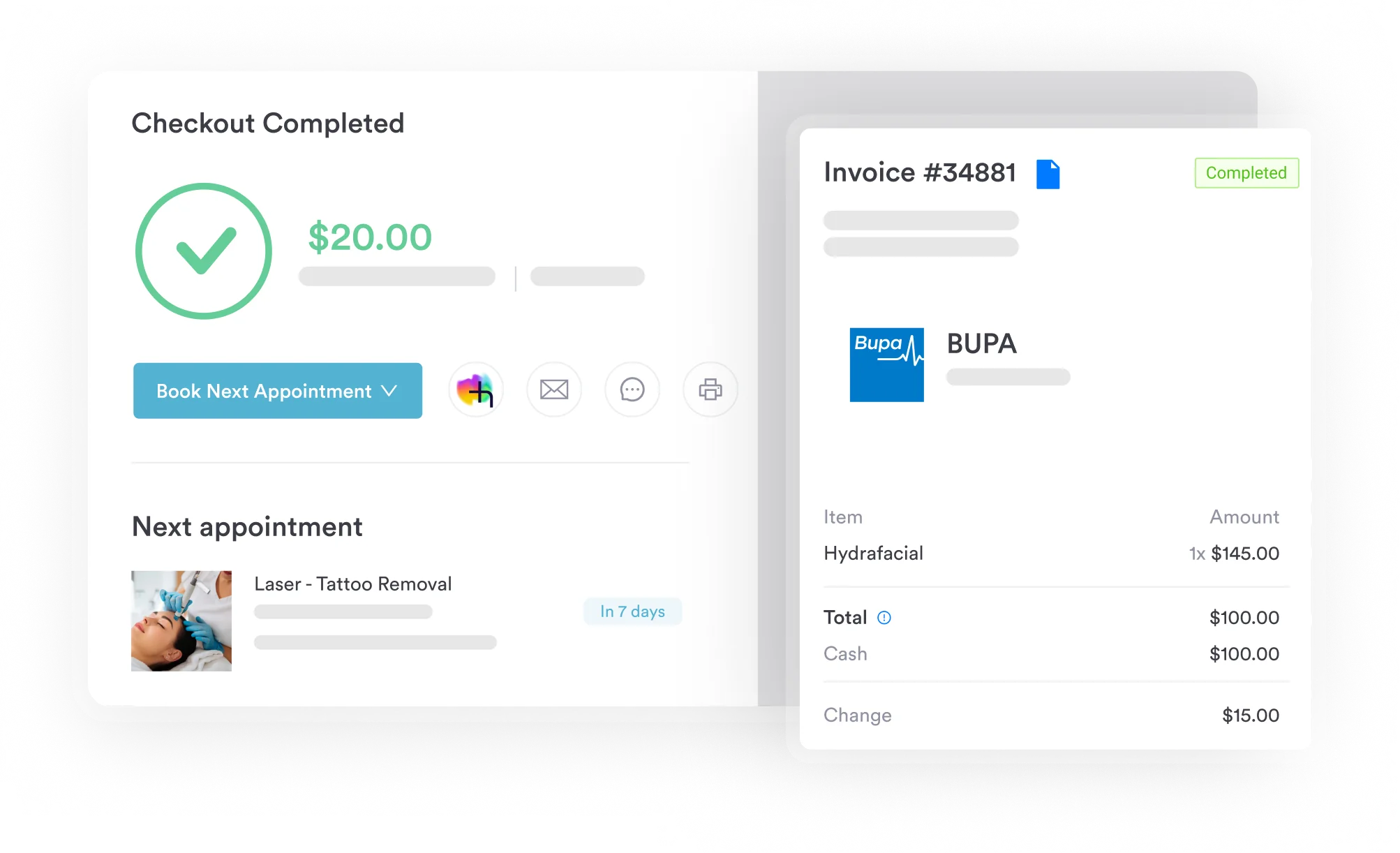

Pabau checkout screen next to a completed Bupa insurer invoice
Pabau raises the insurer invoice from checkout, so the E1910 claim starts from the same record as the appointment and its auth reference.
  • Auth reference tracking: record the insurer’s auth reference against the appointment, so it’s on hand when you build the Healthcode claim. It helps avoid missing-reference denials.
  • Digital consent forms: patients sign consent on Pabau’s digital forms, so the signed form sits in the same patient record as the claim.
  • Claim status tracking: follow each claim after submission without logging in to a separate portal.

Send cleaner CCSD claims with Pabau

Pabau’s Healthcode integration builds CCSD claims from the patient record, so your team stops re-keying codes and auth references. Book a demo to see it with your insurers.

Pabau practice management software for UK private practices

Conclusion

Choosing E1910 is the easy part. The claim succeeds or fails on what surrounds the code: an auth that names it, a same-day operative note and a clean Healthcode submission.

So run the six-point check when you book the surgery. Once the auth, consultant recognition and benefit check are settled before the operation, the claim itself becomes routine. A few minutes of admin up front saves weeks of chasing a returned claim.

Book a demo to see how Pabau keeps E1910 auth references, consent forms and Healthcode claims in one patient record.

Continue your research

Continue your research

Need the wider Bupa picture? Bupa CCSD codes covers how Bupa structures its code search and fee schedule for private practice.

Billing voice restoration after throat surgery? CCSD code E4100 explains how to bill insertion of a voice prosthesis.

Coding other ENT surgery? CCSD code E0230 walks through billing septorhinoplasty with graft.

Chasing a returned claim? Denial codes in medical billing explains what common denial codes mean and how to fix them.

Want fewer claim errors across your billing? Claims management software shows how Pabau builds and tracks insurer claims from the patient record.

Frequently asked questions

Is CCSD code E1910 the same as an OPCS-4 code?

No. OPCS-4 is the NHS classification for operations and procedures. CCSD codes form a separate schedule for private insurance claims. A hospital may record both for the same operation, but the insurer claim uses the CCSD code.

What if the surgeon performs a partial pharyngectomy instead?

Bill the code for the operation the operative note describes, not the one you planned. Partial pharyngectomy has its own CCSD code. Check the schedule and ask the insurer to update the auth before you invoice.

Does Vitality cover CCSD code E1910?

E1910 is generally recognized on UK insurers’ schedules, including Vitality’s. Whether a claim is paid depends on the patient’s policy and on preauthorization. Check both with Vitality before surgery.

Do all insurers pay the same fee for E1910?

No. Each insurer sets its own fee for a CCSD code, and the CCSD Group doesn’t set fees. Check the current figure in each insurer’s fee schedule. The hospital and the anesthetist bill their own charges separately.

Can I resubmit a denied E1910 claim?

Usually, yes. Fix the cause first, such as a missing auth reference or the wrong code, then resubmit through Healthcode. If the insurer queries the clinical records, send the operative note and consent form.
Avatar photo
Monika Lazarevska
Content Writer

Monika Lazarevska writes content for owners and healthcare professionals who want clear, no-fluff content that actually helps them run their practice better. With a background in storytelling and SEO, she knows how to make even the driest topics worth reading. Off the clock, you'll find her in a café somewhere in Europe, probably with a good book and an even better coffee.
×