CPT Code 69610: Tympanic membrane patch repair (myringoplasty)
CPT code 69610: official descriptor and procedure overview CPT code 69610 descri...

Last Updated: Oct 19, 2026
B2752 is the CCSD code for a subcutaneous mastectomy. The surgeon removes the breast tissue through a skin incision and keeps the skin envelope. UK private medical insurers pay the surgeon and anesthetist against this code. What the code leaves out matters most. If an implant or reconstruction goes in during the same operation, B2752 is the wrong code.
That one detail decides whether a claim pays the first time or comes back for rework. B2752 sits in Chapter 7 (Breast) with a Major 1 complexity band. Its neighbors look alike on paper. Below, you'll learn how to tell them apart and what insurers need before you submit.
Let Pabau's smart automation suggest the right codes, reduce claim denials, and keep your practice compliant—effortlessly.
Automate repetitive tasks and focus on what matters most—your patients.
Reduce coding errors and ensure compliance with the latest regulations.
Clean claims, fewer denials, and faster reimbursements.
Powerful insights and reporting to help your practice thrive.
HIPAA compliant SOC 2 certified GDPR-compliant Trusted by 4,000+ clinics worldwide

CCSD code B2752 is a subcutaneous mastectomy in Chapter 7 (Breast), with a Major 1 complexity band.
It covers removal of the breast tissue with the skin envelope kept and no implant placed.
An immediate implant moves the claim to B2700, and skin- or nipple-sparing surgery with node biopsy is B2760.
Most returned claims trace back to the wrong variant, a missing authorization or an operative note that doesn’t match.
The descriptor doesn’t state a side, so ask each insurer how it wants a bilateral operation billed.
CCSD code B2752 is the UK private healthcare code for a subcutaneous mastectomy. The surgeon removes the glandular breast tissue through a skin incision and leaves the skin envelope in place.
The CCSD Technical Guide (October 2025 edition) lists mastectomy codes in Chapter 7, Breast, under sub-chapter 7.2.0 Mastectomy.
Insurer schedules file the code under “Mastectomy (excluding implant/reconstruction).” In other words, B2752 pays for the mastectomy on its own. An implant or flap placed in the same operation belongs to a different code.
The table below pulls the key reference details into one place.
B2752 follows the CCSD single code principle. One code describes the operation from start to finish, including the steps that routinely come with it.
For a subcutaneous mastectomy, that means the incision, removing the breast tissue, controlling bleeding, any drain and closing the wound.
However, several procedures often travel with a mastectomy and still fall outside B2752:
One more detail catches people out. Simple mastectomy (B2780) is listed as unilateral, but the B2752 descriptor doesn’t state a side. So ask the insurer how it wants a bilateral subcutaneous mastectomy billed before you send the invoice.
A subcutaneous mastectomy is usually done under general anesthetic. The surgeon makes an incision, often in the fold beneath the breast or around the areola.
Next, the breast tissue is removed from under the skin. The nipple may or may not be kept, depending on the reason for surgery and the surgeon’s assessment.
Common reasons include risk-reducing surgery for patients with a high inherited cancer risk and some benign breast conditions. Because the same operation can be coded several ways, insurers read the clinical record closely before they pay.
Write the note the way the operation happened, using the words the descriptor uses. If the note mentions an expander or implant, it contradicts a B2752 claim, and the insurer will query it.
The mastectomy sub-chapter holds several codes that differ only by what else happens in the operation. Picking a neighbor by mistake is one of the most common reasons a breast surgery claim comes back.
The decision path below runs through the questions that separate them.
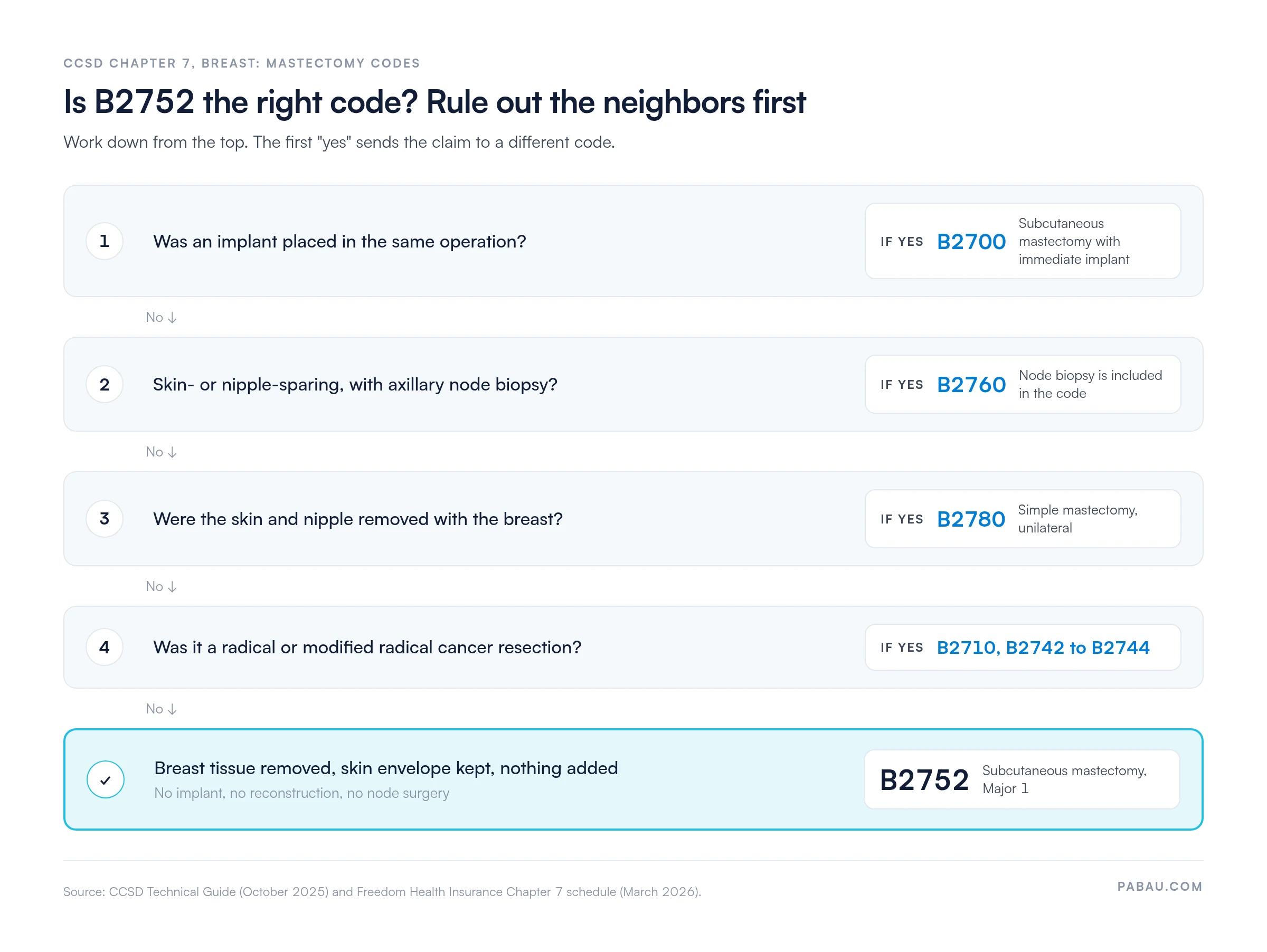
Here’s the full descriptor for each code, side by side:
Descriptors above come from the CCSD Technical Guide and the Freedom Health Insurance Chapter 7 fee schedule.
When two codes seem to fit, code what was performed rather than what pays more. And if the surgeon reconstructs with an expandable prosthesis in the same sitting, CCSD code B3012 is the one to check.
The same logic separates B2752 from the cancer codes in sub-chapter 7.2.0. When the whole breast and overlying skin come out with the pectoralis major preserved and no node procedure, the code is B2743.
UK private medical insurers accept CCSD codes, but each one sets its own fee, authorization rules and submission route. Even so, a B2752 claim usually moves through the same five stages:
Stage five is where claims quietly age. Many practices track authorizations and claim status in claims management software, so a stalled claim shows up within days. Each insurer also publishes its own lookup:
Fees differ between insurers and change with each schedule year. The Freedom figure in the reference table above is only one example. Always bill the fee in force on the date of surgery.
Insurers expect pre-authorization for a mastectomy, so request it once the surgery date is agreed. Most will ask for the following:
Plans do change. If the surgeon decides to place an implant, request a new authorization under the correct code before the operation. An authorization for B2752 doesn’t cover B2700.
A returned claim almost always points to one of four problems. The good news is that each one can be caught before the claim leaves your practice.
Billing B2752 when an implant was placed, or when an axillary node biopsy was included, sends the claim back. The insurer compares the operative note with the descriptor. So the code has to match what the note describes.
A claim sent without a valid authorization reference is usually rejected, even for an approved procedure. Authorizations also expire. Record the expiry date against the booking and check it before surgery.
CCSD lists unacceptable combinations against many codes. If you add a code the schedule treats as part of B2752, the claim is denied. Check the list on the CCSD website before you add a second procedure code.
Insurers may ask for the operative note, pathology report and consent form after surgery. When those sit in different places, a reply takes days and payment waits. Keep them linked to the patient and the surgery date, and your team can answer the same day.
Those four problems suggest a short routine. Run it on every B2752 claim before it goes to the insurer:
The CCSD schedule is the reference for every code, including B2752. It’s updated through the year, so a PDF saved months ago may be out of date.
Here’s how to check the live version:
If you bill other operations too, our CCSD codes archive collects billing guides for more codes in the schedule.
A breast surgery practice juggles authorizations, consent forms and claims across several insurers for each patient. When those sit in separate systems, one missing reference or unsigned form holds up payment.
Practice management software like Pabau keeps the booking, consent, clinical notes and claim in one patient record. Your team can see which authorizations are about to expire and which claims are still unpaid.
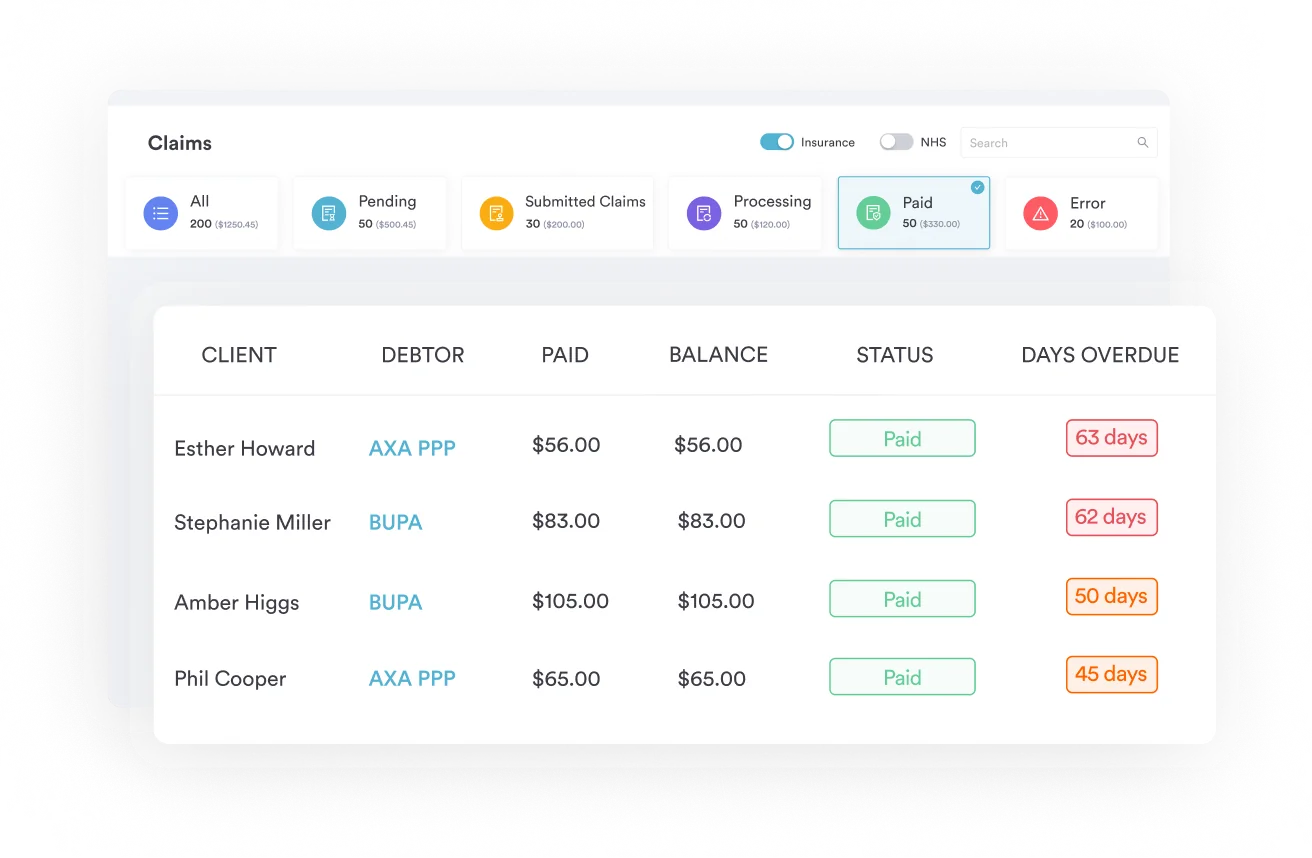
Consent works the same way. Patients sign procedure-specific forms digitally, and each signed copy is stored against their record with a timestamp. So when an insurer asks for evidence, your team can send it the same day.
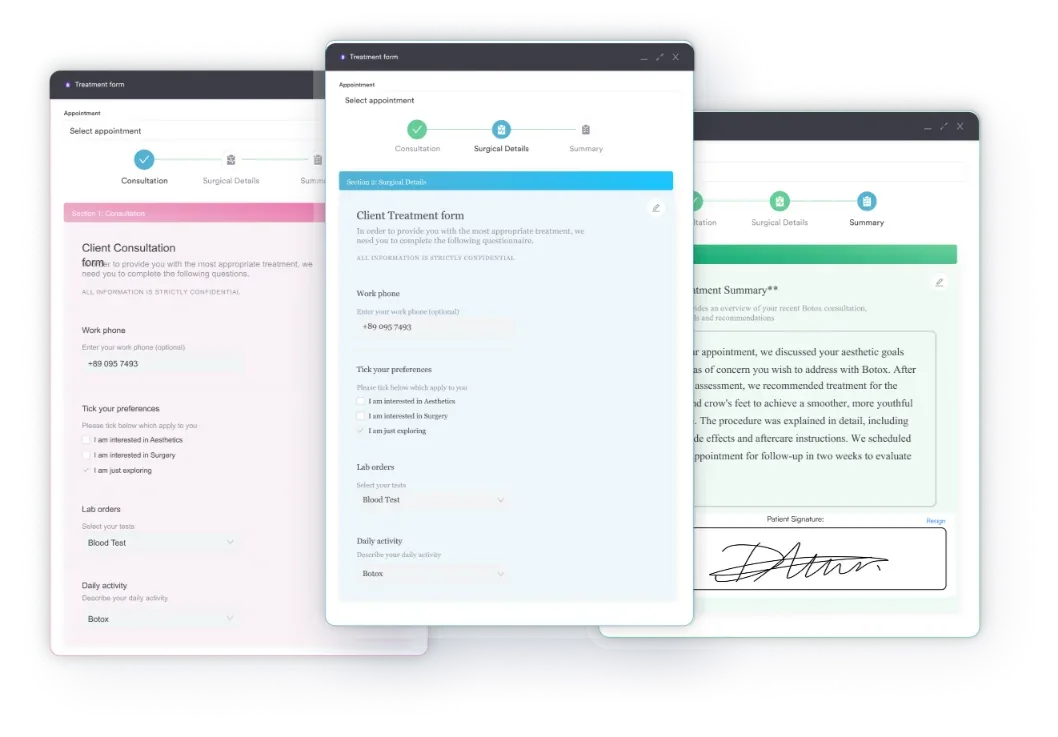

Pabau helps UK private practices track CCSD code submissions, manage pre-authorization workflows and keep the records private medical insurers ask for. See how it works for your practice.

B2752 is easy to apply once the operative note is clear. It pays for breast tissue removal with the skin kept, and nothing added. So most of the work happens upstream, in a precise note and an authorization that quotes the right code.
If there’s any chance the surgeon will place an implant, raise B2700 with the insurer before the day. A short call beforehand costs far less than reworking a returned claim.
Want to see how Pabau keeps consent, notes and claims in one record for breast surgery billing? Book a demo with our team.

Adding an implant or expander? CCSD code B3012 covers mastectomy with immediate reconstruction using an expandable prosthesis.
Reconstructing with a fixed implant? CCSD code B3015 explains billing for breast reconstruction using a fixed prosthesis.
Removing a localized lesion instead? CCSD code B2880 explains excision biopsy of a breast lesion after localization.
Billing mainly through Bupa? Bupa procedure codes fee schedule shows how Bupa sets its fees against CCSD codes.
New to the CCSD system? Bupa CCSD codes explains how the schedule is organized and billed.
CCSD stands for Clinical Coding and Schedule Development. It’s a group formed by Aviva, AXA Health, Bupa and Vitality. The group maintains one shared set of procedure codes and descriptions for UK private healthcare. It doesn’t set fees, so each insurer publishes its own fee for B2752.
No. CCSD codes are used for private treatment billed to UK private medical insurers. NHS hospitals record the same operation with OPCS-4 procedure codes instead. The two systems don’t map one to one, so never copy an NHS code onto a private claim.
The terms overlap, and some surgeons use them loosely. For billing, the CCSD descriptors decide. B2760 covers a skin- or nipple-sparing mastectomy that includes axillary node biopsy. B2752 has no node surgery. Code from what the operative note records, not the name used in clinic.
Start with the rejection reason on the remittance or insurer portal. If the code was wrong, correct it and resubmit with a matching authorization. Where the code was right, reply with the operative note and pathology report. Then log the reason, so your team can catch the same problem next time.