CPT code 93503: Swan-Ganz catheter billing and modifiers
CPT code 93503: Official descriptor and procedure overview In the AMA CPT code s...

Last Updated: Oct 23, 2026
B1800 is the CCSD code for thymectomy for myasthenia gravis/thymoma, the open removal of the thymus gland for either indication. One code covers both, so a patient with myasthenia gravis and a thymoma is billed under B1800 alone.
The code is specific to the open approach, usually through a sternotomy. Video-assisted thoracoscopic (VATS) thymectomy is coded E6200, and robotic-assisted thymectomy is coded B1802 or B1803. Bupa bands B1800 as Major 5, with a fee of £650.
Let Pabau's smart automation suggest the right codes, reduce claim denials, and keep your practice compliant—effortlessly.
Automate repetitive tasks and focus on what matters most—your patients.
Reduce coding errors and ensure compliance with the latest regulations.
Clean claims, fewer denials, and faster reimbursements.
Powerful insights and reporting to help your practice thrive.
HIPAA compliant SOC 2 certified GDPR-compliant Trusted by 4,000+ clinics worldwide

CCSD code B1800 covers thymectomy for myasthenia gravis/thymoma, so one code applies whether myasthenia gravis, a thymoma, or both led to surgery.
B1800 is the code for open thymectomy, usually through a sternotomy. VATS thymectomy is coded E6200, and robotic thymectomy is coded B1802 or B1803.
Bupa’s February 2026 schedule bands B1800, E6200 and B1802 at Major 5 with a £650 fee, while B1803 sits at Major 4 with £618.
The pre-authorization request should name the planned approach and its code, because a change of approach changes the code on the claim.
Pabau, the practice management platform we build, keeps the authorization reference, operative note and CCSD-coded invoice on one patient record.
CCSD code B1800 is the procedure code for thymectomy for myasthenia gravis/thymoma, the official descriptor in the CCSD schedule. It covers open removal of the thymus gland when myasthenia gravis, a thymoma, or both are the documented indication.
One code serves both indications. The schedule has no separate thymoma-only thymectomy code, so a patient with myasthenia gravis and a thymoma is billed under B1800 alone. Which condition prompted surgery still matters for the diagnosis codes, but it doesn’t change the procedure code.
The surgical approach does change the code. B1800 is the open thymectomy code, most often performed through a median sternotomy. Thymectomy by video-assisted thoracoscopic surgery (VATS) is coded E6200, and robotic-assisted thymectomy is coded B1802 or B1803.
CCSD is the UK private-sector schedule, separate from NHS OPCS-4 codes and US CPT codes. Insurers including Bupa, AXA Health, Aviva and Vitality use it to process consultant claims. Our CCSD code guides cover the neighboring codes in the same format.
Myasthenia gravis (MG) is an autoimmune neuromuscular condition. Antibodies, most often against acetylcholine receptors (AChR), block signals between nerve and muscle. The thymus is implicated in that autoimmune response, and removing it improves or settles the disease in many patients.
The key evidence is the MGTX trial (Wolfe et al., NEJM 2016). It showed that thymectomy plus prednisone outperforms prednisone alone in generalized, AChR-antibody-positive, non-thymomatous MG. Cite it when you support a B1800 claim for MG without a thymoma, or appeal a denial.
A thymoma is a tumor of the thymus, and resection is the standard treatment whether or not the patient has MG. In an open thymectomy, the surgeon removes the gland and the surrounding mediastinal fat that may hold ectopic thymic tissue. The operative note must record how complete the resection was.
The indication must be explicit in the pre-authorization request and the correspondence behind it. Insurers query claims where the clinical rationale is missing.
Thymectomy has four CCSD codes, and the surgical approach decides which one applies. The indication can be MG or thymoma under each of them. Bupa’s February 2026 schedule, covered in our Bupa CCSD codes guide, lists them as follows.
Bupa’s April 15, 2025 schedule-change notice lists B1802 against B1800, B1803, E6200, E6300 and T1100 as separate codes. That confirms each thymectomy route carries its own code. Code the approach the surgeon used, and code it once. The diagram below traces each route to its code.
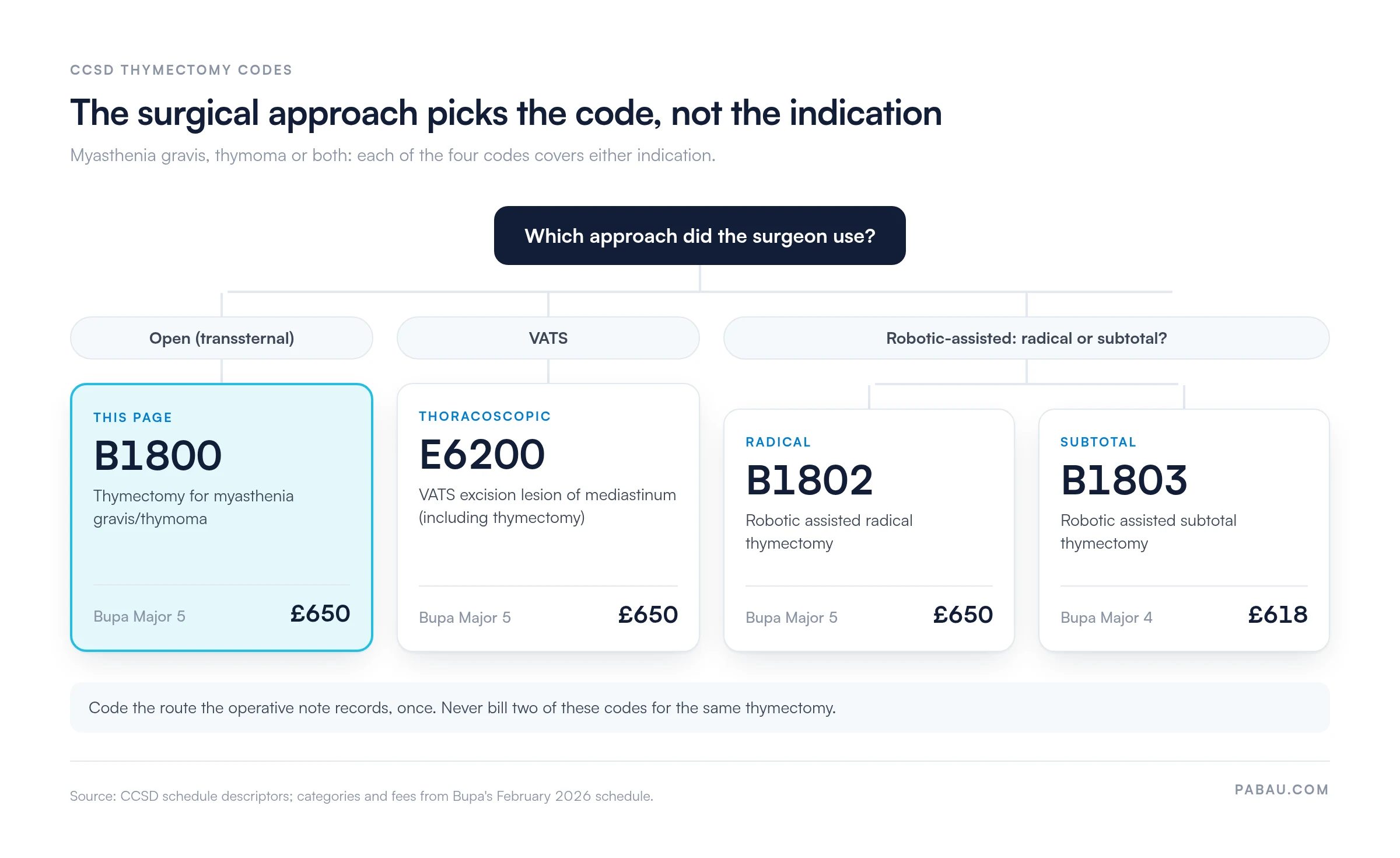
Three of the four codes pay the same Bupa fee, so a wrong approach code may not change the amount. It still creates a mismatch with the operative note, and audits catch that. A robotic subtotal thymectomy coded as B1800 also claims a higher category than the B1803 descriptor supports.
Pre-authorization doesn’t settle a claim by itself. These documents should be in the patient’s file before you invoice.
UK private insurers use the WHO ICD-10, not the US ICD-10-CM, so codes such as G70.00 and G70.01 don’t apply. List the diagnosis that drove surgery first, then any second diagnosis.
UK private insurers treat thymectomy as major elective surgery, so pre-authorization is required before the operation. A B1800 claim without a valid pre-authorization reference is the most avoidable denial. Make the authorization check a fixed step before the operation is booked.
Requirements change with each policy year. Check the Bupa code search portal, the Aviva fee schedule, or the Vitality fee finder before you submit.
Request pre-authorization in writing. Keep the reference number, the agent’s name and the date on the patient’s record, so you can answer a later query from one place.
Other clinicians bill their own part of the episode alongside B1800. Never bill E6200, B1802 or B1803 with B1800 for the same thymectomy, because each code describes the whole operation by one route.
Audit your B1800 claims each quarter. Check that every invoice carries a pre-authorization reference, an ICD-10 code and a filed operative note that names the open approach.
Denial patterns for B1800 repeat across UK private insurers. Knowing them in advance cuts queries and the cash-flow delays they cause. A denial management process handles the queries that still get through.
Most UK private insurers have a formal appeal process. They will reconsider a denied B1800 claim when the right clinical evidence arrives.
A thymectomy claim often moves through three places today. There’s the insurer’s portal for authorization, a word processor for the operative note, and a separate billing tool. Each hand-off risks losing the reference number or the approach detail the insurer checks.
Pabau’s private practice billing software keeps those steps on one patient record. The insurer and policy sit on the record, so each invoice routes to the right insurer. Before a claim goes to Healthcode, Pabau checks that details such as authorization codes are in place.
Once sent, each claim moves through visible stages, from submitted to paid. Your team spots a queried B1800 claim the day it stalls. For consultants new to private practice, that structure shortens the learning curve.

Pabau helps UK private practices track pre-authorization, attach operative notes to claims, and submit CCSD-coded invoices to insurers. See how it works for thoracic surgical teams.

B1800 is settled by two facts, and the indication isn’t one of them. Confirm the surgery is a thymectomy, then confirm it is open. MG, thymoma or both all sit under the same code.
Name the approach in the pre-authorization request and again in the operative note. If the route changes on the day, the code changes with it, and the insurer should hear about it first.
Book a demo to see how Pabau tracks authorizations and CCSD claims for thoracic surgical teams.

Choosing billing software for a UK private practice? Best medical billing software in the UK compares the platforms that submit insurer claims for UK consultants.
CCSD code B1800 covers thymectomy for myasthenia gravis/thymoma, performed as open surgery. One code covers both indications, so it applies whether MG, a thymoma, or both led to surgery. There is no separate thymoma-only thymectomy code.
B1800 applies to open thymectomy, usually through a median sternotomy. VATS thymectomy is coded E6200. Robotic-assisted thymectomy is coded B1802 for a radical resection or B1803 for a subtotal one.
Yes. UK private insurers treat thymectomy as major elective surgery that needs pre-authorization. The request should name the open approach and include neurologist correspondence where MG is an indication, plus the CT chest report.
No. The B1800 descriptor reads “Thymectomy for myasthenia gravis/thymoma”, so an open thymectomy for thymoma uses B1800. What changes is the ICD-10 code, such as D15.0 or C37, listed with it.
The usual reasons are a missing pre-authorization reference and an approach code that doesn’t match the operative note. Others include missing neurologist letters, a missing or US ICD-10-CM diagnosis code, and a vague operative note.
The anesthetist bills separately, and the pathology laboratory bills for histology. An assistant surgeon may bill where the insurer allows it, so confirm before surgery. Never add E6200, B1802 or B1803 for the same thymectomy.