

CCSD code G5100: Bypass of duodenum billing guide
CCSD code G5100 bills a bypass that leaves the duodenum in place CCSD code G5100...

Last Updated: Oct 16, 2026
B1250 is the CCSD code for thyroid re-operation, used when a surgeon operates again on a thyroid gland that has already had surgery. It covers revision surgery such as removing recurrent goiter or recurrent cancer after an earlier thyroidectomy.
The code turns on surgical history, whatever the extent of tissue removed. Published insurer fee schedules band B1250 as Complex Major, above first-time thyroidectomy codes such as B0812, which are banded Major.
Let Pabau's smart automation suggest the right codes, reduce claim denials, and keep your practice compliant—effortlessly.
Automate repetitive tasks and focus on what matters most—your patients.
Reduce coding errors and ensure compliance with the latest regulations.
Clean claims, fewer denials, and faster reimbursements.
Powerful insights and reporting to help your practice thrive.
HIPAA compliant SOC 2 certified GDPR-compliant Trusted by 4,000+ clinics worldwide

CCSD code B1250 applies to thyroid re-operations where a prior thyroid procedure has already been performed, whatever the extent of tissue removed during revision.
The operative note must confirm the prior thyroid surgery, the intraoperative findings of adhesions or altered anatomy, and the clinical indication driving the revision.
Most private medical insurers require pre-authorization before elective thyroid re-operation, and timing and documentation rules vary by insurer.
A planned, staged completion thyroidectomy is the exception to watch, because some insurers expect a primary code such as B0812 instead of B1250.
Claims management software like Pabau helps private practices attach supporting documents, track authorization status, and submit CCSD-coded invoices to insurers without re-keying.
CCSD code B1250 covers thyroid re-operation, meaning any surgical return to a previously operated thyroid field. The key qualifier is surgical history. If the patient has had a prior thyroid procedure, the surgeon is operating in a field already changed by that intervention.
The CCSD schedule is maintained by the CCSD Group, administered by Grant Thornton UK LLP, representing insurers including Aviva, AXA Health, Bupa and VitalityHealth. It assigns B1250 to separate these cases from first-time thyroid surgery. The primary thyroidectomy codes sit elsewhere in the schedule, in the B08xx range, and each of them assumes an unoperated neck.
The descriptor does not specify how much thyroid tissue is removed. The surgeon may remove a remaining lobe, excise a recurrent nodule, or clear residual disease. B1250 applies in each case, as long as a previous thyroid procedure has taken place. Prior surgery, and not the extent of the procedure, drives code selection.
Published insurer fee schedules band B1250 as Complex Major, a step above the Major band of the primary thyroidectomy codes. Each insurer then layers its own fee and pre-authorization rules on top of the base descriptor. Our CCSD code guides cover the neighboring thyroid codes in the same format. They help when you need to check how the index operation was coded.
A thyroid re-operation is consistently more demanding than a primary thyroidectomy. The surgeon re-enters a neck already altered by the first procedure. Scar tissue, adhesions, and fibrosis obscure tissue planes that were clear during the index operation.
The recurrent laryngeal nerve (RLN) is at elevated risk because its normal landmarks may no longer be visible. The parathyroid glands may already have been displaced during the first surgery, which makes them harder to identify and preserve.
B1250 is appropriate when a documented prior thyroid operation makes the revision field materially more complex. Accepted clinical indications include:
Each indication must be documented in the operative note and, where applicable, in the referral letter and any histology or imaging reports. Claims reviewers at UK private medical insurers look for explicit evidence that the clinical situation warranted revision rather than a primary procedure.
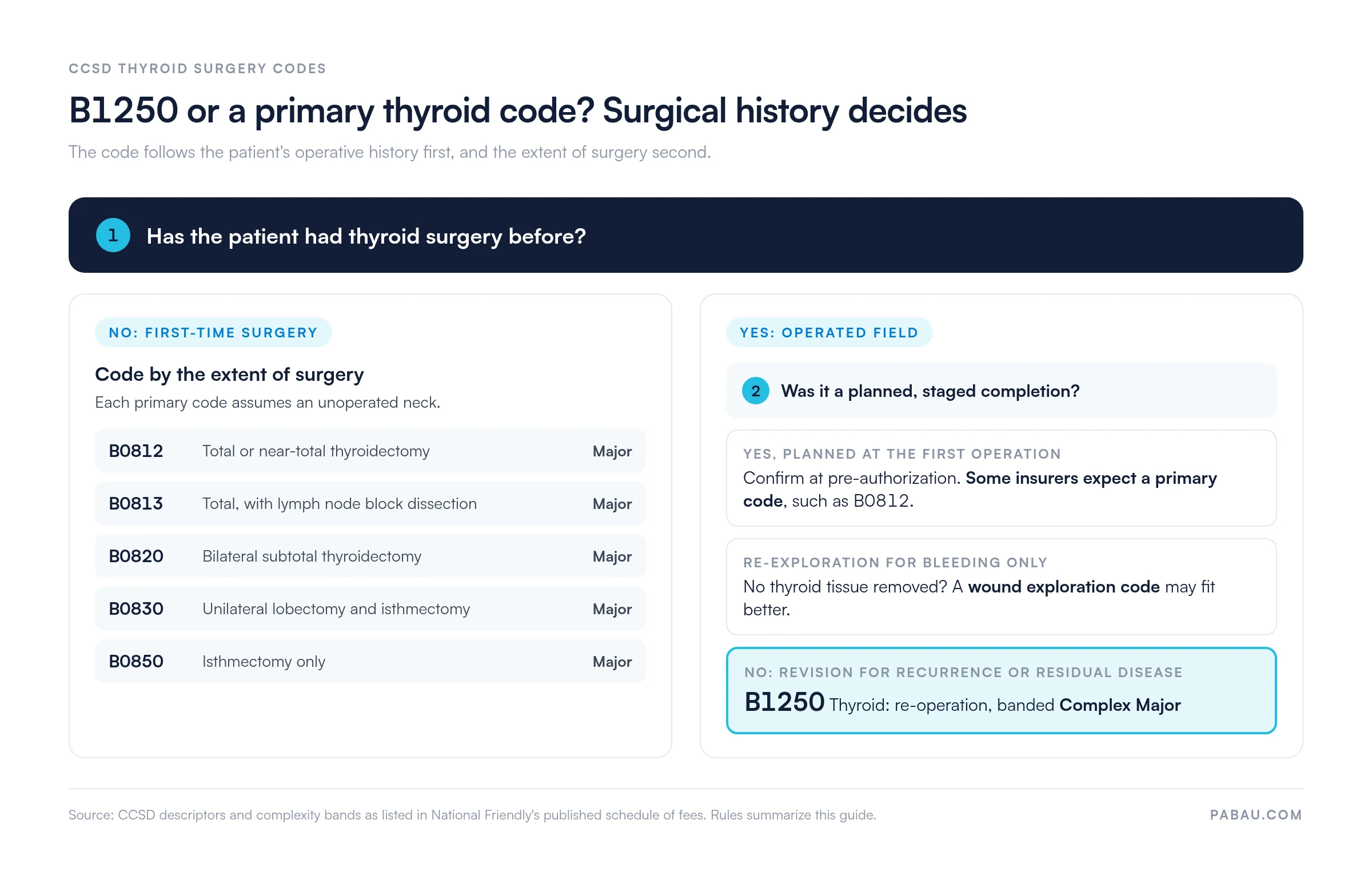
Most first-time thyroid operations are coded in the B08xx range, while B1250 sits apart as the code for any return to an operated thyroid field. What separates them is whether the neck has been operated on before. The table below maps the key codes and the complexity band each one carries on published fee schedules.
The most common coding error in this family involves a patient who had a hemithyroidectomy at an earlier admission. When the remaining lobe comes out, the practice bills B0812. B1250 is usually the correct code for that completion, because the surgeon is operating in a field modified by the first operation. The exception is a completion planned as a staged procedure, covered under coding pitfalls below.
Each B08xx entry in that table assumes a first operation on a gland no surgeon has touched. A first-time total thyroidectomy with a formal block dissection of lymph nodes is coded B0813. Where the first operation was a bilateral subtotal thyroidectomy, coded B0820, removing the remnant later counts as a re-operation.
Watch the neighboring number too. Despite its similar number, B1230 covers a core biopsy of the thyroid gland and never substitutes for a re-operation. The diagram below shows how surgical history routes a thyroid case to the right code.
A B1250 claim without proper documentation is likely to be queried or denied. The operative note is the most important document, and it must contain four core elements to support the claim.
Beyond the operative note, the referral letter from the patient’s consultant should record the clinical reason for revision surgery. Where recurrent cancer or residual disease is the indication, append the histology report and any post-ablation scan reports to the claim.
Where a recurrent nodule or node is sampled by fine needle aspiration first, that cytology claim is coded B1220. It stays a separate line and is not bundled into the revision fee.
Some insurers also require a copy of the original operative report from the first thyroid procedure. The original surgeon’s records are often available through the patient’s referral notes. Gathering these documents before submission reduces the risk of a claim query.
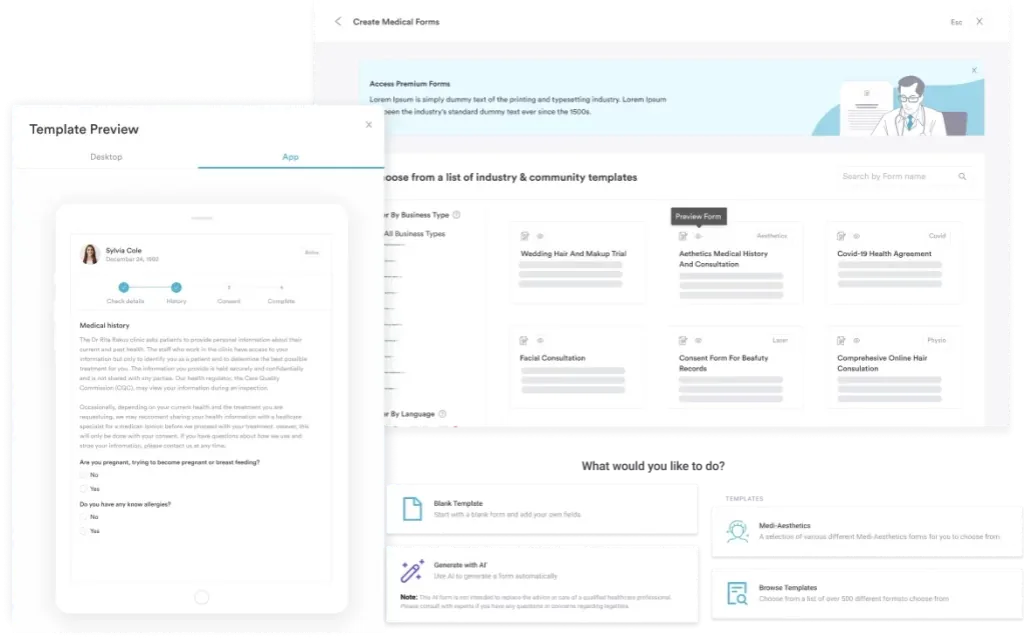
Digital forms that capture structured operative data at the point of care make complete, consistent documentation easier to produce. The alternative is rebuilding the record from memory once a query arrives.
UK private medical insurers typically require pre-authorization before elective thyroid re-operations. The process confirms that the patient’s policy covers the procedure and that the clinical justification meets the insurer’s criteria. Requirements vary between Bupa, AXA Health, VitalityHealth, Aviva, and other insurers, so check the current insurer portal rather than relying on general rules.
A standard pre-authorization submission for B1250 typically includes:
Insurers typically respond to pre-authorization requests within 3 to 5 working days for elective cases, and urgent clinical situations may warrant expedited review. If authorization is refused, the practice can submit a clinical appeal supported by the consultant’s written justification.
For teams working with several insurers, an up-to-date record of each insurer’s portal and submission rules saves repeated calls. Track authorization status per case, so outstanding approvals are flagged before a procedure date is confirmed.
Submitting a B1250 claim follows the same general process as other CCSD surgical codes. The re-operation classification adds several documentation checks that are easy to miss under pressure.
Software for medical claims management can attach operative documents automatically and track submission deadlines across every insurer you bill.
Yes, co-billing with B1250 is permissible in some circumstances, but each additional code must be checked against the individual insurer’s fee schedule and policy. The table below summarizes the most common supplementary codes and their status.
For assistant surgeon fees, the complexity of re-operative thyroid surgery is often the clinical justification, but allowability stays insurer-specific. Never assume co-billing is permitted without checking the relevant insurer’s fee schedule. The Aviva fee schedule and the Vitality fee finder both let practices check code-specific rules and any fee caps before submitting claims.
Elsewhere in the CCSD schedule, the answer runs the other way. Under D2610, the mastoidectomy that opens the way to the endolymphatic sac is access, so a second code would read as unbundling.
Before adding an assistant surgeon code alongside B1250, call the insurer’s provider line and get a reference number confirming allowability. Document that call in the patient’s billing file. An undocumented verbal confirmation will not help you if the claim is later denied.
B1250 denials typically fall into a small number of recurring categories. Knowing these patterns before submission is the most effective way to avoid them.
A templated operative note with set fields for the prior operation and the indication stops the first and fourth denial reasons at the source.
B1250 is sometimes applied where a primary thyroid code or a different code altogether is more appropriate. Incorrect use generates claim queries and may be treated as upcoding if the re-operative complexity cannot be substantiated.
When in doubt, the clinical note governs. A B1250 claim will not withstand insurer scrutiny unless the operative findings clearly describe surgery in a previously operated field. Code to what was documented, never to what was intended.
A B1250 claim often passes through three places today. There’s the insurer’s portal for pre-authorization, a word processor for the operative note, and a separate billing tool. Each hand-off is a chance to lose the authorization reference or the prior-surgery evidence the insurer needs.
Practice management software like Pabau keeps those steps on one patient record. The insurer and policy sit on the record, so each invoice routes to the right insurer automatically. Before a claim goes to Healthcode, Pabau checks that details such as membership numbers and authorization codes are in place.
Once sent, each claim moves through five visible stages: pending, submitted, processing, paid, or error. Your team spots a queried B1250 claim the day it stalls, and can answer it from the same patient record.

Pabau helps UK private practices track pre-authorization status, attach operative documents to claims, and submit CCSD-coded invoices directly to insurers. See how it works for thyroid and endocrine surgical teams.

B1250 rewards the practice that settles the code before the patient reaches the operating room. Check the surgical history at referral, and ask the insurer about staged completions at pre-authorization. Then write the operative note so it proves the re-operative field on its own.
Get those three steps right and a B1250 claim goes out at the Complex Major band it’s meant to carry. Miss one and the claim stalls in a query while your team rebuilds evidence that should have been written on the day.
Book a demo to see how Pabau tracks authorizations and CCSD claims for thyroid and endocrine surgical teams.

Need a complete reference for Bupa CCSD codes? Bupa CCSD procedure codes maps the full CCSD schedule as recognized by Bupa, including fee guidance for surgical procedures.
Sampling a thyroid nodule before surgery? CCSD code B1230 explains how a core biopsy of the thyroid gland is coded and documented.
Coding surgery on retrosternal goiter? CCSD code B0900 covers operations on aberrant thyroid tissue, including retrosternal goiter removal.
Want to reduce claim rejections across your practice? Denial management in healthcare covers the systematic approach to tracking, appealing, and preventing claim denials in UK private practice.
CCSD code B1250 covers thyroid re-operation, meaning any thyroid surgical procedure in a patient who has previously had thyroid surgery. It applies whatever the extent of tissue removed during the revision. The operative history determines the code, not the scope of resection.
B1250 is used whenever a prior thyroid operation is documented and the surgeon is re-entering a previously operated field. If a patient had a hemithyroidectomy at an earlier admission and now needs the remaining lobe removed, B1250 is usually correct rather than B0812. The exception is a planned staged completion, where some insurers expect B0812 or B0813, so confirm at pre-authorization.
The operative note must state the date and nature of the prior thyroid procedure and describe intraoperative findings that confirm the re-operative field. It must also record the clinical indication for revision. The referral letter, imaging reports, and histology results strengthen the claim and reduce the chance of an insurer query.
B1250 is part of the CCSD schedule used by the major UK private medical insurers. These include Bupa, AXA Health, Vitality, Aviva, WPA, Healix, Allianz Care, and Cigna UK. Each insurer may apply its own fee schedule and pre-authorization rules on top of the base CCSD descriptor. Always check the specific insurer’s current rules on its provider portal.
The leading denial reasons are no explicit confirmation of prior thyroid surgery in the operative note and missing or expired pre-authorization. Others include using a primary thyroidectomy code such as B0812 instead of B1250, and insufficient clinical justification for revision. Each is preventable with a complete operative note and pre-authorization confirmed before the procedure date.
Anesthesia charges are generally submitted separately by the anesthetist. Assistant surgeon fees alongside B1250 are insurer-specific. Some insurers allow them given the documented complexity of re-operative thyroid surgery, and others do not. Always confirm allowability with the insurer before the procedure and get a reference number for that confirmation.
Yes, UK private medical insurers typically require pre-authorization for elective thyroid re-operations. The submission should include the referral letter, evidence of prior thyroid surgery, relevant imaging or histology, and the proposed CCSD codes. Requirements and timelines vary by insurer, so check the current portal for each patient’s provider.



