CPT Code 69610: Tympanic membrane patch repair (myringoplasty)
CPT code 69610: official descriptor and procedure overview CPT code 69610 descri...

Last Updated: Oct 19, 2026
A6700 is the CCSD code for release of entrapment of peripheral nerve. It covers open surgery that divides a ligament, fascial band or retinaculum to free a nerve trapped at a superficial tunnel. Typical sites are the tarsal tunnel and the inguinal ligament.
The schedule places A6700 in the Intermediate complexity band. Deeply placed nerves belong under A6600, and nerve repair under A6400. Carpal and cubital tunnel releases have dedicated codes (A6510 and A6710), so check which one the insurer expects.
Let Pabau's smart automation suggest the right codes, reduce claim denials, and keep your practice compliant—effortlessly.
Automate repetitive tasks and focus on what matters most—your patients.
Reduce coding errors and ensure compliance with the latest regulations.
Clean claims, fewer denials, and faster reimbursements.
Powerful insights and reporting to help your practice thrive.
HIPAA compliant SOC 2 certified GDPR-compliant Trusted by 4,000+ clinics worldwide

CCSD code A6700 covers open release of an entrapped peripheral nerve at a superficial tunnel, distinct from deep nerve release (A6600) and nerve repair (A6400).
The ICD-10 diagnosis code paired with A6700 must match the nerve and anatomical site named in the operative report.
Bupa, AXA Health, Aviva and Vitality all require pre-authorization before A6700 surgery, usually backed by nerve conduction study results.
Carpal tunnel and cubital tunnel releases may have dedicated codes, so confirm with the insurer before billing them under A6700.
Practice management software like Pabau pre-fills CCSD claims from the patient record and sends them to insurers through Healthcode.
CCSD code A6700 is the CCSD schedule code for “release of entrapment of peripheral nerve.” It sits in chapter 3 of the schedule, which covers the spine, spinal cord and peripheral nerves, and falls in the Intermediate complexity band.
The Clinical Coding and Schedule Development (CCSD) group maintains the code set. UK private medical insurers use it for procedure billing, including Bupa, AXA Health, Aviva, Vitality Health and Freedom Health Insurance.
The procedure involves surgical access to the compressed nerve and identification of the structure constricting it. That is typically a ligament, fibrous band or thickened fascia, which the surgeon releases or divides to decompress the nerve.
The nerve itself is not repaired, transposed or excised. Those procedures carry different codes, and A6700 covers the release only.
The code isn’t tied to a single anatomical location, so the documentation must name the nerve and site clearly. Carpal tunnel and cubital tunnel releases also have dedicated CCSD codes, which the insurer may expect instead.
Peripheral nerve entrapment release follows a broadly consistent technique regardless of site. The consultant surgeon makes a targeted incision over the entrapment zone, dissects to the compressed nerve, and divides the constricting structure under direct vision.
Most procedures are day cases under local or regional anesthesia. Some, particularly thoracic outlet decompression, require inpatient admission.
The key operative steps billed under A6700 are:
Neurolysis performed as part of the release is generally included in A6700 rather than billed separately. Plastic surgery, orthopedic and neurosurgical private practices all perform procedures that fall within this code.
The operative note must name the specific nerve released and the structure divided. This is the element most often missing when claims are denied.
Several distinct entrapment syndromes are routinely billed under A6700. The table below maps each syndrome to the nerve involved, the release site, and typical insurer acceptance. Where a dedicated code exists or another code fits better, the table says so.
Carpal tunnel syndrome is the most commonly billed entrapment procedure in UK private practice. Before billing carpal tunnel release under A6700, check whether the insurer expects a dedicated carpal tunnel code. Cubital tunnel release needs the same check, because the schedule lists open release without transposition separately as A6710.
Miscoding between A6600 and A6700 is the most common billing error for peripheral nerve procedures. The distinction rests on the operative technique, not only on the nerve involved. Where the operative note records excision of a lesion from the nerve rather than a release, CCSD code A6110 is the code to bill.
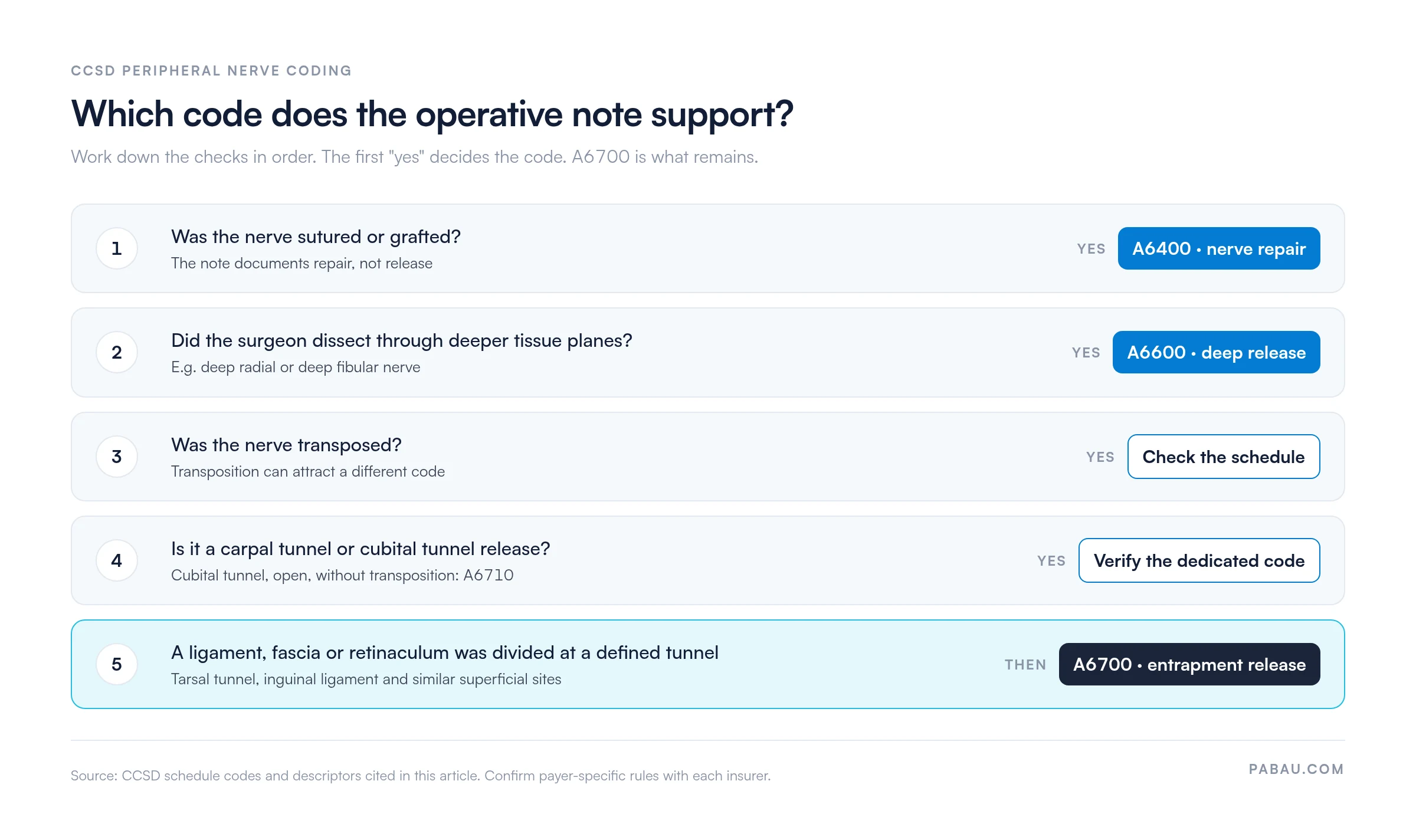
The practical rule is simple. If the surgeon divided a ligament or fascia to free a nerve from a well-defined anatomical tunnel, that is A6700. If they dissected through deeper tissue planes to reach and free the nerve, A6600 is likely more appropriate. If the nerve was sutured or grafted, A6400 applies instead. The checklist below puts those checks in the order a coder should run them.
If the surgeon took a specimen of the nerve for histopathology, the procedure is a biopsy under CCSD code A7310.
Before submitting any peripheral nerve claim, pull the operative note and confirm two details. Look for the specific constricting structure that was divided, and the plane of dissection. A note that says ‘the transverse carpal ligament was divided’ maps clearly to A6700. A note describing deep fascial dissection around the radial nerve at the radial tunnel maps to A6600.
A mismatch between the ICD-10 code and the site named in the operative report is a leading denial trigger for A6700 claims. The diagnosis code must reflect the specific nerve and location the surgeon documented, not just the general category of nerve disorder.
Always verify ICD-10 codes against the current UK ICD-10 release before submission. Codes are updated periodically, and some insurers apply their own mapping preferences on top of the WHO classification.
Take a claim coded G57 (other mononeuropathies of lower limb) when the operative note clearly states tarsal tunnel syndrome. G57.5 is the correct code there, and the vaguer choice invites unnecessary scrutiny.
All major UK private insurers treat A6700 procedures as surgical claims that need pre-authorization before surgery. Billing without a pre-auth reference number is the most frequently cited reason for outright rejection.
The table below summarizes insurer requirements, but policy terms vary, so confirm with the specific policy before booking surgery.
Nerve conduction studies (NCS) and electromyography (EMG) are the standard pre-operative investigations insurers expect to see. They confirm the diagnosis objectively and show that surgery is appropriate.
A pre-auth request without NCS/EMG results is a common reason for delayed authorization, particularly at Bupa and AXA Health. An evidence checklist built into the booking process catches the omission before surgery is scheduled.
A complete A6700 claim needs a specific set of supporting documents. Missing any one of them can trigger a denial, or a request for more information that delays payment by weeks.
The operative note is the most consequential document for A6700 claims. Insurers look for the name of the nerve (e.g. “median nerve”) and the structure released (e.g. “transverse carpal ligament divided”). They also check that no additional procedure, such as nerve transposition, was performed that would attract a different code.
A vague note that says “carpal tunnel release performed” gives the insurer grounds to query the claim. Consultants moving from NHS documentation habits to private practice billing often underestimate this. A CCSD claim needs more specificity than an NHS discharge summary typically captures.
A6700 claim denials follow recognizable patterns. Most come from one of six root causes, and each is preventable with a pre-submission check. Practices with repeat denials on nerve entrapment claims should audit against this list before resubmitting.
A pre-submission checklist catches most of these before the claim leaves the practice. Spotting a missing pre-auth reference at that stage takes minutes, while appealing a denied claim costs time and sometimes the fee.
Record two dates against each A6700 pre-auth reference: the authorization date and the insurer’s submission deadline, typically three to six months from the procedure. A missed deadline is an administrative denial that can’t be appealed on clinical grounds. Set the reminder at the point of booking, not at the point of billing.
Yes, NCS and EMG can be billed separately from A6700. They are diagnostic procedures performed at a separate pre-operative encounter, so they carry their own CCSD codes and aren’t bundled into A6700.
Some insurers restrict billing when the study and the surgery happen on the same date. In that case, ask the insurer whether the diagnostic code will be paid or held as bundled before submitting both on one claim. Anesthetist codes, by contrast, are billed on the same surgical claim without bundling concerns.
CCSD procedure fees are set per insurer, and individual consultant agreements may differ from the published schedule. The CCSD schedule is the framework most UK private insurers use as their fee basis. Actual reimbursement depends on the consultant’s recognition status with each insurer and any agreed rates.
Fees for peripheral nerve entrapment release vary by setting and complexity. Day case procedures, which include most carpal, cubital and tarsal tunnel releases, typically attract lower facility fees than inpatient admissions. Thoracic outlet decompression often needs an inpatient stay and longer operating time, so it sits at the higher end of the range.
Published fee amounts change with each annual CCSD schedule update and with insurer tariff reviews. Verify current rates directly with the insurer or in the current CCSD schedule rather than relying on last year’s figures.
Most preventable A6700 denials trace back to a claim that left the practice with one element missing or mismatched. The procedure code, ICD-10 diagnosis, pre-auth reference, and consultant and facility details need to travel together in one linked record.
Medical claims management software for UK private practice should handle CCSD billing by:
Pabau links each patient to their insurer, applies insurer-specific price lists, and pre-fills the claim from the patient record. You review it and send it to Healthcode without switching tools. Insurers that aren’t on Healthcode receive the claim by email from the same screen.
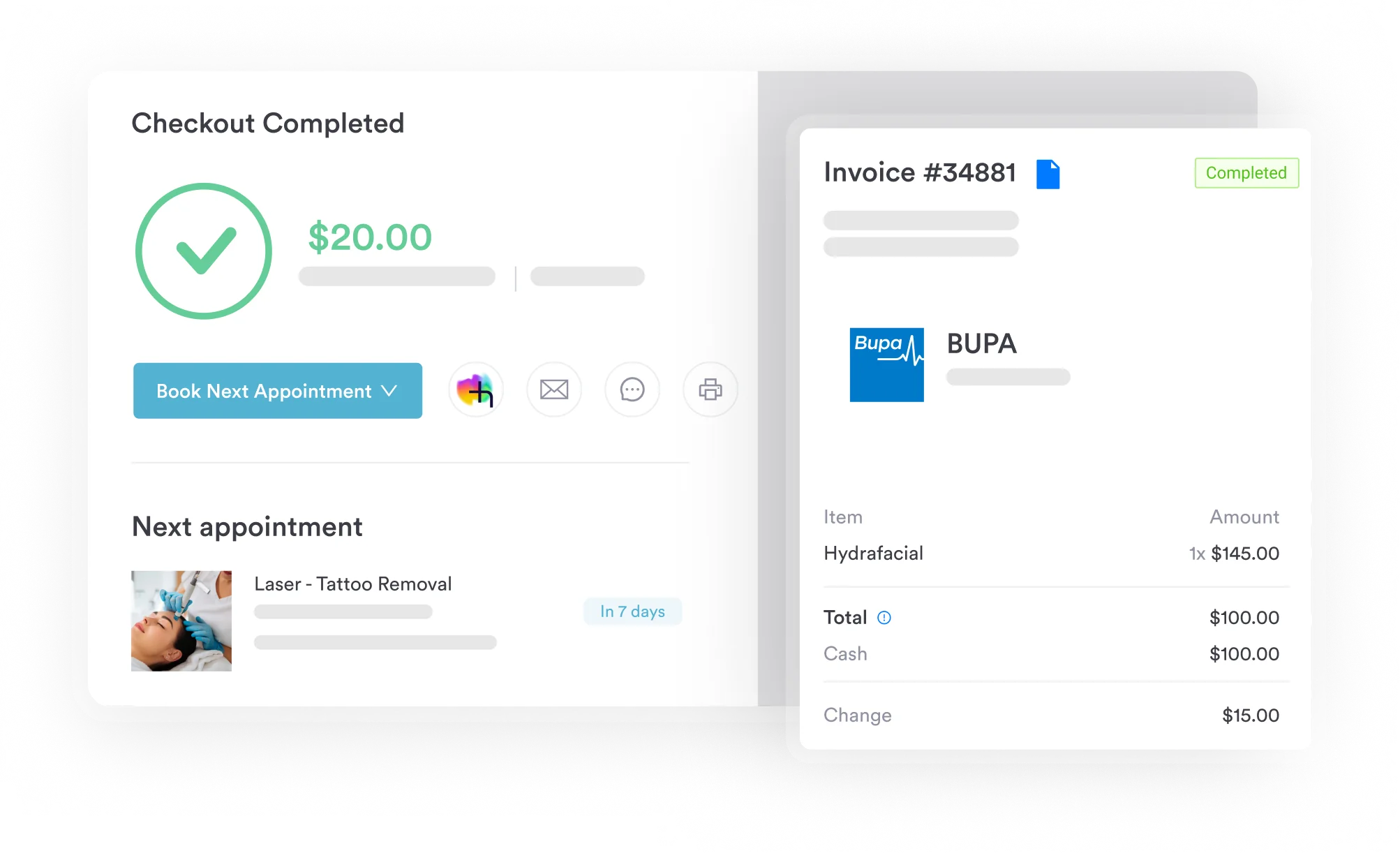
Each claim then moves through clear stages, from Pending and Submitted to Processing, Paid or Error, in one dashboard. For a busy orthopedic or neurosurgical practice, a rejected nerve release claim shows up in the Error stage instead of sitting unnoticed in an inbox.

Pabau pre-fills CCSD claims from the patient record, submits them through Healthcode, and tracks each one to payment. Your team spends less time chasing denials.

A6700 claims rarely fail on the surgery. They fail on paperwork: an operative note that doesn’t name the nerve, a diagnosis code for the wrong site, or a missing pre-auth reference.
So make the operative note do the coding work. If it names the nerve, the structure divided and the dissection plane, the choice between A6700, A6600 and A6400 settles itself. Check carpal and cubital tunnel cases against their dedicated codes before you default to A6700.
The trade-off is a few minutes of checking before submission, against weeks of delay after a denial. Book a demo to see how Pabau pre-fills and tracks CCSD claims for UK private practices.

Did the surgeon also transpose the nerve? A6810 covers peripheral nerve neurolysis and transposition, the code to check when the operation goes beyond a release.
Need to understand Bupa’s full CCSD code set? Bupa CCSD codes covers Bupa-specific procedure coding, authorization requirements, and the CCSD chapters used across Bupa-recognized consultants.
Billing multiple insurer fee schedules from one system? Bupa procedure codes fee schedule provides a reference for Bupa-recognized consultants navigating CCSD fee rates and schedule updates.
CCSD code A6700 covers surgical release of an entrapped peripheral nerve. The surgeon divides the ligament, fascia or fibrous band constricting the nerve at a site such as the tarsal tunnel or inguinal ligament.
A6600 covers release of a deeply placed nerve, which needs dissection through deeper tissue planes. A6700 covers release at a defined anatomical tunnel by dividing a superficial structure such as a ligament or retinaculum. The operative note language determines which code applies.
Carpal tunnel release is often accepted under A6700, because it divides the transverse carpal ligament to decompress the median nerve. Verify with the specific insurer before submitting, as some payers expect a separate carpal tunnel code.
Yes. All major UK private insurers, including Bupa, AXA Health, Aviva, Vitality and Freedom Health, require pre-authorization before peripheral nerve entrapment surgery. Billing without a pre-auth reference number is the most common reason for outright claim rejection.
The ICD-10 code must match the specific nerve and site. Use G56.0 for carpal tunnel syndrome, G56.2 for ulnar nerve lesion (cubital tunnel) and G57.1 for meralgia paresthetica. Use G57.5 for tarsal tunnel syndrome and G54.0 for brachial plexus disorders (thoracic outlet). A mismatch between the ICD-10 code and the operative note is a primary denial trigger.
The most frequent reasons are missing pre-authorization, the wrong CCSD code (A6600 vs A6700), and an ICD-10 code that doesn’t match the operative note. Insufficient evidence of failed conservative management, bundling violations and late submission complete the list.