

HCPCS code E0198: Water pressure pad billing guide
HCPCS code E0198 is a water pad for a standard mattress HCPCS code E0198 is the ...

Last Updated: Oct 13, 2026
A6810 is the CCSD code for neurolysis and transposition of peripheral nerve (excludes carpal tunnel release). It applies when a surgeon frees a peripheral nerve from compression and then re-routes it to a new position. Both acts have to be recorded for the code to hold.
The code sits in Chapter 3 of the CCSD schedule, under peripheral nerves. Anterior transposition of the ulnar nerve at the elbow, for cubital tunnel syndrome, is the operation most often billed under it. Release without transposition is coded elsewhere.
Let Pabau's smart automation suggest the right codes, reduce claim denials, and keep your practice compliant—effortlessly.
Automate repetitive tasks and focus on what matters most—your patients.
Reduce coding errors and ensure compliance with the latest regulations.
Clean claims, fewer denials, and faster reimbursements.
Powerful insights and reporting to help your practice thrive.
HIPAA compliant SOC 2 certified GDPR-compliant Trusted by 4,000+ clinics worldwide

CCSD code A6810 requires both acts named in its descriptor: the nerve is released, and then it is transposed.
Release without transposition is billed under A6700, A6600 or A6710, never under A6810.
Carpal tunnel release is excluded from A6810 and carries its own dedicated CCSD code.
Cubital tunnel syndrome at the elbow is the most common indication, paired with ICD-10 code G56.2.
Pre-authorisation and an operative note naming the specific nerve are both required before the claim is submitted.
The CCSD schedule, maintained by the Clinical Coding and Schedule Development Group, officially describes CCSD Code A6810 as “neurolysis and transposition of peripheral nerve (excludes carpal tunnel release)”. The code belongs to Chapter 3 of the CCSD schedule, which covers the spine, spinal cord, and peripheral nerves. Two independent payer chapter guides – AXA Health and Freedom Health Insurance – confirm this Chapter 3 placement.
The descriptor names two acts, and A6810 requires both of them. Neurolysis is the release of a peripheral nerve from compressive scar tissue, fibrous bands, or adjacent structures. Transposition is the re-routing of that same nerve into a new position, which may be subcutaneous, intramuscular, or submuscular.
A6810 applies when the surgeon frees the nerve and then moves it, on any peripheral nerve except the median nerve at the wrist. Release on its own does not qualify. An isolated decompression that leaves the nerve in its original bed is billed under A6700, A6600 or A6710, depending on the nerve and the site.
Neurolysis and transposition are two parts of the same operation when A6810 applies. Neurolysis frees the nerve from whatever is compressing it. Transposition then moves the nerve into a new position, so the compression cannot return. The table below sets out the three transposition variants a surgeon may record.
Neurolysis carried out on its own belongs to a different code. Where the surgeon releases the nerve and leaves it in its original bed, the claim goes under A6700, A6600 or A6710. The nerve and the site decide which of the three applies. A6810 is reserved for the operation that does both.
The operative note must specify which procedure type the surgeon performed. “Ulnar nerve decompression” on its own is not sufficient. The note must state whether the surgeon transposed the nerve, and which variant they used. Insurers read that detail to confirm A6810 rather than a less complex alternative.
The chart below maps each operative finding in this part of Chapter 3 to the code it belongs under.
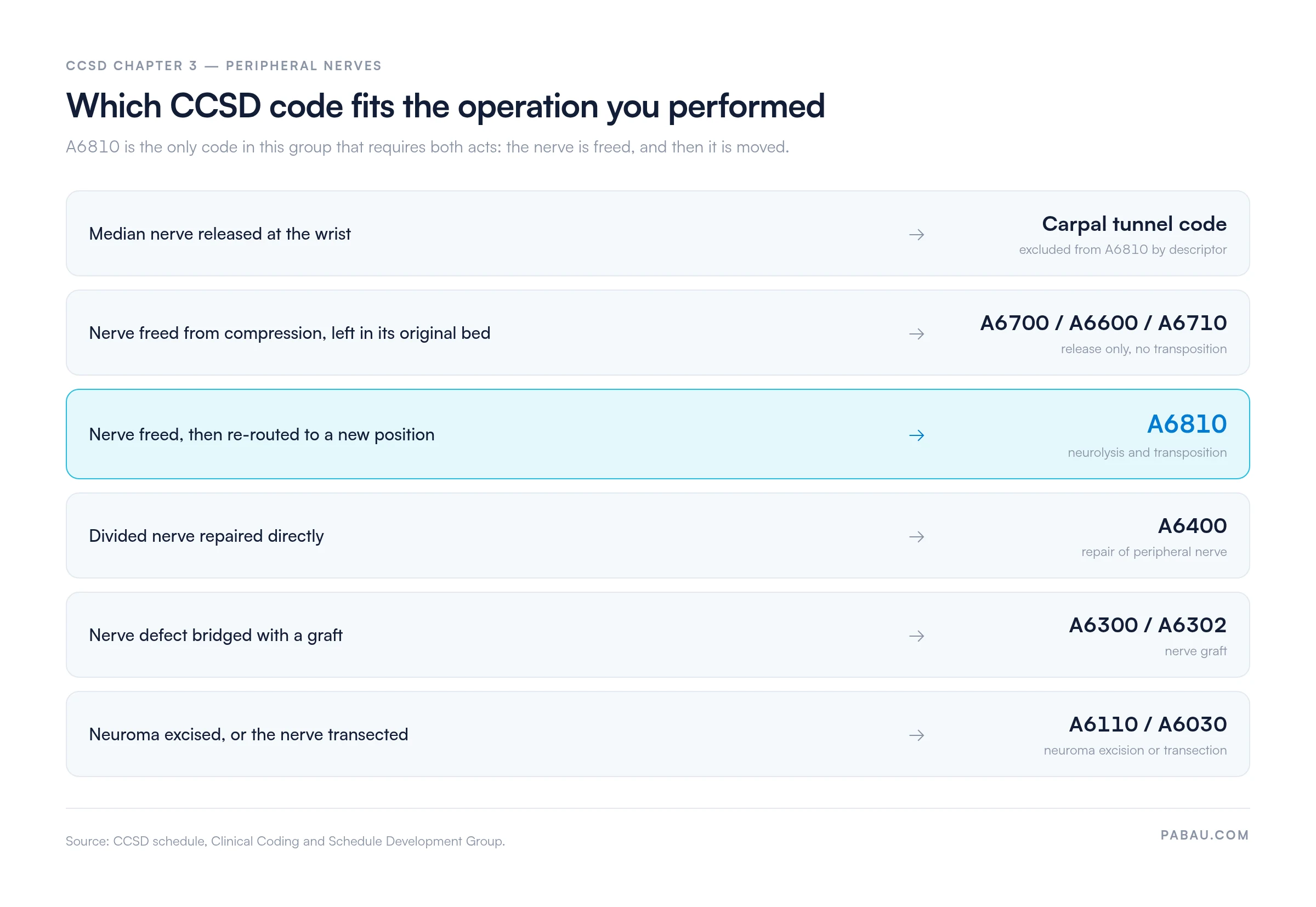
Practices most frequently bill A6810 for ulnar nerve procedures at the elbow. It covers peripheral nerve entrapment across the upper and lower limbs alike. The diagnosis code submitted with the claim must match one of the accepted ICD-10 categories for medical necessity. Verify specific ICD-10 codes against the current NHS Classifications Browser before submitting; the codes below reflect standard clinical mapping.
A6810 is not appropriate for tarsal tunnel syndrome at the ankle, or for procedures on the median nerve at the wrist. Both have their own CCSD codes. Matching the ICD-10 diagnosis to the named nerve in the operative note is the most effective way to prevent a medical necessity denial.
The code’s own descriptor explicitly excludes carpal tunnel release from CCSD Code A6810. The median nerve at the wrist has a dedicated CCSD code, so verify the exact code number in the current CCSD schedule. The schedule is a licensed document, and code numbers for adjacent procedures can be updated. Using A6810 for a carpal tunnel release is a coding error rather than a grey area. As a result, insurers who identify it on audit may seek recovery of the fee.
The anatomical boundary is clear in practice. The median nerve travels through the carpal tunnel at the wrist, and surgeons release it by dividing the flexor retinaculum. That operation falls outside A6810, whether the approach is open or endoscopic. Every other peripheral nerve may fall within A6810, depending on the procedure performed. That includes the ulnar nerve at the elbow, the radial nerve, the common peroneal nerve and the sural nerve.
Cranial nerves fall outside this section of the schedule as well. Implanting a neurostimulator onto one is billed under CCSD code A3300, which sits in Chapter 2 with the brain and cranium codes.
Chapter 3 of the CCSD schedule contains several codes that describe related peripheral nerve procedures. Selecting the wrong adjacent code is the second most common coding error on peripheral nerve claims, after the carpal tunnel exclusion. The reference table below covers the codes most frequently confused with A6810. Fee values are not published here, because the schedule is licensed and fees change. Check your contracted payer schedule, or the wider CCSD codes reference, for current rates.
A6400 covers suture repair of a severed or divided nerve, where the surgeon joins the ends back together. The nerve is neither decompressed nor re-routed, so A6400 never stands in for A6810.
Verify every adjacent code against the current licensed CCSD schedule before you submit, because the schedule is revised and codes move. The BUPA CCSD codes reference shows how one major payer applies the same schedule in practice.
Inadequate operative note specificity is the leading cause of A6810 claim denial. Insurers will almost always query or reject an operative note that says “ulnar nerve surgery at elbow”. The note must be granular enough that a medical reviewer can confirm A6810 is the correct code without calling the surgeon.
Every A6810 claim has to be supported by an operative note carrying all of the following elements.
Consultants arriving from the NHS often underestimate how much more detailed PMI operative documentation has to be. NHS coding teams complete the coding from the record afterwards. By contrast, a private insurer expects the note itself to validate the code.
Build a standard operative note template for A6810 procedures that includes all seven required elements as mandatory fields. Run it through your practice management system’s digital forms so every note is structured identically before it reaches the billing team. Missing one field costs more in appeal time than building the template takes.
All major UK private medical insurers treat peripheral nerve neurolysis and transposition as elective surgical procedures requiring pre-authorisation before the operation takes place. Insurers rarely grant authorisation sought after surgery, and they deny the claim as a result. Verify current pre-auth requirements directly with each payer before booking; rules change and the guidance below reflects general practice rather than a specific policy cycle.
The pre-authorisation pack for a cubital tunnel case usually has three parts.
All three need to reach the insurer before you book the operation.
Insurers deny A6810 claims more often than most surgical procedure claims. The code sits on an exclusion boundary at the carpal tunnel. It also demands more specific operative documentation than a straightforward excision or repair code. These are the six denial patterns encountered most frequently in UK private practice billing.
Most A6810 procedures are performed under general or regional anaesthesia, generating a separate anaesthesia claim. How that claim is structured depends on which payer the patient is insured with and whether the anaesthetist holds their own recognition with that insurer.
Three companion-code scenarios arise regularly on A6810 cases. Each requires a separate conversation with the payer before submission.
When a patient has bilateral cubital tunnel syndrome requiring staged or simultaneous surgery, request written pre-authorisation for both procedures before booking. Verbal payer confirmation is not binding. Document the authorisation number for each nerve and enter both in your practice management system before the claim is built.
A complete A6810 billing workflow has six steps, and following them in order prevents most of the denial causes above. Practice management software like Pabau carries a built-in CCSD code set, so staff pick the code from a validated list rather than type it by hand.
Pabau holds the CCSD code set, the authorisation number, the diagnosis code and the operative note reference against the same patient record. Your billing team builds the claim from what the surgeon already recorded, instead of chasing scattered records. Peripheral nerve claims leave the practice sooner and come back queried less often.

Pabau’s built-in CCSD code set, pre-authorisation tracking, and digital operative note linking help UK private practices submit peripheral nerve claims correctly the first time.

CCSD code A6810 is straightforward to select once three conditions are met: the operative note names the nerve and says what was done to it, the pre-authorisation is in place before the operation, and the coder understands and respects the carpal tunnel exclusion.
Denials on peripheral nerve claims almost always trace back to one of those three conditions. A vague note, a missing authorisation number, or a carpal tunnel release billed here instead of under its own code will each stop the claim.
Keep the code, the diagnosis and the authorisation number on one patient record, from booking through to submission. Your billing team then stops rebuilding each claim from scratch. Book a demo to see how Pabau handles UK private practice billing end to end.

Billing Bupa work in UK private practice? BUPA CCSD codes covers the full Bupa procedure code schedule and what each claim has to carry.
Need the fee side of the same schedule? BUPA procedure codes fee schedule explains how payer fee schedules are structured and where to check current rates.
Choosing a system to submit these claims from? Best medical billing software in the UK compares the platforms UK consultants use for insurer billing.
CCSD code A6810 covers neurolysis and transposition of a peripheral nerve performed together. The surgeon frees the nerve from surrounding scar or fibrous tissue, then re-routes it to a new anatomical position. Carpal tunnel release is excluded and has its own dedicated CCSD code. The most common procedure billed under A6810 is anterior transposition of the ulnar nerve at the elbow.
No. Carpal tunnel release is explicitly excluded from CCSD Code A6810 by the code’s own descriptor. The median nerve at the wrist has its own separate CCSD code. Billing a carpal tunnel release under A6810 is a coding error, and the claim will usually be denied. Where it slips past the initial review, an audit may identify it and the insurer may recover the fee.
CCSD code A6810 is the correct code for cubital tunnel surgery when the ulnar nerve is decompressed and then transposed at the elbow. Where the nerve is released but left in place, the claim goes under A6700, A6600 or A6710 instead. ICD-10 code G56.2 should accompany the claim, supported by nerve conduction study results.
The operative note must name the specific nerve and anatomical site. It must state the procedure type, describe the operative approach, and reference the pre-authorisation number. The claim must also carry the correct ICD-10 diagnosis code and the surgeon’s GMC number. Missing any of these elements is a leading cause of A6810 claim denial.



