CCSD code G5100: Bypass of duodenum billing guide
CCSD code G5100 bills a bypass that leaves the duodenum in place CCSD code G5100...

Last Updated: Oct 16, 2026
A6600 is the CCSD code for release of entrapment of a deeply placed peripheral nerve. It covers surgery that frees a nerve trapped under a fascial tunnel, a fibrous arch, a muscle belly, or bone. Typical sites are the cubital tunnel, the radial tunnel, and the fibular head.
Depth is what separates A6600 from its shallower counterpart, A6700. Carpal tunnel release never belongs here, because it carries its own CCSD codes. The schedule places A6600 in the Intermediate complexity band, so picking the wrong code lowers the fee.
Let Pabau's smart automation suggest the right codes, reduce claim denials, and keep your practice compliant—effortlessly.
Automate repetitive tasks and focus on what matters most—your patients.
Reduce coding errors and ensure compliance with the latest regulations.
Clean claims, fewer denials, and faster reimbursements.
Powerful insights and reporting to help your practice thrive.
HIPAA compliant SOC 2 certified GDPR-compliant Trusted by 4,000+ clinics worldwide

CCSD code A6600 covers surgical release of a deeply placed peripheral nerve in UK private practice.
Qualifying sites include the cubital tunnel, the radial tunnel, the fibular head, and the thoracic outlet.
Carpal tunnel release is never A6600, because it carries its own CCSD codes.
A6700 is the non-deep counterpart, so the operative note has to establish depth.
Major UK insurers all expect pre-authorization before elective deep nerve surgery.
CCSD code A6600 covers surgery that frees a deeply placed peripheral nerve from entrapment. Depth is the whole test.
The nerve has to sit under a fascial tunnel, a fibrous arch, a muscle belly, or a bony channel. Reaching it takes a longer approach than a shallow release does.
The operation itself follows one shape. The surgeon exposes the nerve at the point of compression, then divides or removes whatever is squeezing it. Where the nerve has stuck to surrounding tissue, neurolysis frees it as well.
CCSD stands for Clinical Coding and Schedule Development. The CCSD Group maintains the schedule, and UK private healthcare billing uses it exclusively. NHS work runs on separate coding systems. Check which schedule version you are working from, since the group reviews code narratives periodically.
A6600 does not cover shallow releases. Carpal tunnel surgery is the clearest example. The median nerve sits just under the flexor retinaculum at the wrist, so access is straightforward. That procedure has its own CCSD codes, and it never bills as A6600.
The CCSD descriptor never lists the qualifying nerves by name. Surgeons and coders work from anatomy instead.
The table below shows the sites most consistently billed as A6600 in UK private peripheral nerve surgery. Confirm each one against current BSSH and BOA guidance, plus your payer’s medical policy.
Take a straightforward case. A patient has ring and little finger numbness, and nerve conduction studies show slowing across the elbow. The surgeon releases the ulnar nerve at the cubital tunnel. The note records the Osborne ligament as the structure divided, which supports A6600 without further argument.
The median nerve at the wrist is the common exclusion. Its position under the flexor retinaculum makes it superficial by comparison. Bill a carpal tunnel release as A6600 and the insurer will query or reject it.
Which code applies then depends on how many wrists the surgeon released. An open release on one wrist bills as A6510. Releasing both wrists in the same operation bills as CCSD code A6580.
The approach changes with the nerve, but the logic holds across every site. Expose the nerve, find the compressive structure, release it, then confirm the nerve runs free.
Cubital tunnel release can be open or endoscopic, and published outcomes are comparable. Name the approach in the operative note, and say why you chose it. Some insurers pull endoscopic cases for extra review.
Record the anatomical depth and the exact structure released before the invoice goes out. A note that says only ‘nerve decompressed’ is what triggers most A6600 queries.
Insurers judge an A6600 claim on the documents that arrive with it. Missing paperwork causes more denials than any clinical dispute does. Most UK private medical insurers expect the following on file before elective deep nerve surgery.
The operative note carries the rest of the weight. It must name the nerve, confirm the depth, and identify the structure released.
It must also state the technique, open or endoscopic, and whether neurolysis was performed. Generic decompression wording invites a query.
Every major UK private medical insurer prices claims from the CCSD schedule. Fees, pre-authorization rules, and submission routes still differ by payer.
Confirm the current fee before you invoice, because published amounts change. The Bupa code search and the AXA Health specialist forms portal both allow code-level lookups.
Pre-authorization is standard for elective deep nerve surgery across UK private medical insurers. Operating without a valid reference number usually means no payment, however sound the clinical case. The process runs like this.
The clocks on those stages decide whether a claim lands inside the window at all.
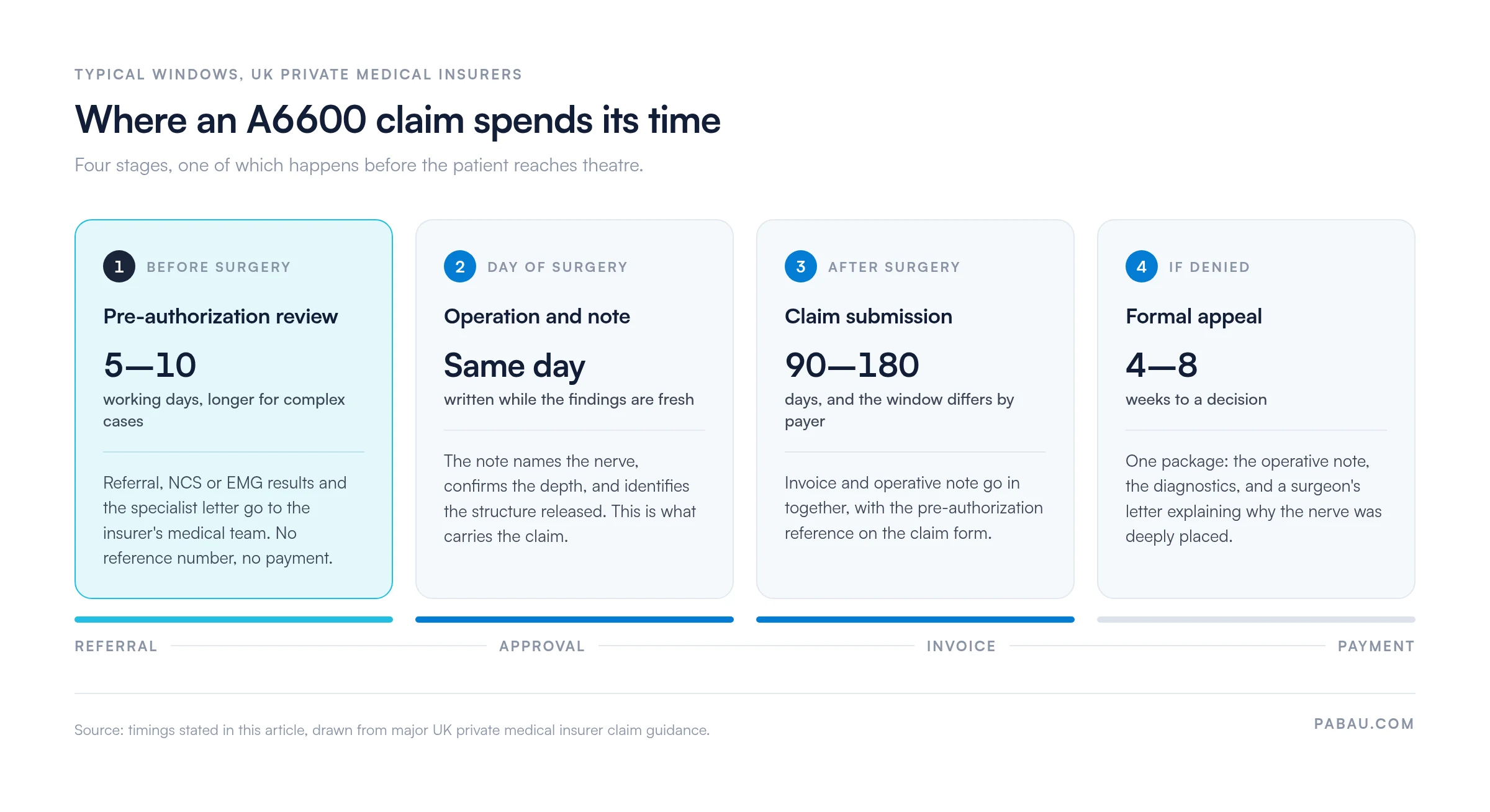
A missing pre-authorization is rarely recoverable afterwards. Flag outstanding authorizations before you confirm the theatre booking, not after.
Picking the wrong code is the most common billing error in peripheral nerve surgery. Depth, pathology, and the type of procedure are what separate the options. The table below sets A6600 against the codes it competes with.
Two of them cause most of the confusion. A6700 is the shallow counterpart, so the operative note has to establish depth before A6600 holds. Where the surgeon also moves the nerve into a new bed, the correct code is A6810.
Scar tissue or an incomplete first release can trap the nerve again after surgery. That repeat operation bills as A6900, which insurer schedules grade as a major procedure.
A6600 is confined to peripheral nerves, so cranial nerve work sits outside it entirely. Implanting a neurostimulator onto a cranial nerve such as the vagus bills as CCSD code A3300.
Cross-check the operative note against the code description before you submit, because that catches most misclassification. Each neighboring entry has its own page in the CCSD code schedule.
Deep nerve entrapment surgery runs under general anesthesia or a regional block. The anesthetist bills separately, using the applicable CCSD anesthetic codes. A6600 is the surgeon’s code alone.
Assistant surgeon billing depends on the payer. Some deep nerve releases are accepted as assistant-claimable on complexity grounds. Single-nerve releases often are not, since the team is usually the consultant and a scrub nurse.
Four rules are worth checking every time:
Denial patterns for A6600 are predictable, which makes them preventable. Six triggers account for the bulk of them.
Most UK private medical insurers run a formal appeal route. Expect four to eight weeks, depending on the payer and the case.
Track denial reasons by code and payer, month by month. Patterns surface quickly. If one insurer keeps querying radial tunnel cases, read their current policy. Then adjust your documentation checklist before the next claim goes out.
Ask the operating surgeon to write the appeal letter, not the billing team. Reviewers accept anatomical findings from the surgeon. The same argument rarely lands from an administrator.
A6600 billing usually runs across three places at once. Pre-authorization references live in an email folder, operative notes sit in the patient record, and invoices go out through a separate portal. The reference number gets typed in twice, and the claim stalls when one copy is wrong.
Practice management software like Pabau keeps that chain in one record. The pre-authorization reference, the operative note, and the CCSD-coded invoice attach to the same patient.
Our claims software for practices validates the required fields before submission. A missing authorization code shows up on screen, not in a rejection three weeks later.
For a UK private practice, that removes the re-keying and the chase. Claims leave with the reference attached, submissions route through Healthcode, and denial reasons land back against the same code. Over a few months the pattern by payer becomes readable, which is what makes A6600 denials preventable.

Pabau helps UK private practices submit CCSD-coded claims and validate the required claim fields before submission. Insurer responses land in one place, without switching between portals.

A6600 turns on one decision, and it is made in theatre rather than in the billing office. If the operative note establishes depth and names the structure released, the claim is straightforward. If it does not, no amount of appeal correspondence will rebuild that evidence afterwards.
So the work sits upstream. Agree the note wording with your surgeons. Hold the pre-authorization reference where the invoice can reach it, and log every denial against the code.
Practices that do that recover faster and write off less. Book a demo to see how Pabau keeps CCSD claims and authorization records against one patient file.

Need the wider Bupa code picture? Bupa CCSD codes guide covers how the schedule is structured and how to look up a current fee.
Billing the endoscopic version instead? CCSD code A6740 covers endoscopic cubital tunnel release without transposition.
Checking what a procedure pays? Bupa procedure code fee schedule explains how fee bandings are published and how to read them.
Chasing authorizations before surgery? The prior authorization process sets out the steps payers expect and where requests stall.
Insurers do. The CCSD Group maintains the codes and their narratives, and each payer then publishes its own fee for A6600. Check the payer’s current schedule before invoicing, since amounts are revised.
Intermediate. Sibling peripheral nerve codes such as A6740 and A6810 sit in the same band. Confirm it in your payer’s current schedule before you invoice, since the schedule is reviewed periodically.
Hand and upper limb surgeons, plastic surgeons, and neurosurgeons all use it, depending on the nerve involved. Thoracic outlet decompression may sit with a vascular or thoracic surgeon instead. The code follows the procedure, not the specialty.
Check the payer first. Some insurers apply a multiple procedure reduction to the second code, and the percentage differs between them. Bill both nerves, but expect the second to be paid at a reduced rate.
Work from the current release. The CCSD Group reviews code narratives periodically, and a superseded description is enough to trigger a query. Re-check the version whenever a payer updates its own schedule.