

CCSD code G5100: Bypass of duodenum billing guide
CCSD code G5100 bills a bypass that leaves the duodenum in place CCSD code G5100...

Last Updated: Oct 16, 2026
A5770 is the CCSD code for facet joint injection (under x-ray control) for 6 joints. It covers a single session in which six spinal facet joints are injected under fluoroscopic control.
Image guidance is written into the descriptor, so it is not billed separately. A four-joint session is coded A5760, and A5771 is published as 5 or more joints, so it overlaps A5770 at six.
Let Pabau's smart automation suggest the right codes, reduce claim denials, and keep your practice compliant—effortlessly.
Automate repetitive tasks and focus on what matters most—your patients.
Reduce coding errors and ensure compliance with the latest regulations.
Clean claims, fewer denials, and faster reimbursements.
Powerful insights and reporting to help your practice thrive.
HIPAA compliant SOC 2 certified GDPR-compliant Trusted by 4,000+ clinics worldwide

CCSD code A5770 is published as facet joint injection (under x-ray control) for 6 joints, so the documented joint count decides the code.
There is no CCSD code A5769. The lower-count entries in this series are A5760 for 4 joints and A5761 for 3 to 4 levels.
A5771 is published as 5 or more joints, so it overlaps A5770 at six. Ask each insurer which code it expects.
Fluoroscopic guidance sits inside the descriptor, so a separate imaging code on the same session reads as unbundling.
The procedure note has to record the joint count, the spinal levels, laterality, confirmation of image guidance, and the drug and dose.
No UK insurer pays an A5770 claim without a valid pre-authorization reference on the invoice.
CCSD code A5770 is the schedule entry for facet joint injection (under x-ray control) for 6 joints. The CCSD Group maintains that schedule on behalf of the UK private medical insurers. The code describes one session in which six spinal facet joints are injected under live imaging.
Two nearby entries in the spine chapter describe a different needle target. The lumbar epidural injection has its own entry, CCSD code A5210. Aiming the needle at the medial branch nerves instead makes the session a block. Legacy schedules listed that block at 1 to 2 levels as CCSD code A5750.
The descriptor counts joints, not vertebral levels. Injecting the left and right facet at a single level counts as two joints. Six joints therefore usually means three levels treated bilaterally, for example L3/4, L4/5 and L5/S1 on both sides.
X-ray control is written into the descriptor, so it is a requirement rather than an optional extra. A session performed on anatomical landmarks alone sits outside this code and cannot be billed under it.
A facet joint injection places corticosteroid, usually mixed with local anesthetic, into one or more zygapophyseal joints along the spine. Fluoroscopy confirms the needle tip position before the drug is delivered. That lowers the risk of a missed target and of injury to neighboring tissue.
The procedure runs at lumbar, cervical, or thoracic joints, depending on which pain generator has been identified. A5770 applies once six discrete joints are treated in the same session. Whichever agent is used, the drug, the concentration, and the volume per joint belong in the operative note.
Fluoroscopy gives live x-ray imaging while the needle advances. Without it, the clinician works from anatomical landmarks alone, a technique associated with higher rates of sub-optimal needle placement.
The words under x-ray control in the descriptor separate the two techniques, and auditors look for explicit confirmation before they reimburse A5770.
A5770 applies when facet-mediated spinal pain affects several levels and conservative management has not given enough relief. UK private insurers expect that justification in writing before they authorize the procedure.
Pre-authorization normally has to be in place before the procedure happens. Seeking it afterwards rarely succeeds with the major UK providers. Confirm the referral pathway and the authorization status before the date is booked.
The facet joint injection entries are separated by how much was treated, but they are not written to a single pattern. Some count joints and others count levels.
There is no A5769 in the schedule, so any billing sheet that lists one is working from an invented code.
Plotted against joint count, the overlap between the two six-joint candidates is easier to see than it is to describe.
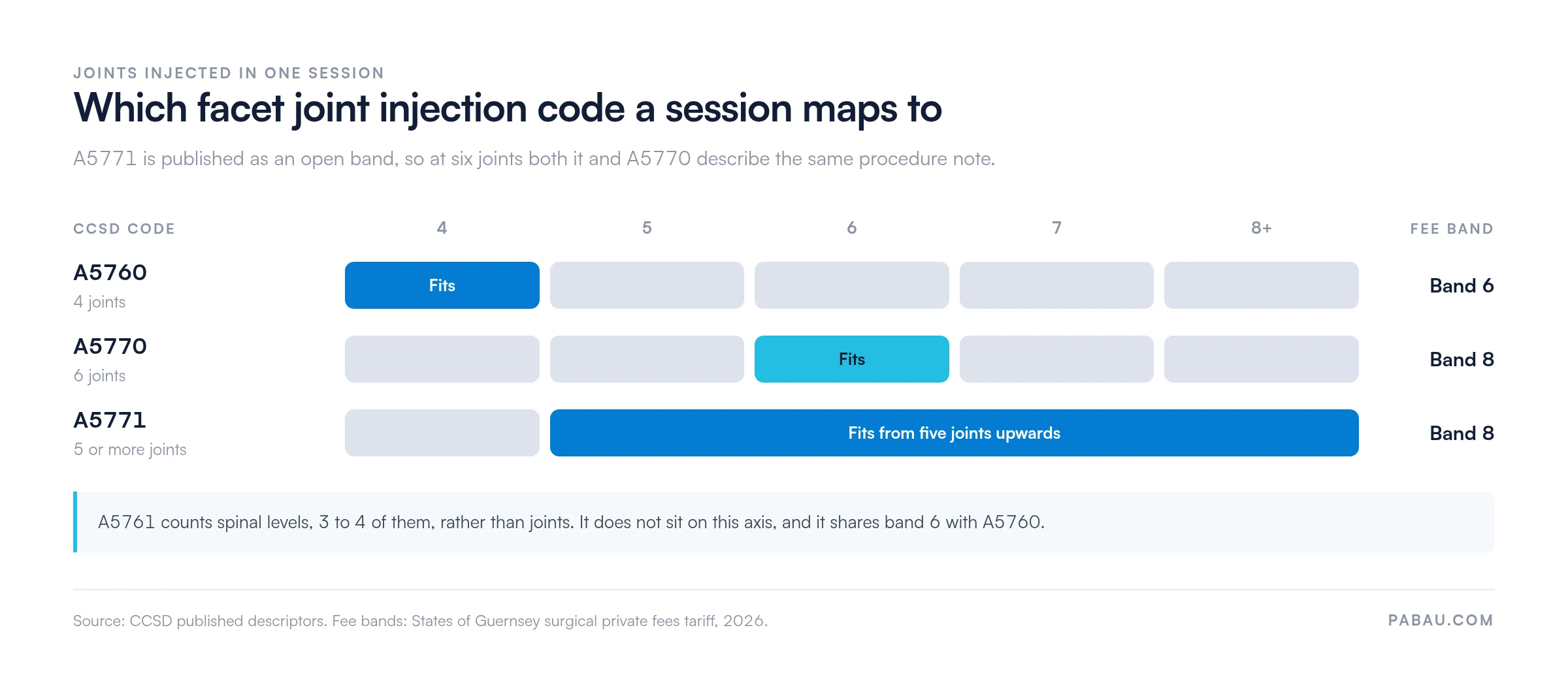
So A5770 and A5771 genuinely overlap. A six-joint session satisfies both descriptors, because A5771 is written as 5 or more joints rather than as a band above A5770. Agree the convention with each insurer before you submit.
Whichever code you agree on, the count in the clinical note drives the selection. If the note records four joints, A5760 is what the documentation supports, whatever was billed. Insurers reconcile the submitted code against the documented count, not against the procedure that was planned.
Neighboring entries in the same chapter are collected in our CCSD codes index. Checking there first is quicker than opening the full schedule.
Facet joint injection sits among several interventional pain procedures in the spine chapter. The entries below are the ones most often confused with A5770 or billed beside it. One of them, A5730, covers radiofrequency thermocoagulation of four to six joints, so the nerve supply is heated rather than injected.
Medial branch block and facet joint injection do different clinical jobs. The block anesthetizes the nerve supplying the joint, to test whether that joint generates the pain. A facet joint injection delivers corticosteroid inside the joint capsule itself.
Billing A5770 for what was clinically a medial branch block gets caught on audit. The note gives it away, because it describes needle placement beside the nerve rather than inside the joint.
Site drives the choice of entry across the whole schedule, not only inside the spine chapter. An injection into the anterior chamber of the eye carries its own CCSD code, C6930, in the eye chapter.
Record the anatomical target in the procedure note before the invoice is raised. If the needle tip sat beside the medial branch nerve rather than inside the joint, the code is A5762 or A5772, not A5770. Confusion between these two procedures is one of the most common audit triggers on spinal injection claims at UK insurers.
A claim filed without a complete operative note is the fastest route to rejection. All six elements below belong in the procedural note for an A5770 claim to be defensible.
Writing those six lines at the time of the procedure is most of the job. General Medical Council guidance on record-keeping asks for notes made at the time, legible, and detailed enough for a colleague to follow what was done.
Between the referral and the payment, an A5770 claim passes through five stages. Knowing which one it is sitting in saves the chase later.
Stage three is where the money usually goes. If the note says multiple levels instead of a number, billing staff have nothing to count, so the claim leaves the practice on a guess.
No, you cannot add a radiological interpretation code to an A5770 session. The x-ray control element is integral to the descriptor and is bundled into the code’s valuation. Billing a separate imaging code alongside it reads as overbilling, and UK insurers reject it or claw it back on audit.
One situation differs. Where a consultant radiologist provides the imaging as a distinct clinical service, payer policy decides whether a second code is allowed. Verify that with the individual insurer first, because most UK contracts do not permit it.
Every major UK private medical insurer requires pre-authorization for A5770. Submitting without a valid reference is the most reliable way to trigger non-payment, however clean the clinical documentation is.
The table below summarizes the usual position, though policies are updated annually.
Bupa adds two conditions of its own. The consultant has to be recognized by Bupa, and the referral must come from a GP or another recognized specialist, since self-referrals are not accepted. Its code search portal shows the current fee and authorization status for A5770 before you submit.
AXA Health runs pre-authorization through its specialist procedure codes portal, where the code forms part of the approval request. Vitality Health and Aviva both ask for the code at authorization stage as well. For the wider picture, see our guide to Bupa CCSD codes.
CCSD publishes the code, not the price. Each insurer sets its own reimbursement, so A5770 pays differently across Bupa, AXA Health, Vitality Health, and Aviva. Most of those schedules sit behind a provider login, which makes benchmarking difficult for a new practice.
One CCSD-based tariff is published openly and gives a usable reference point. The States of Guernsey surgical private fees schedule prices A5770 in band 8, and puts the lower-count entries A5760 and A5761 two bands below it.
Figures come from the 2025 and 2026 States of Guernsey surgical private fees tariffs. They are Guernsey rates rather than UK insurer rates, so treat them as a sense check on relative banding.
Two points still carry over to UK billing. Moving from four joints to six moves the procedure a full two bands, which is why an undocumented count costs money. A5770 and A5771 share a band, so choosing between them changes the audit trail rather than the fee.
That banding is also a useful anchor for self-pay work. Keeping private fees broadly in line with insurer reimbursement simplifies billing for insured patients and reduces shortfall disputes.
Denial patterns for facet joint injection billing in UK private practice are consistent. The same documentation failures recur across Bupa, AXA Health, and Vitality claims, and heading them off beats disputing them afterwards.
One pass over the invoice catches most of what that list describes. Five questions, in this order.
If any line fails, fix it before the invoice leaves the practice. Correcting a claim after submission costs far more staff time than the check does.
Most private practices run the clinical note and the invoice in two places. The consultant writes up the session in one system, and billing staff work from a summary in another. When that summary says multiple levels, someone has to go back and ask.
Practice management software like Pabau keeps both on the same patient record. Structured procedure fields prompt for the joint count, the levels, laterality, imaging confirmation, and the drug and dose while the session is fresh. Billing staff then read the note itself.
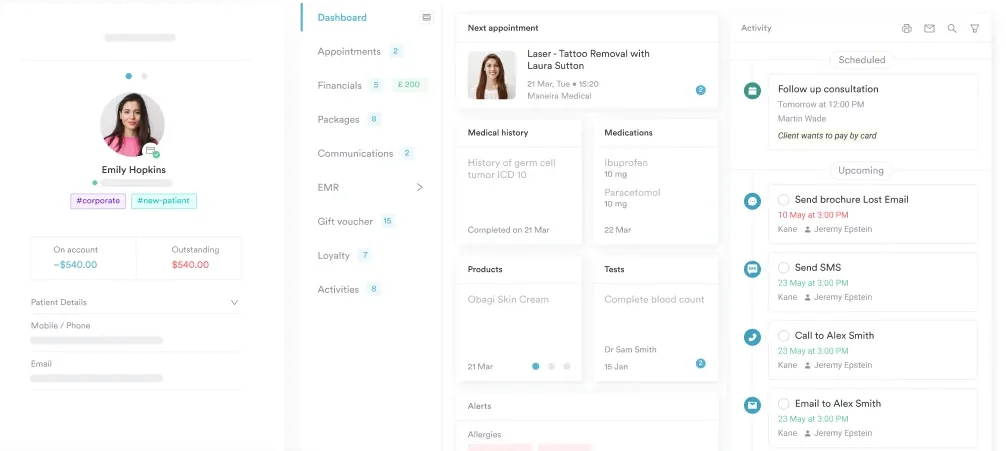
At the invoicing stage, the procedure note and consent forms attach to the invoice record. The submission package is therefore complete before it leaves the practice. Pabau’s claims management software carries the authorization reference and the CCSD line against the same appointment.

For a practice handling spinal injection claims week in, week out, consultant details and insurer references populate themselves on repeat submissions. That removes a common source of re-entry errors, and it keeps denial rates by CCSD code visible enough to act on.
Build a CCSD spinal injection shortlist in Pabau’s billing module with A5760, A5761, A5770, and A5771 pre-loaded. Add the convention each insurer expects when a session reaches six joints. Billing staff then match the documented count to the agreed code in seconds, instead of searching the full schedule each time. That removes the most common code-selection error on facet joint injection claims.

Pabau lets UK practices attach procedure notes directly to CCSD invoices before submitting to Bupa, AXA Health, or Vitality. Your documentation and your billing stay in one place.

Billing A5770 correctly comes down to one number in the procedure note. Without an explicit joint count, the claim cannot be defended against A5760 below it or A5771 alongside it.
So write the count, the levels, the laterality, the imaging confirmation, and the dose while the session is fresh. Attach the note to the invoice, add the authorization reference, and the common denial routes close before they open.
Want to see how a CCSD claim travels from procedure note to submission without a second system? Book a demo and we will walk through it with your own billing workflow.

Billing the same procedure in the US? CPT code 64490 is the facet joint injection guide for the US coding system.
Working on lumbar levels specifically? CPT code 64493 covers lumbar facet joint injection billing in detail.
Coding a paravertebral block instead? CCSD code 25010 is the billing guide for that procedure.
Billing a dorsal root ganglion block? CCSD code 25120 sets out how that entry is coded and documented.
Setting fees against Bupa rates? Bupa procedure codes fee schedule explains how Bupa sets and publishes its rates.
There is no exact match. US practices bill facet joint injections with CPT codes 64490 to 64495, which count spinal levels and region rather than joints. A six-joint CCSD session does not translate into a single CPT line.
No. The A5770 descriptor names neither a region nor a level. A cervical, thoracic, or lumbar session takes the same code once six joints are treated. Record the region and the levels anyway, because the insurer uses them to verify the count.
Bill the code the note supports. If six joints were authorized and four were treated, A5760 is the correct line. Flag the difference against the authorization reference, since it was issued for the larger procedure.
Yes. The CCSD Group reviews the schedule continuously, and entries are added, amended, or withdrawn. Check the published descriptor before billing a code you have not used recently, because an amendment can change the count it covers.
A consultant recognized by that specific insurer. Recognition is granted insurer by insurer, so approval from Bupa does not carry over to AXA Health. Claims from practitioners an insurer does not recognize are not reimbursed.



