Physician credentialing checklist
A physician credentialing checklist lists every license, certificate, verificati...

Last Updated: Oct 23, 2026

The stork balance test measures static single-leg balance, timing how long a subject holds a heel-raised, eyes-open position against published normative tables.
The test has two distinct uses: sports fitness assessment (balance capacity) and clinical orthopedic screening for sacroiliac joint dysfunction.
A score above 50 seconds on the eyes-open protocol rates excellent for young adult males; the harder eyes-closed variant scores far lower and isn’t comparable.
Pabau’s outcome measurements tracking lets physiotherapy and sports medicine practices log stork scores each appointment and monitor balance trends across a patient’s care history.
Most practices that assess balance reach for a stopwatch and a flat patch of floor. Few record the results well enough to track change over time. The stork balance test takes under two minutes to administer. What takes longer is knowing which version you are running, how to score it correctly, and what the result means clinically.
This guide is for physiotherapists, sports scientists, coaches, and practice managers. It covers what the stork balance test is, how to administer it step by step, and how to interpret scores against published normative data. It also explains how the test fits into sports and clinical workflows.
The stork balance test (also called the standing stork test or stork stand balance test) is a standardized measure of static single-leg balance. It is related to the flamingo balance test, but the two are not the same. The flamingo version is performed balancing on a raised beam or board, while the stork test is done on the floor with no equipment.
To perform the stork test, the subject stands on one leg and places the free foot against the inner knee of the standing leg. Hands rest on hips, and the standing heel lifts so the subject balances on the ball of the foot. The stopwatch starts at heel-raise and stops the moment balance is lost. That time, in seconds, is the score.
It is one of the most widely used balance assessments in physical therapy practices and sports science. It requires no specialist equipment and can be completed in almost any practice or training setting. The Physio-pedia clinical reference notes that the test doubles as a fitness assessment and an orthopedic screening tool. That distinction matters, and it is covered in detail below.
The test serves two different populations, and the interpretation differs between them.
Consistent administration is essential for meaningful normative comparisons. Small variations in foot placement, timing of the heel-raise, or surface type can shift a result by 10 or more seconds. Follow this protocol precisely.
Closing the eyes during the hold turns this into a harder variant, used in fall-risk research for older adults. The PMC-published research on this variant reports mean hold times of roughly 13 to 18 seconds, far below the eyes-open norms below. Record which version you used, since the two are not comparable.
The score is the time in seconds the subject maintains the position. Use the best of three trials for athlete populations. Use the mean of three trials when tracking rehabilitation progress, since it is more sensitive to incremental gains. Both approaches appear in the literature. Pick one and apply it consistently across every assessment for a given patient.
The table below reflects normative data commonly referenced in the sports science literature. It matches the original table published by Schell and Leelarthaepin (1994), also cited by Topend Sports. Values represent the eyes-open protocol, timed from heel-raise, using the single best trial for adults aged 18 to 39. Norms for older age groups are lower, and balance performance declines progressively from the fourth decade onward.
Athlete populations typically score considerably higher than the general population norms above. A recreational runner or team sport athlete aged 20-30 scoring in the “Average” band warrants closer inspection of ankle proprioception and hip stability. General population norms should not be applied to elite athletes as a benchmark.
Pabau’s outcome measurements tracking lets clinicians log stork test scores at each appointment and view trends over time. This is particularly useful when monitoring rehabilitation progress over weeks or months.
The clinical orthopedic version of the stork test differs meaningfully from the timed balance version. This distinction matters because conflating the two leads to misinterpretation.
In the orthopedic version, the clinician stands behind the standing patient and palpates the posterior superior iliac spine (PSIS) on both sides. The patient raises one knee to 90 degrees of hip flexion. Normally, the PSIS on the standing side drops slightly. A positive finding is pain in the sacroiliac region, or the PSIS failing to drop as expected. Either result suggests sacroiliac joint dysfunction.
Two important caveats apply. First, the stork test performs better as part of a cluster of tests for SIJ dysfunction than it does in isolation. Second, a positive result should never stand alone as a diagnosis. It is a screening indicator, not a confirmatory tool, so full assessment by a qualified practitioner is still required. This matters most for referral pathways in osteopathy and musculoskeletal practices.
The stork balance test has acceptable test-retest reliability when the protocol is administered consistently. Physio-pedia cites reliability data showing intraclass correlation coefficients (ICC) in the moderate-to-good range. This holds when the same examiner uses the same surface and timing rules across sessions. Between-session variability increases when these conditions are not controlled.
Construct validity is supported by the test’s correlation with other static balance measures and with proprioceptive assessments. Research published in PMC confirms that single-leg balance time correlates with fall risk in older populations and with broader musculoskeletal health. That said, the stork balance test is a static measure only. It does not capture dynamic balance or the ability to recover from a perturbation, which are distinct, clinically important capacities.
Key limitations worth noting in clinical practice:
No single balance test captures every dimension of postural control. The table below compares the stork balance test with four common alternatives. It helps clinicians and sports scientists choose the right tool for the clinical question. For broader clinical decision tools in musculoskeletal assessment, a structured framework reduces the risk of selecting the wrong measure.
The stork balance test sits in a useful niche. It is faster and simpler than the SEBT or Berg, but more specific to single-leg stability than the Romberg. It is the right starting point for most physiotherapy and sports screening when equipment is limited.
A score in the “Fair” or “Poor” category does not simply reflect poor coordination. It signals a deficit in proprioceptive processing, hip stabilizer strength, or vestibular integration, and each responds to different training stimuli.
Test both legs before designing a balance training program. An asymmetry of more than 10% between sides often responds faster to targeted single-leg work than a bilateral deficit does to general stability training. Record the weaker leg’s score as your primary progress metric.
Structured improvement protocols, progressed over 4-6 weeks:
Reassess progress with the stork balance test every 3-4 weeks. A 5-second improvement per reassessment period is a reasonable benchmark for patients starting in the “Fair” category.
Recording a score on paper and filing it is not enough. The clinical value of a balance assessment comes from the trend, not a single reading. That requires every score to sit in the same system, retrievable at the next appointment, and comparable across the patient’s history.
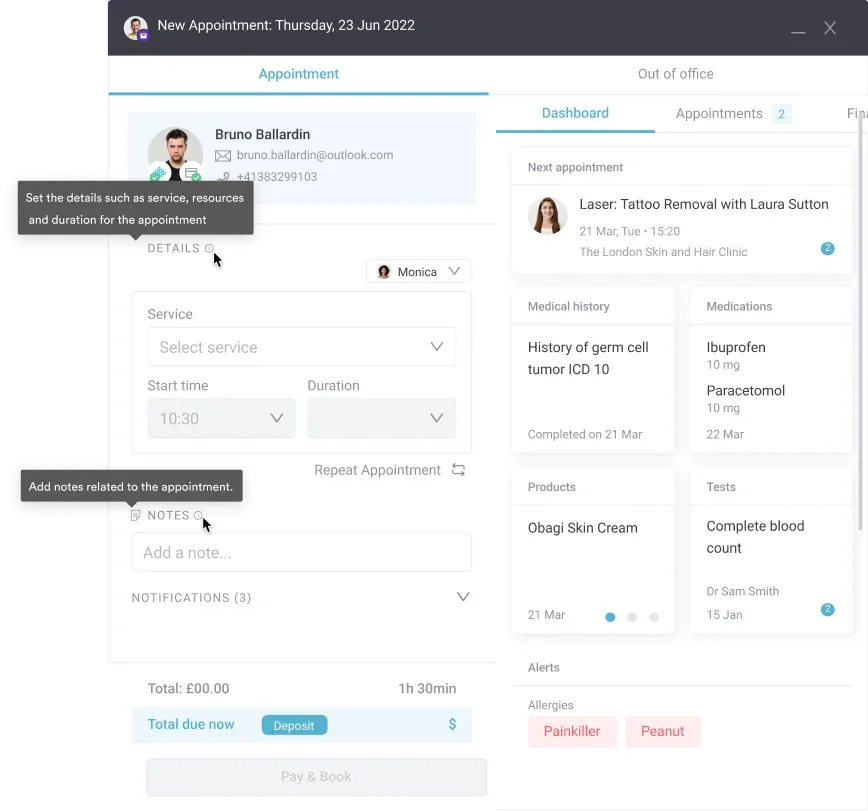
Physiotherapy and sports medicine practices that use Pabau’s patient records can log balance assessment scores as structured fields within the clinical note at each appointment. When a patient returns after four weeks of balance training, the clinician pulls up the prior score on the same screen. There is no paper file to search. Asymmetry flags and trend annotations can be added in the same workflow.

Beyond record-keeping, physiotherapy practice management tools also support outcome reporting for patients and commissioners. If a practice needs to demonstrate measurable functional improvement over a care episode, structured balance scores stored in one system make that reporting straightforward. For practices navigating audit and documentation requirements, physiotherapy compliance guidance outlines the record-keeping standards that apply.
Pabau’s automated patient follow-up workflows can prompt reassessment at preset intervals, so timelines do not rely on staff memory. The patient gets a reminder to book their 4-week review. The clinician sees the prior score loaded automatically on the appointment screen.

Pabau lets physiotherapy and sports medicine practices record outcome measures like the stork balance test at every appointment, flag asymmetries, and generate progress reports automatically. No spreadsheets, no lost paper records.

The stork balance test is a deceptively simple tool: two minutes, a stopwatch, and a flat surface. Getting the result right takes more precision than that setup suggests. You need the correct normative comparison. You also need to keep the fitness version separate from the clinical orthopedic version before using scores to guide treatment.
Practices that take balance assessment seriously get more from Pabau’s outcome measurements tracking and structured patient records. One-off test results become longitudinal data that drives better clinical decisions. If you want to see how that works, book a demo and we’ll walk you through it.

Need a structured framework for physiotherapy documentation? Physiotherapy practice compliance covers the record-keeping and outcome reporting standards that apply to UK and international practice.
Running a sports medicine or musculoskeletal practice? Sports medicine practice software explains how Pabau supports screening, outcome tracking, and multi-practitioner workflows in high-volume sports environments.
Designing a return-to-sport program? Return-to-running protocol for physical therapy provides a phased framework for progressive load management and functional re-testing.
The stork balance test is used to measure static single-leg balance and proprioceptive ability. It has two main applications. The first is a fitness assessment tool in sports science and athletic screening. The second is a clinical measure in physiotherapy, used to monitor rehabilitation progress and fall risk in older adults. A separate orthopedic version (sometimes called the Stork Test or Gillet Test) screens for sacroiliac joint dysfunction.
The subject stands on one leg, places the free foot flat against the inner knee of the standing leg, and rests hands on hips. They then raise the heel of the standing foot to balance on the ball of the foot, eyes open. The timer starts at heel-raise and stops when balance is lost: heel touches the floor, hands leave the hips, or the raised foot loses contact. Three trials are recorded with 60 seconds of rest between each. Closing the eyes during the hold creates a separate, harder variant with its own lower reference times.
These bands apply to the standard eyes-open protocol, timed from heel-raise. For males aged 18-39, a score above 50 seconds is rated Excellent; 37-50 seconds is Good; 15-36 seconds is Average. For females in the same age group, Excellent is above 27 seconds; Good is 23-27 seconds; Average is 8-22 seconds. Norms decline with age, and the eyes-closed variant scores far lower because it is a harder test.
The stork test and the flamingo balance test are similar but distinct assessments. Both use a single-leg stance with the free foot against the inner knee and hands on hips. The stork test is performed on the floor with no equipment. The flamingo test is performed balancing on a raised beam or board, which adds instability and makes it the harder version of the two.
The clinical orthopedic version can indicate sacroiliac joint dysfunction when a positive finding, like pain or restricted PSIS movement, is present. It should not be used as a standalone diagnostic tool. Evidence suggests the test performs best as part of a cluster of sacroiliac joint tests rather than in isolation. Full clinical assessment by a qualified practitioner is required before drawing diagnostic conclusions.
The stork balance test shows moderate to good test-retest reliability when protocol conditions are standardized (same surface, footwear, timer start point, and examiner across sessions). Construct validity is supported by its correlation with other static balance measures and with fall risk in older adults. Reliability decreases when protocol variables are not controlled, particularly surface type and trial order.