Nonsurgical breast lift: Treatment options and consent form
Download your free nonsurgical breast lift consent and aftercare template A read...

38
Last Updated: Sep 4, 2026

The Vancouver Scar Scale rates vascularity, pigmentation, pliability, and height for a total of 0 to 13 points.
No agreed total marks a scar as hypertrophic. One study found the height domain did the work, with a score of 1 or more predicting it best.
A published systematic review reports low inter-rater reliability and inconsistent validity, so keep the same assessor on a patient wherever you can.
Record all four domain scores, not just the sum, because the domain that moves tells you what the treatment changed.
Pabau captures VSS scores inside the patient record, so the trend sits next to the photos and the treatment note.
A ready-to-use scoring form covering all four domains: vascularity, pigmentation, pliability, and height. Use it to record each assessment the same way every time, so you can compare a scar against its own earlier scores.
Download templateScar assessment is a core clinical skill in dermatology, plastic surgery, burn care, and aesthetic medicine. The Vancouver Scar Scale (VSS) is the most widely used clinician-rated tool for grading a scar and tracking it across treatment.
It is also less precise than its reputation suggests. Reviewers keep finding that two clinicians scoring the same scar often disagree, which changes how much weight a single total deserves.
This guide covers how to administer the scale and what a score does and does not tell you. It also covers how to document one so the numbers stay comparable.
The Vancouver Scar Scale is a clinician-administered tool developed in the early 1990s to grade burn scars. It has since become a standard outcome measure across dermatology, plastic surgery, aesthetic medicine, and wound healing research.
Unlike patient-reported scales, it runs entirely on the assessor’s observation and palpation. You rate each domain against a written anchor descriptor, then add the four scores together. That makes it quick enough for a routine review appointment and simple enough to teach a new clinician in an afternoon.
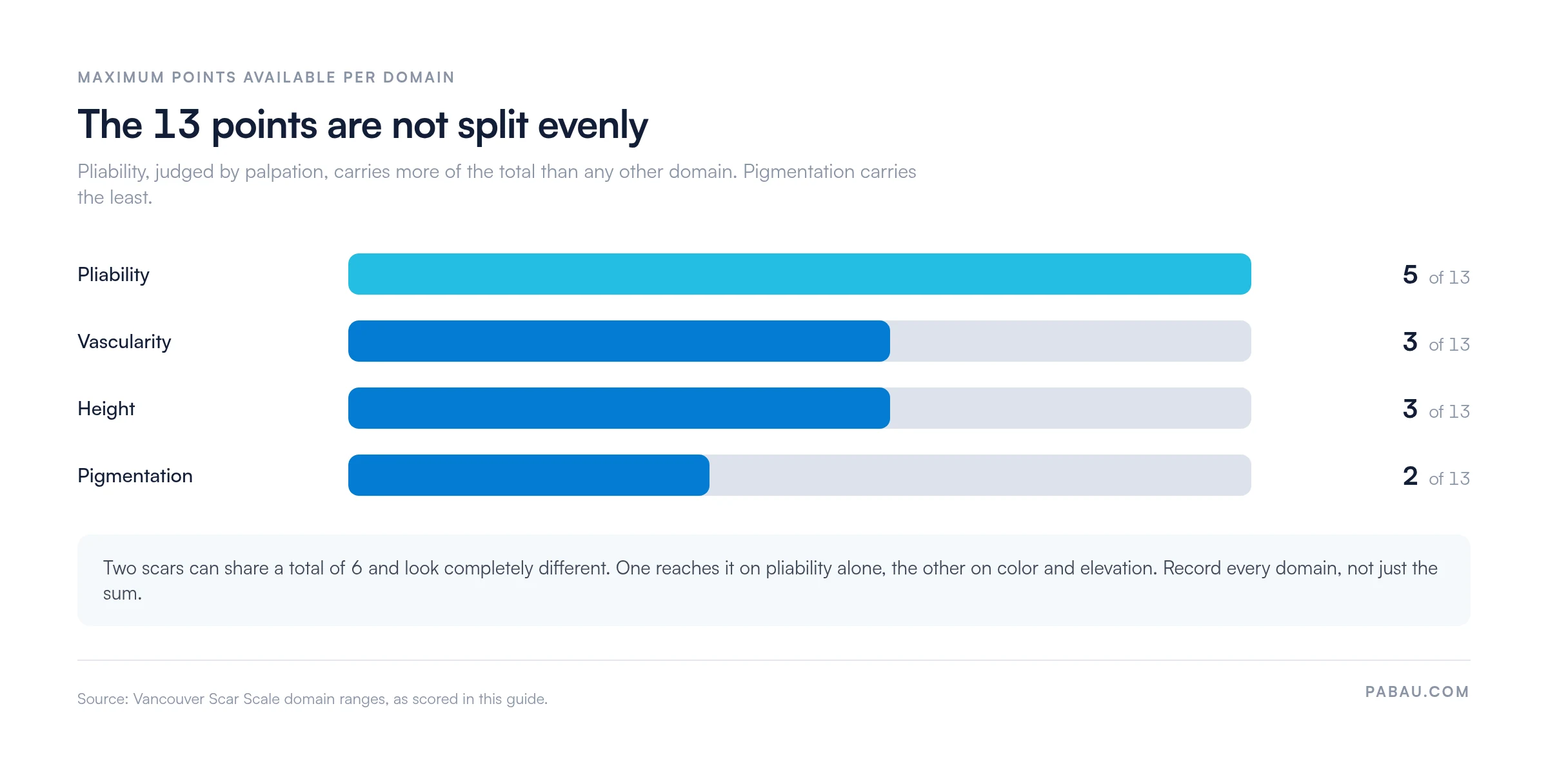
The scale evaluates four independent characteristics. Each one is scored on its own range, then totaled. The ranges are not equal, which matters more than it first appears.
Pliability alone accounts for 5 of the 13 available points, and pigmentation for only 2. Two scars can land on the same total by entirely different routes.
A score of 0 represents normal skin. Higher scores indicate more severe scarring, but no agreed total marks the point where a scar becomes hypertrophic. One study published in PubMed Central found no consensus threshold at all. What did predict hypertrophic scarring was a single item: a height score of 1 or more, at 99.5% sensitivity and 85.9% specificity.
The bands below are a working guide for clinical decisions and patient conversations. Treat them as convention rather than validated cutoffs, because the evidence does not support a hard line between one band and the next.
Record the total and each domain score separately in the patient record. That is what lets you see which domain responded to treatment and which one held. A scar whose pliability improves while its vascularity holds steady is telling you something a single number hides. Dermatology EMR software that stores the four scores as separate fields makes that trend readable at a glance.

Most of the variation between assessors comes from technique, not judgment. These five steps remove the easy sources of it.
Repeat the assessment on a fixed interval: every three to six months for an active scar, annually once it is stable. Record the treatment given between visits in the same place, so the score and the intervention sit side by side. A plastic surgery EMR that timestamps both makes it possible to say which modality moved which domain.
A modified version exists to cover what the original leaves out. The mVSS adds two patient-reported items, pain and itch, which a clinician-only scale cannot capture. Patients frequently report symptoms that the appearance of the scar gives no hint of.
In the widely cited Baryza version, pain and itch are each scored 0 to 2, and pigmentation widens to 0 to 3. That brings the maximum total to 18 points. The expanded scope suits trials that compare patient-reported outcomes against scar appearance. For routine practice, the original scale remains the default.
Several scar instruments are in common use, and they measure different things. Here is how the main three line up.
Many practices run two instruments together, using the VSS for the clinical picture and POSAS for the patient’s symptom burden. If you are still choosing, our roundup of skin assessment tools covers what each one is built to measure.
This is the part worth reading before you build a treatment decision on a total. A systematic review published in PubMed Central examined the scale’s psychometric properties and reached a blunt conclusion: low inter-rater reliability and inconsistent validity.
None of this makes the scale useless. It makes the total a weaker signal than the trend. Keep the same assessor on a patient wherever staffing allows, and score every domain. Treat a one-point shift as noise until a photograph or a second review backs it up.
An unstructured note is where comparability dies. When the score lives in free text, one clinician writes “VSS 6” and another writes “moderate scarring”. The domain breakdown disappears within a week of the appointment.
Build the form into your record template instead, with a separate field for each domain and an automatic total. Stamp it with the date, the assessor, and the treatment given since the last review. Medical records management that keeps those fields structured gives you a scar history you can chart. It also gives you an audit trail for research or an inspection.
Most practices score the VSS on a printed sheet that gets scanned into the file, or type the total into a note. Both work until you want the trend. Then someone has to open six months of PDFs and copy four numbers out of each one by hand.
Practice management software like Pabau handles it differently. You build the VSS form once as a digital form, with a field per domain and a calculated total. Every clinician then scores against the same anchors, and each completed assessment saves into the patient record with its date and its author attached.
From there the score sits beside the things that explain it: the before-and-after photos from the same visit, the treatment note, and the next appointment. Aesthetic practices already running on medical spa software can add the assessment to a workflow they use every day. Nobody has to remember a separate scoring sheet.

Build the VSS as a digital form in Pabau and score it on a tablet at the chairside. It files against the patient record with the photos from the same visit, so the trend is one click away.

The VSS earns its place because it is fast, free, and understood everywhere. It does not earn the weight practitioners often put on a single total. Read it as four numbers moving over time, not as one verdict delivered at one appointment.
The practical consequence is small and worth doing. Keep one assessor per patient, score every domain, and store the result somewhere you can chart it. Do that and the scale becomes a record of what your treatment achieved rather than a number in a note.
Download the template above and use it at your next scar review. Book a demo to see how Pabau turns those four scores into a scar history your whole team can read.

Treating a raised scar with a silicone device? Embrace scar therapy is the matching template for practices running device-based scar treatment.
Scoring another clinician-rated skin scale? EASI score calculator walks through the eczema equivalent, domain by domain.
Need the broader skin exam around it? Full skin assessment template covers the head-to-toe check a scar review often sits inside.
Assessing scar tissue after breast implants? Capsular contracture explains how the fibrous capsule around an implant is graded.
Comparing two scoring systems? SCORAD vs EASI shows how two clinician-rated scales differ in what they actually measure.
The four components are vascularity (color, 0-3 points), pigmentation (uniformity, 0-2 points), pliability (elasticity, 0-5 points), and height (elevation, 0-3 points). The total runs from 0 to 13.
No agreed cutoff exists. One published study found no consensus threshold for the total. It identified the height domain as the useful signal instead. A height score of 1 or more was 99.5% sensitive and 85.9% specific for hypertrophic scarring. Read the domain scores rather than the sum.
Less reliable than its popularity suggests. A published systematic review reported low inter-rater reliability and inconsistent validity. Keep the same assessor on a patient where you can, and treat a one-point change between visits as noise until something else confirms it.
Yes. The scale is in the public domain and free for clinical and research use, with no licensing fee or copyright restriction.
Pliability describes how elastic the scar tissue is. You assess it by pinching and rolling the scar during palpation. The grades run from yielding (normal, supple tissue) through supple, firm, and banding to contracture, which indicates fibrosis and restricted movement.
The modified Vancouver Scar Scale adds patient-reported pain and itch, each scored 0 to 2, and widens pigmentation to 0 to 3. The widely cited Baryza version therefore tops out at 18 points. The four original clinical domains stay in place.