How to ask patients for reviews: Timing, channels and scripts
Knowing how to ask patients for reviews comes down to four habits. Ask every pat...

Last Updated: Oct 8, 2026
Charm pricing means setting a price just below a round number, like $299 instead of $300, so patients read it as cheaper. At a med spa, it works on entry-level treatments, add-ons, retail skincare and memberships.
It only works when the drop changes the price’s first digit, which we call the left-digit rule. Before you build these price points into your booking system, our comparison of the best med spa software checks how platforms handle memberships and retail.
Keep round prices on consultations, clinical treatments and premium plans, where a $299 tag can read as a markdown rather than expertise. Below you’ll find the research, a price-ending matrix for a treatment menu, and a six-week test you can run from your own booking reports.

Charm pricing sets a price just below a round number, such as $99 instead of $100, so it reads as cheaper.
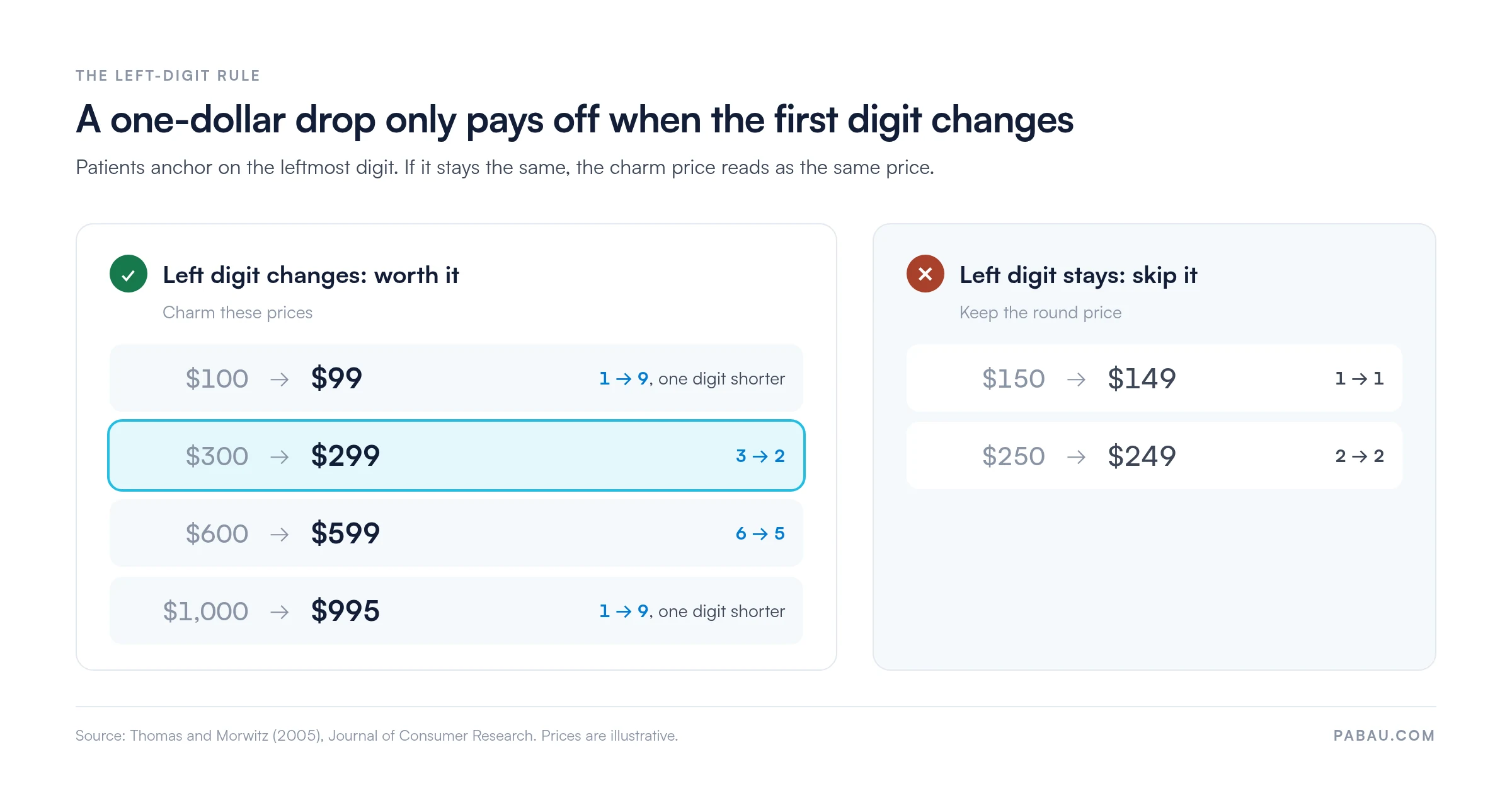
The left-digit rule says to drop a dollar only when it changes the first digit, so $300 to $299 works and $250 to $249 doesn’t.
Charm entry-level facials, add-ons, retail skincare and membership fees, where patients compare prices and decide quickly.
Keep round prices on consultations, medical treatments and premium plans, where a round number signals quality and care.
Test two or three services for four to six weeks, then compare bookings and average ticket before re-pricing the whole menu.
Charm pricing is setting a price just below a round number, such as $99 instead of $100, so it reads as cheaper than it is.
Most charm prices end in 9, which is why the tactic is also called .99 pricing or odd pricing. Retailers work in cents ($9.99), while service businesses usually drop a whole dollar ($199). The price ending you choose sends its own signal:
Defining it takes one line. Deciding which prices on a treatment menu should carry a 9 takes the rest of this guide.
The left-digit effect is our habit of anchoring on a price’s first digit, so $2.99 feels closer to $2 than to $3.
We read prices from left to right and start judging a number’s size before we finish reading it. Manoj Thomas and Vicki Morwitz tested this in a 2005 study in the Journal of Consumer Research. Nine-ending prices seemed smaller than a price one cent higher only when the leftmost digit changed, as in $2.99 versus $3.00.
When the first digit stayed the same, the effect disappeared. That finding is the basis for the left-digit rule later in this guide.
Odd-even pricing is the umbrella strategy: odd endings like $99 signal value, while even or round endings like $100 signal quality.
Charm pricing is the most common odd-ending form. The even side is prestige pricing, which gets its own section below. A med spa menu usually needs both: odd endings where patients shop on price, and round ones where they shop on trust.
Yes, charm pricing works, but the lift is small, it depends on the first digit changing, and it can cheapen a premium service.
The research behind charm pricing is mixed. Four findings matter for a med spa:
So psychological pricing works at the margin, not as a growth engine. In the med spa menus we see, it’s common for every price to end in 9, including $249-style prices that cross no digit. Those endings give away a dollar per booking with no gain in how cheap the price feels.
Only knock a dollar off when it changes the first digit a patient reads: $300 to $299 works, while $250 to $249 does nothing.
The left-digit rule turns the Thomas and Morwitz finding into a quick pricing check. Compare the first digit of the round price with the first digit of the charm price. If it doesn’t change, keep the round number and the extra dollar.
| Round price | Charm price | Left digit changes? | Worth it? |
|---|---|---|---|
| $100 | $99 | Yes, 1 to 9, and the number gets shorter | Yes |
| $150 | $149 | No, stays 1 | No |
| $250 | $249 | No, stays 2 | No |
| $300 | $299 | Yes, 3 to 2 | Yes |
| $600 | $599 or $595 | Yes, 6 to 5 | Yes |
| $1,000 | $995 | Yes, 1 to 9, and the number gets shorter | Yes |
Plenty of charm pricing examples online break this rule. The diagram below sorts each drop into the lane it belongs in.
The best charm pricing examples on a med spa menu are $99 entry facials, $49 add-ons, $39 retail and $99 monthly memberships.
Use the matrix below as a starting point for your own menu. Every price is illustrative, not a market rate, so set yours from your costs and local competition.
| Service type | Price ending | Why | Illustrative price |
|---|---|---|---|
| Entry-level facial or peel | Charm (9) | First-time patients compare prices across med spas | $99 instead of $100, or $199 instead of $200 |
| Add-ons such as LED or dermaplaning | Charm (9) | Small, quick decisions made at booking or checkout | $49 instead of $50 |
| Retail skincare | Charm (9) | Patients compare these prices with online retailers | $39 or $59 instead of $40 or $60 |
| Monthly membership | Charm (9) | The monthly fee is the number patients compare and remember | $99 a month instead of $100 |
| Laser hair removal package | Charm only if it crosses a digit | A higher ticket, so the dollar only counts when the first digit moves | $599 instead of $600, never $249 instead of $250 |
| Consultations and medical treatments | Round (0) | A round fee reads as professional, not promotional | $150 consultation |
| Premium plans such as laser resurfacing or full-face filler | Round (0) | Emotional, high-trust purchases where quality outweighs a deal | $1,200 treatment plan |
These psychological pricing examples follow one pattern. Charm prices go where a patient is shopping, and round prices go where a patient is trusting you with their face.
Use prestige pricing, meaning round numbers like $800 or $1,200, for premium, emotional and clinical treatments where patients buy on trust rather than price.
Wadhwa and Zhang’s research explains why. Round prices feel right when feelings drive the purchase, and a full-face treatment plan is exactly that kind of decision. Schindler and Kibarian add the other half: a 99 ending reads as a discount, which can undercut a high-quality image.
Medical trust raises the stakes further. A patient booking laser resurfacing or a filler plan wants a skilled practitioner, not a bargain. A $799 price printed beside a medical consent form sends a mixed message.
Overuse is the other risk. If every price on the menu ends in 9, the charm prices stop standing out and the menu starts to look like a sale rack. A workable split looks like this:
For the bigger decision between cost-plus, value-based and competitive pricing, see how to choose a med spa pricing strategy.
The psychological pricing strategies that pair best with charm pricing are tiered menus, bundles, memberships, limited-time offers and loyalty rewards.
| Strategy | What it does | Med spa use |
|---|---|---|
| Price anchoring and tiered menus | A higher option makes the middle one feel reasonable | Basic facial $99, advanced $199, premium $300 |
| Bundles and packages | One price for several sessions feels like a better deal | A three-session peel course at $399 instead of $400 |
| Memberships | Turns one-off visits into recurring revenue | $99 a month for one facial plus member rates |
| Limited-time offers | Adds urgency to a price change | A birthday facial at $99, down from $120 |
| Loyalty rewards | Gives repeat patients a reason to return beyond price | Points toward a $49 add-on after a set number of visits |
The benefits of psychological pricing stack when the tactics work together. A charm pricing strategy on the entry tier brings patients in, and the round premium tier signals quality. Notice the tiers above obey the left-digit rule: $129 would not, because $130 to $129 keeps the 1.
Bundles are where charm prices do the most work, and these med spa package ideas give you ready-made combinations to price.
If recurring revenue is the goal, our guide to building a med spa membership program covers setting the monthly fee.
To test charm pricing at med spas, re-price two or three entry services across a left digit and compare four to six weeks of results.
Your patient base shapes the result. First-time, price-comparing visitors respond to charm prices more than loyal, high-end regulars do. If most of your revenue comes from premium injectables, start the test on retail and add-ons.
Treat the result as one input into your med spa pricing rather than a final verdict. A charm price that lifts bookings but lowers the average ticket hasn’t earned its place.
A price test often means editing the menu in one tool, the booking page in another, and tracking results in a spreadsheet. Practice management software like Pabau keeps services, prices and sales in one system, so the change and the result sit side by side.
Pabau is medical spa software built for aesthetic practices. Here is how Pabau supports each step of the test above:
Every Pabau subscription includes every feature. Structured onboarding sets up your treatment menu and reports with you, so the first price test runs on clean data.

Pabau keeps your price list, packages, memberships and sales reports in one system. Change a price, then see how bookings and revenue respond.

Charm the entry points, round the premium, and let the test data decide the rest. The left-digit rule does most of the work. If the first digit doesn’t move, the extra dollar belongs on your books, not off the tag.
The trade-off to remember is trust. A $49 add-on invites a quick yes, but a $799 medical treatment can read as a markdown. Get the split right and your menu says value and expertise at the same time.
Book a demo to see how Pabau helps you set, test and track charm prices across your treatment menu.

Building your treatment menu from scratch? How to create a med spa service menu shows how to structure services so patients find and rebook them.
Want to measure a price change properly? Med spa KPI guide covers average ticket, revenue per service and the other numbers a pricing test moves.
Pricing laser packages? Laser hair removal clinic income breaks down what a laser service line earns each month.
A charm price sits just below a round number, such as $199 instead of $200, so it reads lower than it is. Retailers use cents, while med spas usually drop a whole dollar.
Yes, but modestly. Recent charm pricing research, a meta-analysis of 69 studies, found just-below prices still lift purchase decisions by a small margin. The lift is largest on low-ticket items patients compare.
Yes, when the ending changes the first digit. Thomas and Morwitz found $2.99 reads as cheaper than $3.00, but the left-digit effect vanishes when the leftmost digit stays the same. On a med spa menu, $199 works and $249 doesn’t.
A med spa that prices a first-visit facial at $99 and laser resurfacing at $800 uses both halves. The odd $99 signals value, and the even $800 signals quality.
Round figures on high-trust services, such as a $150 consultation, an $800 laser resurfacing session or a $1,200 full-face filler plan. Round numbers read as confident and complete, which suits purchases driven by trust or emotion.