8 Best Mangomint Alternatives for Salons, Spas & Medspas (2026)
The Best Mangomint Alternatives for Salons, Spas, and Medspas Mangomint built it...

April 23, 2026


Buy now, pay later is now available in Pabau

Mindbody vs Vagaro: Mindbody suits larger fitness studios and wellness chains needing class scheduling and marketplace exposure; Vagaro fits smaller salons, spas, and independent practitioners who need affordable, straightforward booking.
Pricing gap: Vagaro starts around $30/month per bookable calendar; Mindbody’s plans are significantly more expensive and may require annual contracts on higher tiers.
Neither platform offers native clinical charting, medical notes, or HIPAA-compliant documentation workflows as core features.
Pabau is the preferred alternative for medical aesthetic clinics, med spas, and clinical wellness providers that need built-in charting, consent forms, and treatment documentation alongside scheduling.
The choice between these two platforms comes down to one core question: what kind of business are you running? Mindbody is built for fitness studios, yoga and Pilates chains, and larger wellness businesses that need class scheduling, membership management, and marketplace-driven client acquisition. Vagaro is built for salons, spas, and independent practitioners who need affordable, reliable appointment booking without a steep learning curve or a steep monthly bill. This guide covers pricing, scheduling, marketing, multi-location tools, and compliance, then explains why a third platform deserves serious attention for any business with clinical or medical aesthetic services.
Pricing is where the comparison becomes immediately practical. Vagaro uses a per-bookable-calendar model, where each staff member who takes appointments requires their own calendar slot. The standard rate is $30/month for a single calendar, with each additional calendar adding $10/month – capping at $90/month once you reach seven or more calendars. (Vagaro currently offers a promotional entry rate of $23.99/month for a single calendar, so $30 is the standard, non-promotional price.) For a five-person salon team, that works out to $30 + ($10 x 4) = $70/month at standard rates. That predictability is one of the platform’s most cited advantages among small business owners. If you want a Vagaro alternative that goes further on clinical workflows, options exist beyond both platforms covered here.
Mindbody does not publish a standard pricing grid publicly. Multiple independent reviewers note that Mindbody’s plans are substantially more expensive than Vagaro at comparable team sizes, and higher-tier plans may require annual contracts. The platform’s pricing is structured to match larger businesses with more complex needs, which explains the cost gap. For a boutique fitness studio with 10+ staff and class schedules, Mindbody’s feature depth may justify the premium. For a three-room salon, it likely does not.
Scheduling is the functional heart of both platforms, and the split here reflects their different audiences. Mindbody excels at group class scheduling. Studios running multiple concurrent Pilates classes, yoga sessions, or HIIT workouts across several rooms get a robust class management system, waitlist handling, instructor assignment, and capacity controls. According to multiple independent reviewers, Mindbody dominates for group scheduling scenarios involving complex multi-instructor timetables.

Vagaro’s strength is individual appointment management. Online booking for individual service providers, clear calendar visibility per staff member, and a clean client-facing booking experience make it a favourite for salons and spas where one practitioner’s availability is the central scheduling unit. As StudioGrowth’s expert review puts it: if individual calendars and availability are crucial, Vagaro should be the default choice.
Businesses running both group classes and individual appointments (a yoga studio that also offers massage therapy, for example) may find Mindbody handles the hybrid model better due to its deeper class infrastructure. For a Mindbody alternatives shortlist that includes clinical-grade scheduling, Pabau’s appointment system adds treatment-specific booking flows and integrated consent forms at the point of booking, which neither platform here offers natively.
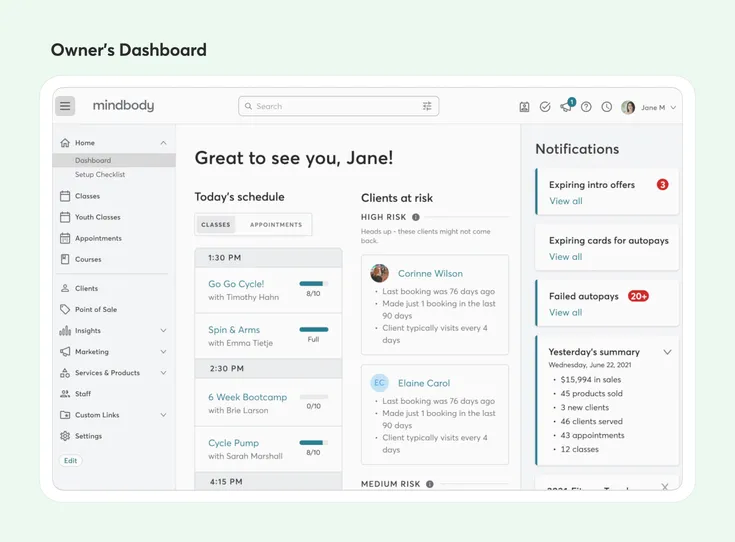
Mindbody’s marketing toolkit goes well beyond scheduling. The Mindbody consumer app functions as a wellness marketplace where potential clients actively search for studios, classes, and treatments in their area. For fitness and yoga businesses, this marketplace exposure represents a meaningful client acquisition channel that Vagaro simply does not offer. Mindbody also includes AI-driven retention tools, automated email and SMS campaigns, and reporting dashboards that track client lifetime value.
Vagaro’s marketing automation tools are more basic by comparison. Email and SMS campaigns, promotional offers, and a consumer-facing Vagaro marketplace (smaller than Mindbody’s) give smaller businesses a starting point, but the depth of segmentation and automation lags behind Mindbody’s enterprise-level tools. For a growing salon with 500+ active clients, Vagaro’s marketing may feel limiting within 12-18 months.
The shared gap matters for med spa and aesthetics businesses where client recall is built around treatment intervals. Botox clients need reminders at 12-16 weeks; filler clients at 6-12 months. Generic email campaigns do not handle this logic well. Platforms purpose-built for medical aesthetics handle recall based on the specific treatment administered, not just the last visit date.

Pabau is built for medical aesthetic clinics, med spas, and clinical wellness providers that need more than booking software. See clinical charting, digital consent forms, and treatment-based recall working together.

Multi-location capability is a significant differentiator for growing businesses. Mindbody handles multi-location fitness and wellness chains well. Centralized reporting, staff scheduling across locations, and the ability to manage memberships that work at any site are mature features that regional yoga chains and wellness groups rely on. According to FitVizPro’s analysis, Mindbody tends to win for complex multi-location operations while Vagaro wins for straightforward day-to-day scheduling at a single site.
Vagaro suits single-location or small multi-location setups better. The platform works well for an owner with two or three locations, but the reporting and staff management tools across locations are less sophisticated than Mindbody’s. A franchise operator running 10 locations would find Vagaro limiting quickly. Pabau’s multi-location management is optimized for clinical environments, handling centralized reporting, inventory, and staff across sites for medical aesthetic and clinical wellness groups.
Before committing to either platform, map your most common weekly tasks: how many are class-based vs. individual appointments, how many staff need their own calendars, and whether client acquisition through a consumer marketplace matters to your business model. The answers usually point clearly toward one platform.
The table below maps core platform capabilities side by side.
User sentiment tells a clear story. According to Capterra reviewers, Vagaro holds a 4.7/5 rating from over 3,479 verified reviews, with recurring praise for affordability, ease of use, and solid day-to-day scheduling. Reviewers consistently describe it as good value for money and straightforward to set up for small teams.
Mindbody’s reviews are more mixed. Capterra shows a 4.0/5 rating from over 2,982 reviews. Positive reviews highlight the marketplace feature and class scheduling depth. Critical reviews cluster around pricing, customer support responsiveness, and complexity for smaller businesses. Worth noting: Mindbody’s Capterra sub-ratings on specific dimensions run notably below its 4.0 overall score – Customer Service sits around 3.8 and Value for Money around 3.6, both lower than Vagaro’s equivalent metrics. That gap between the overall score and the service/value dimensions is a useful signal to weigh before committing.
For context: Pabau holds a 4.4/5 rating on Capterra from verified reviewers, with themes around comprehensive clinical features, strong scheduling, and good client communication automation. The platform’s clinical charting and treatment documentation capabilities are consistently noted as differentiating features that neither Mindbody nor Vagaro offer.
The right choice depends entirely on your business type and growth trajectory. Neither platform is universally better; they serve fundamentally different operational models.
This comparison leaves a significant gap for one growing category: businesses that sit at the intersection of wellness and clinical medicine. Medical aesthetic clinics, med spas, IV therapy providers, physiotherapy practices, and clinical wellness centres have clinical documentation requirements that neither Mindbody nor Vagaro address as core features.

Pabau is built specifically for this category. It functions as an all-in-one medical spa software platform that combines appointment scheduling with native medical charting, treatment notes, digital consent forms, and before-and-after photo management in one system. For a med spa running Botox, filler, and laser treatments alongside wellness consultations, this means a single platform handles every clinical and operational touchpoint.

The clinical capability gap is not minor. Running Mindbody or Vagaro for a med spa means bolting on separate consent form tools, separate charting software, and separate before/after photo management. Each additional tool adds cost, creates integration risk, and introduces compliance exposure. For a thorough review of medical spa EMR software options for clinical operations, the comparison between wellness-first platforms and clinical-first platforms matters significantly.
Beyond documentation, Pabau’s marketing automation is tied to treatment history. Recall campaigns trigger based on the specific treatment administered and the clinically appropriate follow-up interval, not just the last visit date. That distinction drives higher rebooking rates for treatment-based businesses. You can explore how Pabau compares with Mindbody in more detail on the dedicated comparison page, and review how med spa compliance requirements affect software selection for clinical aesthetic businesses.
For businesses considering a move from either platform, the best medical spa software evaluation should include clinical charting depth, consent workflow automation, and treatment recall logic as primary criteria alongside scheduling and payment features.

Looking for a detailed Mindbody comparison? Pabau vs Mindbody covers how the two platforms differ across clinical tools, scheduling, and pricing for aesthetic and wellness businesses.
Evaluating Vagaro alternatives for your spa? Vagaro Alternative Guide reviews platforms that go further on clinical documentation and treatment-based automation.
Running a med spa and need compliant software? Med Spa Compliance Guide outlines the documentation and consent workflow requirements that your software must support.
Comparing the best options for medical spas? Best Medical Spa Software ranks platforms across clinical capability, scheduling depth, and pricing structure.
The decision comes down to scale and business model. Vagaro wins on affordability and simplicity for salons, spas, and smaller wellness businesses. Mindbody wins on class scheduling depth and marketplace exposure for fitness studios and larger wellness chains. Both platforms fall short for businesses with clinical service lines, where documentation, consent, and treatment recall are non-negotiable operational requirements.
If your business includes medical aesthetic treatments, clinical consultations, or any service requiring patient-level documentation, neither platform provides what you need out of the box. Pabau’s integrated approach, combining scheduling, clinical charting, digital consent forms, and treatment-based marketing in one system, is purpose-built for that gap. Book a demo to see how Pabau handles the full clinical and operational workflow for medical aesthetic and wellness practices.
Mindbody is the stronger choice for fitness studios. Its class scheduling infrastructure, multi-instructor calendar management, and consumer wellness marketplace are purpose-built for group fitness environments. Vagaro handles individual appointments well but lacks the class management depth that yoga, Pilates, and HIIT studios typically require.
Vagaro is substantially more affordable. Plans start at approximately $30/month for a single bookable calendar, with costs scaling per staff member. Mindbody does not publish standard pricing and is widely reported by reviewers to cost significantly more, with higher-tier plans potentially requiring annual contracts.
Vagaro works for small multi-location setups (two or three sites) but becomes limiting at larger scale. Multi-location reporting, centralized staff management, and cross-site membership logic are stronger in Mindbody, which is the preferred choice for regional chains or franchise operations with five or more locations.
Yes. Neither Mindbody nor Vagaro offers native clinical charting, medical-grade consent forms, or before-and-after photo management as core features. For med spas and medical aesthetic clinics, Pabau provides all of these alongside scheduling, payment processing, and treatment-based recall automation in one integrated platform.
The primary differences are pricing model, target market, and feature depth. Mindbody uses tiered pricing (not publicly listed) and targets fitness studios and large wellness businesses needing group class scheduling and marketplace exposure. Vagaro uses per-calendar pricing from around $30/month and targets salons, spas, and individual practitioners who need straightforward, affordable appointment management.