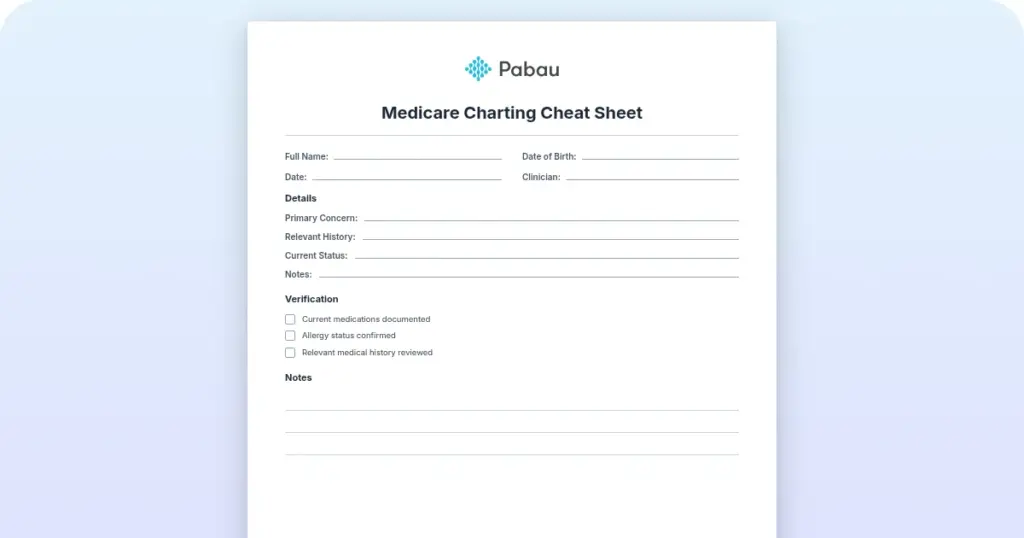
Medicare charting cheat sheet
A Medicare charting cheat sheet is a one-page reference that lists what Medicare...

6
Last Updated: Oct 21, 2026

Mindbody suits larger fitness studios and wellness chains that need class scheduling and marketplace exposure. Vagaro fits smaller salons, spas, and independent practitioners who want affordable, straightforward booking.
Pricing: Vagaro starts around $30/month per bookable calendar. Mindbody does not publish rates, and higher tiers may require an annual contract.
Both platforms include native clinical notes. Vagaro ships SOAP notes on every plan, and Mindbody markets HIPAA-compliant SOAP notes with custom client forms and waivers.
Vagaro also has a HIPAA-compliant in-app camera, annotation tools, and stock tracking inside SOAP notes. Mindbody routes before-and-after photos through its partner network instead.
Both platforms will chart a treatment, but a med spa needs more structure than either was built to hold. Practice management software like Pabau goes further on injectable-level records, photo annotation, and recall dated from each treatment.
The choice between these two platforms comes down to one question. What kind of business are you running? Mindbody is built for fitness studios, yoga and Pilates chains, and larger wellness businesses. Class scheduling, membership management, and marketplace-driven client acquisition are what it does best.
Vagaro is built for salons, spas, and independent practitioners who want affordable, reliable appointment booking. Its learning curve and its monthly bill both stay modest.
This guide covers pricing, scheduling, marketing, multi-location tools, and clinical documentation. It then explains where a purpose-built clinical platform goes further for med spas and aesthetic practices.
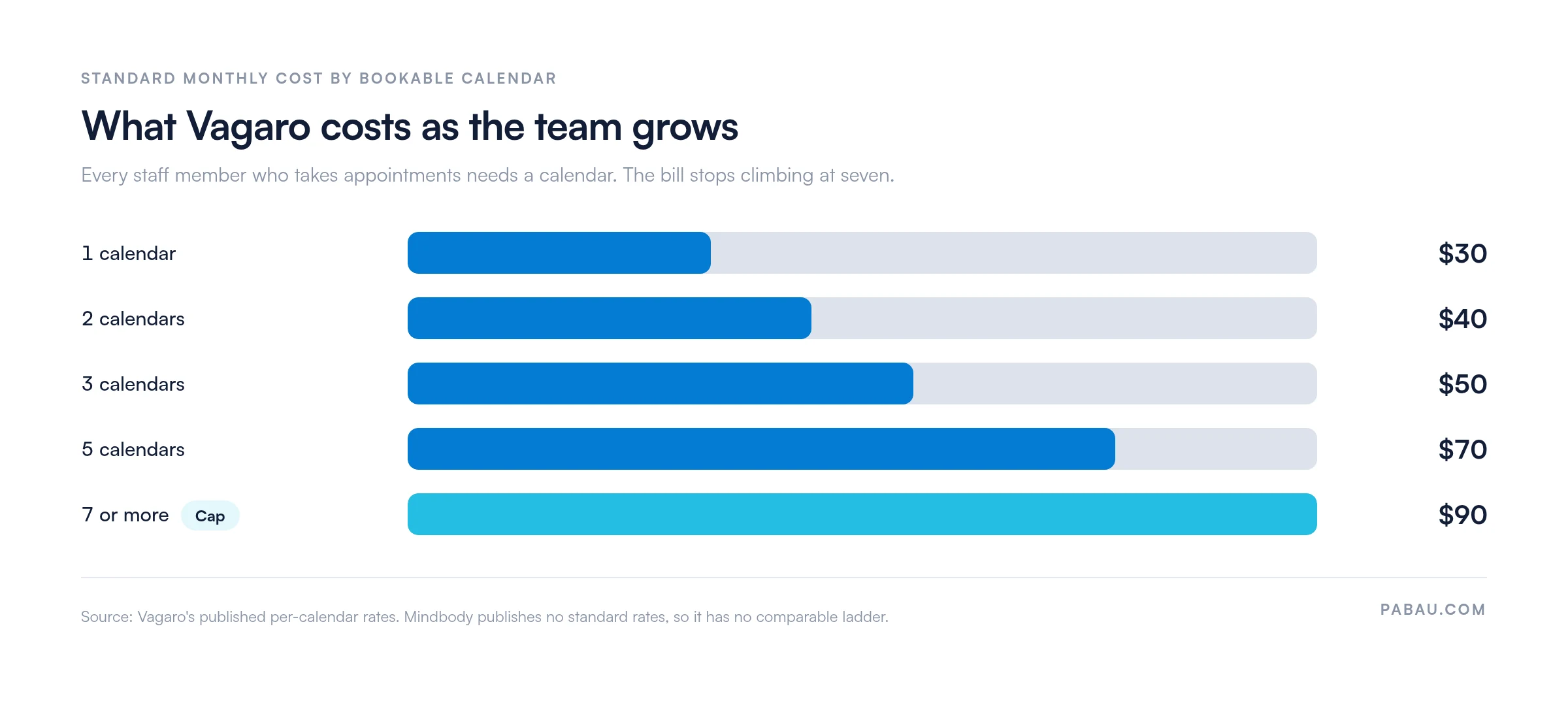
Pricing is where the comparison becomes immediately practical. Vagaro uses a per-bookable-calendar model. Every staff member who takes appointments needs their own calendar slot, and the standard rate is $30/month for one.
Each additional calendar adds $10/month, and the total caps at $90/month at seven or more calendars. Vagaro also runs a promotional entry rate of $23.99/month for a single calendar. For a five-person salon team, the standard bill works out to $70/month. The ladder below shows how that scales.
That predictability is one of the platform’s most cited advantages among small business owners. If you want a Vagaro alternative that goes further on clinical workflows, options exist beyond both platforms covered here.
Mindbody does not publish a standard pricing grid publicly. Multiple independent reviewers note that its plans cost substantially more than Vagaro at comparable team sizes, and that higher-tier plans may require annual contracts.
The pricing is structured to match larger businesses with more complex needs, which explains the cost difference. For a boutique fitness studio with 10 or more staff and a full class schedule, Mindbody’s feature depth may justify the premium. For a three-room salon, it likely does not.
Scheduling is the functional heart of both platforms, and the split here reflects their different audiences. Mindbody excels at group class scheduling. Studios running concurrent Pilates classes, yoga sessions, or HIIT workouts across several rooms get a robust class management system.
Waitlist handling, instructor assignment, and capacity controls come with it. According to multiple independent reviewers, Mindbody dominates for group scheduling that involves complex multi-instructor timetables.

Vagaro’s strength is individual appointment management. Online booking for individual service providers and clear calendar visibility per staff member are the draw. A clean client-facing booking experience makes it a favorite for salons and spas.
In those businesses, one practitioner’s availability is the central scheduling unit. As StudioGrowth’s expert review puts it, Vagaro should be the default choice when individual calendars and availability are crucial.
Businesses running both group classes and individual appointments may find Mindbody handles the hybrid model better, thanks to its deeper class infrastructure. A yoga studio that also offers massage therapy is the classic example.
For a Mindbody alternatives shortlist that includes clinical-grade scheduling, Pabau ties each booking to the treatment being delivered. The matching consent form, medical questionnaire, and before-photo prompt then go out ahead of the visit.
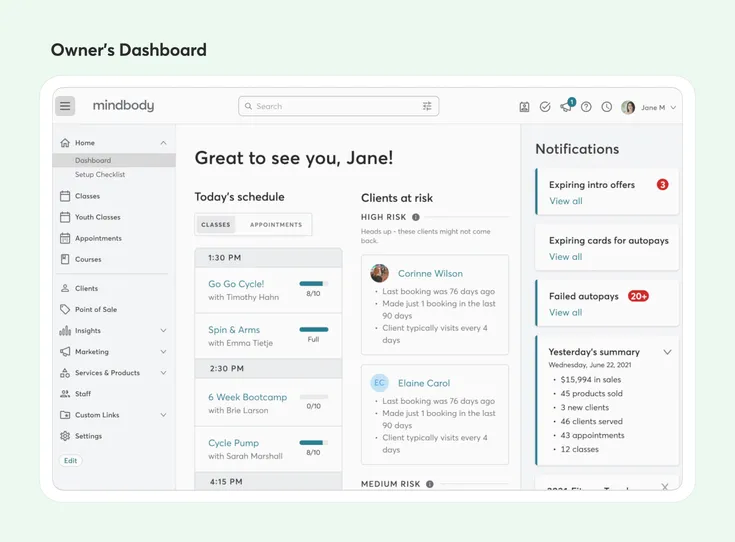
Mindbody’s marketing toolkit goes well beyond scheduling. The Mindbody consumer app works as a wellness marketplace where potential clients search for studios, classes, and treatments in their area. For fitness and yoga businesses, that exposure is a meaningful client acquisition channel Vagaro does not match.
Mindbody also includes AI-driven retention tools, automated email and SMS campaigns, and reporting dashboards that track client lifetime value.
Vagaro’s marketing automation covers less ground. Email and SMS campaigns, promotional offers, and a consumer-facing Vagaro marketplace give smaller businesses a starting point.
That marketplace is smaller than Mindbody’s, and the depth of segmentation and automation sits behind Mindbody’s enterprise-level tools. For a growing salon with 500 or more active clients, Vagaro’s marketing may start to feel limiting within 12 to 18 months.
That distinction matters for med spa and aesthetics businesses, where client recall is built around treatment intervals. Botox clients need reminders at 12 to 16 weeks, and filler clients at 6 to 12 months. Generic email campaigns do not handle that logic well. Platforms purpose-built for medical aesthetics date the recall from the specific treatment administered, not from the last visit. Treatment-based recall like this is easier to run at scale with marketing automation built for medical aesthetics.
Multi-location capability is a significant differentiator for growing businesses. Mindbody handles multi-location fitness and wellness chains well. Centralized reporting, staff scheduling across locations, and memberships that work at any site are mature features that regional yoga chains rely on.
According to FitVizPro’s analysis, Mindbody tends to win for complex multi-location operations, while Vagaro wins for straightforward day-to-day scheduling at a single site.
Vagaro suits single-location or small multi-location setups better. The platform works well for an owner with two or three locations. Its reporting and staff management tools across locations are less sophisticated than Mindbody’s, so a franchise operator running 10 sites would find Vagaro limiting quickly.
Pabau’s multi-location management is built for clinical environments. It handles centralized reporting, stock, and staff across sites for aesthetic and clinical wellness groups.
Both platforms handle clinical notes natively, and how much structure those notes hold is where they separate. Vagaro includes SOAP notes on every plan. Mindbody markets HIPAA-compliant SOAP notes alongside custom client forms and waivers. Its own physical therapy pages describe adding notes and sending forms from inside the software.
Vagaro’s Forms and SOAP Notes system is the more built-out of the two. Per Vagaro’s own support documentation, it ships with three prebuilt templates: a standard note, a facial anatomy chart, and a full-body anatomy chart.
Practitioners capture photos in a HIPAA-compliant in-app camera with alignment guides, then annotate them with the Markup Editor. Product used during a treatment can draw down stock automatically. Custom and branded forms sit in Vagaro’s paid Forms add-on, which is a first-party product rather than a third-party integration.
Mindbody’s clinical layer lives in the client profile. Staff can add SOAP notes, send digital forms ahead of a visit, and use staff permissions to control who reads or edits a note.
Before-and-after photo documentation is the exception. Mindbody points customers to its partner network for photo management, e-prescribing, assessments, and templated note macros rather than shipping those tools itself.
The ceiling shows up once treatments get technical. Injectable records in both platforms are only as structured as the template a practice builds by hand. Batch numbers, expiry dates, and units per injection site depend on custom fields rather than a purpose-made screen.
Recall automation keys off the last visit rather than the treatment itself. To a visit-based reminder, a Botox client due at 12 weeks and a filler client due at 9 months look identical.
For a salon adding a single facial line, that is a reasonable trade. For a med spa running injectables, lasers, and prescriber sign-off, the record has more to carry than a booking-first platform was designed for.
Before committing to either platform, map your most common weekly tasks. Count how many are class-based versus individual appointments, how many staff need their own calendars, and whether marketplace discovery matters to your business model. If you chart, add one more question: how much structure does a treatment record need to hold? The answers usually point clearly toward one platform.
The table below maps core platform capabilities side by side.
User sentiment tells a clear story. According to Capterra reviewers, Vagaro holds a 4.7/5 rating from more than 3,479 verified reviews. Recurring praise covers affordability, ease of use, and solid day-to-day scheduling. Reviewers consistently describe it as good value for money and straightforward to set up for small teams.
Mindbody’s reviews are more mixed. Capterra shows a 4.0/5 rating from more than 2,982 reviews. Positive reviews highlight the marketplace and the depth of class scheduling. Critical reviews cluster around pricing, support responsiveness, and complexity for smaller businesses.
Mindbody’s Capterra sub-ratings also run below its 4.0 overall score, with Customer Service around 3.8 and Value for Money around 3.6. Both sit under Vagaro’s equivalent metrics, and that spread is worth weighing before you commit.
For context, Pabau holds a 4.7/5 rating on Capterra from more than 600 reviews. Themes there cover comprehensive clinical features, strong scheduling, and client communication automation.
Reviewers single out the depth of the charting and treatment documentation. That is where a purpose-built clinical platform pulls ahead of general booking software.
The right choice depends on your business type and growth trajectory. Neither platform is universally better, because they serve fundamentally different operational models.
Pabau earns a look when the clinical record does more work than the calendar. Medical aesthetic practices, med spas, IV therapy providers, and physical therapy practices all fall in that group. Neither Mindbody nor Vagaro was built for how much that record has to carry after the visit.

Both Mindbody and Vagaro will store a note and a signed form. Pabau carries that record through to what happens next. The batch and units recorded against each injection site stay with the treatment. Photo sets line up for comparison across a course. Aftercare goes out on its own, and the recall is dated from the treatment rather than the visit.
Pabau is an all-in-one medical spa software platform. It combines scheduling with medical charting, treatment notes, digital consent forms, and before-and-after photo management.
For a med spa running Botox, filler, and laser treatments alongside wellness consultations, one system covers every clinical and operational touchpoint. Our software comparisons for practices put Pabau next to Mindbody and the rest, feature by feature.

Pabau prices by location and number of users, and every plan includes every feature. There is no starter tier that locks functionality away, so a solo injector gets the same charting and consent tools as a 20-user group.
Marketing Plus, Care Plus, and Insights Plus are additional products for practices that want to do more in one specific area. Annual billing saves up to 20%.
There is no free trial, which is a deliberate choice. Clinical configuration is what makes the platform useful, so new practices get a demo and structured onboarding instead. A dedicated client coordinator and a documented setup portal cover the migration and the account setup.
Pabau is strongest where a treatment has a clinical tail. The record holds what was injected, where, and in what quantity, and the follow-up schedules itself from that. Photo sets, consents, and aftercare hang off the same treatment rather than sitting in separate tools.
Practices that switch usually do so after outgrowing a booking-first platform. The consolidation is the win. One system replaces five, and no record gets copied by hand between them.
Pabau is not the cheap option, and it does not try to be. It is also not built for group fitness. A studio running twelve classes a day across three rooms will get more from Mindbody’s class engine and its consumer marketplace.
Setup also takes time, since the clinical configuration is what makes the platform work. Pabau GO runs on iOS only, with no Android version.
Pabau fits medical aesthetic practices, med spas, IV therapy and weight loss providers, dermatology and cosmetic surgery practices, and clinical wellness groups. It works across the size range, from a solo injector to a multi-site group.
If you are shortlisting, weigh charting depth, consent automation, and recall logic alongside scheduling and payments. Those are the three places a booking-first platform runs out of room first.

Pabau is built for medical aesthetic practices, med spas, and clinical wellness providers that need more than booking software. See clinical charting, digital consent forms, and treatment-based recall working together.

The decision comes down to scale and business model. Vagaro wins on affordability and simplicity for salons, spas, and smaller wellness businesses. Mindbody wins on class scheduling depth and marketplace exposure for fitness studios and larger chains. Both carry native clinical notes, so neither one leaves a practice documenting treatments on paper.
What changes with a clinical service line is how much that documentation has to hold. Structured injectable records, aligned photo sets, and recall dated from the treatment sit beyond what a booking-first platform was designed for. Pabau brings scheduling, charting, consent, and treatment-based marketing into one system built for that work. Book a demo to see it run through a full aesthetic workflow.

Still chasing Mindbody’s numbers? Mindbody pricing breaks down what studios pay across its plans, since the company publishes no standard grid.
Evaluating Vagaro alternatives for your spa? Vagaro alternative guide reviews platforms that go further on clinical documentation and treatment-based automation.
Is Zenoti built for your med spa? Zenoti review weighs its strengths against practices smaller than a hotel spa chain.
Weighing cost against features for a salon? Fresha alternative compares booking platforms for salons and spas that have outgrown their first system.
Want Pabau against Mindbody directly? Pabau vs Mindbody sets the two side by side on clinical tools, scheduling, and pricing.
Mindbody is the stronger choice for fitness studios. Its class scheduling infrastructure, multi-instructor calendar management, and consumer wellness marketplace are purpose-built for group fitness environments. Vagaro handles individual appointments well, but it does not match that class management depth for yoga, Pilates, and HIIT studios.
Vagaro is substantially more affordable. Plans start at approximately $30/month for a single bookable calendar, with costs scaling per staff member. Mindbody does not publish standard pricing, and reviewers widely report that it costs significantly more. Higher-tier Mindbody plans may also require an annual contract.
Vagaro works for small multi-location setups of two or three sites, but it becomes limiting at larger scale. Multi-location reporting, centralized staff management, and cross-site membership logic are stronger in Mindbody. Mindbody is the better fit for regional chains or franchises with five or more locations.
The primary differences are pricing model, target market, and feature depth. Mindbody uses tiered pricing that is not publicly listed, and it targets fitness studios and large wellness businesses that need group classes and marketplace exposure. Vagaro uses per-calendar pricing from around $30/month for salons, spas, and individual practitioners.
Yes. Vagaro includes SOAP notes on every plan, with three prebuilt templates covering a standard note, a facial anatomy chart, and a full-body chart. A HIPAA-compliant in-app camera captures before-and-after photos, and the Markup Editor annotates them. Custom and branded forms sit in Vagaro’s first-party Forms add-on rather than a third-party integration.
Yes. Mindbody markets HIPAA-compliant SOAP notes, custom client forms, and waivers, and staff permissions control who can view or edit a note. Before-and-after photo documentation is the exception. Mindbody points customers to its partner network for photo tools, e-prescribing, assessments, and note macros.
For med spas the question is depth rather than availability. Both platforms chart natively, and Vagaro also handles before-and-after photos in-app. Pabau goes further on what a treatment record has to carry. That means structured injectable and batch detail, aligned photo comparison, and recall dated from each treatment. Scheduling, payments, and marketing sit in the same system.