Tebra Pricing in 2026: Modules, Add-Ons, and Real Costs
Most independent practices evaluating EHR software run into the same wall when t...

April 30, 2026


Buy now, pay later is now available in Pabau

Pabau supports UK, EU, UAE, and US clinics with built-in GDPR and HIPAA compliance; Aesthetic Record is designed primarily for HIPAA-compliant US aesthetic practices.
Both platforms offer consent forms and before/after photo management, but Pabau’s documentation tools cover a broader range of clinic types and workflows.
Pabau includes a built-in CRM with automated marketing campaigns and recall workflows; Aesthetic Record’s marketing automation is more limited.
Aesthetic Record may suit solo injectors and small US medspas; Pabau scales across multi-practitioner, multi-location clinics globally.
Pabau’s scheduling is tightly integrated with its CRM and marketing tools, enabling automated client journeys end-to-end.
Choosing between Pabau vs Aesthetic Record is one of the most common decisions facing aesthetic clinic owners and medical spa managers in 2026. Both platforms target the same core market – aesthetic and cosmetic practices – yet they take very different approaches to practice management, compliance, and scalability. This article breaks down the key differences across clinical documentation, scheduling, CRM, compliance, pricing, and integrations so you can make a well-informed decision for your practice.
Pabau is a multi-industry medical spa software and practice management platform serving aesthetic, wellness, and medical clinics across the UK, US, EU, and UAE. Aesthetic Record is an HIPAA-compliant EMR and practice management tool built specifically for US-based aesthetic medicine practices, with a focus on injectors, cosmetic clinics, and medspas. Understanding where each platform excels – and where it falls short – is the starting point for selecting the right system for your clinic’s needs.
Pabau and Aesthetic Record share a common goal – replacing paper-based workflows with integrated digital systems – but they differ significantly in scope, geographic focus, and the breadth of features they offer. Pabau supports aesthetic, wellness, medical, and multi-specialty practices with a unified CRM, clinical documentation, and operational workflow system. Aesthetic Record is purpose-built for aesthetic medicine, with its feature set closely aligned to the workflows of injectors and cosmetic practitioners in the US market.
Aesthetic Record positions itself as an EMR-first platform. Its core value proposition is streamlined clinical charting, consent form capture, and before/after photo management – the documentation essentials for aesthetic medicine. Pabau takes a broader approach, combining EMR capability with appointment scheduling, automated marketing, staff and inventory management, and multi-location oversight in a single platform.
For UK and EU-based practices, the compliance picture is a decisive factor. Pabau is headquartered in the UK and built with GDPR compliance as a foundational requirement, while also supporting HIPAA compliance for US medical and aesthetic practices. Aesthetic Record’s compliance infrastructure is HIPAA-centred, which creates meaningful gaps for clinics operating under UK GDPR or CQC oversight. Practices in the US, on the other hand, will find Aesthetic Record’s HIPAA-compliant documentation framework well-suited to their regulatory environment.
Clinical documentation is the centrepiece of both platforms, and it is where the comparison gets most nuanced. Aesthetic Record has built its reputation on consent form workflows and before/after photo capture. The consent form experience is reported by users as highly intuitive, with templates designed around the most common aesthetic treatments. Photo capture is tightly integrated into the client record, making it straightforward to document treatment progress visually.
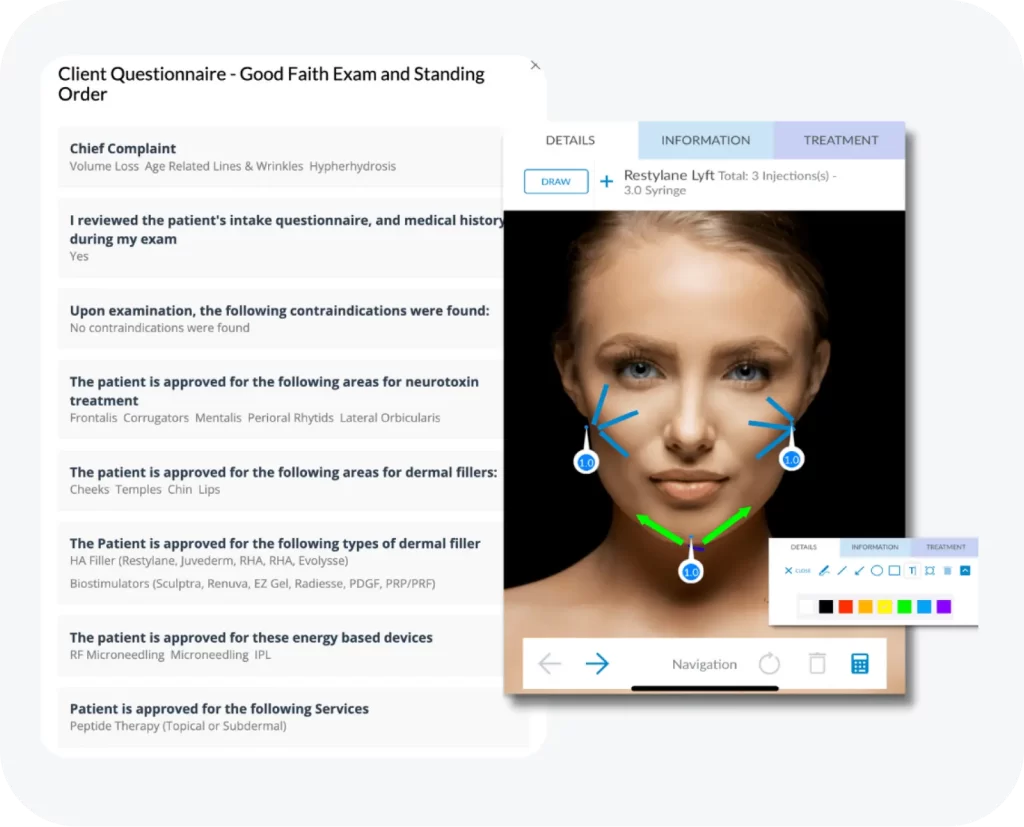
Pabau’s digital consent forms and treatment note capabilities are customisable across clinic types – from aesthetics to physiotherapy to GP practices. This flexibility means aesthetic clinics can configure forms and templates to match their specific treatment protocols, while multi-specialty or hybrid practices can use the same platform for all their documentation needs. Pabau also includes before and after photo management integrated directly within the patient record.
Injection plotting is another differentiator worth noting. Pabau’s injection plotting tool allows practitioners to annotate anatomical diagrams with treatment details, creating a structured visual record that supports both clinical accuracy and medico-legal documentation. This capability is particularly valued by aesthetic nurses and cosmetic doctors managing high treatment volumes.
AI-assisted documentation is an emerging differentiator in aesthetic practice software. Pabau’s Echo AI feature supports clinical note generation, helping practitioners reduce the time spent on documentation after each treatment. For clinics running back-to-back appointments, the reduction in administrative load translates directly into more consultation time per client. Aesthetic Record also offers AI-powered charting through its ChartSmart feature, which converts dictated or recorded encounters into structured clinical notes within the EMR. While both platforms are investing in AI-supported documentation, their implementations and workflows differ as each platform continues to expand its AI capabilities.
Aesthetic Record has earned strong adoption among US-based injectors and small aesthetic practices. Its focused feature set means practitioners can get up and running quickly, with minimal configuration required for standard aesthetic workflows.
Consent form management is one of Aesthetic Record’s most widely praised capabilities. The platform provides pre-built consent form templates for many common aesthetic procedures and the client-facing consent experience is consistently described as smooth and professional. Before/after photo management is similarly strong – photos are captured, stored, and linked to the client record without requiring additional configuration.
Point-of-sale integration is another area where Aesthetic Record performs well for its target market. Medspas and aesthetic clinics can process payments, manage retail product sales, and track transactions within the same platform used for clinical documentation. The platform’s pricing structure includes entry-level tiers aimed at smaller practices, which lowers the barrier to digital adoption for new or growing practices.
According to Capterra reviewers, Aesthetic Record holds a rating of 3.5 out of 5, with users frequently highlighting the platform’s purpose-built aesthetic focus and intuitive photo management as standout strengths.
Customer support response times are occasionally cited as a concern in some Aesthetic Record reviews. Practices that encounter technical issues or need onboarding guidance may experience delays depending on support volume and time zones, which can disrupt clinical workflows. For busy clinics where the software is central to daily operations, support responsiveness is not a minor concern.
Geographic limitations may affect practices operating outside the United States. Aesthetic Record’s pricing, compliance messaging, and many integration partners are primarily oriented toward the US medspa market. Clinics operating under UK GDPR or CQC requirements may find fewer native compliance workflows aligned with their regulatory environment. The integration ecosystem is also more focused on US-based tools, which can create gaps for practices needing connections to UK accounting software, local payment processors, or healthcare data systems outside the US.
Reporting and analytics are sometimes described by users as relatively straightforward rather than deeply analytical. Practices that rely on detailed business intelligence – revenue per practitioner, treatment trend analysis, retention cohorts – may require additional reporting tools or integrations as operational complexity grows.
Pabau is designed for aesthetic, wellness, and medical clinics that need more than a documentation tool. Its platform spans clinical records, scheduling, marketing automation, and multi-location management – making it a strong fit for practices with growth ambitions or complex operational structures.

Marketing automation is where Pabau pulls clearly ahead for clinics focused on client retention. The built-in marketing tools include automated SMS and email campaigns, loyalty programmes, recall workflows, and lead management – all operating from the same client database used for clinical records. A practice running Botox recall campaigns, post-treatment follow-up sequences, and seasonal promotional offers can manage all of these from a single system without third-party integrations.
Multi-location management is a genuine strength. Pabau’s multi-location features allow clinic groups to manage appointments, staff, inventory, and reporting across sites from a centralised platform. For aesthetic groups operating two or more locations, this removes the operational fragmentation that comes with running separate systems per site.
GDPR compliance is built in, not bolted on. For UK and EU aesthetic clinics, this is a fundamental operational requirement – particularly given the sensitive nature of patient data in aesthetic medicine. Pabau’s infrastructure supports CQC-ready documentation workflows and UK GDPR data handling, providing a solid compliance foundation for regulated practices.
According to Capterra reviewers, Pabau holds a rating of 4.6 out of 5 based on over 600 verified reviews. Positive themes include comprehensive feature coverage, strong automation tools, and good multi-location support. On G2, Pabau holds a 4.7 rating.
New users frequently note a learning curve during onboarding. Pabau’s breadth of features – which is a strength for established practices – can feel overwhelming for practitioners setting up the platform for the first time. Pabau offers onboarding support and training resources, but some smaller clinics report that initial configuration takes longer than expected.
Pricing is a consideration for very small or solo practices. Some users note that Pabau’s subscription structure is better suited to growing or multi-practitioner clinics, and sole practitioners with limited feature requirements may find the entry cost higher relative to more narrowly focused tools.
Pricing structures differ meaningfully between the two platforms, and the right choice depends heavily on practice size and growth trajectory. Aesthetic Record offers tiered subscription plans, including a starting option designed for solo injectors and small practices. This entry-level plan provides a starting point for practitioners who are just launching or operating independently, though exact current pricing should be confirmed directly on Aesthetic Record’s website.
Pabau uses a subscription-based model with tiered plans based on team size and feature requirements, with no per-transaction fees. Current pricing details are available at Pabau’s pricing page. The platform is designed to scale with growing practices – solo clinics can start with an appropriate tier and expand as headcount or locations increase, without migrating to a different system.
When evaluating cost, consider the total operational picture. A platform that requires third-party tools for marketing automation, loyalty programmes, or multi-location reporting adds subscription costs and integration overhead that a unified platform absorbs. For practices that need only EMR and consent form functionality, a lower-priced specialist tool may represent better value. For clinics with retention, growth, or multi-site ambitions, the economics shift in favour of a broader platform.
Before committing to either platform, map out every third-party tool your clinic currently pays for – marketing email tool, loyalty app, separate reporting dashboard, booking widget. Add those costs to the base subscription price. For many aesthetic practices, a platform that consolidates these functions works out cheaper than the sum of its parts, even at a higher headline price.

From consent forms and injection plotting to automated recall campaigns and multi-location reporting – explore how Pabau supports aesthetic practices across every operational touchpoint.

Integration capability matters most when a clinic’s operational stack extends beyond the core practice management platform. Pabau integrates with payment processors, accounting tools including Xero, The Doctor’s Lab, Cloud Rx, SignatureRx, Pharmacierge, Clynxx and DoseSpot, and BNF drugs database, – with API access available for enterprise clients. For UK and EU practices, this integration set covers the tools most commonly used in private clinical practice: Xero for accountancy, local payment processors, and NHS-adjacent data flows where relevant.
Aesthetic Record’s integration partners are more US-centric, with connections to US payment systems and an aesthetic-specific add-on marketplace. The platform also integrates with Nextech for practices that use that system. For clinics operating entirely within the US ecosystem, this integration set is generally sufficient. However, practices that require connectivity with UK or European business tools will find fewer native options.
Klarna financing is available through Pabau’s Klarna integration, which allows aesthetic clinics to offer patient financing at the point of booking. This is particularly relevant for higher-value treatments where payment flexibility influences conversion rates. Offering finance options within the booking flow – rather than redirecting clients to a separate application – reduces friction and supports revenue growth for clinics running treatment packages.
According to Capterra reviewers, Pabau holds a 4.6 out of 5 rating based on over 600 verified reviews. Users consistently highlight the platform’s comprehensive feature set, with particular praise for automation and marketing tools, multi-location support, and regular product updates. Responsive customer support is a recurring positive theme across reviews.
The most commonly noted challenges relate to the learning curve for new users. Practitioners setting up the platform independently sometimes report that the breadth of configuration options extends the onboarding timeline. Some smaller clinics also raise pricing as a consideration, noting that the full feature set represents more capability than a solo practitioner needs.
On G2, Pabau holds a 4.7 rating, with users reinforcing the automation and clinical documentation strengths observed on Capterra.
According to Capterra reviewers, Aesthetic Record holds a 3.5 out of 5 rating. Users frequently highlight before/after photo management and consent form workflows as the platform’s strongest features. The purpose-built aesthetic focus means practitioners can begin using core documentation features quickly, with minimal setup time required for standard treatment types.
Customer support response times are the most frequently cited negative theme. Some reviewers report that resolving technical issues requires more time than expected, which can affect clinical operations when the platform is central to daily workflows. Reporting features are also noted as more basic compared to broader practice management platforms. On G2, Aesthetic Record holds a 5 rating.
Choose Pabau if your practice is based in the UK, EU, UAE, or US, needs built-in GDPR or HIPAA compliance, or operates across multiple locations. Pabau is also the stronger choice for practices that want marketing automation, loyalty programmes, and advanced reporting integrated with clinical records—rather than managed through separate tools. Growing aesthetic groups, medical spas, and multi-specialty clinics with complex workflows will find Pabau’s breadth of features matches their operational reality.
Choose Aesthetic Record if you are a solo injector or small medspa operating in the US, your primary need is streamlined consent form management and before/after photo capture, and you prefer a platform purpose-built for aesthetic medicine with a lower entry price point. HIPAA compliance is built in, making it a practical choice for US practices that don’t need the wider operational capabilities of a multi-industry platform.
The right platform often comes down to where a clinic sits in its growth cycle and what its operational model looks like day-to-day. A solo aesthetic nurse running 15-20 clients per week from a single location has very different software requirements than a clinic director managing three sites, ten practitioners, and a marketing calendar.
For solo injectors and new aesthetic practices in the US, Aesthetic Record’s focused feature set and accessible pricing represent a practical starting point. The platform covers the documentation essentials without requiring extensive configuration or a large subscription investment.
For established UK or EU aesthetic clinics, Pabau’s GDPR compliance and CQC-ready documentation workflows are not optional extras – they are regulatory requirements. The built-in compliance management tools support the documentation standards that CQC inspection processes require. For US-based medspas and aesthetic clinics, Pabau also provides HIPAA-compliant workflows, ensuring clinical records, consent forms, and patient data meet US regulatory requirements.
For growing medspas and aesthetic groups at any location – whether running two sites or planning expansion – Pabau’s multi-location management capabilities and centralised reporting provide the operational infrastructure needed to scale without fragmenting into disconnected systems. The marketing automation and client retention tools also become increasingly valuable as the client base grows and repeat treatment revenue becomes a larger share of overall income.
For dermatology and skin clinics with a mixed treatment portfolio – combining aesthetic procedures with clinical dermatology services – Pabau’s flexibility across clinic types means both the aesthetic and clinical sides of the practice can operate from the same skin clinic software platform.

Want a deeper look at Pabau’s aesthetic clinic capabilities? Aesthetic Record vs Pabau covers the full feature comparison on Pabau’s dedicated compare page.
Looking for best-in-class medical spa software options? Best Medical Spa Software reviews the leading platforms for medspas in 2026, with criteria ranked by operational impact.
Need to understand aesthetic EMR options before deciding? Aesthetic EMR Software explains what to look for in an EMR built for aesthetic practice workflows.
Exploring compliance requirements for UK aesthetic clinics? Medspa Compliance outlines the regulatory obligations affecting aesthetic practices operating in regulated markets.
The Pabau vs Aesthetic Record decision ultimately comes down to geography, scale, and operational requirements. Aesthetic Record is a purpose-built tool for US aesthetic practices that prioritises streamlined clinical documentation, consent forms, before/after photo management, and accessible entry-level pricing. Pabau is a comprehensive practice management platform serving aesthetic, wellness, and medical clinics across the UK, EU, UAE, and US – with built-in GDPR and HIPAA compliance, marketing automation, multi-location scheduling, and operational workflows that growing clinic groups require.
Neither platform is universally superior. For a solo injector or small medspa in the US focused on clinical documentation and patient consent, Aesthetic Record delivers the core capabilities needed. For UK, EU, or US clinic groups managing multiple sites, complex workflows, and client retention programmes, Pabau provides the operational depth and compliance infrastructure to support that model. Assess your regulatory environment, growth trajectory, and workflow needs to guide your choice.
Reviewed against current product documentation from Pabau and Aesthetic Record, and verified review data from Capterra and G2.
Aesthetic Record is an EMR and practice management platform designed for aesthetic medicine practices, primarily in the US. It is used for digital consent form management, before/after photo capture, appointment scheduling, clinical charting, and point-of-sale transactions at medspas and cosmetic clinics.
Yes. Pabau is used by aesthetic clinics across the UK, US, EU, and UAE for appointment scheduling, digital consent forms, injection plotting, before/after photo management, automated marketing, and multi-location management. It supports aesthetic-specific workflows alongside broader clinic management capabilities.
Both platforms offer digital consent form workflows. Aesthetic Record’s consent forms are purpose-built for US aesthetic treatments and are frequently praised for their intuitive client-facing experience. Pabau’s digital forms are highly customisable across clinic types and support GDPR-compliant data handling for UK and EU practices, as well as HIPAA-compliant workflows for US-based clinics. The better option depends on your regulatory environment and the flexibility you need.
Aesthetic Record is primarily designed for the US market. Its compliance infrastructure is built around HIPAA, and its pricing, integrations, and support resources are US-centric. UK and EU aesthetic clinics requiring GDPR compliance and CQC-ready documentation, and US clinics needing HIPAA compliance will generally find Pabau a more appropriate fit for their regulatory environment.
The main differences are geographic focus, compliance coverage, and operational breadth. Aesthetic Record is purpose-built for US aesthetic practices with HIPAA compliance at its core. Pabau serves UK, US, EU, and UAE clinics with GDPR and HIPAA compliance built in, and offers a broader feature set including marketing automation, multi-location management, loyalty programmes, and advanced analytics alongside its clinical documentation tools.
For US-based medspas, Aesthetic Record’s focused EMR capabilities and aesthetic-specific consent and photo workflows make it a practical choice, particularly for smaller practices. Pabau, meanwhile, serves medspas and aesthetic clinics across the US, UK, EU, and beyond, providing HIPAA- and GDPR-compliant workflows, integrated marketing automation, multi-site management, and advanced reporting for practices that require broader operational support.