Anja Dodevska

OT SOAP note sample: Free template and worked examples
Download your free OT SOAP note sample A four-page form with an identifying head...

6
Last Updated: Nov 5, 2026
Free PDF 2 pages, print-ready Clinician-reviewed
A hand profile template is a patient-completed questionnaire that rates wrist and hand pain, daily function and, optionally, appearance on 0–10 scales. Its items mirror the Patient-Rated Wrist/Hand Evaluation (PRWHE). The patient rates pain at rest and during activity, then the difficulty of ten everyday tasks, all over the past week. Hand therapists, occupational therapists and hand surgeons use the scores as a baseline before treatment. Repeating the same form at later visits shows whether pain and function are improving. The form holds no measurements or exam findings, so pair it with your own clinical assessment.
A two-page, patient-completed questionnaire with four 0–10 pain ratings and a box for how often pain occurs. It adds ten 0–10 difficulty ratings for specific and usual activities, plus an optional appearance section.
Start from scratch, or upload this PDF or any form you already use, and Pabau's AI Form rebuilds it with tick boxes, text fields and a signature. Attach it to the treatment once, and every patient gets it on time.
AI Form rebuilds the consent, history and aftercare forms you already use. You review each one, then publish.
Patients complete forms on their phone before they arrive, so the front desk stops retyping paper.
Every signed form is versioned and attached to the treatment record, ready when you need it.
Set how long a consent stays valid. Returning patients skip forms they have already signed.
Supports HIPAA and GDPR compliance AES-256 encryption 4.8 on G2 4.7 on Capterra Trusted by 4,000+ practices worldwide

The hand profile is a patient-rated questionnaire covering wrist and hand pain, daily function and, optionally, appearance.
Every scored item uses a 0–10 scale for the past week, where 0 means no pain or no difficulty.
Its items mirror the PRWHE, whose published scoring gives pain and function subscales of 0–50 and a 0–100 total.
The form records no range of motion, strength or exam findings, so pair it with your own clinical assessment.
With Pabau’s practice management software, patients complete the questionnaire online before each visit, and the answers go into their record.
A hand profile template is a questionnaire the patient fills in to rate how their wrist or hand affects daily life. Every scored item uses a 0–10 scale and asks about the past week. The patient answers on their own, before the clinician examines the hand.
Its items mirror the Patient-Rated Wrist/Hand Evaluation (PRWHE), an outcome measure for wrist and hand conditions. That makes the form a patient-reported outcome measure. The patient tells you what hurts and what they can no longer do. Movement, strength and sensation still come from your own examination.
The PDF runs to two pages and four sections. Three of them are scored, and the appearance section is optional.
The four pain ratings separate pain that is always there from pain that a movement or a load brings on. If rest pain falls but lifting pain stays high, the patient is telling you where the problem still sits. The form never asks where the pain is, so mark its location on a hand pain diagram.
The ten activity items move from precise tasks, such as fastening buttons, to whole roles, such as work and recreation. Most specific-activity items name the affected hand, so the patient rates that hand and not how they coped with the other one.
One wording quirk is worth knowing. The usual activities instructions repeat the pain wording, but the scale beneath them is labeled for difficulty. Ask the patient to rate difficulty there, as the scale shows.
The appearance questions matter most after an injury, surgery or condition that visibly changes the hand. The patient first says how important appearance is to them, then rates their dissatisfaction from 0 to 10.
Skip the section when appearance isn’t relevant to the treatment. The pain and function scores don’t depend on it.
The PDF prints the scales but carries no scoring box, so scoring follows the published PRWHE method. Each subscale runs from 0 to 50, and higher scores mean worse pain or worse function.
The diagram below traces each rating on the form to the subscale it feeds.
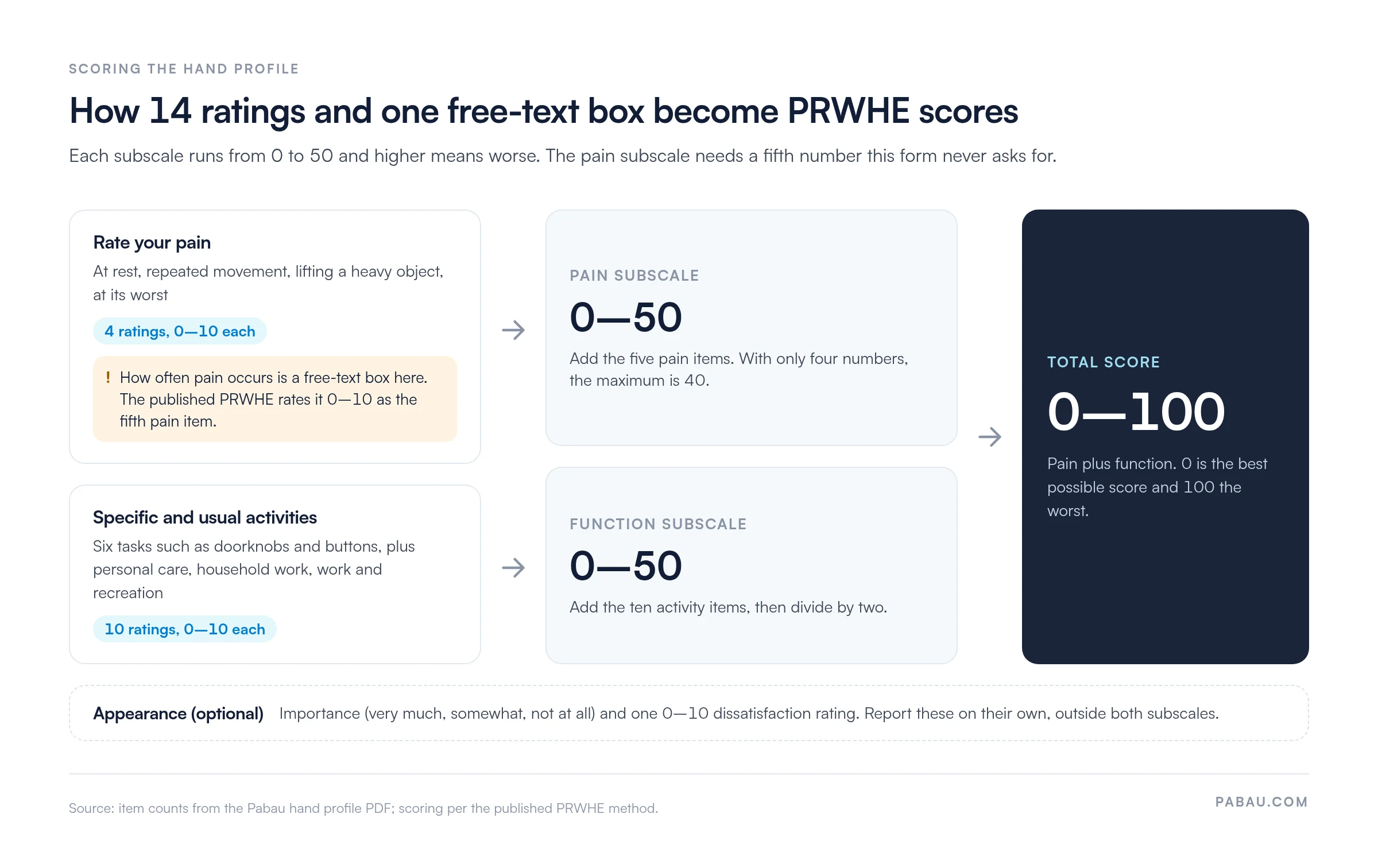
In the published PRWHE, how often pain occurs is the fifth pain item, rated 0 to 10. This form gives it a free-text box instead. Without a number there, only four pain items can be totaled. The pain subscale then tops out at 40 and the total at 90, so neither matches the published range.
Ask the patient to add a 0–10 frequency rating, or report the function subscale on its own. The appearance items sit outside both subscales, so report them separately.
Any team that treats the wrist or hand and needs the patient’s own view of progress can use the form.
A single score says little on its own. The value comes from comparing scores, so the routine matters more than any one result.
Pair the questionnaire with objective tests at the same visits, because the form contains no measurements. A range of motion assessment records joint movement, and the grip strength norms template gives you reference values to read grip results against.
On paper, the hand profile arrives at check-in, gets scored by hand and ends up in a folder. Comparing today’s visit with the baseline means finding both sheets and redoing the arithmetic.
In Pabau, you can rebuild the questionnaire as a digital intake form. Patients complete it through the patient portal before each appointment. Their answers land in their patient record, next to your treatment notes.
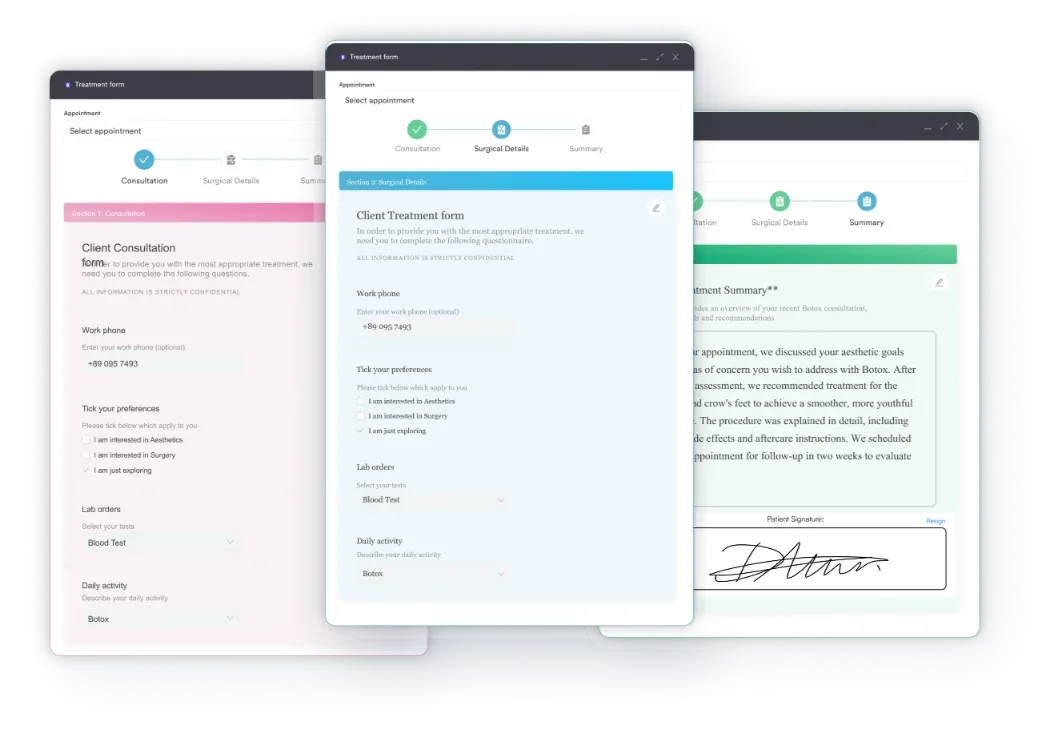
A digital form also keeps the wording and scales identical at every repeat, which is what makes one visit comparable with the next.
Hand therapy teams see those scores in an EMR that tracks progress, beside the treatment plan. For the notes around the scores, Pabau Scribe, our AI scribe, drafts them from the consultation for the clinician to review.

Pabau’s digital forms let patients complete the hand profile before each appointment, with every answer stored in their patient record. See how it fits your hand therapy workflow.

The hand profile earns its place when you use it for what it is: the patient’s own rating of pain and function. It won’t stand in for a goniometer or a dynamometer, and it isn’t meant to.
Give it at baseline, repeat it the same way at each review, and settle the frequency rating before you total the pain items. A falling score then becomes evidence you can show the patient and the referrer.
Book a demo to see how Pabau collects the questionnaire before each visit and keeps every score in the patient record.

Need a shorter outcome measure for the whole arm? QuickDASH outcome measure gives you a record sheet for filing each QuickDASH score alongside your notes.
Choosing which outcome measures to run? Outcome measures template shows how to choose, score and track progress from visit to visit.
Setting goals with an occupational therapy patient? Canadian Occupational Performance Measure gives you the COPM interview guide and rating fields for importance, performance and satisfaction.
A hand profile template is a patient-completed questionnaire that rates wrist and hand pain, daily function and, optionally, appearance. Each scored item uses a 0–10 scale covering the past week. Its items mirror the Patient-Rated Wrist/Hand Evaluation (PRWHE).
The patient does, ideally before the clinician examines the hand. Staff can explain how the scales work, but the ratings should be the patient’s own. The clinician then scores the form and files it with that visit.
Under the published PRWHE method, the five pain items add up to a pain subscale of 0–50. The ten activity items are added and halved for a function subscale of 0–50. Together they give a 0–100 total, where lower is better. This form records pain frequency as free text, so collect a 0–10 rating for it before you total the pain items.
No. The form holds only the patient’s ratings of pain, function and appearance. Record range of motion, grip and pinch strength, sensation and skin findings in your own clinical assessment.
Yes, the hand profile PDF is free to download and print from this page. Review it against your local documentation standards before you use it with patients.