Tanja Lepcheska

Pain medication chart: Strength tiers, DEA schedules and free PDF
What is a pain medication chart and how do clinicians use it? A pain medication ...

1
Last Updated: Nov 4, 2026
Free PDF 7 pages, print-ready Clinician-reviewed
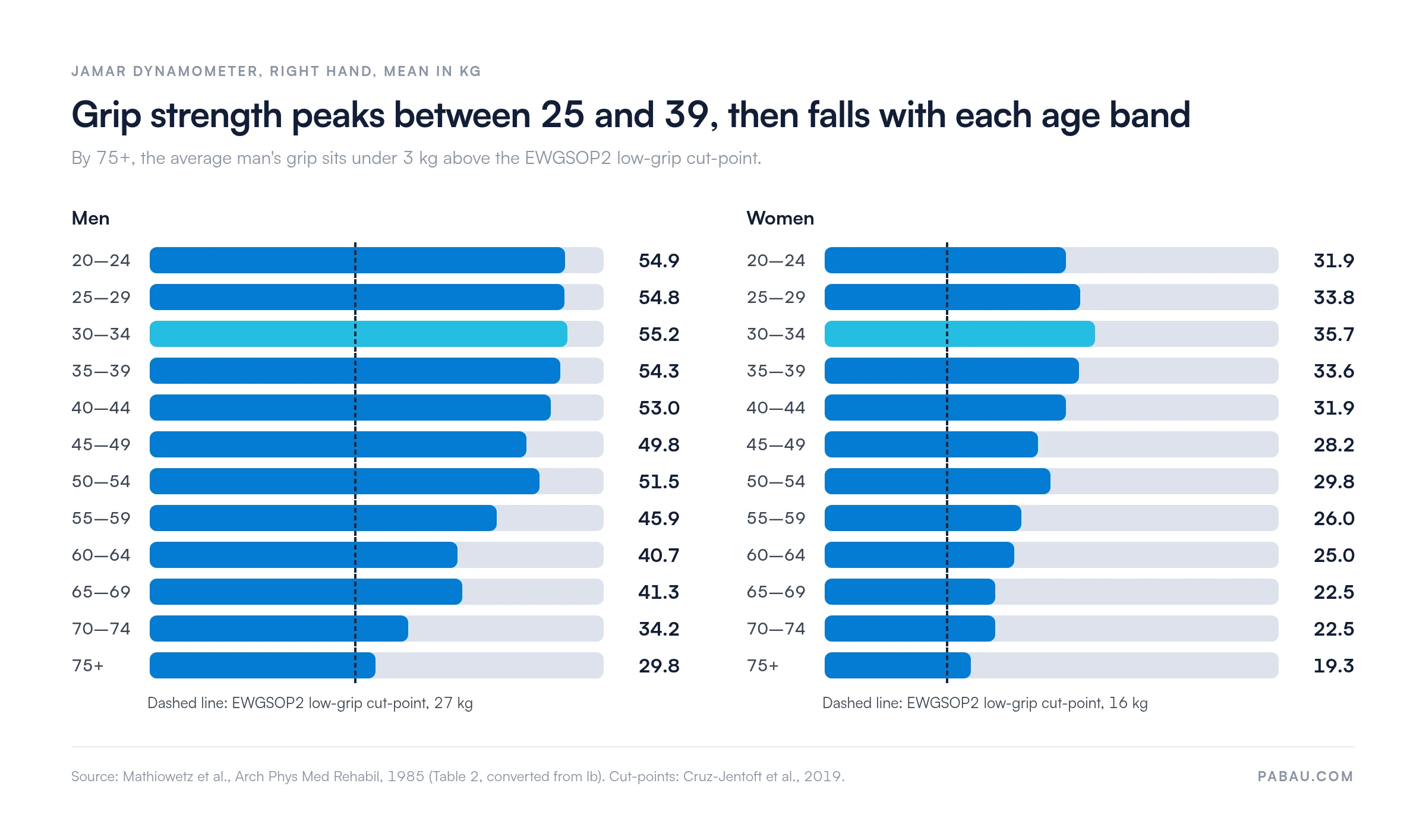
Grip strength norms are population reference values, split by age and sex, that show where a patient's hand grip force sits against healthy peers. The most cited Jamar dataset comes from Mathiowetz and colleagues in 1985. Between 20 and 39, right-hand grip averages about 54 to 55 kg for men and 32 to 36 kg for women. Values then fall with each age band, to about 30 kg and 19 kg at 75 and over. A score only compares fairly with a norm when it is measured the same way. This guide covers the reference values, the test protocol and how to read a result.
A pinch strength form with patient details and setup instructions for lateral, three-point and tip-to-tip pinch. Each pinch type has three trials and an average for each hand, plus a notes field.
Start from scratch, or upload this PDF or any form you already use, and Pabau's AI Form rebuilds it with tick boxes, text fields and a signature. Attach it to the treatment once, and every patient gets it on time.
AI Form rebuilds the consent, history and aftercare forms you already use. You review each one, then publish.
Patients complete forms on their phone before they arrive, so the front desk stops retyping paper.
Every signed form is versioned and attached to the treatment record, ready when you need it.
Set how long a consent stays valid. Returning patients skip forms they have already signed.
Supports HIPAA and GDPR compliance AES-256 encryption 4.8 on G2 4.7 on Capterra Trusted by 4,000+ practices worldwide

Grip strength norms are age- and sex-specific, so always compare a score against the matching band.
In the Mathiowetz Jamar data, right-hand grip peaks at 30 to 34, at about 55 kg for men and 36 kg for women.
Jamar values are the most cited clinical reference, and readings from other dynamometers are not interchangeable.
Under EWGSOP2, grip strength below 27 kg for men or 16 kg for women counts as low.
Pabau’s digital forms store each score with its device and hand, so progress stays comparable over time.
Grip strength norms give a fixed point of comparison, so a single measurement becomes a clinical finding rather than an isolated number. Hand therapists, physical therapists, occupational therapists, geriatricians and hand surgeons all use them for baseline assessment and tracking change.
A norm is only as reliable as the measurement behind it. Standard protocols from the American Society of Hand Therapists (ASHT) set the seated position, elbow angle and handle setting used for testing. The Jamar norms in this guide were collected in that standard position.
Dynamometry gives a continuous score in kilograms, where manual muscle testing grades strength on a 0 to 5 scale. That makes small gains during rehabilitation visible between visits.
Jamar dynamometer values are the reference most clinicians recognize, and the device is widely treated as the clinical standard. Readings from other dynamometers can differ, so compare like with like. The table gives mean grip strength for each hand, in kilograms and pounds, from a study of 638 adults (Mathiowetz et al., 1985).
Each value is a group mean, and the spread around it is wide. Men aged 20 to 24 averaged 54.9 kg with the right hand, but individual scores ran from about 41 to 76 kg. The study reports right and left hands rather than dominant and non-dominant, because only 7% of its subjects were left-handed.
Means stay close to their peak until the mid-40s, then fall with each age band. The chart sets that decline for the right hand against the low-grip cut-points covered further down.
Percentile rankings place a score within the population. A patient at the 25th percentile is stronger than about a quarter of the reference population and weaker than about three quarters. A single percentile does not diagnose a condition.
Pediatric grip strength changes quickly through childhood and differs by sex from adolescence onward. The adult table above starts at age 20, so it does not apply to younger patients. Pediatric norms come from smaller, older studies, so note the sample size and population before applying them to a patient.
Clinical cut-points for low grip strength come from named consensus groups, not from a single universal number. The EWGSOP2 consensus (Cruz-Jentoft et al., 2019) uses sex-specific thresholds as one part of a sarcopenia assessment.
Set those thresholds against the table and the margin in older patients is narrow. A man in his 70s who scores well below his age-band mean may already sit under 27 kg. When that happens, a structured plan of resistance training for seniors is a common next step after the clinical review.
Pinch strength is measured separately from grip, and lateral, three-point (palmar/three-jaw chuck) and tip-to-tip pinch each have their own reference values. The same 1985 study reports adult means for all three pinch types alongside grip.
Hand therapists often record both, using the free Pinch Grip Test form on this page, so grip and pinch results sit in the same record. Our pinch grip test guide covers positioning, scoring and interpretation for each pinch type.
Interpretation starts by matching the patient to the right age and sex band. Compare the score with the mean for that band, then decide whether follow-up is needed.
Grip strength tells you how hard the hand can squeeze, not how well the patient manages daily tasks. Pair it with a patient-reported measure such as the QuickDASH outcome measure, so strength and function are tracked together.
Record the dynamometer model, handle position and dominant hand on every test. Without these details, a score cannot be fairly compared to a norm months later.
Several factors shift a result away from the norm even when the patient is well. Note them in the record so outliers are read in context.
Paper assessment sheets make results hard to compare across visits, because the device, handle setting and hand tested often go unrecorded. Digital forms keep every assessment in the same structure, so the protocol details are captured with each score.
Pabau, the practice software we build, turns a grip and pinch form into a template your team completes on a tablet. As a physical therapy EMR, it saves each result to the patient record next to the treatment notes.

At the next session, the clinician opens the previous score in the same record and compares like with like. Change over months then shows up as a series of dated results instead of loose sheets.

Pabau’s clinical documentation and digital forms let your team store measured scores, track change over time and reference them at the next session.

Treat a grip score as meaningful only when the device, handle setting and hand match the source table. A Jamar reading set against the Mathiowetz means is comparable. A reading from another dynamometer is not, however close the numbers look.
The trade-off is reach. The 1985 sample is modest and came from one US metro area, so newer or local norms may fit some patients better. Pick one source, name it in the record and keep it for every follow-up. The norms then support clinical judgment instead of replacing it.
Book a demo to see how Pabau keeps each grip and pinch result in one record, ready for the next comparison.

Want the full pinch protocol? Pinch grip test explains positioning, scoring and interpretation for each pinch type.
Mapping where the hand hurts? Hand pain diagrams let patients mark pain locations before you test grip.
Grading strength without a dynamometer? MRC scale for muscle strength records 0 to 5 grades for each muscle group.
Is weak grip a nerve problem? Hand nerve tests cover median, ulnar and radial nerve exams.
Testing strength beyond the hand? Muscular strength test gives a structured form for whole-body strength checks.
Grip strength norms are reference values for hand grip force, usually split by age and sex. They show how a patient’s score compares with a healthy population.
The strength is the same, but the unit changes the figure. Always use a table published in the same unit as your device output to avoid rounding errors.
Jamar dynamometer norms are the most cited in clinical literature. Readings from other devices can differ, so note the device used.