Who can prescribe peptides: The 2026 rules for practice owners
Who can prescribe peptides depends on license and state: physicians (MD or DO) c...

Last Updated: Nov 19, 2026
How to open a peptide clinic: run peptide therapy as a prescribed service inside a licensed practice, led by a licensed prescriber. You also need a licensed 503A or 503B compounding route, a federal status check on each peptide, peptide-specific consent, program pricing and linked records.
Under HHS’s interim enforcement policy of October 28, 2026, HHS won’t act against 503A compounding of six named peptides when strict conditions hold. Those compounded products are still not FDA-approved, and each one still needs a valid patient-specific prescription.
The seven steps below each leave a record that answers a specific rule. We call that chain the peptide service record trail. It’s what you show a board, a pharmacy or a patient who asks why a peptide was given.

A peptide clinic is a prescribed service inside a licensed practice, so a licensed prescriber and a patient-specific prescription come first.
Since October 28, 2026, HHS won’t act against 503A compounding of BPC-157, Epitalon, KPV, MOTS-c, Semax and TB-500 when 10 conditions are met.
FDA’s safety-risk list for compounding, current as of April 22, 2026, still names GHRP-2, GHRP-6, ibutamoren mesylate, ipamorelin acetate and kisspeptin-10.
Practices package peptide programs as a flat monthly fee, a prepaid multi-month program or a membership, and labs are priced inconsistently.
The peptide service record trail ties each launch step to a named record, from the approved prescription to the lot logged against the patient.
A peptide clinic is a licensed medical practice offering a prescribed service. Searches for a “peptide company” usually mean selling research-use-only products, which are not for patient use.
HHS spells out the risk in its own policy. HHS says the interim policy is meant to discourage widespread use of research-use-only peptides from foreign manufacturers. HHS describes those products as a safety risk to US patients.
This guide covers one model only: a licensed prescriber, a licensed pharmacy and a patient record. Sourcing, suppliers and resale are outside its scope.
To start a peptide clinic, set up seven things in order: prescribing, status checks, a compounding route, consent, pricing, records and recalls.
The list below is how to start a peptide clinic inside a practice you already run. Each step depends on the one before it.
A licensed prescriber writes every patient-specific prescription in a peptide clinic. Your state decides who that can be and whether a medical director is required.
Under section 503A, FDA says a drug must be compounded based on a valid patient-specific prescription. That rule is set out in FDA’s compounding law summary, checked November 19, 2026. So the prescriber is the starting point for every order.
Physician, nurse practitioner and physician assistant authority all vary by state, and so do supervision rules. Our guide on who can prescribe peptides covers each role in depth. Where your state requires a medical director, name one before launch.
In Pabau, an all-in-one practice management system, non-prescribers can draft a prescription, but only a prescriber can approve and send it. US e-prescribing runs through DoseSpot, so the approved prescription sits on the patient record from day one.
Before you offer any peptide, check its current federal status. Most peptides marketed to practices are not FDA-approved for the uses promoted.
Two federal documents set the picture on November 19, 2026. The first is the HHS interim policy of October 28, 2026, whose Appendix A names six peptides. HHS won’t take enforcement action against a state-licensed pharmacy, federal facility or licensed physician compounding them, but only when all 10 conditions hold.
The second is FDA’s safety-risk list of bulk drug substances for compounding, current as of April 22, 2026. That list names five substances practices see marketed as peptides. Ibutamoren mesylate is flagged under both 503A and 503B, for congestive heart failure risk. BPC-157 no longer appears on it.
GLP-1 drugs are FDA-approved prescription drugs for their labeled indications. Treat them as a separate decision, never as interchangeable with a compounded peptide.
HHS says it may revisit the policy if a safety signal or product quality issue arises. Re-check both documents before each launch, then confirm your state’s rules with the state board and counsel, because they differ by state. This guide is not legal advice.
Order compounded peptides only through a state-licensed 503A pharmacy filling a patient-specific prescription, or through an FDA-registered 503B outsourcing facility.
FDA says an outsourcing facility must comply with CGMP requirements and is inspected on a risk-based schedule (FDA on outsourcing facilities, checked November 19, 2026). FDA also says a 503B facility may distribute against a patient-specific prescription or a provider’s order, such as office stock. The HHS interim policy addresses 503A compounding only.
Before the first order, the practice confirms these points with the pharmacy:
Keep the COA, lot and expiry with the patient record when the product arrives. That pairing is what lets you trace a recall back to the patients who received the lot.
Peptide consent should state that the product is compounded and not FDA-approved. It should also cover off-label use, monitoring and how to report a reaction.
Protocols are your prescriber’s own work. Write down who may prescribe, the review schedule and what pauses a program. This guide gives no dosing.
In Pabau, consent and intake forms go out before the visit. The completed form lands in the patient record rather than sitting as a PDF. Pabau GO, our iOS app for practitioners, supports care-pathway forms and consents, so a patient can sign before arriving.
Practices price peptide programs in three ways: a flat monthly fee, a prepaid multi-month program, or a membership that buys clinician access.
Four US practices publish peptide program prices on their own websites. The table shows each one as listed on November 19, 2026, at package level only.
Two patterns stand out on these pages. Commitment is rewarded, through a prepaid cycle or a minimum term. Labs are the least consistent line item: included, optional, or billed by the lab.
For tier design, our guide to longevity membership pricing shows how practices structure membership levels.
Pabau handles recurring memberships and treatment packages for hormone, GLP-1 and longevity programs. Pabau’s membership tools bill weekly, monthly or yearly, and a perk can cover a service, a category or wallet credit with rollover. The till also sells 2–12 month installment plans through Stripe, so a prepaid program doesn’t need one lump payment.
The peptide service record trail is seven records, from the approved prescription to the lot number logged against the patient, each answering a named rule.
Keep all seven on one patient record, so an inspector, a pharmacy or a covering clinician sees the whole chain. Each item below names the rule it satisfies.
The chart below lines up each launch step with the record it leaves and the rule behind it.
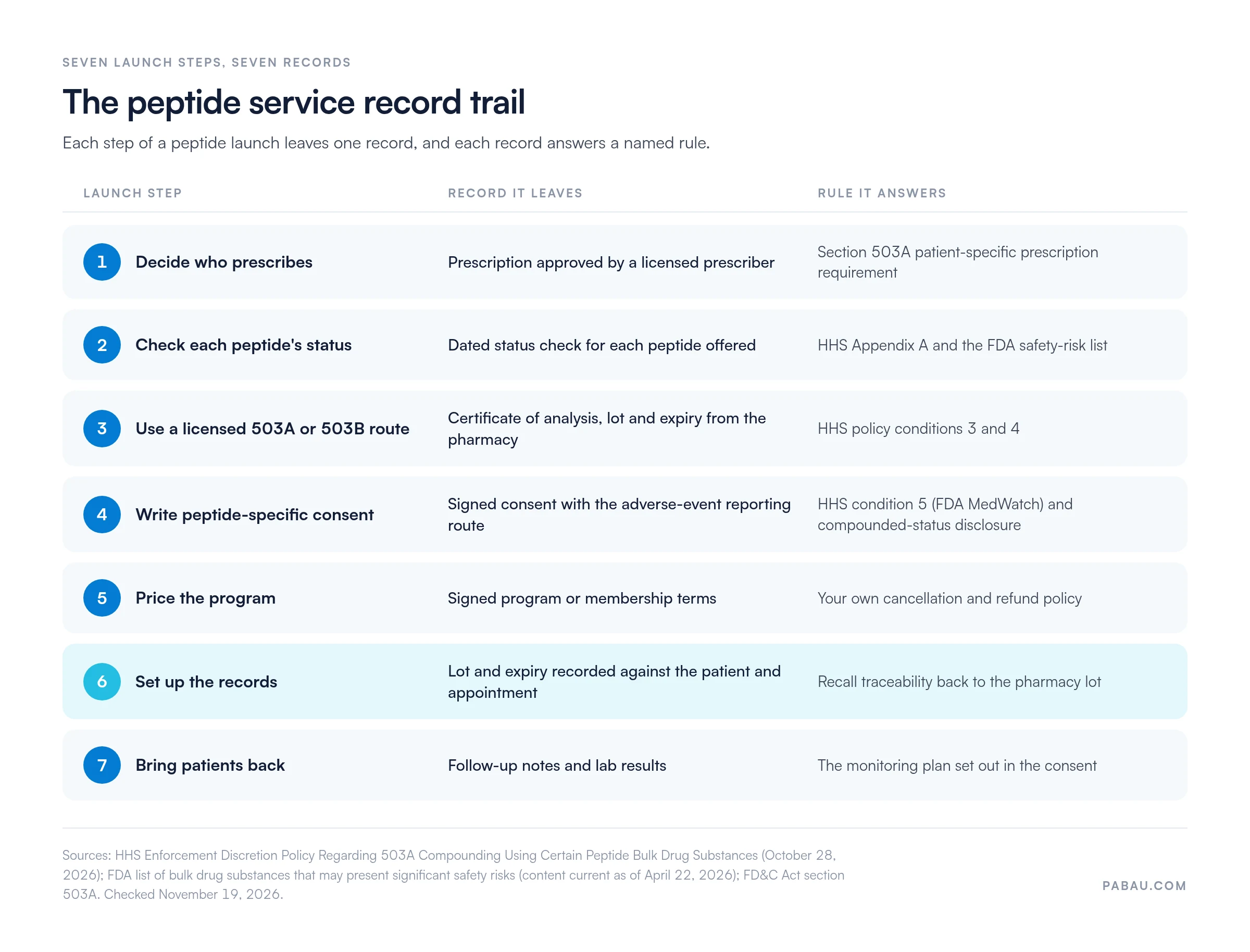
A batch number kept on a paper log, away from the patient record, is the weakest link in the trail.
In Pabau, stock carries a batch number and an expiry date, and the lot is recorded against the patient and the appointment. Practices can switch on Labs, which lets them order Quest tests from the patient record with their own Quest login. Quest results import automatically.
Labcorp orders are placed in Labcorp Link, and results sync back automatically. A biomarker-over-time chart then sits on the patient record, next to the consent and prescription.
Book each peptide patient’s review before the current cycle ends, so monitoring happens before any reorder.
In Pabau, recall Workflows use 90-day and 6-month templates to send SMS, email or WhatsApp. Pabau’s recall Workflows skip patients who already have a booking, so nobody gets chased twice. SMS uses usage-based credits, so a text-heavy recall plan adds to the monthly bill.
Track three numbers from launch: follow-up visits completed, reorders that had a review first, and adverse-event reports logged. If reorders outrun reviews, pause new starts until the reviews catch up.
If you already run a licensed practice, add peptide therapy to your practice as a new service line. The license, prescriber, records and patients already exist.
Four delivery models show up across practices offering peptides:
Whichever model you pick, run it on one system rather than a second stack. Pabau’s longevity clinic software keeps peptide, hormone and longevity programs on the same patient record. Pabau bills insurance too, with electronic claims in the US, UK and Australia, and policies, authorizations and superbills in Canada.
Practices adding peptides often run IV therapy as well. Our guide on opening an IV therapy clinic covers that launch. Where peptides sit inside a wider longevity program, our guide on how to build a longevity clinic walks through oversight, lab partners and membership design.
A peptide clinic should make no healing, anti-aging, performance or outcome claims, and should never supply research-use-only products to patients.
The FTC’s Health Products Compliance Guidance (December 2022, checked November 19, 2026) says health benefit claims for drugs need competent and reliable scientific evidence. The FTC also says an honest testimonial does not replace that evidence.
Give the front desk approved wording, and a rule to pass every clinical question to the prescriber.
Pabau runs booking, charting, consent forms, payments and memberships for practices that offer aesthetics, hormone therapy, weight loss and longevity care in one system. For a peptide service, the prescription, consent, lot number and recall reminder all sit on the same patient record.
Pabau handles self-pay, memberships and insurance billing in one system, in the US, UK and Australia. Every Pabau plan includes the core features, and add-ons enhance the experience. Credits for SMS, 2FA, telehealth and Pabau Scribe, our AI scribe, are usage-based, so check Pabau’s pricing page for current rates.
Each new practice starts with structured onboarding before it goes live. Pabau is rated 4.8 on G2 and 4.7 on Capterra.
Comparing systems first? Our roundup of software for peptide clinics sets the main options side by side. If peptides sit inside a wider longevity program, see our pick of the best longevity clinic software.

Pabau keeps the approved prescription, signed consent, lot and expiry, and recall Workflows on one patient record. Each peptide decision leaves a record your team can find in seconds.

The peptide service record trail is what makes a peptide service defensible. When a board, a pharmacy or a patient asks why a peptide was given, the answer should already be on the record.
Federal status will keep moving. The HHS policy is interim and FDA’s list changes, so re-check both before each new peptide goes live.
The trade-off is a slower start. A practice that builds the records first may launch with fewer peptides, but it can show its work on every one.
Book a demo to see how Pabau keeps prescriptions, consent, lot numbers and recalls for your peptide service on one patient record.

Choosing a system for peptide therapy? Best peptide therapy clinic software compares the platforms practices use to run peptide programs.
Designing membership tiers? Longevity clinic membership pricing shows how practices structure and price membership levels.
Building a functional medicine service line? How to start a functional medicine practice walks through the launch steps for that model.
Yes, in practice. Anyone working out how to start a peptide clinic needs a licensed prescriber and a valid patient-specific prescription for each patient. Ownership and supervision rules vary, so check with your state medical board and counsel.
Yes. A med spa can add peptide therapy to its practice as a prescribed service when a licensed prescriber orders each product. Medical director rules for med spas differ by state, so check your state board first.
Since October 28, 2026, HHS has said it won’t take enforcement action against 503A compounding of BPC-157 when all 10 interim-policy conditions are met. BPC-157 is still not FDA-approved, and state boards may set their own limits.
A peptide clinic needs a medical director where its state requires one. Requirements differ on physical presence, supervision and delegation, and every prescription still needs a licensed prescriber.