Anja Dodevska

OT SOAP note sample: Free template and worked examples
Download your free OT SOAP note sample A four-page form with an identifying head...

1
Last Updated: Nov 5, 2026
Free PDF 2 pages, print-ready Clinician-reviewed
A PTA SOAP note example shows how a physical therapist assistant records one treatment session in the Subjective, Objective, Assessment and Plan format. The subjective captures what the patient reports, and the objective captures measured findings. The assessment tracks progress toward goals the supervising PT set, and the plan states what happens next. Copying a colleague's notes tends to pass on their scope errors, so a structured example gives each note a fixed standard to check against. This guide covers the four sections, worked examples for three common caseloads and a free PTA SOAP note template for your practice.
A ready-to-use documentation template covering patient details, subjective and objective fields, assessment prompts, plan and frequency, and a worked example section. You can adapt it to your practice.
Start from scratch, or upload this PDF or any form you already use, and Pabau's AI Form rebuilds it with tick boxes, text fields and a signature. Attach it to the treatment once, and every patient gets it on time.
AI Form rebuilds the consent, history and aftercare forms you already use. You review each one, then publish.
Patients complete forms on their phone before they arrive, so the front desk stops retyping paper.
Every signed form is versioned and attached to the treatment record, ready when you need it.
Set how long a consent stays valid. Returning patients skip forms they have already signed.
Supports HIPAA and GDPR compliance AES-256 encryption 4.8 on G2 4.7 on Capterra Trusted by 4,000+ practices worldwide

A PTA SOAP note records what the patient reports, the measured findings, progress toward the PT’s goals and the plan for the next visit.
PTAs report progress objectively, while the supervising PT judges why progress was or was not made.
Medicare needs a progress report written by the PT at least once every 10 treatment days, whoever writes the daily notes.
Co-signature rules vary by state practice act and payer, so check both before you adopt a format.
Pabau, the practice software we build, keeps SOAP note templates inside the patient record, so every PTA documents to the same structure.
A PTA SOAP note example is a completed Subjective, Objective, Assessment and Plan record written by a physical therapist assistant for one treatment session. It shows the level of detail, wording and scope a PTA is expected to document under supervision.
PTAs work under the direction of a supervising physical therapist, who performs the evaluation and sets the goals. The assessment section therefore tracks progress toward those goals rather than offering an independent diagnosis. State practice acts define what a PTA may document alone and what needs PT review, so check your state’s rules before adopting any format.
The evaluating therapist works from a different form, with goals and the plan of care, covered in our PT SOAP note template. Occupational therapy assistants write daily notes inside the supervising therapist’s plan of care, as our occupational therapy SOAP note sample shows.
The template follows the order a PTA works through a visit, so the form doubles as a checklist. Work through it in five steps.
Outpatient orthopedic practices use the template for high-volume daily notes, where a consistent structure saves time at each visit. Inpatient rehabilitation and skilled nursing teams use it to keep notes comparable across a shared caseload.
PTA students and new graduates also benefit, because an annotated structure shows what each section should contain before they write notes on their own.
A consistent structure makes notes easier to review at audit, because the same fields appear in the same place every time. It also lowers the chance that a payer reviewer finds a missing measurement or an unclear plan.
Standard wording for scope boundaries helps PTAs stay within what their state allows. A template cannot guarantee reimbursement, but it supports the completeness that Medicare reviewers look for.
Each SOAP section answers a different question about the visit. Keeping them separate stops findings from drifting into the wrong section, and it shows where the PTA’s part ends. The table below sets out that boundary section by section.
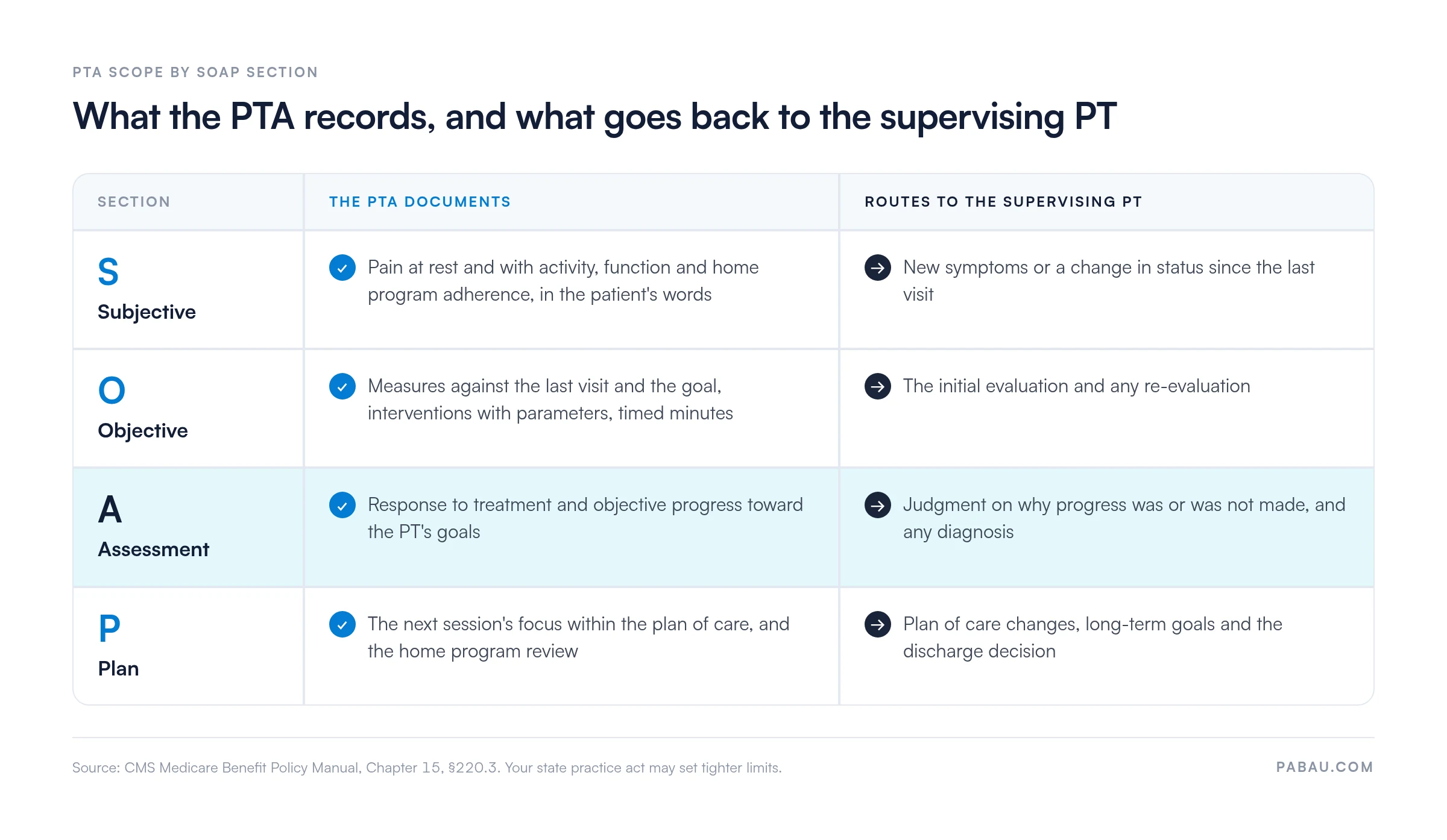
The subjective section records the chief complaint, pain level, functional limits and home program adherence in the patient’s own words. Vague entries such as “feels better” do not show progress, so note the specific tasks the patient can or cannot now perform.
A new symptom or a change in status since the last visit goes to the supervising PT as well as into the note.
The objective section holds numbers you can compare across visits, such as range of motion in degrees and manual muscle testing grades. It also lists gait measures and the interventions delivered, with their parameters.
Medicare expects the total timed code minutes and total treatment time on every treatment note. The initial evaluation and any re-evaluation stay with the PT.
The assessment section records how the patient responded to treatment and how far they have moved toward the goals the PT set. Medicare’s manual draws the limit precisely in its section on progress reports. Assistants may report progress objectively, but may not make clinical judgments about why progress was or was not made.
The manual’s own example contrasts “increasing strength,” which is not objective, with “patient ambulates 15 feet with maximum assistance,” which is. Flag concerns for PT review instead of explaining them, and never write an independent diagnosis.
The plan names the next session’s focus, any update to the home exercise program and any referral back to the PT. It can restate the frequency and duration from the plan of care, but only the PT changes them. A clear plan lets the next clinician pick up treatment without guessing.
The examples below show how the same four sections change with the condition. Each is a short illustrative note, not a record of a real patient. Notice that every assessment reports measured change against a PT goal and leaves the reasons to the PT.
S: Patient reports 4/10 knee pain and can walk 100 feet with a walker. Home exercise program done twice daily.
O: Knee flexion 85 degrees (from 60 degrees last visit). Quad sets and straight leg raises performed with good form. Gait with walker, antalgic pattern.
A: Flexion is up 25 degrees since the last visit, toward the PT goal of 100 degrees. Walking tolerance is 100 feet with a walker, and pain stays at 4/10 with the current program.
P: Continue gait training and flexion work three times weekly, per the plan of care. Review progress at the next PT visit.
S: Patient reports 3/10 low back pain, and sitting tolerance has improved to 45 minutes. Walking daily.
O: Lumbar flexion 50 percent of normal. Symptoms centralized with repeated extension. Lumbar stabilization exercises completed with cueing.
A: Sitting tolerance is 45 of the 60 minutes in the PT’s goal of pain-free sitting. No adverse response to the current exercise progression.
P: Progress to standing stabilization exercises within the plan of care and continue the home program. Report any new neurological symptoms to the supervising PT.
S: Patient reports more confidence transferring from bed to chair. Family present, with concerns about home safety.
O: Sit-to-stand with moderate assistance. Reduced weight bearing through the left lower extremity. Sitting balance with minimal loss of control.
A: Transfers need moderate assistance, measured against the PT’s goal of safe independent transfers. Sitting balance status shared with the PT for review.
P: Continue transfer training and sitting balance work. Pass the family’s safety concerns to the PT for a home assessment.
Medicare documentation rules for therapy are set out in the Medicare Benefit Policy Manual, Chapter 15. They cover progress note frequency and the KX modifier. Check the current version before you rely on any timing rule.
Under section 220.3, the PT must write a progress report at least once every 10 treatment days. A PTA may write elements of a report between the PT’s reports, but those never count as a complete progress report.
Every treatment day needs its own note, with the date, each intervention billed and the total timed and treatment minutes. Payers and facilities often add their own timing rules, so confirm the requirement for each payer on your caseload. For the evaluation side of the record, see the PT documentation cheat sheet.
SOAP is the most common structure in physical therapy, but DAP notes (Data, Assessment, Plan) are used in some settings. DAP folds subjective and objective into one data section, which can suit facilities that want a shorter note.
SOAP notes separate what the patient reports from what you measured, which makes progress easier to show to a payer reviewer.
Students learn fastest by comparing their notes against annotated examples. Write a draft, then check each section against the template and ask your clinical instructor to review the assessment wording.
Keep practice notes out of real patient records. Use fictional cases until your instructor confirms your scope and format.
The discharge decision and the discharge note belong to the supervising PT. Medicare treats the discharge note as a progress report written by the clinician, covering the period since the last report.
Sometimes the PT expects discharge within three treatment days of a progress report. The PT may then set objective goals that let the PTA discharge once they are met. Either way, the PTA’s last note feeds the discharge note. Record the final measurements against each goal and the home program the patient will continue.
Many practices start PTAs on a Word or PDF template like this one. The notes then sit in folders apart from the evaluation, and the supervising PT reviews them by chasing paper.
Pabau, the software for PT practices we build, turns the template into a form inside the patient record. Each PTA opens the same Subjective, Objective, Assessment and Plan fields at every visit. The PT’s evaluation and goals sit in the same record, so each note is written against them.
Pabau Scribe, our AI scribe, can draft the note from the session for the PTA to review and sign. The result is a caseload where every note reads the same way when a payer asks for records.

Pabau keeps SOAP note templates, treatment notes and patient records in one place, so every PTA on your team documents to the same structure.

The line that matters most in a PTA note is the one between reporting and judging. Record what you measured against the PT’s goals, and send the question of why to the supervising PT. Notes written that way hold up in a Medicare review.
Start with the free template, and adapt its fields to your state’s co-signature rules before the first patient. Book a demo to see how Pabau keeps every PTA’s notes in one structure, next to the PT’s plan of care.

Tracking function after a knee replacement? Knee outcome survey (KOS-ADLS) gives you a scored measure to log in the objective section.
Need a measure for stroke rehabilitation notes? Stroke impact scale covers scoring and the change worth reporting in each domain.
Not sure which outcome measure to record? Outcome measures template helps you choose, score and track progress across visits.
Documenting gait beyond distance walked? Functional gait assessment template structures a standardized gait and balance test.
Recording pain the same way at every visit? Pain scale 1-10 explains what each score means for the subjective section.
A PTA SOAP note is a Subjective, Objective, Assessment and Plan record written by a physical therapist assistant for one treatment session or reporting period.
Yes. A PTA can document the response to treatment and objective progress toward the goals the supervising PT set. The PTA should not explain why progress changed or write a diagnosis, and state practice acts set further limits.
SOAP notes separate subjective and objective findings into two sections, while DAP notes combine them into one data section.
For Medicare patients, the PT must write a progress report at least once every 10 treatment days. A PTA can write elements of a report in between, but those never replace the PT’s report.
Yes, the template on this page is a free PDF you can download and adapt to your practice’s workflow.